
Weapons, insurance and texts
eDreams ODIGEO, Strabag, Interparfums, Accelleron, Swiss Life, Safran, Pernod Ricard, Kendrion, Transport Trade Services, UBM Development, Fielmann, TEXT

At Lux Opes, we break down companies into quick takes that get straight to the point - what is happening, why it matters, and what to watch next. We publish 2-3 times per week, depending on the news flow.
For the best reading experience, we recommend reading at Lux Opes
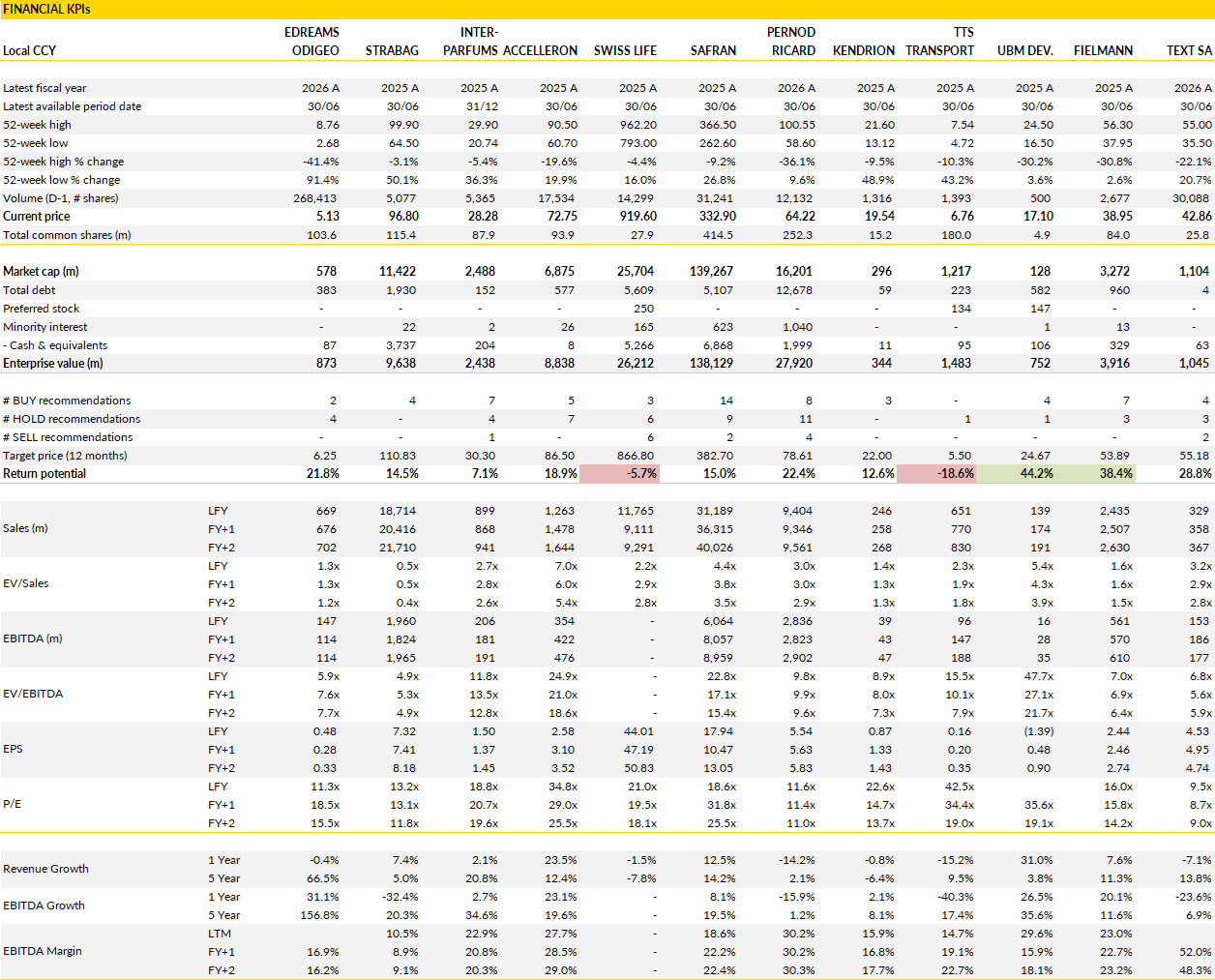
Financial KPIs
Companies covered in this edition: eDreams ODIGEO, Strabag, Interparfums, Accelleron, Swiss Life, Safran, Pernod Ricard, Kendrion, Transport Trade Services, UBM Development, Fielmann, TEXT
eDreams ODIGEO (EDR Spain): A return to cash EBITDA expansion incoming
eDreams ODIGEO started FY 2026/27 ahead of consensus despite the temporary revenue effects from changes to Prime billing and restrictions on access to airline content.
Q1 revenue margin declined 4% to €165.5m, while cash revenue fell 2% to €159.7m. Adjusted EBITDA reached €28.9m even as variable costs increased 13%, reflecting deliberate spending on customer acquisition as the company introduces new products and enters additional markets. Prime membership continued to expand, with 173,000 subscribers added during the quarter and the total reaching 8.1m. The subscriber increase is particularly relevant given the transition from annual upfront Prime payments towards monthly billing, which shifts cash receipts between periods and temporarily depresses reported cash metrics without changing the economics of the underlying subscriber relationship.
Management maintained all FY 2026/27 objectives. Prime is expected to finish the year at around 8.5m members, implying approximately 600,000 net additions for the full year. Adjusted EBITDA before investment is targeted at €167m and cash EBITDA at approximately €115m. The current year remains an investment period as eDreams funds expansion before the additional subscriber base produces its full earnings contribution.
Management expects the year-on-year development in cash EBITDA to turn positive during Q4, providing a useful milestone for judging whether the increased acquisition spending is translating into profitable growth. The Q1 subscriber addition represents a reasonable start towards the annual target, while EBITDA performance leaves some room to absorb the planned increase in commercial investment over the coming quarters. Restrictions on air-content access remain an operational issue, although they have not caused management to alter its financial objectives.
The longer-term plan requires a substantial further increase in Prime's scale. eDreams is targeting more than 13m subscribers by 2030 and cash EBITDA above €270m, compared with 8.1m members today. Achieving this depends on extending Prime beyond its established markets and increasing the range of products purchased through the subscription, gradually making eDreams a broader travel membership platform. The economics should improve as the subscriber base grows because acquisition spending is incurred upfront while recurring membership and transaction revenue develops over the customer relationship.
This also makes the expected Q4 cash EBITDA inflection important: it would provide the first evidence that the current investment cycle is moving into its harvesting phase.
Strabag (STR Austria): Very confident
Strabag entered the second half with substantially higher activity, a record order book and stronger profitability across its construction portfolio.
H1 output increased 12% to €9.98bn, including a 16% increase in Q2, with revenue rising 15% to €9.15bn. EBITDA +30% to €560m and the EBITDA margin widened from 5.4% to 6.1%. Reported EBIT increased 35% to €174m despite a €50m goodwill impairment related to WTE. Excluding that charge, underlying EBIT was around one-third higher than previously anticipated. North + West produced €182m of EBIT, helped by German municipal road construction, railway and energy infrastructure as well as high-tech building projects. Cash generation also improved markedly, with operating cash flow reaching €11m compared with a €284m outflow in H1 2025. Strabag retained considerable balance-sheet capacity, with net cash of €2.61bn at the end of June.
Management has already increased its full-year objectives, several months earlier than Strabag has typically adjusted guidance in previous years. The company now expects 2026 output to approach €23bn, up from approximately €22bn previously, and has lifted the targeted EBIT margin from 5.0-5.5% to 5.5-6.0%. This means EBIT of roughly €1.16-1.26bn.
The revision follows an H1 performance that was considerably stronger than the previous full-year assumptions implied and indicates that the company expects the current level of activity to remain healthy through the second half. Net investment, including acquisitions, is expected to remain below €1.5bn. Higher output combined with the wider margin range also increases the earnings base heading into 2027, particularly if the current strength in German infrastructure and specialist construction persists.
Order development provides substantial support for that expectation. Backlog reached roughly €36bn at the end of June, +15% yoy and a new record. Q2 order intake increased 64% to €9.04bn, producing a quarterly book-to-bill ratio of 1.57x, while the H1 ratio was approximately 1.46x. Growth was spread across several markets instead of depending on a single large contract. North + West backlog increased 13% to €14.75bn, and International + Special Divisions recorded an 84% increase to €12.54bn. Germany, Austria and Central and Eastern Europe, particularly Poland and the Czech Republic, made sizeable contributions, alongside growth in the US and Australia.
In short, Strabag is really kicking it, combining a large secured workload with improving margins and a strong net cash position at a time when infrastructure spending is increasing across several of its core markets. The unusually early guidance is a big boost to confidence about what more is to come.
Interparfums (ITP France): New fragrance franchises set up a return to growth (... finally)
Interparfums is approaching a stronger product cycle after two years in which FX pressure, tariff volatility, difficult comps and overall softer fragrance consumption constrained growth.
Revenue declined 7.3% in H1 2026 and 3.7% at constant currencies, with the stronger euro continuing to reduce reported sales and European consumer demand remaining subdued. The comparison should become easier during H2, following particularly strong growth at the beginning of 2025, while the year-on-year currency effect is also becoming smaller. The underlying fragrance category has remained reasonably resilient despite the weaker consumer backdrop, leaving scope for Interparfums to recover as its own product calendar improves. Profitability has also held up relatively well through the recent slowdown. The company generated a 19.5% operating margin in 2025 despite tariff costs, demonstrating that the weaker sales trajectory has not resulted in a significant deterioration in the economics of the business.
The larger change now comes from the launch program planned for 2027 and 2028. Interparfums will introduce new fragrance franchises for several of its most important licensed brands, including Montblanc, Lacoste and Coach in 2027, followed by Jimmy Choo in 2028. These are full franchise launches alongside the regular extensions of existing ranges, giving them greater potential to generate incremental sales. Longchamp will also join the portfolio under licence from 2027, broadening Interparfums' exposure to another globally recognised luxury brand. At the same time, the company is expanding its portfolio of owned brands through Off-White and Annick Goutal, following the recent introduction of Solférino.
The resulting calendar is unusually dense by Interparfums' historical standards and spreads the opportunity across several brands and price points. Successful launches across even part of this programme could materially increase the group's revenue base and provide a path towards €1bn of annual sales.
The timing is favourable because the launch cycle begins as several of the factors that depressed recent growth start to ease. Volume comparisons become less demanding from H2 2026, currency pressure should moderate if exchange rates remain around current levels, and the next two years contain substantially more new-product activity than the previous period. The portfolio structure also provides some diversification between established licences, newly added licences and wholly owned brands, although the increased launch intensity will require substantial marketing investment and strong execution across distribution channels. Operating margins are expected to remain around current levels through this expansion phase before improving as the new franchises gain scale.
Overall, Interparfums enters 2027 with a considerably stronger commercial calendar than it had over the past two years. The Montblanc, Lacoste and Coach launches will provide the first indication of how much incremental demand the programme can generate, with Longchamp, Off-White, Annick Goutal and eventually Jimmy Choo providing additional growth opportunities thereafter.
It might finally be time for the shares to run.
Accelleron (ACLN Switzerland): Higher growth without stretching pricing or capacity
Accelleron is benefiting from unusually strong demand across marine, gas compression and data-centre applications, but management intends to protect customer relationships and existing profitability instead of pursuing aggressive price increases. Direct pricing has contributed only around 20-30bp despite tight industry capacity, a modest increase given the strength of several end markets.
Part of this reflects the economics of the business today: EBITA margins are already around 25-26%, among the highest in the capital-goods sector, reducing the need to extract additional margin from customers during a period of exceptional demand. The strength of the Swiss franc has also effectively increased prices for customers buying products based on Accelleron's CHF price lists. Data centres could account for roughly 10% of revenue this year, but management does not expect them to dominate the portfolio over time. Maintaining reliability and delivery performance therefore takes precedence over maximising pricing during the current capacity squeeze.
Profitability has nevertheless strengthened. Services currently represent slightly below 60% of the business and remain the largest source of earnings, but their share has fallen materially from the levels seen in 2021 and 2022 without causing group margins to decline. Accelleron has maintained EBITA margins around 25-26% despite an estimated 10-15 percentage point reduction in service mix. This suggests that new-build equipment has become structurally more profitable, helped by better mix and tight operating-cost control.
Capacity management is now in focus. Demand warrants additional investment, particularly where data centres and gas compression are creating incremental orders, but management needs to avoid building facilities around demand levels that may eventually normalise. The current approach favours measured capacity additions that preserve delivery performance without creating a larger fixed-cost base than the company can support through a full cycle.
The stronger demand environment has already led Accelleron to raise its 2026 organic growth guidance to 14-17%, materially increasing the revenue base from which the company enters the following years. Marine demand remains healthy, gas compression is staying strong and renewed data-centre activity provides an additional growth channel.
The opportunity consequently rests primarily on higher volumes at already exceptional profitability, accompanied by strong free cash flow and returns on capital. There could still be some upside from mix if future orders contain a greater proportion of higher-value products, particularly since Accelleron does not disclose order intake or backlog profitability. Management's restrained approach to headline price increases should therefore not be interpreted as that the economics of new orders are static. With margins already at 25-26%, preserving those economics while expanding revenue at a double-digit rate would itself produce substantial earnings growth without requiring another step-up in group profitability.
Swiss Life (SLHN Switzerland): Fee growth and excess capital fund another round of shareholder returns
Swiss Life delivered another solid half-year performance, with the fee businesses providing an increasing contribution alongside stable insurance earnings.
Operating profit increased 8% to CHF967m and net profit rose at the same rate to CHF649m, although the transfer of the International network business contributed a CHF29m operating gain and CHF23m at the net level. Fee income increased 7% in local currencies to CHF1.34bn, while the fee result grew 11% to CHF430m. Insurance operating profit advanced 4% to CHF600m. Switzerland remained the largest contributor with a segment result of CHF469m, complemented by higher earnings in France, Germany and International. Asset Managers also maintained its growth, with third-party assets under management reaching CHF158bn. Net inflows moderated to CHF7.2bn after an exceptionally strong CHF13.2bn in H1 2025, but remained substantial in absolute terms.
Cash generation and capital strength continue to give Swiss Life considerable flexibility. Cash remitted to the holding company increased 5% to CHF1.23bn, while return on equity reached 20.2%, already above the 17-19% range targeted under Swiss Life 2027. The Swiss Solvency Test ratio remains around 215%, leaving capital well above the level required to operate the business and finance organic growth. Following completion of a CHF750m repurchase program in May, management has announced another CHF250m buyback. The combination of growing fee income, high cash remittance and excess solvency capital allows Swiss Life to maintain substantial distributions without compromising its financial position. The fee businesses are particularly valuable in this respect because they increase earnings without requiring the same amount of capital as traditional insurance activities, gradually improving the group's earnings and cash-generation profile.
Management is also preparing the cost base for the period beyond the current strategic plan. Around 600 positions will be removed by the end of 2028, split broadly between the Swiss insurance operation and Asset Managers. Most of the reduction is expected to take place through natural attrition, limiting restructuring disruption while lowering the structural expense base. This should provide additional support to profitability after Swiss Life 2027 concludes, particularly if fee income continues to expand. Execution will still require care, especially within Asset Managers where the company needs to reduce costs without weakening investment capabilities or distribution.
H1 nevertheless leaves Swiss Life comfortably ahead of several of its existing financial objectives, with ROE above target, strong cash transfers and substantial surplus capital.
Safran (SAF France): Engine aftermarket strength extends well beyond the current cycle
Safran continues to see substantial earnings support from the CFM56 installed base, with aftermarket revenue expected to grow through 2030. Engine retirements are not expected to accelerate materially before 2029, allowing pricing to remain firm for several more years, while improved material availability is supporting a consistently high level of work performed during shop visits. Around 2,400 CFM56 engines are expected to pass through workshops annually, with physical capacity limiting further increases in volume.
There is still scope for revenue to exceed current assumptions if the mix shifts towards more extensive and higher-value maintenance events. This gives Safran an unusually long runway from a mature engine program at the same time as LEAP gradually becomes a larger contributor. The combination should sustain strong Propulsion earnings as CFM56 aftermarket activity eventually peaks and the economics of the newer engine fleet improve.
LEAP production is planned to reach 2,600 engines in 2028 and could approach 3,000 by 2030. Safran expects original-equipment sales to remain profitable in 2027 even as the proportion of replacement engines normalises towards 10-12% of deliveries. In services, the company remains conservative in recognising margins under its rate-per-flight-hour contracts. The introduction of the new Maverick blades for the LEAP-1B is scheduled for late 2026 or early 2027 and is not expected to affect current-year guidance.
Over the longer term, Safran intends to bring the profitability of LEAP service contracts towards the levels currently generated by CFM56 by 2040. Discussions around the next generation of narrow-body aircraft could also lead to changes in commercial arrangements with Airbus and Boeing. Safran is open to alternative structures for engines and avionics, including greater manufacturer participation in development investment, provided project returns and risk allocation remain consistent with its existing financial criteria. Higher prices for new engines would be one mechanism for preserving returns if the economics of the current model are altered.
Capital allocation remains disciplined despite Safran's interest in further acquisitions. Management continues to prioritise smaller defence transactions in Europe, particularly in ISTAR, where acquisitions can add technology or improve access to national markets without tying the business to individual platforms. The abandoned Exail transaction demonstrated that financial hurdles remain binding even where there is a strong strategic fit.
Portfolio simplification is progressing in parallel, following the disposals of Passenger Innovations and the 50% interest in EZAir, with the Cabin business also moving through a sale process. Safran intends to distribute at least 70% of free cash flow to shareholders and expects approximately €1.3bn of share repurchases during 2026. Management sees no need to accelerate that program unless cash generation materially exceeds its assumptions. The CFM56 aftermarket remains the largest near-term earnings engine, but LEAP production growth, the gradual improvement in service-contract profitability and selective defence expansion provide additional sources of growth as the legacy fleet begins to mature later in the decade.
Pernod Ricard (RI France): India remains strong, while the US and China delay the recovery
Pernod Ricard is preparing for yet another subdued year as weakness in the US and China continues to offset healthy growth across India and other emerging markets.
Management now expects organic sales to be broadly stable in FY 2027, followed by growth near the lower end of its 3-6% medium-term range in FY 2028 and FY 2029. Destocking remains a problem in both the US and China and is expected to weigh particularly on the first part of FY 2027, although Chinese demand is showing some improvement, including for Martell in duty-free. India remains considerably stronger, with growth across whisky and vodka and market-share gains for both domestic and international brands. The UK-India trade agreement should provide another benefit as lower tariffs improve the affordability of imported Scotch. These geographic differences leave Pernod Ricard increasingly dependent on India and emerging markets to compensate for prolonged weakness across two of its historically important profit pools.
Management is responding with a broader product range, new formats and RTDs, greater emphasis on the on-premise channel and more concentrated investment behind strategic brands. The latter have shown relatively resilient volumes, declining only 1% despite a 3% negative price effect. Cost reductions will carry much of the burden on profitability while revenue growth remains limited. Pernod Ricard completed €500m of savings in FY 2026 and expects to secure the remaining €500m by FY 2028, one year earlier than originally planned. This should allow operating margins to improve despite higher costs for aged spirits, raw materials and logistics. Advertising and promotion expenditure is expected to remain around 16% of sales.
The program overall provides a credible route to protect earnings through a difficult demand environment, although a stronger sales recovery will ultimately require improvement in the US and China alongside sustained expansion in India.
The balance sheet adds another constraint. Leverage stands at 3.7x debt-to-EBITDA and management aims to bring this below 3x by 2029. Capex and strategic investments will consequently be limited to no more than €700m annually from FY 2027, while shareholders will have the option to receive 50% of the dividend in shares to preserve cash. Refinancing could also become more expensive from 2028 as low-cost bonds carrying coupons of around 1-1.5% mature.
An IPO of the Indian operations remains under consideration, with legal preparations already completed to retain flexibility. Such a transaction could accelerate deleveraging, although it would also dilute Pernod Ricard's ownership of its fastest-growing major market.
In short, the company has several tools to strengthen cash generation and the balance sheet, but near-term earnings growth remains constrained by weak volumes and inventory reductions in the US and China. India, cost savings and eventual normalisation in those two markets can improve the profile over time, with limited evidence yet of a rapid recovery in FY 2027.
Kendrion (KENDR Netherlands): Margin gains and new applications broaden the growth opportunity
Kendrion delivered a solid first half, with 5% organic growth accompanied by a substantial improvement in profitability. The EBITDA margin increased from 15.4% to 17.5%, helped by a milestone payment from Knorr-Bremse, but even excluding this contribution the margin expanded by around 110bp. The main weakness came from Industrial Actuators and Controls, where several customers reduced volumes despite growth in the underlying market. Management expects these volumes to recover, although the improvement may not yet be fully evident in Q3. Elsewhere, new projects are scaling up and recent product introductions are gaining traction, supporting management's expectation for further profitable growth during H2.
The combination of organic expansion and higher margins is encouraging after the portfolio restructuring of recent years, particularly as Kendrion now operates with a more concentrated industrial technology portfolio.
Cash generation should improve materially after a weak first half. H1 free cash flow was affected by payments associated with an earlier legal dispute, back taxes relating to 2022 and restructuring expenses. Even after adjusting for these items, free cash flow was only €4m because working capital absorbed more cash than anticipated. Management expects this working-capital pressure to moderate during H2, allowing cash generation to recover despite higher capital expenditure. Further improvement should follow as EBITDA grows, inventory requirements normalise and capex eases after the current investment phase. This is important because Kendrion is simultaneously funding a growing pipeline of new applications across automation and electrification. The company has remained disciplined on acquisitions, which leaves excess cash available for additional share repurchases if no suitable transactions meet its return criteria.
The Capital Markets Day on 17 September should provide greater detail on Kendrion's ambitions through 2030 and on the technologies that can sustain its medium-term growth. Management plans to highlight commercial progress in beverage dispensing, inductive heating, automated guided vehicles and industrial robots, alongside prototypes aimed at emerging applications such as collaborative and humanoid robots, surgical robotics, parcel lockers and a new generation of handheld power and gardening equipment. These markets expand Kendrion's addressable opportunity beyond its established industrial applications and could provide additional scale for products already developed within the group.
The existing project pipeline is at a record level, giving management a strong base from which to set its next financial objectives. After reaching a 17.5% EBITDA margin in H1, the current 15-18% margin framework is already beginning to look conservative. The September presentation should clarify how much of the recent profitability improvement can be sustained and how quickly the newer automation and robotics applications can become meaningful contributors to revenue.
Transport Trade Services (TTS Romania): Industrial cargo lifts margins but low Danube levels threaten H2 volumes
Transport Trade Services produced a much stronger Q2 earnings performance despite limited revenue growth, helped by better utilisation of its logistics network and tighter cost control.
Revenue increased 2.1% to RON164.7m, while EBITDA rose almost 30% to RON30.2m, lifting the EBITDA margin from 14.4% to 18.3%. EBIT recovered to RON9.0m from a small loss a year earlier, and net profit returned to positive territory at RON2.4m. The improvement came primarily from operating efficiency, better absorption of fixed costs and a more profitable cargo mix. This is encouraging for a business with substantial infrastructure and fleet costs, as relatively modest changes in utilisation can have a large effect on earnings.
The shift towards industrial cargo is helping reduce TTS's historical dependence on agricultural volumes. Industrial goods represented 66% of transported volumes over the past 12 months, while agriculture declined to 30.9%. Chemicals were particularly strong, with Q2 volumes increasing 60.3% to a record 0.85m tonnes as TTS captured new flows across the Lower Danube basin. A larger contribution from chemicals, minerals and other industrial products provides steadier activity across the year and reduces exposure to the timing of harvests and agricultural exports.
This diversification also improves fleet and terminal utilisation, contributing to the margin expansion seen in Q2. Agricultural volumes should become more supportive during H2 as the export season develops, while management also expects renewed Ukrainian flows and continued strength in industrial cargo. Together, these sources provide a healthy underlying volume pipeline if the transport network can operate normally.
The immediate constraint is the exceptionally low water level on the Danube. Navigation conditions have deteriorated since July, with upstream traffic from Cernavoda interrupted and vessels operating elsewhere forced to reduce convoy loads. Management has kept its 2026 targets of RON746m of revenue, RON158m of EBITDA and RON45m of net profit, but indicated that actual performance could vary by approximately 10% depending on market conditions and hydrology. The current plan assumes navigation begins to recover around the end of Q3 or beginning of Q4, allowing accumulated mineral and chemical cargo in Constanta to move through the system.
A prolonged period of low water would delay those volumes and weaken capacity utilisation during H2, reversing part of the operational benefit visible in Q2. TTS has nevertheless entered this disruption with a more diversified cargo base and significantly better underlying efficiency than a year ago.
UBM Development (UBS Austria): Residential recovery advances
UBM Development's recovery progressed in the first galf of the year, with residential sales providing the main source of operating momentum. Revenue increased 36% to €81.2m and the company sold 208 apartments, matching the strong level achieved in H1 2025. More than 90 additional units have already been contracted and are awaiting completion before they can be recognised as sales. Prague remains the strongest market, with selling prices at the completed Na Plzence development increasing by 20%, while German residential activity continues to suffer from weak market confidence. H1 EBT improved to €7.3m, although the result included €9.1m of positive property revaluations, around €5m of which related to a non-core asset in Styria. The underlying cost base has also fallen after headcount was reduced to 188 employees, a level management now considers appropriate for the current organisation. Construction costs were temporarily low because development activity remains subdued, but should increase as the next generation of projects moves into execution.
Affordable housing is becoming a larger part of UBM's development strategy as the company seeks to deploy capital into a segment where housing shortages remain substantial. Its first pilot project is underway in Vienna, with management expecting the supply-demand imbalance to support a broader pipeline over time. Funding that expansion requires further rotation of the existing portfolio. UBM has already sold Paket 6 for €35m and a non-core property in Styria for €10m. Both were completed above their carrying values, generating gains of €2.8m and €5m respectively, although the associated cash inflow was €21m. Management has cautioned that future sales may not achieve comparable premiums. Accelerating disposals could require accepting weaker pricing, particularly where assets no longer fit the group's strategic direction. The pace at which UBM can release capital without sacrificing substantial value will therefore influence how quickly the affordable-housing portfolio can expand.
Hotels remain the main uncertainty within the disposal program. Conditions in the hotel investment market have softened, and management is unwilling to commit to a timetable for planned transactions, leaving open the possibility that some sales move into 2027. This also explains why UBM has refrained from issuing formal group guidance despite the improvement in residential activity.
The operational turnaround is nevertheless becoming more tangible: apartment demand is healthy, Prague is producing strong pricing, the cost base has been reduced and the first affordable-housing investments are underway. The next phase depends increasingly on execution of the portfolio rotation. UBM needs to convert non-core properties into cash, fund new residential developments and maintain balance-sheet flexibility while avoiding excessive losses on asset sales.
Fielmann (FIE Germany): German demand improving (modestly)
Fielmann has seen better trading through July and August after a subdued second quarter, although conditions in Germany remain difficult.
As discussed last week, H1 revenue increased 2.3% like-for-like and the adjusted EBITDA margin held broadly stable at 23.7%, indicating that weaker demand has not materially affected the group's cost structure. International markets provided most of the growth, led by Spain, where Q2 sales increased by almost 10%, while Germany was broadly flat.
Management indicated that trading subsequently improved during the summer, including in Germany, but the company remains cautious given that the improvement covers only two months and consumer confidence is still weak. German customers have extended the replacement cycle for glasses by around six months, and management expects this behaviour to normalise gradually. Contact lenses are also under pressure, with sales down 4% as online competitors discount branded products. Fielmann is responding by shifting towards its own contact-lens brands, which generate lower sales but carry better margins.
The US remains of course an important growth opportunity, although progress will require further investment before the business reaches the performance of Fielmann's more established European operations. US growth improved to around 5% in Q2, but remained below the rates achieved by major competitors. The company is expanding medical capabilities, training employees and adapting its customer proposition to local requirements. A first store incorporating the complete Fielmann concept has opened in Illinois, with management planning to assess its performance before committing to a broader rollout. A stronger contribution from this format is therefore unlikely before mid-2027. In the meantime, additional staff and capacity reduced the US margin by around 250bp during H1. This is a deliberate investment phase aimed at building the infrastructure required for a larger US business, but the eventual returns will depend on whether the adapted store model can produce stronger sales growth once replicated across the network.
Store expansion is also continuing across the wider group, with 70 net openings planned for 2026, split between 37 in H1 and 33 in H2. Their immediate earnings contribution will be modest because new locations generally require between one and three years to reach breakeven. Together with heavier marketing expenditure, this should result in lower group margins during H2 even if underlying trading continues to improve. The key near-term variable remains Germany, where Fielmann needs the replacement cycle to normalise before domestic growth can regain momentum. Spain is already providing healthy expansion, and the US offers a larger medium-term opportunity if the Illinois pilot validates the group's adapted concept.
Stable H1 profitability shows that the core business remains resilient despite soft German demand and US investment costs. The recent improvement in sales is encouraging, but a sustained acceleration will require several more quarters of better German consumer activity and tangible progress from the US rollout.
TEXT (TXT Poland): Product adoption improves, but revenue growth and margins remain under pressure
Text started FY 2026/27 with weaker reported earnings as currency movements and higher costs offset modest underlying sales growth.
Q1 revenue declined 1.9% to PLN83.2m, although at constant exchange rates it increased 2.1%. The difference largely reflects the weaker US dollar, with the USD/PLN conversion rate 3.9% below the prior-year period. EBITDA fell 9.2% to PLN38.4m and EBIT declined 11% to PLN31.4m, while net profit decreased 6% to PLN29.1m. Profitability consequently moved lower, with the EBITDA margin falling from 50% to 46% and the EBIT margin from 42% to 38%. Approximately PLN2m of restructuring expenses contributed to the decline, but margins were still weaker after adjusting for this charge. Gross margin improved sequentially, suggesting some stabilisation at the direct-cost level, although this has yet to translate into a recovery in operating profitability.
There are more encouraging developments within the customer base. The proportion of monthly recurring revenue generated by customers using multiple Text products increased by 5 percentage points sequentially, indicating greater adoption beyond the company's traditional single-product relationships. The share of MRR generated by customers spending more than $500 per month also increased materially, reaching 55% compared with 45% a year earlier. This suggests that Text is becoming increasingly concentrated around larger customers with broader product usage. Part of the change may also reflect churn among smaller single-product customers, however, making it difficult to determine how much comes from genuine expansion within existing accounts. The transition towards a broader product suite is still at an early stage, so the development of multi-product penetration over the next several quarters will be important in assessing whether Text can generate stronger growth from its installed customer base.
The immediate issue is that the improvement in customer mix has not yet produced meaningful underlying revenue acceleration. Q1 constant-currency growth was only 2.1%, and the increase in recurring revenue appears to have benefited significantly from recent pricing actions. At the same time, operating costs have increased as Text restructures the organisation and begins its transition towards the suite model. That creates a more demanding period in which the company needs higher multi-product adoption and larger customer relationships to compensate for churn and restore operating leverage.
Text still generates unusually high margins, with Q1 EBITDA and net profit margins of 46% and 35%, respectively, but the direction of profitability has been negative over the past year. The next MRR update should therefore provide a clearer indication of whether improved product penetration is beginning to generate stronger underlying growth or whether pricing remains the principal source of expansion.