Energy solutions, construction and flying trains
Tecan Group, Accelleron, Flughafen Wien, Fielmann, Eiffage, Stadler Rail, Novartis, DEME Group, ASTA Energy Solutions, ID Logistics, Vienna Insurance Group, CFE
At Lux Opes, we break down companies into quick takes that get straight to the point - what is happening, why it matters, and what to watch next. We publish 2-3 times per week, depending on the news flow.
For the best reading experience, we recommend reading at Lux Opes
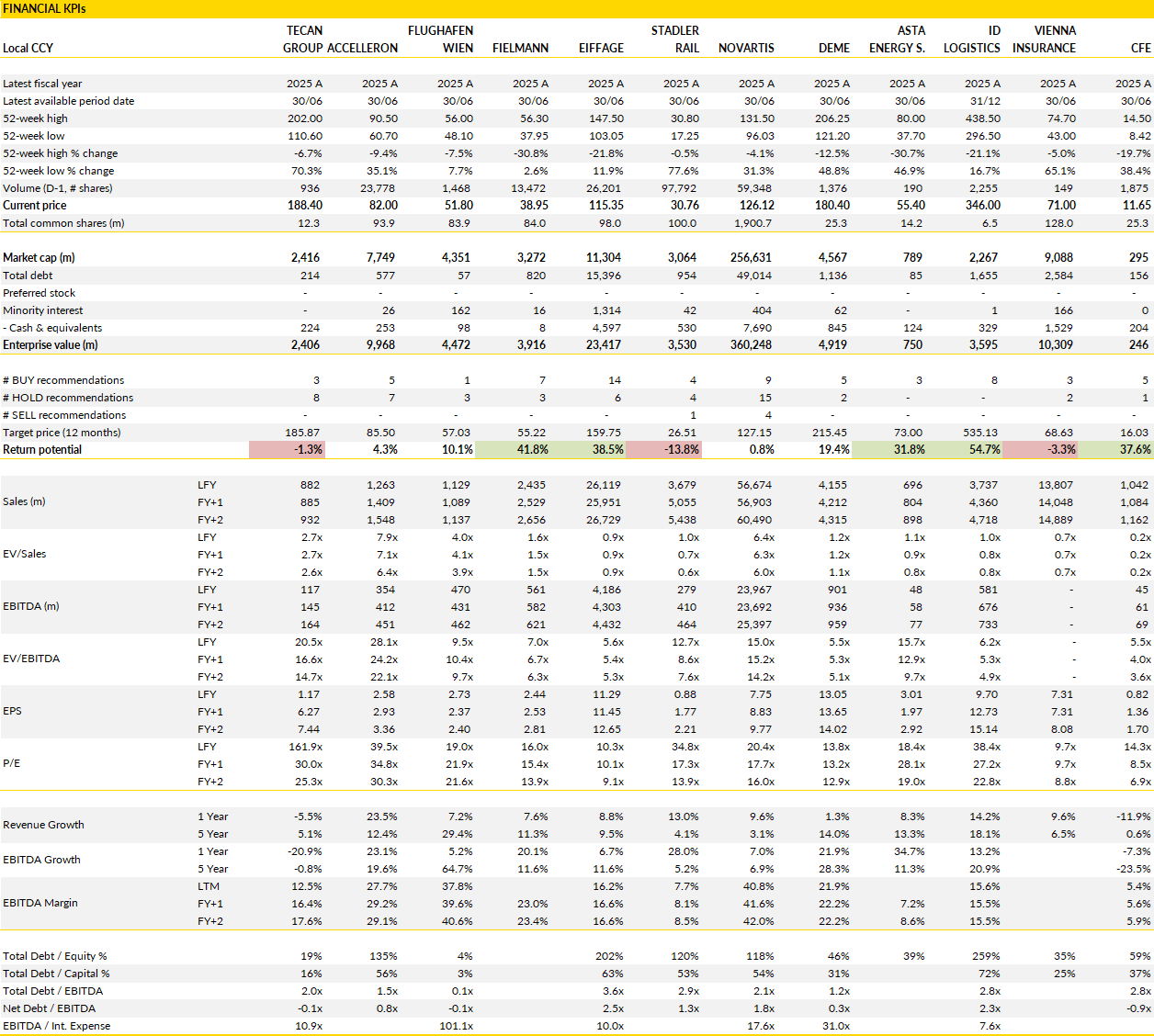
Financial KPIs
Companies covered in this edition: Tecan Group, Accelleron, Flughafen Wien, Fielmann, Eiffage, Stadler Rail, Novartis, DEME Group, ASTA Energy Solutions, ID Logistics, Vienna Insurance Group, CFE
Tecan Group (TECN Switzerland): Recovery is taking shape (but the rerating has already captured much of it)
Tecan’s first-half results suggest that conditions across its laboratory automation markets are gradually becoming healthier after an extended period of customer destocking and restrained capital spending.
Life Sciences and Diagnostics are showing clearer signs of stabilisation, although purchasing decisions remain cautious and the pace of improvement differs considerably by customer type and geography. Academia & Government remains the weakest area, with funding uncertainty still affecting demand. This leaves larger instrument purchases somewhat unpredictable, but the overall environment has improved from the more difficult post-pandemic adjustment period. Tecan has also protected profitability reasonably well through the downturn, helped by cost discipline and its broad exposure across laboratory automation, diagnostics and life-science workflows.
The next stage of the recovery depends on a broader return in customer spending. Tecan should benefit when laboratories become more comfortable committing capital to larger automation projects, particularly given the long-term need to increase throughput, reduce manual processes and improve reproducibility. Management is keeping spending under control without cutting back on selected initiatives that can support future growth. The first-half performance indicates that this balance is working, with earnings holding up despite demand remaining below normal levels in parts of the portfolio. Life Sciences and Diagnostics offer the clearest opportunity for further improvement over the coming quarters, whereas Academia & Government may take longer to recover. A stronger demand environment would also improve utilisation and provide scope for margins to expand as incremental revenue is absorbed by the existing operating base.
Following H1, consensus expectations for the next few years have moved only modestly higher, which reflects the gradual nature of the recovery. The more significant change has occurred in the share price, which has risen by more than 50% since the beginning of the year. Tecan therefore enters the next phase from a very different valuation starting point. Further upside increasingly requires evidence that the current stabilisation can develop into sustained revenue growth and stronger margins.
The underlying business remains attractive, with established customer relationships and exposure to increasing laboratory automation, but the recovery is still developing and several end markets remain subdued. After the sharp rerating, the shares already incorporate a meaningful improvement in operating conditions, leaving less room for execution disappointments and making the next few reporting periods dependent on tangible progress in demand and profitability.
Accelleron (ACLN Switzerland): Marine demand and data centres push growth expectations higher
Accelleron delivered a strong first half, with both divisions contributing to revenue well ahead of market expectations.
Group sales reached $737m, supported particularly by marine new-build activity and continued demand associated with data-centre infrastructure. Marine & Large Stationary generated $529m of sales, with new vessel construction providing much of the upside. High Speed was even stronger relative to expectations, producing $209m of revenue and operational EBITA of $55m. Group operational EBITA reached $190m, equivalent to a 25.7% margin. The margin was slightly below the level implied by the strongest revenue outcome, reflecting a higher contribution from new equipment, but remained firmly within Accelleron's established profitability range. Net profit reached $144m and free cash flow amounted to $88m, leaving the first-half performance strong across revenue, earnings and cash generation.
The High Speed division was particularly encouraging from a profitability perspective. Its operational EBITA margin reached 26.2%, despite a business mix that appears to have included substantial new-equipment activity. Marine & Large Stationary produced a 25.5% margin, with strong demand from shipbuilding customers supporting volumes. Conditions in Accelleron's main markets remain healthy, although the sources of growth are beginning to shift. Data-centre expansion continues to support demand for high-speed applications, and marine construction remains active. Service agreements should also provide a recurring contribution from the installed base. Retrofit and upgrade activity is likely to moderate, however, following the postponement of the IMO Net Zero Framework, and some diesel and injection-related businesses could also grow more slowly.
This makes the durability of marine new-build demand and the scale of data-centre-related orders increasingly relevant to the growth profile over the next several quarters.
The strength of H1 has led management to increase its expectations for 2026. Organic revenue is now expected to rise by 14-17%, compared with the previous 9-14% range, with the operational EBITA margin still expected between 25% and 26%. Accelleron is adding capacity and investing in technology and personnel to accommodate the higher level of demand, alongside the share buyback launched in May.
The upgraded sales outlook comes with additional spending requirements, although profitability remains robust enough to absorb these investments within the existing margin objective. The main issue from here is how long the current marine cycle can sustain its recent pace, particularly as some retrofit activities soften. Data centres provide a separate source of expansion and the service business adds resilience, giving Accelleron several avenues for growth even if marine new-build orders eventually moderate.
H1 demonstrates that demand remains stronger than previously assumed, but after the substantial appreciation in the shares, maintaining the current valuation will require continued execution near the upper end of the company's (new) growth range.
Flughafen Wien (FLU Austria): Cost control sustains a difficult traffic year
Flughafen Wien is handling the current pressure on passenger volumes considerably better than the headline traffic numbers suggest.
Vienna Airport saw passengers fall 7% in Q2 as Wizz Air and Ryanair reduced capacity and Middle Eastern routes remained disrupted, contributing to a 3% decline in quarterly revenue. EBITDA nevertheless increased 7%, with the margin reaching 48.0%, 430bp above the prior year. Cost reductions contributed to the improvement, alongside lower maintenance expenses after provisions had weighed on the comparable period. The group also benefits from having Malta in the portfolio, where conditions are much stronger. H1 revenue at Malta increased 15% and EBITDA rose 18%, providing a useful counterweight to the weaker traffic environment in Vienna.
Traffic developments should become somewhat easier during H2. The loss of capacity from Wizz Air and Ryanair was initially a major concern, but other carriers are filling a larger portion of the gap than previously expected, led by Austrian Airlines. Around 40% of the approximately 3m passengers affected by the LCC reductions could now be replaced through additional capacity elsewhere, compared with an assumption of at least 25% earlier in the year. Middle Eastern routes are also recovering from the severe disruption experienced in H1. Management expects passenger numbers on these routes to remain 20-30% below last year during the second half, an improvement from the 45% contraction recorded in H1. The winter schedule currently contains no further significant LCC capacity reductions, reducing the risk of another deterioration from this source.
These developments prompted Flughafen Wien to lift its 2026 Vienna passenger forecast from 30m to 30.5m. That figure still implies a decline of around 9% during H2, steeper than the 7% Q2 contraction despite improving conditions, leaving some room for a better outcome if the Middle East situation does not deteriorate again.
Overall, the operational performance is stronger than passenger volumes alone would indicate, with cost discipline allowing Flughafen Wien to protect earnings through a difficult year. Longer-term constraints remain, however. Austria charges an aviation tax of €12 per passenger, which makes Vienna less attractive for airlines when allocating incremental capacity and has already contributed to the decisions by low-cost carriers to reduce their presence. This creates a structural constraint on traffic growth unless the regulatory environment changes.
Flughafen Wien is also entering a period of heavier investment, which will absorb more of the cash generated by the airport and reduce free cash flow over the coming years. H1 has demonstrated that the group can defend profitability effectively during a traffic downturn, and the second half could exceed the assumptions embedded in the updated passenger forecast. LEt's now see whether Vienna can return to sustained capacity growth once the current disruptions fade, particularly if Austria's aviation tax remains unchanged.
Fielmann (FIE Germany): International growth cushions a weaker German consumer
Fielmann's first half showed modest group growth as weakness in its largest market offset better development elsewhere. Sales increased 1.8% to €1.25bn, with Q2 growth of 2.2%. Germany, which still represents roughly 60% of group revenue, grew only 0.8%, and Austria was similarly subdued at 1.2%. Performance outside these markets was considerably stronger. Spain expanded 7.4% in H1 and accelerated to 10% in Q2, while the remaining smaller markets grew 11% at constant currencies. The US also improved sequentially, with constant-currency growth reaching 4.5% in Q2 compared with 3.3% for the half year. This geographic spread is becoming very useful as German consumer demand remains soft, although Germany is still large enough that stronger international markets cannot fully compensate for domestic weakness.
Profitability has held up relatively well despite the subdued sales environment. Adjusted EBITDA increased 1.4% to €296m and the margin slipped only 10bp to 23.7%. European operations produced a 25.1% margin, slightly above the previous year, helped by cost control and productivity measures. The US remains at a different stage of development. Its H1 margin declined from 14.9% to 12.5% as Fielmann invests in transforming the local business model, leaving the region as both a source of future growth and a near-term drag on group profitability. Management expects additional stores, increased staffing capacity and productivity improvements to help revenue growth pick up during H2. Spain and the other international businesses are already demonstrating stronger momentum, but a meaningful acceleration at group level will still depend heavily on German customers becoming more willing to spend.
That all said, persistent weakness in Germany has prompted management to reduce its expectations for the year. Fielmann is now planning for 2026 revenue of €2.50-2.55bn, corresponding to growth of 2-5%, compared with the previous €2.55-2.60bn range. Adjusted EBITDA is expected at €560-580m, with a margin of 22-23%, after the company had previously anticipated €590-610m and a margin around 23%. The adjusted EBT margin expectation has also moved to approximately 12% from the earlier 12-13% range.
The relatively limited margin deterioration compared with the reduction in sales expectations reflects the work already done on the cost base. Fielmann's international expansion is gradually reducing its dependence on Germany, and Spain in particular is developing strongly, but this diversification still needs more time to change the group's overall growth profile. The US adds another sizeable opportunity, although current investment spending and the lower margin demonstrate that the model is not yet mature.
With Germany subdued and the US transformation still underway, a stronger second half needs to come from execution across the store network and continued international growth.
Eiffage (FGR France): Concessions absorb softer motorway traffic
Eiffage's first-half operating performance was slightly softer than market expectations, but the contracting businesses remain in good shape.
Q2 revenue increased 3.8% to €6.55bn, including 2.8% like-for-like growth, supported by construction, civil engineering and energy systems. For H1, group revenue reached €12.2bn and EBIT was €1.02bn, leaving the operating margin unchanged at 8.4%. Profitability within contracting improved, with Energy Systems increasing its margin from 4.9% to 5.2% and Construction holding at 3.5%. The weaker element was concessions, where EBIT declined to €822m and the margin contracted by 60bp. Net profit nevertheless increased to €342m, helped by the gain on the Volterres disposal. The balance sheet also moved in the right direction, with net debt declining to €9.4bn from €9.9bn a year earlier. First-half FCF was negative €75m, although seasonal working-capital movements make the H1 cash figure relatively uninformative for a construction group.
The order book provides a strong base for the contracting operations. Outstanding work reached €31.5bn at the end of June, 7% higher year-on-year, including increases of 9% in Energy Systems, 6% in infrastructure and 6% in construction. Germany offers further opportunities as government infrastructure spending increases, particularly across civil engineering and Deutsche Bahn projects. The initial benefit has already helped compensate for completion of the A3 contract, although limited engineering capacity means the stimulus program is unlikely to translate immediately into a dramatic increase in activity.
Data centres provide another potential source of work. Eiffage intends to pursue two or three projects in France before expanding the activity into Germany, but management is being selective because large data-centre contracts can carry substantial execution risk. This discipline is sensible given that the existing backlog already provides ample work and allows the group to prioritise projects offering appropriate margins and contractual terms.
Concessions face a more difficult near-term environment. Light-vehicle motorway traffic has been declining since March, affected by high fuel prices and working-from-home patterns, although heavy-goods traffic remains positive at around 1%. Eiffage has introduced operating and personnel cost measures that should provide greater protection to concession profitability during H2. Management now expects concession operating profit to decline slightly this year, compared with its previous assumption of modest growth, but still anticipates higher operating profit from contracting and an increase in group net income for 2026.
The combination of a growing order book, improving margins in Energy Systems and opportunities from German infrastructure spending should keep contracting earnings moving higher even without a rapid acceleration in the underlying construction market. Motorway traffic and French political developments, including the possibility of additional exceptional taxes, remain the main uncertainties. Operationally, however, the modest H1 earnings shortfall does not indicate a material deterioration in Eiffage's broader earnings trajectory.
Stadler Rail (SRAIL Switzerland): Record backlog fuels the rerating
Talk about a good set of results. Stadler Rail's order intake jumped nearly 60% year on year in the first half of 2026, to CHF 2.7 billion, lifted by a large contract to supply Copenhagen's S-Bahn network in Denmark. This pushed the book-to-bill ratio to 1.39, meaning the group booked more new business than it shipped, and left the order backlog above CHF 33 billion, the deepest in the company's history. Revenue kept pace on the other side of that equation, rising 37.8% on a comparable basis as Stadler worked through the backlog it has been building for several years. Production volumes rose 11% in the half, evidence that the group is genuinely accelerating output instead of just booking orders faster than it can build trains.
With a backlog now equal to more than six years of first-half revenue, the constraint on Stadler's growth has shifted from finding customers to converting what it has already sold into delivered, invoiced trains.
Profitability improved alongside volumes. EBIT reached CHF 79 million, a margin of 4.0%, up 140 basis points from 2.6% a year earlier. Net income barely moved, at CHF 31.2 million versus CHF 30.9 million, because higher financial expenses tied to currency movements and a heavier tax rate absorbed most of the operating improvement before it reached the bottom line. Free cash flow stayed negative at CHF 54 million, reflecting the cash a ramping production system consumes before it turns into shipped, paid-for trains, but that outflow was a fraction of the CHF 744 million burned in the first half of 2025, when the working-capital build tied to the backlog's growth was at its heaviest. Net debt stood at CHF 424 million at the half-year mark. Read together, the half shows a business converting an unusually large backlog into revenue and profit while still absorbing the cash cost of scaling production, with that cash cost easing as the ramp matures instead of because backlog growth is slowing.
Stadler confirmed its full targets for this year: revenue above CHF 5 billion, a book-to-bill ratio of 1 to 1.5, and an EBIT margin above 5%, alongside its existing medium-term target of a 6% to 8% margin by 2028. Getting from the 4.0% margin booked in the first half to more than 5% for the full year, and eventually into the high single digits by 2028, depends on the same dynamic playing out over the rest of the backlog: production volumes keep climbing, fixed costs get spread over more delivered trains, and the cash drag from ramping up new contracts fades as they move from build phase into steady deliveries.
The Copenhagen order and the rest of the CHF 33 billion backlog give Stadler multiple years of revenue already committed; the 2026 to 2028 targets are essentially a bet on how efficiently that backlog gets built and billed.
Novartis (NOVN Switzerland): All eyes on the next patent cycle
Novartis returned to modest sales growth in Q2, with revenue increasing 1% despite US generic competition for Entresto since Q3 2025. The improvement reflects continued expansion across the newer oncology, inflammation and neurology portfolio and should strengthen during H2. Management remains comfortable with its objective of delivering 5-6% annual sales growth between 2025 and 2030, even though products representing 37% of current revenue face patent expiries during that period. Existing medicines are expected to provide most of the growth required to absorb these losses. Pluvicto and Kisqali in oncology, Leqvio in cardiovascular disease and Rhapsido in inflammation are among the main contributors, with additional pipeline launches adding to the portfolio over time. Cosentyx is the largest upcoming patent issue, currently representing around 15% of group sales and facing potential biosimilar competition from 2029. Its biologic complexity and extensive formulation patent estate extending beyond 2035 could make the erosion slower or later than a conventional small-molecule expiry, although the eventual impact remains significant.
Several H2 readouts will help determine how much additional growth the pipeline can provide. Remibrutinib in multiple sclerosis is particularly important given expectations for the drug already incorporate around $3.3bn of 2030 sales across its indications. Management believes tolerability could differentiate the drug from competing BTK inhibitors and sees disability progression as an important measure of clinical benefit, given the already high efficacy of existing treatments in controlling relapses. Pelacarsen provides another potentially sizeable opportunity in cardiovascular disease by targeting elevated lipoprotein(a). Management would regard a 15% reduction in cardiovascular risk across the overall study population favourably, although adoption could initially be gradual because patients first need to be identified and physicians educated around Lp(a). A stronger effect of around 20% among patients with Lp(a) above 90 mg/dl could also establish a compelling profile in a narrower high-risk population. Del-desiran provides another upcoming clinical catalyst. Collectively, these readouts will determine how much confidence can be placed in the next generation of products before the larger patent expiries arrive.
The long-term challenge becomes more pronounced after 2030. Kisqali and Kesimpta, which together account for around 26% of current sales, face patent expiries in 2031, adding another sizeable replacement requirement shortly after Cosentyx. Novartis will update its medium-term objectives at its 18 November investor day, extending the planning horizon through 2031, and stronger clinical results during H2 could allow management to set more ambitious growth assumptions. The current portfolio is diversified enough to absorb the Entresto decline and maintain growth over the next several years, but sustaining that pace into the following decade requires the pipeline to produce several meaningful new products. Remibrutinib, pelacarsen and del-desiran therefore have significance beyond their individual commercial opportunities.
With the shares already reflecting a substantial degree of confidence in the existing portfolio, further appreciation increasingly depends on clinical evidence that Novartis can replenish revenue ahead of the next major patent-expiry cycle.
DEME Group (DEME Belgium): Equity stakes do the heavy lifting
DEME Group's first-half 2026 net profit rose 20% year on year to €215 million, or €8.53 per share against €7.07 a year earlier, a jump that outran anything happening in the group's own operating segments.
Group EBITDA was essentially flat, up just 0.3% to €465.9 million, and EBIT rose only 3.3% to €230.8 million. The gap between that modest operating growth and the much larger jump in net profit sits in a single line: earnings from DEME's joint ventures and associates, structures where DEME holds a stake but doesn't consolidate the full result, more than tripled to €59 million. Those are largely offshore wind installation projects run jointly with local partners, including DEME's Taiwanese joint venture with shipbuilder CSBC, CSBC-DEME Wind Engineering, which has been working through projects such as Hai Long. It's that JV income, sitting below the segment figures, that did most of the work in pushing group profit ahead of what the underlying fleet and contracting business delivered on its own.
The segment picture underneath pulled in different directions. Offshore Energy revenue grew 5.8% to €1,207 million, but EBITDA fell 10% to €322 million, a 26.7% margin, as revenue from the Americas dropped following the completion of offshore wind projects along the US East Coast and as two newly acquired vessels from the Havfram deal, Norse Wind and Norse Energi, entered the fleet ahead of full deployment, alongside the relocation of Orion and Sea Installer from the US East Coast to Europe. Fleet utilization in Offshore Energy reached 70%, or 18.2 weeks. Dredging & Infra moved the opposite way, with EBITDA up 82% to €212 million and a 22.0% margin, helped by better fleet utilization, hoppers at 21 weeks against 19 a year earlier and cutters at 16 weeks against 9, and an EBIT of €92 million that looked especially strong next to a prior year hit by impairments. Environmental shrank across the board, with revenue down 7.8%, EBITDA down 31% and EBIT down 44%. Netted together, that mix is why group EBITDA barely moved even as revenue grew.
The balance sheet strengthened at the same time. Organic free cash flow, excluding the cash spent on the Havfram acquisition, doubled to €231 million from €123 million, even as operating working capital became more negative, at minus €834 million against minus €742 million at the end of 2025, a position typical of a contractor collecting client advances ahead of construction spending. Net debt fell to €291 million from €391 million at year-end 2025, taking net debt to EBITDA down to 0.3 times from 0.4 times.
On the back of this, DEME lifted its full-year 2026 guidance, now expecting turnover to slightly exceed the record €4.2 billion booked in 2025 and the EBITDA margin to hold around last year's 22.4%, a target that leans on the same combination of a maturing offshore fleet, including the Havfram vessels now entering service, and continued contribution from its joint ventures.
ASTA Energy Solutions (1AST Austria): Strong first half puts upgraded profit target within reach
ASTA Energy Solutions went into the second half with earnings already well advanced against its recently raised full-year target.
Q2 sales increased by roughly 28% year-on-year to €239.4m, partly reflecting higher copper prices, with net value sales of €52.1m providing a better measure of the group's underlying industrial activity. Adjusted EBITDA reached €20m in Q2, an improvement of around €2.8m from the first quarter, bringing H1 EBITDA to €37m. This represents close to 60% of the midpoint of the new €60-64m full-year range announced on 18 August. H1 net profit reached €22.5m, although a lower tax charge provided some additional support below the operating line. Cash generation was also healthy, with €22.8m of FCF under ASTA's definition, which excludes movements in working capital.
The strong H1 performance fits with the broader expansion of ASTA's end markets. The company supplies highly specialised copper components used in transformers and generators, giving it direct exposure to investment in electricity grids and other energy infrastructure. Demand is benefiting from rising power consumption and the substantial investment required to expand and modernise transmission networks. ASTA has already secured long-term agreements that underpin part of its future business, although the contracts referenced with the H1 release had previously been announced and therefore do not represent incremental order news. Management continues to expect net value sales above €170m for 2026. The upgraded EBITDA range of €60-64m, compared with €55-59m previously, indicates that the improvement in profitability has progressed faster than anticipated earlier in the year.
H2 EBITDA is expected to come in below the first-half level, which is consistent with normal seasonality and spending on additional capacity. This investment is necessary to accommodate the demand ASTA is seeing from customers and should expand the group's ability to participate in future grid and energy-infrastructure projects. What's now important after recent guidance increase is how quickly new capacity can be brought online. Inventory movements also had a greater influence on the Q2 P&L than initially expected, making the underlying earnings progression an area to monitor over the coming quarters.
Still, reaching almost 60% of the upgraded annual EBITDA target in H1 provides a substantial starting point for the remainder of 2026. With long-term customer agreements already secured, capacity being expanded and demand for transformer-related copper products remaining strong, ASTA has a pretty good base for growth beyond the current financial year.
ID Logistics (IDL France): Rapid expansion accompanied by further margin gains
ID Logistics combined another period of very strong growth with higher profitability in the first half.
Revenue reached €2.09bn, an increase of 18.3% year-on-year and 20% organically, reflecting continued contract wins and the contribution from recent project launches. Underlying operating income increased 23% to €81m, lifting the margin from 3.7% to 3.9%, despite the initial costs associated with bringing 17 new contracts into operation during the period. France generated a 4.0% underlying operating margin, 20bp higher year-on-year, showing that profitability can still improve in the group's more established market. International operations recorded a 3.85% margin, up 15bp, even as ID Logistics absorbed the costs of entering Australia. Net income attributable to shareholders increased 17% to €26m.
The margin development is particularly encouraging given the pace at which new business is being added. Contract logistics typically carries start-up costs before a new site reaches normal productivity, creating a temporary drag when many projects commence simultaneously. ID Logistics is currently absorbing this effect across a large number of new operations, yet productivity improvements at sites opened during 2025 and tight control over implementation costs allowed group margins to expand. The second half should also benefit from the normal seasonal increase in activity towards year-end. Cash generation recovered alongside the operating improvement, with H1 free cash flow excluding IFRS 16 estimated at €60m. Capital expenditure remained elevated at €104m, equivalent to 5% of revenue, but roughly three-quarters relates to contracts already secured and scheduled to start over the coming months. So this spending provides additional capacity against identified customer demand. Balance-sheet capacity remains ample, with net financial debt of €155m and leverage of only 0.6x EBITDA excluding lease liabilities.
International operations remain the main source of expansion. Following the H1 performance, full-year revenue css expectations have been increased (growth ~17%), with organic growth expected to remain particularly strong outside France. Underlying operating income is looking to go towards €200m, equivalent to a 4.5%+ margin, extending the gradual improvement achieved over recent periods.
The tender pipeline also remains active, providing scope for additional contract awards once the current wave of launches has been absorbed. With a large proportion of capex already tied to signed business, the current investment program should translate into revenue as those facilities commence operations. The low level of financial leverage also leaves room for acquisitions if suitable opportunities emerge.
Vienna Insurance Group (VIG Austria): Healthy underwriting and investment income
Vienna Insurance Group produced yet another solid first half, with insurance revenue rising 7% to €6.85bn and growth spread across most of the portfolio.
Life and Health expanded by almost 9%, helped by an 18% increase in life products without profit participation, 11% growth in unit-linked products and a 9% increase in health insurance. Non-life revenue advanced almost 7%, with property products making the largest contribution. Growth was also geographically broad. Türkiye led with an increase of almost 11%, Extended CEE and Czechia each grew around 9%, and Austria advanced 3.6%. Underwriting remained disciplined alongside the revenue expansion. The combined ratio improved by 50bp to 91.4%, despite weather claims increasing to €81m from €73m in the prior-year period.
Investment income provided a particularly strong contribution to H1 earnings. The investment result increased 26% to €374m, helped by higher fixed-income income, stronger fund performance, currency gains and lower expected credit losses. Income from fixed-income investments alone increased by €47m, or 9%. This supported EBT of €642m and attributable net profit of €473m, with the latter up 22% from €387m in H1 2025. The balance sheet also remains comfortably capitalised following the acquisition of NÜRNBERGER. The Solvency II ratio declined from 290% to 258% after the transaction, still substantially above VIG's internal 170-200% range. NÜRNBERGER is not yet included in the existing 2026 earnings objective, and management plans to provide consolidated figures incorporating the acquisition with preliminary full-year results next March. The transaction therefore adds another element to the earnings base without creating an immediate capital constraint.
For 2026, VIG is working toward EBT of €1.25-1.30bn before the contribution from NÜRNBERGER. H1 performance leaves the group well advanced toward that objective, supported by continued premium growth, a combined ratio close to 91% and a sizeable investment portfolio benefiting from higher fixed-income income. The geographic mix also remains attractive, with faster expansion across several CEE markets complementing the mature Austrian business. At the same time, the strong H1 investment result included benefits from fund valuations and FX that may fluctuate between periods, making underwriting performance the more useful indicator of underlying progress. On that measure, the first half was solid, with revenue growth accompanied by a further improvement in the combined ratio. VIG also retains considerable excess capital following NÜRNBERGER, giving it financial flexibility for integration and future capital deployment.
The shares trade below the peer group on earnings, although part of that discount can be explained by VIG's comparatively conservative dividend distribution. With operating performance healthy and the balance sheet strong, the principal constraint at the current share price is the amount of earnings and capital strength already reflected in the valuation.
CFE (CFEB Belgium): Stronger margins mask a cautious second-half outlook
CFE’s first-half earnings improved sharply, but the quality of the result was uneven and management’s full-year comments suggest a much softer second half.
Revenue declined 2.6% to €531.5m, with weakness in real estate development and construction offsetting growth in the multi-technics activities. EBITDA increased 40% to €30.4m and group EBIT rose 51% to €17.4m, lifting the EBIT margin from 2.1% to 3.3%. Net profit reached €12.9m. The headline improvement was heavily concentrated in Construction & Renovation, where operating profit jumped to €20.2m and the margin reached a record 5.7%. The division benefited from better project execution, but also from the disposal of a production site, favourable settlements with subcontractors and the absence of the heavily loss-making contracts that burdened the previous year. Elsewhere, results were considerably weaker. BPI was around breakeven without major property transactions, MOBIX remained loss-making because of problems on the LuWa contract, poor profitability on several other projects and an oversized cost base, and Deep C moved into a €2.2m loss as Vietnamese land sales dropped sharply.
The individual businesses are moving in very different directions. VMA is performing well, supported by commercial momentum, operational improvements and tighter overhead control, and management expects a significant increase in both revenue and operating profit for 2026. MOBIX requires a more substantial turnaround, with a new management team appointed to address project execution and costs against a backdrop of weak activity. Construction & Renovation has also improved materially, although the exceptional strength of H1 will not carry through at the same level during the remainder of the year. Management expects 2026 revenue in the division to remain broadly comparable with 2025 and operating profit to increase, but has explicitly indicated that H2 earnings will fall short of the first-half contribution. BPI remains dependent on the timing of property transactions, leaving its annual contribution difficult to predict. Deep C faces a separate set of pressures in Vietnam, where lower land transactions, higher financing costs and disruption to material availability have affected profitability. Management nevertheless expects its full-year net profit, excluding adverse currency movements in H2, to at least reach the 2025 level.
The main concern is the earnings profile implied by CFE’s new guidance. Management is targeting a return on equity of at least 10% for 2026. Against equity of roughly €265m, that corresponds to annual net income of at least €26.5m. With €12.9m already generated in H1, the target leaves limited evidence of a substantial earnings acceleration during the remainder of the year and sits below the previous €33.5m full-year earnings expectation. The €1.63bn order book has also remained broadly unchanged since year-end, although several sizeable contracts are expected to be added shortly. CFE retains a solid financial position, ending June with €21m of net cash, but this has fallen from €43.8m at the end of 2025.
H1 consequently shows genuine progress in parts of the group, particularly VMA and Construction & Renovation, alongside persistent problems at MOBIX and weaker contributions from BPI and Deep C. Following the strong share-price recovery over the past year, we believe that the softer earnings outlook reduces the scope for further near-term upside.