
Steel, paint and big deals
Wienerberger, Sartorius AG, AkzoNobel, flatexDEGIRO, Leonardo, Antofagasta, Schneider Electric, Aperam, GEA Group, Clariant, Quadient, Sika

At Lux Opes, we break down companies into quick takes that get straight to the point - what is happening, why it matters, and what to watch next. We publish 2-3 times per week, depending on the news flow.
For the best reading experience, we recommend reading at Lux Opes
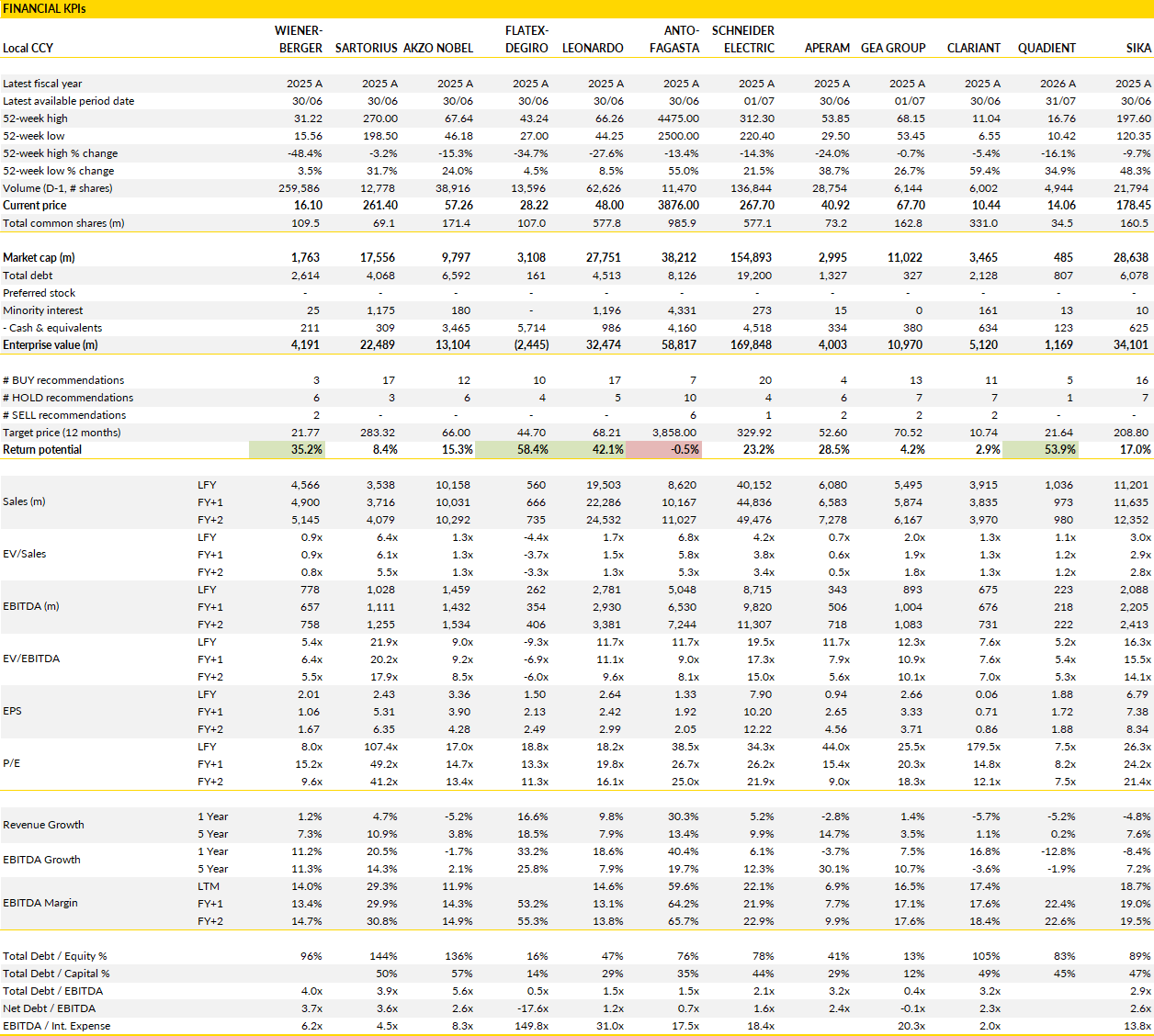
Financial KPIs
Companies covered in this edition: Wienerberger, Sartorius AG, AkzoNobel, flatexDEGIRO, Leonardo, Antofagasta, Schneider Electric, Aperam, GEA Group, Clariant, Quadient, Sika
Wienerberger (WIE Austria): Housing weakness leads to another profit warning
Wienerberger has cut its 2026 operating EBITDA target for the second time, with management now expecting €640-650m compared with €700m previously.
Q3 trading deteriorated more than anticipated as weak residential construction in North America and the UK continued to depress volumes. Pricing also proved harder to implement fully, leaving the group with insufficient revenue support against a rising cost base. Energy, raw materials and logistics became particularly expensive during September, and low factory utilisation magnified the impact on profitability. Wienerberger expects Q3 operating EBITDA of €170-180m on revenue of €1.2-1.3bn, compared with €202m of EBITDA and €1.17bn of revenue a year earlier. Operating EBITDA for the first nine months should consequently be around €500m. The revised full-year range leaves Q4 needing to contribute roughly €140-150m, below the €170m generated in the comparable period last year but still dependent on cost control in a difficult demand environment.
The deterioration has prompted interim CEO Hanke to initiate a broader strategic review shortly after taking charge. Management says fundamental decisions are required and is preparing further restructuring measures alongside additional price increases. Reducing financial leverage will be one of the priorities, together with improving returns across the business. This represents a more extensive response than the recurring optimisation measures used during the residential downturn so far. Wienerberger has already been cutting costs for an extended period, yet weaker volumes and under-utilised plants continue to absorb much of those savings.
The next update on 12 November should provide more detail on Q3 performance, although the larger questions concern the eventual scope of the restructuring and the strategic decisions emerging from the review. Any meaningful reduction in the group's fixed-cost base could improve earnings resilience, but implementation may also require cash restructuring charges and potentially asset impairments.
Residential construction remains the central constraint on a sustained earnings recovery. The weakness has lasted long enough that Wienerberger can no longer rely on incremental efficiency measures to bridge the gap until volumes return. North America and the UK remain particularly difficult, and the latest warning shows that pricing cannot fully compensate when utilisation remains depressed and input costs rise simultaneously.
Management is therefore moving towards a deeper reassessment of the cost base, portfolio and balance sheet under new leadership. The revised €640-650m EBITDA target provides a lower starting point from which these measures can be developed, while the strategic review could lead to more significant changes than those undertaken earlier in the downturn. A recovery in residential construction would still provide substantial operating leverage given current capacity utilisation, but Wienerberger first needs to adapt the business to demand conditions that have remained weak for considerably longer than initially expected.
Sartorius AG (SRT3 Germany): Single-use adoption has room to run
Sartorius has a long runway for growth as biopharmaceutical manufacturing moves towards smaller, more flexible production systems.
Management expects the Bioprocess Solutions market to expand by 8-10% annually, supported by rising demand for biologic medicines and a drug pipeline increasingly weighted towards new modalities. Biopharma revenues exceeded those from traditional therapies for the first time in 2025 and are expected to reach 57% of the market by 2030, while novel modalities already represent around half of the global drug pipeline. This changes how manufacturers design capacity. More targeted indications and personalised treatments generally require smaller production volumes, reducing the economic advantage of large stainless-steel facilities built around high-volume drugs. Sartorius can address projects from early drug development through commercial manufacturing with an integrated portfolio that can be scaled as demand develops, allowing customers to add capacity with less upfront investment and greater flexibility.
The gap between single-use penetration in development and commercial manufacturing shows how much adoption could still increase. More than 85% of clinical development already uses single-use technology, compared with less than 20% of commercial production. Economics become particularly attractive for medicines requiring annual output below 500kg, an increasingly relevant part of the market as drug development fragments across narrower indications.
Sartorius benefits from this shift across multiple stages of the manufacturing process. Its offering combines filtration and process analytics with bioreactors and chromatography, giving customers the ability to build more of a production process around compatible technologies from one supplier. Higher commercial penetration also expands the installed base consuming recurring materials, so the benefit extends beyond the initial equipment sale. So the opportunity is tied both to additional production capacity and to a larger recurring consumables base as single-use systems move further into commercial-scale manufacturing.
Manufacturing intensity adds another source of demand. Upstream processes can operate at higher cell concentrations, raising output from a smaller bioreactor footprint, while purification is becoming more efficient through advances in chromatography and related downstream technologies. Customers can produce more without increasing factory size at the same rate, reducing capital requirements and improving utilisation of existing facilities.
Sartorius participates in these efficiency gains through the technologies and consumables required to run the intensified process, meaning lower capital intensity for drug manufacturers does not necessarily translate into lower demand for its products. Greater throughput can instead increase consumption of filters, chromatography materials and other components.
The combination of continued biopharma growth, low single-use penetration in commercial manufacturing and the move towards more productive facilities creates several independent sources of expansion for Bioprocess Solutions. Sartorius' broad platform gives it scope to capture a larger share of customer spending as these manufacturing practices become more widely adopted.
AkzoNobel (AKZA Netherlands): Southeast Asia sale accelerates deleveraging
AkzoNobel has agreed to sell its Southeast Asian Decorative Paints operations to Nippon Paint for $1.35bn, or approximately €1.2bn, with completion expected by mid-2027.
After taxes and minority interests, AkzoNobel expects to receive around €0.9bn in cash. The transaction values the business at 21x 2025 EBITDA, a substantial price for an asset that sits outside the group's strongest market positions. It also follows the disposals of the Indian and Pakistani activities and is consistent with management's strategy of withdrawing from markets where AkzoNobel lacks sufficient leadership. The company will retain its regional Coatings operations and Global Business Services, so the deal is specifically a further reshaping of Decorative Paints instead of a full withdrawal from Southeast Asia. The immediate financial benefit is clear: €0.9bn of additional cash materially strengthens the balance sheet before the planned Axalta combination and gives AkzoNobel greater flexibility around leverage and future capital allocation. It is of course also another big step in the company's pivot towards Coatings.
Nippon Paint is a natural owner for the assets given the scale of its existing Asian franchise. Its NIPSEA operations outside China have been expanding rapidly, and the acquisition adds businesses in markets where Nippon already has substantial positions as well as additional scale elsewhere in the region. For AkzoNobel, the 21x EBITDA transaction multiple is also useful evidence of the strategic value attached to established Decorative Paints franchises. Recent disposals have achieved similarly strong prices, with India sold at around 25x EBITDA and Pakistan at roughly 14x. These transactions show that regional paint assets with recognised brands and distribution networks can attract buyers at valuations that are difficult to capture inside a diversified listed group. AkzoNobel has consequently been able to simplify its geographic footprint without accepting discounted exit prices.
The sale also leaves AkzoNobel with a smaller and more concentrated Decorative Paints portfolio, increasing the range of strategic options available for the remaining business. A disposal of the entire portfolio would still be a large transaction, but removing Southeast Asia reduces its size and follows a clear pattern of portfolio separation through individual regional exits.
Whether management ultimately pursues additional disposals will depend on the structure of the combined AkzoNobel-Axalta group and its longer-term priorities, but the Southeast Asian transaction demonstrates that credible buyers exist for substantial pieces of Decorative Paints. It also establishes a strong valuation reference without requiring AkzoNobel to sell the whole division in a single step.
Longer term, continued portfolio rationalisation could release additional capital and increase the combined group's concentration on coatings markets where scale, technology and customer relationships provide stronger competitive advantages.
flatexDEGIRO (FTK Germany): Interest income offsets softer trading
flatexDEGIRO should continue to benefit from a favourable mix between brokerage revenue and interest income in Q3, even as trading activity remains constrained by the seasonally quieter summer period.
July and August recorded more transactions than a year earlier, followed by a modest decline in September. Customer cash balances have meanwhile increased by around 15% year on year, providing a larger deposit base from which the group can generate interest revenue. Margin lending is also seeing continued demand, and higher interest rates add another benefit to treasury income. The resulting earnings mix should be more profitable than a recovery based solely on transaction volumes. The company will report Q3 results on 21 October, with trading volumes and the contribution from customer cash and lending providing the main indications of whether the recent earnings momentum can be sustained beyond the summer period.
Management changes create a separate issue following an unexpectedly broad reorganisation of the group's governance structure. Benon Janos has been promoted to Co-CEO and will take responsibility for the consumer brokerage operation, while Oliver Behrens remains chairman of the management board with responsibility for treasury and B2B activities. Thomas Lindner, who joined flatexDEGIRO in 2012, will become CFO. At supervisory board level, Hans-Hermann Lotter is stepping down as chairman and will leave the board together with Martina Pfeifer by 10 October.
The resulting structure splits responsibility for the group's core brokerage franchise from the businesses overseen by Behrens. A Co-CEO model can work effectively if responsibilities are clearly delineated, but the transition introduces an additional organisational layer at a time when the company is still developing its earnings model beyond transaction commissions. The practical effect should become clearer as the new management structure settles and capital allocation and strategic responsibilities are divided between the two executives.
Operationally, flatexDEGIRO enters this transition with several supportive earnings drivers. Higher customer deposits increase the recurring contribution from interest income, while margin loans provide another source of revenue that is less directly dependent on daily trading activity. Brokerage remains sensitive to market participation and seasonality, as demonstrated by the softer September transaction count, but the group's revenue base is broader than it was when commissions dominated the model. Cost discipline also remains relevant because incremental revenue can translate into substantial profit growth once the platform's fixed costs are covered.
The longer-term question is how durable the current interest contribution proves as rates and customer cash allocations change. Continued growth in accounts, assets and trading activity would reduce that dependence over time. For Q3, however, the balance between moderate commission growth and stronger treasury-related income should allow flatexDEGIRO to extend its earnings progression despite a relatively quiet trading quarter.
Leonardo (LDO Italy): Defence electronics leads
Leonardo's Q3 should extend the operational improvement seen earlier in the year, with defence electronics again providing much of the earnings momentum.
Profitability in the segment continues to benefit from higher activity levels and operating leverage, with contributions spread across the group's European operations, DRS and its interests in Hensoldt and MBDA. The integration of Iveco Defence Vehicles adds another source of revenue growth, although the underlying business is also expanding strongly without the acquisition.
The more relevant development is the conversion of higher defence spending and the existing backlog into better margins. Defence Electronics has been at the centre of this progression, and another quarter of improvement would strengthen the case for higher profitability targets when Leonardo next updates its industrial plan. The breadth of the contribution is also encouraging because the improvement isn't dependent on one geography or program.
Order intake remains healthy after an exceptionally strong first half, when book-to-bill reached 1.6x. The ratio is likely to normalise as contract timing becomes less favourable, but commercial activity remains substantial. Recent awards span the 12 M346 aircraft ordered by Indonesia, helicopters for The Helicopter Company, the initial Brazilian Army tranche for Centauro II vehicles and another international GCAP agreement involving Edgewing. The sequence of these awards is less important than the range of platforms generating demand across Leonardo's portfolio. Q4 should add a sizeable Italian naval contract, with around €1.2bn associated with two DDX destroyers expected to enter the order book. Management's 2026 order target stands at €28.2bn, and the continued pace of contract awards provides a strong foundation for activity beyond the current year. This backlog expansion is particularly valuable in defence electronics, where higher volumes can support further absorption of fixed costs and margin improvement.
Cash conversion is another area where Leonardo has made progress. Management is working to reduce the traditional year-end concentration of free operating cash flow through tighter working-capital management and earlier customer advances. IDV remains seasonally demanding on cash during Q3, so improvement elsewhere in the group may initially be partly obscured by the acquired business. Leonardo nevertheless maintains a full-year FOCF target of €1.37bn, supported by the combination of rising earnings and stronger commercial cash inflows. Better phasing would make the quality of that cash generation more consistent across the year and reduce reliance on a very large Q4 inflow.
With order intake running strongly and defence electronics generating both revenue growth and better profitability, Leonardo's operating development remains favourable even before any further increase in its medium-term ambitions.
Antofagasta (ANTO UK): Production recovery shifts to Q4
Antofagasta's production recovery is taking longer than originally expected, with Los Pelambres still working through a difficult mining phase after extensive maintenance during the first half.
Winter conditions have added another constraint during Q3, although operations at the mine have held up reasonably well despite the weather. The company lowered its 2026 copper production guidance in August to 625-655kt from 650-700kt, following output of 143kt in Q1 and 142kt in Q2. A larger improvement is consequently required in the final quarter to reach even the lower portion of that range. Q3 should show some sequential progress, but the more meaningful increase is expected once seasonal disruption eases and Los Pelambres moves beyond the operational constraints that affected the first nine months.
Costs remain elevated even as volumes begin to recover. Sulphuric acid accounts for around 5% of gross costs, while diesel represents approximately 7%, and both have become more expensive during the second half. Antofagasta's full-year gross cost guidance remains $2.40-2.60/lb. Diesel carries an additional supply risk from the possibility of US export restrictions, although the group has some protection against short interruptions. Its mines generally hold 15-30 days of fuel inventories, with a similar quantity typically in transit, and Chile maintains strategic reserves that could provide another buffer if supply becomes constrained. Centinela adds a separate operational issue, with negotiations involving two of its three unions now taking place through a government mediator after the parties failed to reach agreement directly. A strike or a sizeable wage settlement remains possible, although Antofagasta has avoided major industrial action since 2019. With production already weighted heavily towards Q4, preventing additional disruption at Centinela becomes particularly relevant to delivering the revised annual guidance.
The external environment for Antofagasta remains unusually supportive despite these operational constraints. Copper is trading around $14,500/t, giving the group direct exposure to one of the strongest major commodity markets without the iron ore exposure carried by several diversified miners. High prices can absorb part of the pressure from elevated operating costs and weaker first-half volumes, although trade policy introduces another source of volatility. Potential US copper tariffs could alter physical flows into Comex and affect availability elsewhere, adding uncertainty to a market already experiencing tight supply conditions.
Antofagasta's immediate priorities are more operational: delivering the expected Q4 production increase, containing input-cost inflation and completing the Centinela labour negotiations without material disruption. Successful execution would leave the group entering 2027 from a much stronger production base than the first half of 2026, with copper prices providing substantial earnings leverage once mine output normalises.
Schneider Electric (SU France): Filling the software gap
Schneider Electric is making a major expansion in industrial software with the $23.7bn acquisition of PTC, adding a business focused on product lifecycle management and computer-aided design to its existing automation portfolio.
The $205 per share all-cash offer values PTC's equity at $22.6bn and carries a roughly 43% premium to its last closing price. PTC brings more than 30,000 customers, with particular strength in discrete and hybrid manufacturing, an area where Schneider has lacked the software depth of competitors such as Siemens and Dassault Systèmes.
The strategic rationale is more than just adding another software asset. Schneider wants to connect product development with manufacturing and the subsequent operation and maintenance of industrial assets, creating a digital thread across the full lifecycle. PTC also comes with substantially higher profitability than Schneider's existing group average, with an adjusted EBITA margin of around 40%, as well as a larger recurring-revenue component. Completion is expected in Q3 2027.
The financial commitment is substantial, with Schneider planning €16-17bn of new debt alongside a €5-6bn equity raise while retaining its objective of an A credit rating from S&P. Management expects the acquisition to increase adjusted EPS from the first full year of consolidation. The industrial logic rests partly on the complementary nature of the two customer bases. Schneider is targeting €800m of longer-term revenue synergies through cross-selling, while €250m of cost savings are expected within three years. PTC's software can be sold deeper into Schneider's industrial customer base, while PTC's relationships create another channel for Schneider's automation and energy-management technologies. The acquisition also increases group margins and cash generation mechanically because PTC operates at much higher profitability. Execution will depend heavily on converting those commercial overlaps into actual sales, particularly because the targeted revenue synergies are considerably larger than the cost savings.
PTC gives Schneider a stronger position in discrete automation at a time when software is becoming more closely integrated with industrial hardware and control systems. It also increases the group's exposure to an area facing potential disruption from AI, particularly in engineering and design software, making product development and customer retention important variables after closing.
Schneider is nevertheless buying an established platform rather than attempting to build these capabilities internally, accelerating its ability to compete across a broader portion of industrial digitalisation. The capital increase creates near-term dilution and the additional debt reduces financial flexibility, so the transaction needs to deliver more than portfolio expansion alone. Management's €1.05bn combined synergy ambition provides a measurable benchmark for the integration.
If Schneider can connect PTC's design and lifecycle software effectively with its automation and energy-management offering, the acquisition should deepen customer relationships across the manufacturing process and shift the group further towards recurring, higher-margin software revenue.
Aperam (APAM Netherlands): Trade protection needs time to work
Aperam's near-term trading remains subdued despite a more favourable regulatory backdrop for European stainless steel.
Management has recently reiterated that Q3 adjusted EBITDA should fall between the €90m generated in Q1 and €130m in Q2. Several temporary factors are working against the quarter, including scheduled maintenance in Alloys and smaller inventory valuation benefits, alongside normal seasonal weakness in European recycling and stainless steel. More fundamentally, demand remains soft. Construction is beginning to show tentative improvement, but this has yet to translate into stronger orders. The immediate impact of tighter European import restrictions is also being delayed by inventories accumulated before the measures took effect. Energy provides an additional drag, with management previously indicating a low-double-digit EBITDA impact following higher gas and freight costs and more expensive electricity in Belgium. Aperam's exposure is uneven, however, as power remains relatively inexpensive across its operations in the US, Brazil and France.
The more substantial opportunity comes from the new European trade regime and should emerge progressively as excess inventories clear. Since July, import quotas have been halved and tariffs applied beyond those quotas have increased from 25% to 50%. Aperam expects imported stainless steel's share of the European market to fall from around 25% to 15%, allowing industry capacity utilisation to rise by 7-10 percentage points. Management estimates that the eventual EBITDA benefit could reach €200 per tonne, compared with €75 already captured by the end of H1. The majority of the improvement is expected to become apparent by 2028, when Aperam targets adjusted EBITDA of €700-800m versus €339m in 2025.
This creates a large gap between current earnings and management's medium-term ambition. Closing it requires the trade measures to translate into higher utilisation and pricing, but does not depend on a particularly strong cyclical recovery in European end demand. The timing is slower because pre-tariff inventories must first work through the supply chain.
Aperam also has more earnings sources outside conventional European stainless steel than it did several years ago. Universal Stainless, acquired in 2025, expanded the Alloys business into higher-value applications including electronics, LNG shipping and aerospace. Its Brazilian forestry assets provide low-cost upstream inputs and are being developed further through biochar and biooil, while recycling activities increasingly extend into areas such as aerospace components. Integration with distribution provides another advantage by giving Aperam closer access to customers and greater ability to capture value in segments facing less import competition. These businesses reduce dependence on a straightforward recovery in European stainless volumes and should become increasingly relevant to group profitability.
The next few quarters may still be constrained by weak demand and elevated energy costs, but there's a large opportunity further out as import inventories normalise, European capacity utilisation improves and the newer parts of the portfolio contribute more fully.
GEA Group (G1A Germany): Order strength extends into Q3
GEA's strong first-half order performance appears to have carried into Q3, reducing the risk that the recent acceleration was concentrated in a handful of projects.
Organic order intake grew 10.7% in H1, with Q2 particularly strong, and management indicated during its pre-close call that the pace remained healthy during the third quarter. Large orders alone exceeded €100m, compared with €64m in the prior-year period. Demand is also spread across the portfolio. Pharmaceutical equipment remains strong, particularly continuous tablet pressing, and dairy processing is seeing healthy demand for both components and projects. Food applications continue to perform well, including poultry, and beverage activity has remained resilient. Dairy farming has improved after a weaker period, helped by the US and demand from larger farms. Protein-related investment is another source of project activity, with management expecting the trend to persist over the next two years. Notable here is the breadth of these orders.
Profitability continues to rise alongside the stronger order book. GEA's 2026 sales growth guidance remains 6-8%, and the company has already reached several objectives originally set for this year ahead of schedule. Services have played an important role in that improvement because of their higher margins and recurring characteristics, while better commercial discipline allows GEA to be more selective about the projects it accepts. Management indicated that further margin progress was achieved during Q3 after an adjusted EBITDA margin of 17.0% in the comparable quarter last year.
Longer term, the group is working towards margins around 19% by the end of the decade. Its competitive positions support that ambition: GEA is a leading supplier of separators through Pure Flow Processing and holds strong positions across several other equipment categories. Scale, installed equipment and service relationships give the company scope to capture aftermarket revenue while maintaining pricing discipline on new projects.
The operational improvement under CEO Stefan Klebert has increasingly shifted GEA from restructuring towards sustained organic growth. Changes to the previous GEA One organisational model and a greater emphasis on accountability have been accompanied by stronger margins, cash generation and order execution. The balance sheet also gives management flexibility over capital allocation. GEA maintains a dividend payout ratio of around 50%, with share repurchases available when larger acquisitions do not absorb excess cash. Strong orders now extend the revenue pipeline further beyond 2026, and the diversity of demand across processing equipment, farming technology and pharmaceutical applications reduces dependence on any single end market.
If current demand persists, GEA can combine mid-single-digit or better organic growth with further profitability gains, extending the improvement well beyond the targets that have already been reached ahead of schedule.
Clariant (CLN Switzerland): Catalysts approach a recovery
Clariant's Catalysts business could begin recovering after a sharp deterioration in volumes during the second quarter, although utilisation rates across Asian and Middle Eastern petrochemical plants remain depressed.
Segment volumes fell 14.2% in Q2 after declining only 2% in Q1, largely because customers postponed catalyst replacement as production remained low. These refills cannot be deferred indefinitely, creating the potential for a catch-up as operating rates stabilise. There are already some encouraging developments in China, where propane dehydrogenation plants are increasing production and Clariant has a particularly strong competitive position. The company has also secured the catalyst contract for the world's largest PDH unit in China, adding new-build demand alongside the eventual refill recovery. The precise timing remains uncertain, but delayed replacements could begin contributing from Q4 and become more meaningful during 2027. This would allow Catalysts to recover without requiring a full normalisation of petrochemical markets across the region.
Other parts of the portfolio are developing more steadily. New additives capacity in China is gradually being absorbed, including halogen-free flame retardants used in electronics, supporting growth as utilisation of the recently installed capacity increases. Adsorbents are benefiting from stronger US biodiesel activity and also serve purification applications in edible oils. These businesses provide some balance while Catalysts works through the downturn, but the latter remains capable of producing a much larger earnings swing because of the severity of the recent volume decline.
Clariant should also benefit disproportionately when deferred catalyst changes eventually take place: replacement demand has been postponed instead of permanently lost, while new petrochemical projects continue to require initial catalyst loads. The Chinese PDH market is particularly relevant given Clariant's strong share and the additional capacity being constructed. A combination of replacement activity and new installations could therefore restore Catalysts towards its previous earnings level relatively quickly once customer utilisation improves.
The legal overhang has also diminished following the Amsterdam District Court's July dismissal of Shell's €1bn damages claim against Clariant and three other defendants concerning the ethylene purchasing market. The court rejected the analysis underpinning the claim as unreliable and implausible. Significant additional claims remain outstanding in the Netherlands and Germany, so the litigation has not disappeared, but the Shell decision provides a favourable precedent for Clariant's defence. Separately, the completed disposal of R. Stahl to Henkel generated CHF176m of net cash proceeds, further strengthening the balance sheet.
These developments leave operating performance, particularly the timing of the Catalysts recovery, as a more prominent determinant of performance. Clariant does not need an immediate return to high petrochemical utilisation for conditions to improve: delayed catalyst replacements, Chinese PDH projects and the gradual filling of newer additives capacity can each contribute independently. A meaningful rebound in Catalysts during 2027 would restore an important earnings contributor after an unusually weak 2026 and give the group a better balance between its different specialty chemicals businesses.
Quadient (QDT France): Digital takes over from Lockers
Quadient's exit from parcel lockers is progressing quickly and should leave the group with a simpler business, substantially lower capital requirements and additional cash for debt reduction and shareholder returns.
The UK operation has already been sold for an enterprise value of €65m, covering roughly 3,000 lockers and anticipated revenue of around €12m. Management is now working on exits from the much larger US and Japanese operations, where Quadient has approximately 16,000 and 7,500 lockers respectively. The strategic review only began in July, but the remaining transactions could be completed within three to six months. There appears to be meaningful buyer interest in locker networks, helped by Quadient's established positions in its markets, including around 70% share in Japan and 40% of the US residential segment. Beyond the disposal proceeds, exiting Lockers removes approximately €120m of investment requirements over five years. That materially changes Quadient's cash profile by eliminating the most capital-intensive part of the portfolio.
Digital should become the main source of growth once the disposal is completed. Annual recurring revenue has expanded at roughly 15% annually since 2019 and was still growing 12.9% at the end of H1 2026. Electronic invoicing regulation provides another opportunity to sustain that expansion, with mandatory adoption beginning in France in September 2026 before implementation in other European markets over the following years. Quadient estimates that it already holds a 13-19% share in France following its acquisition of Serensia. Management expects Digital's EBITDA margin to exceed 19% in 2026, compared with 14.5% during H1, leaving substantial room for operating leverage as revenue scales. By 2030, the division is targeted to generate at least €550m of revenue with an EBITDA margin of 30% or more. It should then represent over half of group revenue and more than 55% of EBITDA, compared with 33% and 25% respectively today. Mail remains a sizeable cash-generative activity, with management targeting around €500m of 2030 revenue and a 20-25% EBITDA margin, but its role within the group will steadily diminish.
The disposal also changes how Quadient can allocate capital. Net debt excluding leases stands at approximately €216m and management intends to eliminate it, while the lower investment burden should allow more cash to be directed towards dividends or share repurchases. Growth towards the 2030 objectives is expected to come organically, reducing the need to recycle disposal proceeds into acquisitions. The combination of debt repayment and lower locker investment should therefore leave a significantly larger proportion of future free cash flow available to shareholders.
More fundamentally, Quadient is moving from a portfolio containing three very different businesses towards a structure dominated by recurring digital revenue and a mature, profitable Mail franchise. Execution in Digital remains central, particularly the conversion of electronic invoicing regulation into customers and higher margins. If management reaches its 2030 targets without major acquisitions, the group should emerge with a less capital-intensive model, a larger recurring revenue base and substantially greater flexibility over cash distributions.
Sika (SIKA Switzerland): Adhesives broaden the growth base
Sika's adhesives portfolio is becoming a larger source of differentiation, with the technology now representing 27% of group sales and benefiting from a relatively high rate of product renewal.
Products launched recently account for 23-25% of adhesive sales, giving the business a stronger innovation component than much of the broader portfolio. Pureform is one example, providing the technology behind products spanning flooring, sealants and adhesives. The platform already generates more than CHF250m of sales and has grown at an average annual rate of 12%. Sika's scale also gives it scope to use digital tools across product development and commercial activities. AI has reduced development time for cement additives by 40%, while the preparation of Environmental Product Declarations now takes 90% less time. AI agents have contributed a 2% increase in e-commerce sales. Management sees proprietary data as an advantage that smaller competitors will find difficult to replicate, potentially shortening development cycles and reducing operating costs while improving the commercialisation of new products.
The recently completed Akkim acquisition adds another route for expansion. The business generates around CHF220m of sales, close to 2% of Sika's total, with profitability broadly in line with the group. Management intends to double its size within five years. Sika can initially introduce its own portfolio through Akkim's established distribution channels, followed later by selling Akkim products under the Sika brand through European retail networks. The larger contribution is expected during years three to five as these cross-selling initiatives mature. Akkim also extends Sika into customer channels where its presence has historically been smaller, including e-commerce and the paint sections of large DIY retailers. Geographically, the acquisition strengthens access across the Middle East and Central Asia as well as parts of Africa and Eastern Europe. Three manufacturing plants support the platform, with the newest facility scheduled to become operational during H2 2026. The acquisition therefore combines distribution expansion with additional local production capacity instead of relying solely on cost synergies.
Cost measures provide another source of earnings improvement while some construction markets remain weak. Sika's Fast Forward plan targets CHF150-200m of benefits by 2028, including around CHF80m from 2026, with management aiming towards the upper end of CHF80-110m for the structural run-rate savings from 2027. Around 50bp of margin improvement had already been achieved during H1 2026, offsetting higher transportation costs associated with disruption in the Middle East. China remains the main cyclical constraint.
Management has not changed its outlook there and expects the residential property recovery to take longer, although Sika believes it is performing relatively well within the current environment. This leaves much of the medium-term improvement under the company's own control. Adhesive innovation, the scaling of Akkim, digital productivity and Fast Forward can all contribute without requiring a rapid Chinese construction rebound. The existing financial targets remain unchanged, but the CMD provided more detail on how Sika can generate growth and margin improvement through portfolio mix and internal execution.