
Music, spin-offs and recovering shorts
Universal Music Group, 2CRSi, Vincorion, Publicis, thyssenkrupp, Whitbread, Nexans, Wallix, ArcelorMittal, Euronext, Eramet

At Lux Opes, we break down companies into quick takes that get straight to the point - what is happening, why it matters, and what to watch next. We publish 2-3 times per week, depending on the news flow.
For the best reading experience, we recommend reading at Lux Opes
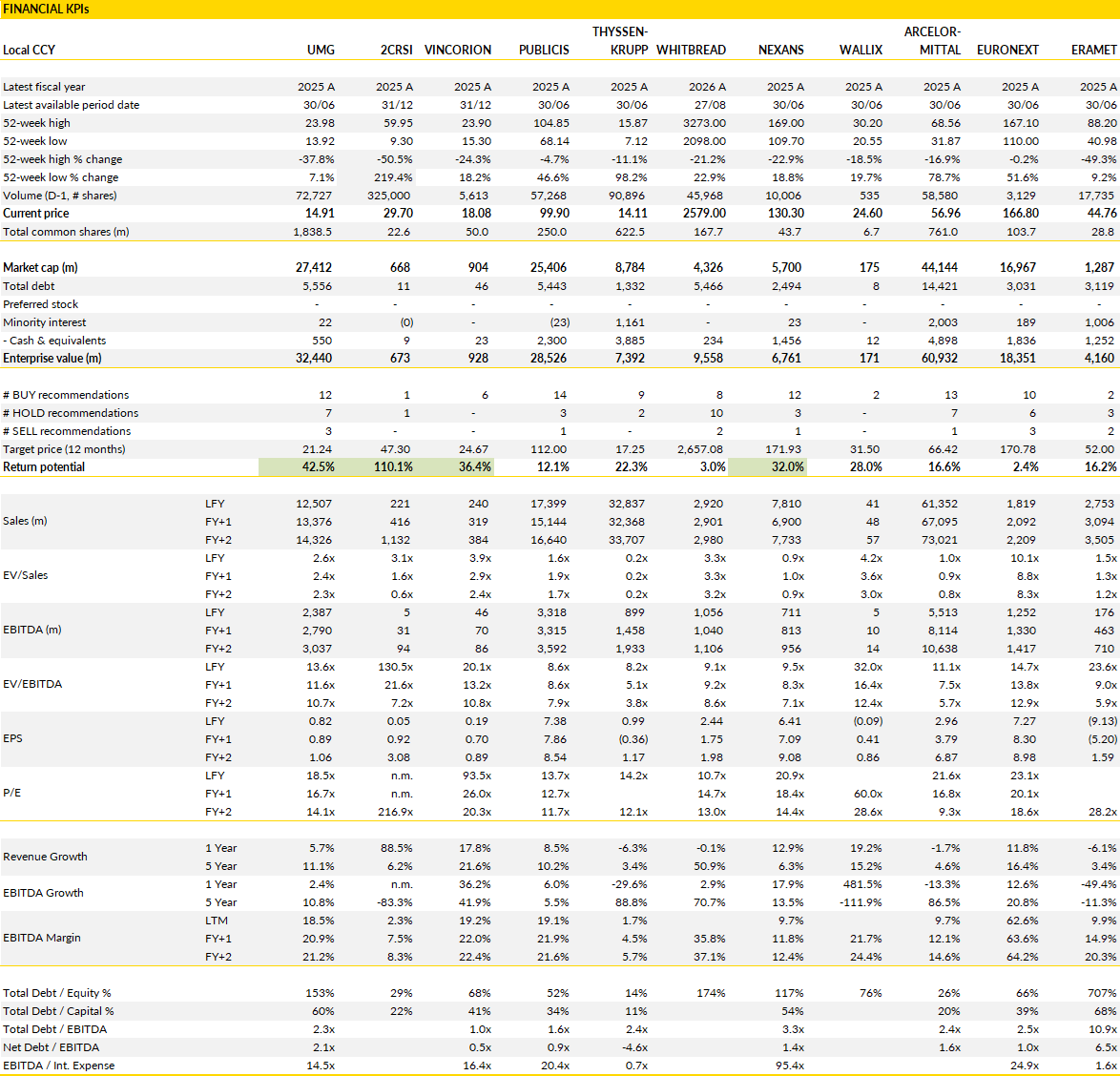
Financial KPIs
Companies covered in this edition: Universal Music Group, 2CRSi, Vincorion, Publicis, thyssenkrupp, Whitbread, Nexans, Wallix, ArcelorMittal, Euronext, Eramet
Universal Music Group (UMG Netherlands): Streaming recovery puts costs in focus
Universal Music Group is expected to report stronger paid streaming growth in Q3, helped by a more active release schedule and continued expansion of the global subscription market.
The underlying industry remains healthy, with subscriber growth holding up and price increases from major streaming platforms contributing additional revenue per user. Spotify's recent performance suggests that consumption and subscription demand remain resilient, while pricing actions by YouTube, Apple and Spotify continue to support the economics of recorded music. UMG should also recover some of the market share lost during the first half as its release schedule becomes more competitive. New music from KATSEYE, Karol G and Ariana Grande, alongside releases involving Stray Kids and Gracie Abrams, has strengthened the quarter, with existing material from Noah Kahan, Olivia Rodrigo and Drake providing further support. The late-September Taylor Swift release should contribute more meaningfully in Q4.
The improvement in paid streaming is therefore supported by both industry growth and a better contribution from UMG's own repertoire, although the demanding comparison with last year may limit the extent of the acceleration.
Other revenue streams are likely to deliver a more uneven performance. Publishing is recovering from the timing effects that affected Q2, but management has already indicated that near-term growth should remain in the mid-single digits. New contract contributions face demanding comparisons, and the pace of expansion in performance and digital publishing revenues is unlikely to return immediately to last year's levels. Physical music sales also face an unusually strong prior-year quarter, when major releases and initial Taylor Swift deliveries supported substantial growth. Advertising-supported streaming remains structurally less attractive than subscriptions, particularly as consumption shifts towards short-form video formats that generate lower revenue per stream. Licensing is another area where growth should normalise after an exceptional Q2, which benefited from audiovisual activity and live-related revenues. These differences across revenue categories reinforce the importance of paid streaming to UMG's overall growth. Subscription revenues offer a combination of recurring consumption, expanding subscriber numbers and periodic price increases, whereas physical releases and licensing contracts can produce considerable quarterly fluctuations.
Profitability will be an equally important part of the Q3 update on 29 October. UMG has been carrying elevated professional and legal expenses, while the integration of Downtown Music adds further pressure to reported margins. Management has also chosen to reinvest part of its cost savings in areas such as artificial intelligence, reflecting the need to develop new capabilities as technology changes music discovery, production and distribution. The balance between these investments and operating efficiency deserves attention, particularly after the margin deterioration recorded in Q2. Some of the exceptional overhead pressure should ease during the second half, but the company still needs to demonstrate that revenue growth can translate into stronger earnings. Downtown's integration complicates the near-term comparison, making underlying cost development especially relevant.
UMG retains a strong catalogue, broad artist relationships and significant exposure to the expanding subscription market, with pricing providing an additional source of growth beyond consumption volumes. A recovery in market share would improve revenue momentum, but sustained margin expansion will require tighter overhead control and disciplined reinvestment.
2CRSi (2CRSI France): Aether AI campus advances
2CRSi's involvement in the ÆTHER project has taken another step forward following an agreement to secure a large industrial site in Strasbourg, potentially creating a substantial new source of demand for its AI servers.
Aether Infrastructures, the legally separate company developing the project, has signed a letter of intent to acquire FR-SXB2, the former Dumarey Powerglide facility. The property covers approximately 90 hectares and includes 110,000m² of existing buildings, with initial occupancy possible from 15 October under a lease arrangement. The intention is to develop an integrated European AI campus combining computing infrastructure, server manufacturing and low-carbon energy production. The project brings together Aether Utilities, which will manage energy requirements, Aether Compute, responsible for computing capacity, and Aether Facilities, which will develop the physical infrastructure. For 2CRSi, the opportunity extends beyond supplying hardware. The company would also contribute to infrastructure design, equipment selection and systems integration, potentially increasing its participation in the overall value chain. However, 2CRSi is a consortium member and prospective equipment supplier, not the developer or controlling entity behind ÆTHER. Its eventual commercial contribution will therefore depend on the project's financing, technical specifications and implementation schedule.
The Strasbourg facility could also become an important part of 2CRSi's manufacturing strategy. The company is considering bringing more production activities associated with its GODÌ server range back to Europe, initially through the integration of critical components and potentially later through motherboard manufacturing. This would give 2CRSi greater control over parts of its supply chain and strengthen its offering to European customers seeking locally manufactured computing infrastructure. Demand for sovereign AI capacity is creating opportunities for regional hardware suppliers, particularly where customers want greater control over data processing, equipment sourcing and energy consumption.
Management estimates that the initial deployment of ÆTHER's computing capacity could generate more than €1bn in revenue for 2CRSi during 2026/27. This illustrates the project's scale but remains a potential commercial opportunity, with no firm order of equivalent value disclosed. Discussions with banking partners are reportedly well advanced, although the financing structure and committed amounts have not been made public. The proposed campus benefits from the availability of an existing industrial site, which could shorten certain development stages, but the conversion into a large-scale AI facility will still require substantial infrastructure investment and technical preparation.
Execution risks remain considerable given the size and complexity of the proposed development. Administrative approvals, final infrastructure choices and access to critical computing components could all affect the schedule. GPUs and memory remain particularly important constraints, and shortages could push some equipment deliveries beyond June 2027. The final acquisition of FR-SXB2 is also subject to customary conditions, leaving further steps before the project can proceed at scale.
For 2CRSi, securing firm contracts and establishing a reliable delivery timetable will be necessary before the potential revenue can be treated as part of its established business pipeline. The company is due to publish its full-year results on 29 October, providing an opportunity to assess the performance of its existing operations alongside progress on ÆTHER. An independent expert's conclusions concerning the allegations raised in the Grizzly Research report are also expected towards the end of October, adding another important near-term development for the company.
The Strasbourg announcement gives the project a more tangible industrial foundation and creates opportunities for 2CRSi to expand its European manufacturing activities. Nevertheless, the scale of the potential contribution makes financing commitments, binding customer orders and component availability particularly important.
Vincorion (V1NC Germany): Strong execution drives another guidance upgrade
Vincorion's preliminary Q3 results demonstrate that the company is converting its substantial defence order book into revenue at an impressive pace, without sacrificing profitability as production expands.
Third-quarter sales increased 40% to €87.5m, bringing revenue for the first nine months to €237.7m, an increase of 41%. The performance is particularly encouraging given that Q3 is traditionally a quieter period for the business. Management has consequently raised its 2026 revenue guidance to €323-333m, compared with the previous range of €280-320m. The midpoint implies annual growth of approximately 35%, with around €90m of revenue required in Q4. This suggests that the pace of deliveries achieved during the summer can be sustained through year-end.
Vincorion is benefiting from accelerating European defence procurement, with its specialised power generation and energy management systems playing an important role in military platforms. The company's €1.2bn order book provides a substantial base of contracted business, while the rapid increase in deliveries indicates that production capacity is expanding sufficiently to meet customer requirements. The consistency of execution is particularly encouraging for a company operating through such a significant industrial ramp-up.
Profitability has developed better than management initially anticipated, despite the additional costs associated with expanding the workforce and increasing development expenditure. At the half-year stage, Vincorion had indicated that second-half margins could moderate from the 18.9% achieved in H1, partly because some research and development spending had been deferred and recruitment costs would become more apparent. The latest guidance suggests that these pressures have been absorbed more effectively than expected. Management now targets an adjusted EBIT margin of 18.5-19.5% for 2026, up from 18-19% previously. This implies that profitability should remain close to the first-half level even as manufacturing activity accelerates. Higher production volumes are helping absorb fixed costs, while the company's specialised product portfolio supports attractive margins.
Maintaining this level of profitability during a period of approximately 40% revenue growth indicates that the expansion has been managed carefully, with operating efficiencies offsetting much of the additional expenditure. It also strengthens confidence in the company's ability to sustain margins as it increases investment in manufacturing capacity and product development.
The medium-term outlook remains supported by the scale of European defence modernisation programs and Vincorion's growing role as a supplier of critical subsystems. Management's existing plan calls for annual revenue growth above 15% over the medium term and an adjusted EBIT margin of approximately 20% by 2030. The recent results suggest that the company is progressing rapidly towards those objectives, although sustaining the current growth rate will depend on production scheduling, customer deliveries and the timing of new contracts. Additional opportunities are emerging from TPS, which could broaden the company's addressable market beyond the programs already reflected in its order book. These initiatives are still at an early stage and could provide another source of expansion as the existing business matures.
Vincorion's immediate priority remains scaling production without compromising delivery reliability or cost discipline, particularly as defence customers seek faster fulfilment of increasingly large orders. The Q3 figures offer further evidence that the company can handle this expansion while preserving strong profitability. Full results on 11 November should provide more detail on capacity development, order conversion and the contribution of newer growth initiatives.
Publicis (PUB France): Strong client wins sustain growth
Publicis delivered another solid quarter, with organic revenue growth accelerating to 5.0% in Q3 from 4.8% in Q2 and 4.5% in Q1.
Net revenue reached €3.81bn, an increase of 7.9% on a reported basis, including positive contributions of €52m from currencies and €50m from acquisitions net of disposals. The performance was particularly encouraging in the US, where organic growth reached 4.5% despite a demanding comparison with the 7.1% expansion recorded a year earlier. Publicis benefited from new client wins and continued demand for its Connected Media and Intelligent Creativity services, while its technology activities returned to growth in the country.
Elsewhere, China delivered 10.6% growth, helping Asia-Pacific advance 5.4%, while Latin America expanded 23.8% on strong demand across media and creative services. European performance was more varied, with Germany growing 7.7% and France 4.5%, while the UK remained broadly flat as weakness in technology consulting offset double-digit growth in Connected Media. Central and Eastern Europe also performed well, growing 7.2%. The Middle East and Africa remained affected by regional conflicts, although the decline moderated to 1.4%. The broad geographic contribution demonstrates Publicis' ability to sustain growth despite uneven advertising conditions and difficult comparisons in some of its largest markets.
The development of Publicis Sapient is becoming an important part of the near-term outlook. Technology consulting, which represents approximately 13% of group net revenue, remains in a low-single-digit organic decline globally, reflecting subdued demand and exposure to customers affected by developments in the Middle East. However, performance has improved sequentially, and the return to growth in the US suggests that conditions are beginning to stabilise. Management now expects the technology business to resume positive organic growth globally in Q4. A recovery would add another source of expansion to a group already benefiting from healthy demand for its larger advertising activities. Connected Media accounts for approximately 62% of revenue and continues to grow at the upper end of the single-digit range, supported by the increasing importance of data-driven advertising and integrated media services. Intelligent Creativity, representing the remaining 25%, is expanding at a lsd pace.
Publicis' ability to combine these capabilities with technology consulting and customer data infrastructure has become an important competitive advantage, particularly as clients seek to coordinate marketing investment across channels. The integration of LiveRamp should further strengthen the group's data capabilities, although the operational and commercial benefits will become clearer as the integration progresses.
Management has reaffirmed all its 2026 financial objectives following the Q3 performance. Organic growth is expected to reach 4.5-5.0% for the full year, with Q4 anticipated to remain within the same range. The operating margin should exceed the 18.2% achieved in 2025, while free cash flow before working capital movements is expected to be approximately €2.2bn.
The group also reported a record level of new business wins, providing a substantial pipeline of client relationships that should contribute to revenue in 2027. Its performance has benefited from the ability to attract large accounts across multiple services, supported by investments in data, technology and integrated marketing solutions. Further improvement at Sapient would strengthen the earnings outlook, particularly if the recovery in technology spending extends beyond the US. For now, the combination of sustained media growth, improving technology demand and strong commercial activity provides a solid foundation for the remainder of 2026 and the following year.
thyssenkrupp (TKA Germany): tk accelis prepares for a standalone future
Thyssenkrupp's upcoming separation of tk accelis will create one of the largest independent materials distribution and processing companies, with approximately €11bn in annual revenue and a substantial presence on both sides of the Atlantic.
The business extends well beyond traditional steel distribution, supplying a broad range of metals and providing processing, manufacturing and supply-chain services that are increasingly integrated into customers' operations. Its particularly strong position in nonferrous materials and the development of its higher-value Solutions activities provide opportunities to improve the revenue mix over time. North America already represents an important growth market, with tk accelis ranking among the region's four largest distributors. The market remains highly fragmented, offering considerable scope for consolidation, while reshoring initiatives and investment in data centres are creating additional demand for metals and associated services. Unlike several competitors, tk accelis has historically expanded largely through organic investment, leaving opportunities to accelerate growth through selective acquisitions. The business could have approximately €500m available for M&A, allowing it to acquire regional distributors, broaden its processing capabilities and strengthen relationships with industrial customers.
Europe presents a different operating environment, although recent policy developments could improve conditions after several difficult years. tk accelis is the largest independent materials distributor in the region and holds a particularly strong position in Germany, where industrial weakness and subdued steel consumption have weighed on volumes. European steelmakers also retain extensive distribution operations of their own, limiting the addressable market for independent service centres. Competition from imported steel has added pressure to pricing, but tighter trade safeguards and the EU's Carbon Border Adjustment Mechanism could gradually improve the competitive environment. Germany's €500bn infrastructure investment program should provide another source of demand, particularly for construction-related materials and industrial applications.
Internally, tk accelis has opportunities to improve performance through site consolidation, higher capacity utilisation and further investment in processing activities. The European business has been affected by restructuring expenses and inventory valuation losses following the post-pandemic decline in metal prices. Those inventory effects have amplified the earnings downturn, although they also reverse some of the benefits recorded during the earlier period of unusually high prices. A recovery in industrial activity, together with a leaner operating footprint, would help restore profitability in the region.
The separation should give tk accelis greater freedom to allocate capital according to its own priorities, with expansion in North America and the development of higher-margin services likely to feature prominently. Its Solutions business offers a route to deeper customer relationships through inventory management, tailored processing and supply-chain integration, which can generate more stable revenue and reduce exposure to fluctuations in underlying metal prices. A greater contribution from these activities, combined with efficiency improvements in Europe, could gradually narrow the profitability gap with North American competitors.
The group is expected to generate approximately €345m of EBITDA in FY 2025/26, reflecting the difficult conditions that have affected the European business. The longer-term opportunity lies in improving margins through a stronger geographic and product mix, while maintaining discipline over working capital and capital expenditure. A standalone balance sheet would also allow management to balance acquisitions with shareholder distributions as cash generation improves.
For thyssenkrupp, the transaction represents another step towards simplifying its portfolio and giving individual businesses clearer strategic and financial responsibilities. The success of tk accelis will ultimately depend on its ability to use its European scale more efficiently while expanding the processing and service capabilities that distinguish it from conventional metals distributors.
Whitbread (WTB UK): Premier Inn gains share as restructuring weighs on profits
Whitbread's first-half results showed improving trading conditions across its Premier Inn estate, although higher operating costs and restructuring expenses continued to affect profitability.
Group revenue increased 2% to £1.57bn, while adjusted profit before tax declined 9% to £287m. In the UK, Premier Inn maintained its competitive advantage over the midscale and economy hotel market, delivering accommodation revenue growth of 3% and a 2% increase in revenue per available room (RevPAR). Average room rates rose 2%, with occupancy broadly unchanged, indicating that pricing remained the principal source of growth. The business outperformed its market by approximately two percentage points on both accommodation revenue and RevPAR, extending its RevPAR premium to £7.75. This sustained market-share performance is encouraging given the relatively subdued domestic travel environment and ongoing pressure on consumer spending. Total UK revenue was broadly unchanged, however, as growth in hotel accommodation was offset by a 9% decline in food and beverage sales. This reduction was expected and reflects the Accelerating Growth Plan (AGP), under which Whitbread is withdrawing from parts of its traditional restaurant business and redeploying capital towards more productive hotel operations.
Germany remains an important source of expansion, with revenue increasing 20% in reported terms and 19% in local currency during the first half. The opening of ten additional hotels contributed to growth, alongside improving performance at established properties. Occupancy increased by 390 basis points to 72.6%, demonstrating that the expanding estate is attracting additional demand as newer locations mature. Accommodation revenue rose 18%, or 16% in local currency, although RevPAR remained broadly stable because of a weaker events calendar and softer market conditions. The financial contribution has yet to match the improvement in trading activity. Germany's adjusted loss before tax widened to £8m from £3m, reflecting opening expenses and continued investment in the operating platform. Management nevertheless expects the German business to deliver a second consecutive year of profitability on a full-year basis. Recent trading has reportedly strengthened in both Germany and the UK, supported by encouraging forward bookings. The German expansion offers Whitbread a sizeable opportunity to build a second major Premier Inn market, but improving returns will depend on occupancy gains translating into higher margins as the hotel network grows. The UK business, meanwhile, must absorb wage inflation, property costs and the disruption associated with its restaurant restructuring.
Execution of Whitbread's five-year plan is progressing, with the closure of all 197 remaining branded restaurants completed in September. Agreements have been reached for the disposal of 173 sites, and offers have been received for most of the remaining properties affected by the restructuring. These transactions should help release capital from underperforming assets and simplify the operating model. Whitbread generated £39m of efficiencies during the first half and remains on course to achieve £60m for the full year.
Management also reaffirmed its objectives for £450-500m of property-related proceeds and net capital expenditure of £200-300m. The balance sheet requires careful management during this transition, with net debt rising to £663m and lease-adjusted leverage reaching 3.4x, compared with 3.2x a year earlier and the group's internal ceiling of 3.5x. Higher lease expenses and temporary AGP costs are already affecting earnings, making the timing of disposals and cost savings particularly relevant.
Whitbread has reaffirmed its full-year outlook, supported by improving bookings and continued market-share gains. Sustained RevPAR growth in the UK, a stronger earnings contribution from Germany and successful completion of the property disposal program would help restore profit growth and create greater financial flexibility over the coming years.
Nexans (NEX France): Grid and Connect sustain growth
Nexans expects the positive operating trends seen during the first half of 2026 to extend into Q3, with its Grid and Connect divisions continuing to benefit from investment in electrical infrastructure.
Management recently reiterated its confidence in the business during a recent pre-close call, with no material change to the outlook. Grid delivered organic growth of 4.9% in H1, supported by demand for network equipment and accessories, while Connect grew 7.3%, benefiting from data centre investment and other electrical applications. These markets remain healthy despite continued weakness in the Nordic region, where demand has yet to recover. Profitability is also developing favourably across both divisions. Management expects Grid to maintain an EBITDA margin of at least 15%, helped by the growing contribution from higher-value accessories, while Connect should sustain a margin of at least 12%. Nexans' international exposure provides some protection against uncertainty in individual markets, with France accounting for only 7-8% of group revenue. The company is benefiting from sustained spending on electrification, particularly where ageing distribution networks require upgrades and expanding data centre capacity creates additional demand for electrical connections.
The integration of Republic Wire is progressing according to plan following the acquisition's consolidation in June. The US business supplies low-voltage cable systems to local authorities, electrical distributors and network operators, strengthening Nexans' presence in an attractive North American market. Republic Wire generates approximately €520m in annual revenue at an EBITDA margin of around 12%, adding meaningful scale to the group's existing operations. Management continues to target €23m of annual synergies within three years, with approximately half expected during the first year. The acquisition should therefore contribute to both revenue growth and profitability as integration progresses.
Nexans is also maintaining organic growth in the US, indicating that its expansion is supported by underlying customer demand as well as acquisitions. Republic Wire complements the group's strategy of building a broader electrical cable and systems portfolio, particularly in markets where grid investment and local infrastructure spending provide recurring demand. The integration of Electro Cable adds another contribution to reported growth, although the longer-term benefits will depend on extracting purchasing efficiencies, improving the product mix and developing commercial opportunities across the enlarged North American business.
Transmission is following a different trajectory after two years of exceptionally strong expansion. Management expects activity to moderate during the second half as major projects move through different stages of completion and installation, with demanding comparisons also affecting reported growth. The slowdown appears consistent with the timing of the project portfolio, and the division continues to make progress on profitability. Its EBITDA margin improved by 190 basis points in H1, supported by a more favourable project mix. Nexans is targeting a margin of at least 17% in Transmission by 2028, compared with approximately 12.3% in 2025, illustrating the earnings potential from improved execution and contract selection. Discussions concerning additional mass-impregnated cable projects in the Mediterranean are continuing, with potential announcements expected in the coming weeks. New awards would help replenish the project pipeline and support activity beyond the current installation cycle. At group level, management maintains its 2026 adjusted EBITDA guidance of €770-840m, compared with €727.6m achieved in 2025.
The combination of improving Transmission margins, profitable growth in Grid and Connect, and the contribution from Republic Wire provides several sources of earnings grwoth, even with a temporary moderation in large transmission projects.
Wallix (ALLIX France): Profitable growth is (finally) taking shape
Wallix is making substantial progress towards sustainable profitability as its recurring cybersecurity revenues expand and operating costs grow more slowly than sales.
First-half revenue increased 14.2% to €20.6m, while the operating loss narrowed to €1.2m from €3.0m a year earlier. The net loss also declined significantly, reaching €0.9m compared with €3.1m in H1 2025. Operating expenses rose by just 8%, including the contribution from Malizen, demonstrating that Wallix can accommodate higher business volumes without a corresponding increase in its cost base. Cash generation improved alongside earnings, with free cash flow turning slightly positive at €0.2m, an encouraging development given the company's historical tendency to consume cash during the first half. Better working capital management contributed to this improvement and should provide a more durable benefit as the recurring revenue base expands. Net cash reached €4.5m at the end of June, up from €3.8m at year-end 2025, before the subsequent conversion of NextStage's €5m convertible bond in August. The stronger balance sheet gives Wallix additional flexibility to invest in product development and commercial expansion while reducing its dependence on external financing.
Demand for identity and access management solutions remains supported by increasingly stringent cybersecurity requirements and the growing complexity of corporate IT environments. Wallix is benefiting from renewed interest in European cybersecurity providers, particularly among organisations seeking greater control over sensitive systems and reduced dependence on non-European technology suppliers. The implementation of the NIS2 directive should gradually encourage additional investment in access security, although purchasing decisions and regulatory compliance programs may develop unevenly across customers.
Wallix is also expanding its commercial opportunities through partnerships with global systems integrators, which can provide access to larger enterprise accounts and support international deployment. Within its existing customer base, the company has opportunities to increase spending through additional products and broader adoption of its identity management capabilities. Artificial intelligence is becoming another area of product development, with potential applications in security automation and the management of increasingly complex access environments. These initiatives should support recurring revenue growth, although traditional licence sales remain an important source of quarterly variability, particularly towards year-end.
Management has reaffirmed its 2026 objectives of rapid recurring revenue growth, positive operating profit and positive free cash flow. The first-half performance provides a stronger foundation for achieving those targets, with the operating break-even point approaching as revenue increases. Wallix's cost structure has become more scalable, allowing additional sales to make a greater contribution to earnings without requiring the same pace of investment as in previous years. The company nevertheless needs to maintain commercial momentum during the second half, when licence transactions can create fluctuations in reported revenue and profitability.
Its improved financial position also creates strategic options, including further investment in AI capabilities and expansion of its distribution network. The broader cybersecurity industry remains active in consolidation, and Wallix's specialised technology, European presence and growing recurring revenue base could attract interest from larger industry participants. Previous takeover interest from KKR demonstrates that the business has already attracted financial investors, although there is no certainty that another transaction will emerge.
For now, the operational progress is tangible: losses have narrowed considerably, cash generation has improved and management continues to target a profitable full year. Sustaining that progress as the business scales will be central to Wallix's development over the coming years.
ArcelorMittal (MT Netherlands): European steel protection creates new opportunities
ArcelorMittal is preparing to increase European production as tighter trade restrictions begin to change the economics of the regional steel industry.
The restart of a blast furnace at Fos-sur-Mer in July, following three years of inactivity, illustrates the group's confidence that domestic producers will capture a greater share of European demand. The French site has annual capacity of approximately 4m tonnes across two blast furnaces and benefits from direct maritime access, rail infrastructure and competitively priced electricity. Its location is particularly attractive given the difficulties facing Italian steel production. Italy remains Europe's second-largest steel market, but domestic crude steel output has declined sharply as the Ilva complex operates at less than 20% of capacity, with a potential closure creating further supply shortages. Fos can supply hot-rolled coil to Italian processors, which retain substantial downstream capacity despite the weakness of domestic steelmaking. The plant's limited cold-rolling and galvanising facilities have historically constrained its ability to serve higher-value customers directly, but its proximity to Italy now provides an opportunity to increase utilisation without major downstream investment. The European Carbon Border Adjustment Mechanism and stronger import safeguards should further improve the competitive environment by restricting the advantage enjoyed by overseas suppliers.
The impact of these measures will take time to appear in ArcelorMittal's financial performance. European steel demand remains weak, and customers accumulated inventories ahead of the trade restrictions introduced on 1 July, temporarily reducing the need for additional purchases. This has delayed the expected improvement in domestic volumes and selling prices. Nevertheless, tighter import conditions could eventually support both higher capacity utilisation and stronger steel spreads, particularly if industrial demand begins to recover. Energy costs remain an important constraint, especially for electric arc furnaces, which represent almost 30% of the group's European production capacity. Outside Europe, operational disruptions have also affected recent trading. A strike at a Canadian facility and incidents at Mexican plants have weighed on North American production, while the Mining division faces lower iron ore prices and increased freight costs.
These issues are likely to affect Q3 earnings ahead of the results scheduled for 30 October. The longer-term opportunity in Europe remains substantial, but the immediate recovery depends on the reduction of excess inventories, stabilisation of energy expenses and a gradual improvement in steel consumption. ArcelorMittal's ability to restart existing capacity provides an advantage if demand strengthens, allowing it to increase production without committing to entirely new facilities.
Decarbonisation represents another important strategic consideration for the Fos operation. The site has sufficient land to accommodate an electric arc furnace and the associated scrap-handling infrastructure, while its French location could provide access to attractive long-term electricity arrangements. These characteristics make it a potential candidate for a future conversion to lower-carbon steelmaking. Management is currently prioritising Dunkirk, however, and intends to proceed cautiously with further investments until the commercial and regulatory environment becomes clearer. The economics of major decarbonisation projects depend on reliable low-cost electricity, supportive public policy and sufficient customer demand for steel produced with lower emissions.
ArcelorMittal is therefore seeking to balance its environmental commitments with the need to preserve returns on capital, particularly during a period of weak European industrial activity. The renewed importance of Fos illustrates how changes in trade policy and regional supply capacity can alter the attractiveness of existing industrial assets. For the company, the immediate priorities are improving utilisation, recovering margins and benefiting from a more protective European market. Larger investments in low-carbon production can follow once the commercial conditions justify the additional capital commitment.
Euronext (ENX France): A potential political challenge in Italy
Euronext faces a potential political challenge in Italy following reports that the government is considering acquiring its controlling interest in MTS, the electronic bond-trading platform purchased as part of the Borsa Italiana transaction in 2021.
The Italian state is reportedly exploring the purchase of Euronext's 63% holding for approximately €600m, with the remaining 37% owned by a group of banks that includes several major Italian government bond dealers. Rome's interest reflects the strategic importance of the platform to the country's sovereign debt market, where MTS plays a central role in facilitating trading between financial institutions. However, Euronext has invested heavily in expanding the business beyond its Italian origins, making it an increasingly important part of the group's European market infrastructure. MTS has delivered exceptionally strong growth, with trading volumes increasing at an annualised rate of approximately 45% over the past three years. Revenue has also expanded rapidly, making the platform an increasingly meaningful contributor to Euronext's earnings.
A sale would therefore remove an attractive growth business from the portfolio at a time when its international expansion is still developing. There is currently no indication that Euronext intends to dispose of the asset voluntarily.
MTS has evolved into a broader European fixed-income trading infrastructure, with opportunities extending well beyond its established Italian government bond franchise. The platform now handles debt issued by the European Union and has expanded coverage to sovereign bonds from the Netherlands, Portugal and Spain. Discussions with the French Treasury could eventually open another substantial market, although any agreement may take one or two years to materialise. Government bond trading remains the principal source of revenue, complemented by corporate bond and repo activities. This broader product and geographic coverage has strengthened the platform's competitive position by attracting additional participants and increasing trading activity across different markets.
The growth also fits Euronext's strategy of developing pan-European financial infrastructure, using its existing relationships with exchanges, clearing institutions and market participants to expand services across national borders. MTS provides exposure to fixed-income trading at a time when higher sovereign debt issuance and more active secondary markets can support transaction volumes. Its importance to Euronext extends beyond current revenue, as further European adoption could strengthen the platform's network effects and deepen customer relationships.
The practical obstacles to an Italian acquisition appear considerable. Euronext controls the majority of MTS, and a transaction would ordinarily require its agreement. Italy has regulatory powers under its Golden Power framework, but using them to compel a sale of an established European market infrastructure business could prove legally and politically difficult. The proposal would also sit uneasily alongside efforts to integrate Europe's capital markets, including plans to strengthen supervision at the EU level through ESMA. Greater centralisation of market oversight is intended to reduce fragmentation and improve the competitiveness of European financial infrastructure. Bringing MTS back under Italian ownership would move in the opposite direction, particularly after Euronext has spent several years developing it as a cross-border platform. Relations between Euronext and the Italian authorities have generally been constructive, which may encourage a negotiated approach to any concerns over national oversight.
The reported interest therefore introduces uncertainty, but the commercial rationale for Euronext to retain MTS remains strong. Its expanding geographic reach, growing trading activity and contribution to the group's broader infrastructure strategy make it a valuable asset to keep within the business. Unless the Italian government identifies a workable mechanism to secure control, Euronext appears likely to continue developing MTS as a European fixed-income platform.
Eramet (ERA France): French state takes control of the recapitalisation
Eramet's planned €500m capital increase has received decisive support from the French government, substantially reducing uncertainty surrounding the group's immediate financing requirements.
The Agence des participations de l'État (APE), which currently owns 27.1% of Eramet, intends to subscribe for its entitlement and acquire some or all of the subscription rights belonging to the Duval family. The family, currently the largest shareholder with 37.1%, will not contribute additional capital, reflecting its financial constraints and reluctance to increase its exposure to the mining group. The transaction could leave the French state with approximately 38% of Eramet, compared with around 27% for the Duval family, although the final ownership structure will depend on the allocation of subscription rights. The government intends to keep its interest below 49%, preserving Eramet's status as a privately controlled business. The capital increase is scheduled to launch following the publication of Q3 results on 29 October. Banks are expected to underwrite the portion not covered by the state, potentially representing approximately 35.8% of the transaction. Their existing lending exposure provides a commercial incentive to support the recapitalisation. Together, these arrangements make completion considerably more achievable despite limited institutional investor appetite for additional exposure to Eramet.
The increased involvement of the French state also brings a clearer emphasis on balance-sheet repair. Eramet has confirmed that investment requirements and debt reduction will take priority over shareholder distributions, with dividends suspended until net leverage falls below 1x. Management aims to reach that threshold well before 2030, although the company still faces a substantial reduction in indebtedness before distributions can resume. The planned disposal of selected assets is expected to generate several hundred million euros, providing additional resources to reduce borrowings and strengthen liquidity. Discussions with potential strategic investors are concentrated on these disposals, leaving institutional investors as the principal audience for the equity offering. The two processes are complementary: the capital increase should address immediate financing needs, while asset sales can accelerate deleveraging without placing further demands on existing shareholders. However, the eventual improvement in Eramet's financial position will depend on the proceeds realised, the timing of transactions and the cash generation of its remaining operations. The state becoming the largest shareholder may provide greater stability during the restructuring, but it does not eliminate the underlying exposure to volatile commodity markets or the capital requirements of the group's mining portfolio.
Operating conditions remain difficult across much of Eramet's business. Lithium has recently joined nickel, mineral sands and manganese in experiencing challenging market conditions, creating pressure on prices, profitability and cash generation. Although many of the group's assets occupy competitive positions on their respective industry cost curves, that advantage provides limited protection when commodity prices remain depressed for an extended period. The current environment makes it harder to fund development expenditure internally, particularly while the company is seeking to reduce leverage. Eramet's asset portfolio retains considerable industrial value, including exposure to materials used in batteries and other strategic supply chains, but restoring financial flexibility requires more than completing the equity raise.
The disposal program must deliver meaningful proceeds, operating performance needs to stabilise and investment commitments must remain consistent with the group's financial resources. The forthcoming Q3 results should provide further information on trading conditions and the immediate funding outlook. Government participation removes a significant obstacle to the recapitalisation and reduces the risk of a failed transaction.
Nevertheless, the recovery in Eramet's financial position is likely to depend heavily on commodity prices and the successful execution of its restructuring measures. The company now has a more credible route to rebuilding its balance sheet, although a sustained improvement in profitability remains essential to achieving management's leverage objective.