
Construction, eyewear and beer
EssilorLuxottica, Heineken, Montana Aerospace, Andritz, KION Group, Saint-Gobain, Fagron, La Française de l'Energie, OPmobility, Anheuser-Busch InBev, Thales, PORR

At Lux Opes, we break down companies into quick takes that get straight to the point - what is happening, why it matters, and what to watch next. We publish 2-3 times per week, depending on the news flow.
For the best reading experience, we recommend reading at Lux Opes
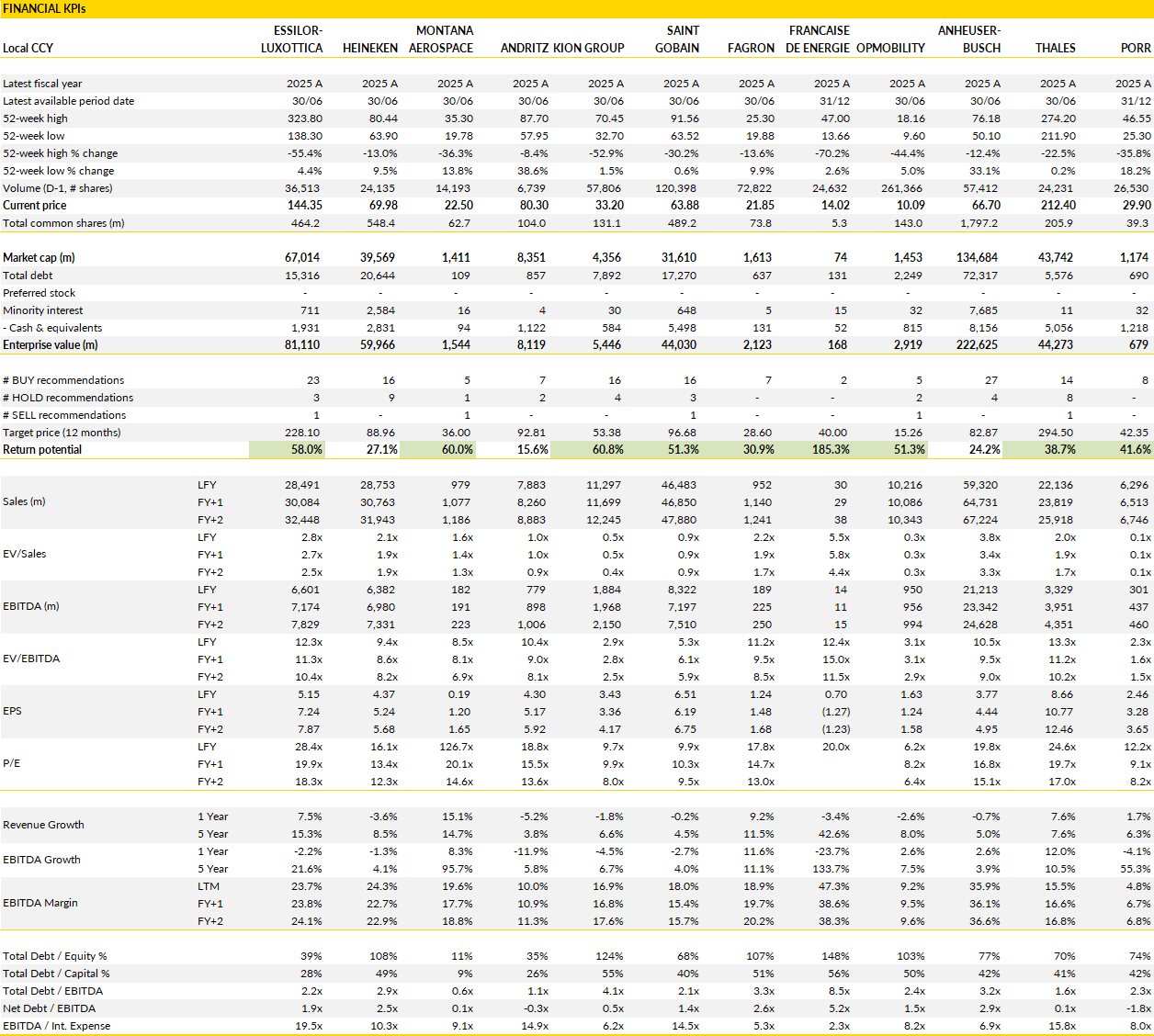
Financial KPIs
Companies covered in this edition: EssilorLuxottica, Heineken, Montana Aerospace, Andritz, KION Group, Saint-Gobain, Fagron, La Française de l'Energie, OPmobility, Anheuser-Busch InBev, Thales, PORR
EssilorLuxottica (EL France): Smart glasses enter a slower phase
EssilorLuxottica is preparing for a marked slowdown in reported growth during the second half as smart glasses begin cycling exceptional demand from late 2025.
The comparison is particularly demanding in Q4, when wholesale revenue rose more than 40% in North America and over 20% in Europe, partly because distributors built inventories. This creates an unusually high base for a category whose quarterly sales have also proved volatile. The rest of EssilorLuxottica's portfolio is behaving much more consistently. Excluding the exceptional contribution from smart glasses, growth has historically been around 4-6% at constant exchange rates including smaller acquisitions, and management saw no deterioration during H1. Q2 was close to the top of that range, and the company expects a similar underlying pace during H2. The slowdown should therefore be concentrated in smart eyewear and its demanding comparisons, with the core lenses, frames and retail activities maintaining their recent trajectory.
Smart glasses remain an attractive growth category, but recent developments suggest a more gradual adoption curve than the initial launch momentum implied. Privacy concerns are one constraint, and EssilorLuxottica has responded by introducing Ray-Ban Meta products without video functionality. The partnership with Meta nevertheless has a strong position in the category outside China, combining established eyewear brands and distribution with Meta's technology.
The important change is that future group growth should become less dependent on exceptionally rapid smart-glasses adoption. That would reduce quarterly volatility and make the underlying performance of EssilorLuxottica's much larger optical business more representative of consolidated growth. It could also be relatively benign for profitability because smart glasses carry a lower margin than the group average. H1 gross margin additionally benefited from almost €90m of tariff-related one-offs, which provides a tougher profitability comparison once those benefits cease, although continued underlying growth should provide some operating leverage.
The recent volatility in smart eyewear does not alter the broader direction, but it changes the pace at which the new category can contribute. After the initial surge and distributor inventory build, demand now needs to develop on a more sustainable consumer replacement and adoption cycle. Meanwhile, the established portfolio continues to deliver growth within its historical range, giving the group a sizeable base that is considerably less dependent on any single product cycle. Smart glasses can still add meaningful incremental sales if adoption broadens, especially as the product range expands to address different consumer preferences, but they no longer need to carry as much of the group's growth. That should produce a more balanced profile after the difficult H2 comparisons have passed.
Heineken (HEIA Netherlands): New CEO inherits uneven growth
Heineken's Q3 trading appears to have remained close to the pace seen in Q2, leaving the new CEO with a business that is growing but still producing uneven results across its major markets.
Asia Pacific has been the strongest region, supported by robust growth and market-share gains in India and Vietnam. Europe also benefited from good summer trading, particularly during July and August, before momentum weakened in September. France, Italy and the UK performed well, whereas conditions remained difficult across Poland and parts of Central and Eastern Europe. Spain had an unusually hot summer that hurt on-premise beer consumption. The Americas were softer. Mexico was broadly flat and the US remained subdued, while Brazil continued to operate against a weak beer market. Easier comparisons, favourable weather and demand for Amstel and Heineken Ultra helped mitigate the pressure there, although further investment is required to rebuild market share.
The result is another quarter without a clear group-wide acceleration despite healthy performance in several important markets.
Conditions across Africa are similarly mixed. Ethiopia continued to perform better than cautious expectations, although renewed unrest in the north creates uncertainty for Q4. Heavy September rainfall weakened Nigeria, and South Africa maintained roughly the growth rate seen in Q2, with beer performing better than wine. Elsewhere in Asia, Cambodia remains difficult, although the ring-pool ban introduced from October could improve the competitive environment in future quarters. China offers longer-term distribution potential for Heineken despite a cautious beer market, but the weaker share price of CR Beer could revive concerns around the carrying value of Heineken's investment after the impairment recorded in 2024.
These regional differences leave market-share development more important than broad category growth. Heineken is gaining ground in several Asian markets and parts of Europe, but Brazil requires additional spending and several mature markets remain soft. Q3 therefore looks more like a continuation of the existing regional pattern than the beginning of a stronger consolidated recovery.
Leadership has now become another element of the outlook, with the new CEO taking office on 1 October. His initial assessment was unusually direct, describing Heineken as neither broken nor currently winning. He has endorsed EverGreen 2030 but sees scope to increase execution speed and strengthen the performance culture, and is visiting key markets before presenting his priorities with the FY 2026 results. Cost discipline will require attention alongside commercial execution. Temporary duplication of expenses and the accounting treatment of IT-related amortisation are increasing overhead pressure, potentially limiting the earnings benefit from underlying revenue growth. Management's 2026 organic operating profit guidance remains 2-6%. The strategic direction is unlikely to change materially after only a few months under new leadership, but the first full-year presentation should clarify where execution can be tightened.
Improving market share in weaker markets and controlling overheads would provide the clearest route to better earnings growth if the current regional demand environment remains broadly unchanged.
Montana Aerospace (AERO Switzerland): Building a larger presence
Montana Aerospace is building a larger presence in space and defence, using its established aerospace manufacturing capabilities to enter programs with attractive growth and profitability prospects. Management is targeting €1.4bn of revenue by 2030, alongside an EBITDA margin above 20%. The planned shift in the business mix is substantial, with defence expected to account for 10% of sales, roughly double its current contribution, and space rising from approximately 10% to 20%. The latter should also help improve group margins.
Potential defence opportunities include components for Lockheed Martin's F-35 program in Germany or Belgium, as well as work linked to Rheinmetall's expansion in Romania following its €5.7bn contract supported by the European SAFE program. These opportunities remain at different stages of development, but they would broaden Montana's customer base beyond commercial aviation. The company already has relationships with major aerospace manufacturers, giving it an industrial foundation for this expansion. Its medium-term targets depend on converting that expertise into additional contracts and increasing production across existing facilities, with space becoming a progressively larger contributor to earnings.
Romania is central to these ambitions. Montana operates two substantial manufacturing sites there, with the 80,000m² Baia Mare Airport facility serving customers and programs linked to Boeing, Spirit and the space industry, while the 42,000m² Dumbravita plant concentrates primarily on Airbus aircraft. The industrial model is unusually integrated, combining subsystem assembly and surface treatment with machining and metal extrusion. Montana has particular expertise in aluminium and belongs to a relatively small group of manufacturers capable of extruding titanium, creating opportunities to increase its share of Airbus-related work. Production capacity can be shifted between programs as demand changes, giving the company flexibility to manage aircraft production schedules and accommodate new space contracts. Aluminium recycling also contributes to efficiency, with recycled material accounting for approximately 30% of the mix.
The Romanian operations are expected to receive €20-25m of investment over the next two years and generate €150-200m in annual revenue by 2030. Group capital expenditure is budgeted at €80-90m, including approximately €50m of maintenance spending. Customer qualification remains a constraint on the speed of expansion, particularly in titanium components, where each individual part requires lengthy approval from the aircraft manufacturer.
Governance is undergoing a transition following the unexpected departure of CEO Kai Arndt for personal reasons. Executive Chairman Michael Tojner has assumed part of the former CEO's responsibilities, with newly appointed COO Christian Preslmyar taking a more direct role in operational execution. The board expects this arrangement to remain in place for two to three years while it identifies a permanent successor.
Montana's decentralised structure should help maintain continuity, as individual subsidiaries already have considerable responsibility for their operations. Tojner has also received an option package covering up to five million shares at market price, increasing his direct financial exposure to the company's development. The management transition comes during an important period of industrial expansion, with qualification cycles, customer diversification and capital allocation all requiring sustained attention.
Montana's vertically integrated facilities provide a competitive advantage in manufacturing flexibility and technical capabilities, but the pace of growth will depend on winning additional contracts and bringing qualified components into serial production. The 2030 objectives appear achievable if commercial aerospace activity remains supportive and the planned expansion into space and defence progresses as management expects.
Andritz (ANDR Austria): Energy supports higher 2029 targets
Andritz has raised its medium-term ambitions, targeting €10bn of revenue and a 9-11% comparable EBITA margin by 2029, with 10% as the midpoint.
Energy infrastructure provides a substantial part of the growth opportunity. Around €3bn, or 36% of current group revenue, already comes from applications linked to electrification, grid stability, storage and power generation. The portfolio includes technologies used in pumped storage and hydropower upgrades, alongside equipment for electrical steel, turbo generators, synchronous condensers and cooling systems. This gives Andritz exposure to investment in both electricity generation and the infrastructure required to manage increasingly complex power grids. Service is another sizeable contributor, accounting for approximately 45% of revenue after growing at an 8% annual rate since 2018. A larger installed base across energy and industrial equipment can expand this recurring activity further, providing a useful counterweight to the project-driven parts of the group.
The 2029 targets also require another step in profitability. Hydropower now has an 8-10% comparable EBITA margin objective, increased from the previous 7-9% range for 2027, and Metals has been lifted to 7-9% from 6-8%. Pulp & Paper retains its 11-13% target, with Environment & Energy aiming for 10-12%. Management plans to reach these levels through productivity improvements, selective adjustments to capacity and greater use of automation, digitalisation and AI, supplemented by organic growth and acquisitions. The broader strategic priorities remain decarbonisation, customer service and digitalisation. Higher service penetration can improve the quality of the revenue mix, and stronger profitability in Hydropower and Metals provides additional scope for group margin expansion.
Current trading gives management a solid base from which to pursue the new targets. Q3 order intake exceeded €2bn, including a mid-triple-digit-million-euro modernisation project in Slovakia, and the company reiterated its 2026 guidance for €8.0-8.3bn of revenue and an 8.7-9.1% comparable EBITA margin. Capital allocation is also unchanged. Andritz intends to distribute 50-60% of net income through a progressive dividend while continuing to fund internal investment and acquisitions. Bolt-on transactions remain the preferred approach, although the balance sheet provides capacity for larger deals if they meet the group's requirements for margins and returns on invested capital.
The 2029 plan consequently combines several existing strengths: a growing service base, established positions in energy infrastructure and further margin improvement within businesses that have already undergone substantial operational work. Reaching €10bn of sales will require sustained expansion over the next three years, but the current order intake and breadth of energy-related demand provide a good foundation.
KION Group (KGX Germany): Margin recovery is taking longer
KION faces a more difficult recovery in profitability as competitive pressure in industrial trucks persists and warehouse automation customers become more cautious about investment.
The immediate concern is Industrial Trucks & Services (ITS), where an unfavourable product mix and pressure on average selling prices are limiting margins despite relatively resilient revenue. Chinese manufacturers are becoming more competitive on both quality and pricing, making it harder for established suppliers to improve profitability through price increases. Factory utilisation is another constraint, particularly if volumes fail to strengthen sufficiently to absorb fixed manufacturing costs. Further adjustments to the cost base may eventually be required.
These conditions create a risk that management will lower its 2026 profitability expectations when KION reports Q3 results on 29 October, even if group revenue remains broadly consistent with its existing guidance. The weakness in ITS appears increasingly persistent, with a recovery in product mix taking longer than previously anticipated. The division still has opportunities to improve efficiency through its manufacturing footprint, including its operations in China, but stronger operating margins will require better capacity utilisation and a more favourable balance between volumes, pricing and costs.
Industrial Automation Solutions (IAS) faces a different challenge. Demand for warehouse automation remains supported by the longer-term adoption of robotics and increasingly sophisticated logistics systems, yet customer investment decisions are sensitive to financing costs and capital expenditure budgets. Higher US interest rates could lead to project delays or reviews, and a possible slowdown in Amazon's investment activity during 2027 adds uncertainty to the near-term order outlook. Management has already indicated that IAS order intake weakened sequentially and that margin development has been disappointing. These developments could delay progress towards the division's 10% margin objective.
The structural opportunity remains substantial, particularly as physical AI expands the capabilities of automated warehouse equipment and makes automation economically attractive across more applications. KION has the engineering expertise and installed customer relationships to participate in that development, although the timing of large projects can create considerable volatility in orders and earnings. IAS therefore has a stronger long-term growth opportunity than current order trends would imply, but achieving higher margins will depend on project execution and a recovery in customer spending.
The combination of slower automation orders and weaker industrial truck margins has made KION's medium-term financial ambitions harder to achieve. Its 10% group margin objective now appears more distant, and management may need to revise the pace of improvement when it provides further guidance. Nevertheless, the business retains several financial and strategic strengths. Cash generation offers capacity to fund acquisitions, while KION's Chinese manufacturing presence gives it opportunities to improve its cost competitiveness against emerging rivals. The group also benefits from exposure to warehouse automation, where technological development should support demand over time even if investment decisions remain uneven. Unlike the automotive industry, industrial trucks face limited disruption from the replacement of an established propulsion technology, although competition from Chinese manufacturers is becoming a more significant challenge. Lower energy costs or easing interest rates could eventually help customer confidence and investment activity, particularly in logistics automation.
For the next few quarters, however, KION needs to stabilise profitability in ITS and demonstrate better margins and order momentum in IAS.
Saint-Gobain (SGO France): Growth softens in Q3
Saint-Gobain is heading into its Q3 update with end markets still subdued and less support from volumes than it enjoyed in the previous quarter.
The regional picture remains uneven. Asia-Pacific continues to benefit from healthy domestic demand and growing adoption of the group's construction solutions, whereas activity in the Americas is much softer. US new residential construction remains constrained by high interest rates, and the absence of weather-related rebuilding demand provides an additional drag. Latin America is seeing some hesitation ahead of the Brazilian elections. Conditions across Europe offer limited relief. The UK construction market remains weak, Germany is still reducing lower-quality activity under its shrink-to-grow approach, and unusually hot summer weather temporarily disrupted parts of Southern Europe. Against this backdrop, pricing is expected to account for a larger share of growth than volumes during Q3, reversing some of the improvement in the mix seen earlier in the year.
Profitability has held up considerably better than construction activity, reflecting the changes Saint-Gobain has made to its portfolio and operating model over recent years. Management continues to target an EBITDA margin above 15% for 2026 after reaching 15.5% in 2025, equivalent to an operating margin of at least 11%. Maintaining the balance between selling prices and input costs remains central to achieving that objective. The first half was complicated by adverse weather across both North America and Europe, and Q3 brings a different set of constraints through weak new-build markets and temporary weather disruption in Southern Europe. Germany's ongoing restructuring should help protect returns as activity is reduced in less attractive areas. More broadly, Saint-Gobain has demonstrated an ability to defend margins despite relatively weak volumes, making pricing discipline and cost control more relevant to 2026 earnings than a near-term construction recovery.
The Q3 release on 27 October should therefore be judged primarily on whether the current margin framework remains intact and how management sees volumes developing into year-end. The company is unlikely to alter its 2026 guidance at this stage. Asia-Pacific remains the clearest source of organic expansion, but its growth is not yet enough to offset the absence of momentum in several larger construction markets. Europe could improve as temporary summer effects fade, although the UK and Germany still face structural or cyclical constraints, and a meaningful US residential recovery remains tied to financing conditions.
Saint-Gobain consequently entered Q4 with limited help from its markets but with profitability proving resilient. Continued control of the price-cost equation would allow the group to preserve an EBITDA margin above 15% even if volumes remain modest, leaving a future recovery in construction activity as additional earnings leverage once conditions eventually improve.
Fagron (FAGR Belgium): North American recovery coming close
Fagron's Q3 results showed healthy demand across most of its businesses, with the ongoing disruption to North American Compounding Services masking much stronger underlying growth.
Group revenue reached €281.3m, with organic growth of 3.4% at constant exchange rates. Essentials grew 10.6% and Brands increased 8.3%, demonstrating that demand for Fagron's broader portfolio remains robust. Compounding Services, however, declined 5.0% organically as the industry-wide IV-bag recall continued to restrict production in North America. The regional figures illustrate how concentrated the problem has become. North America-Pacific reported a 2.8% organic revenue decline, entirely attributable to the 12.9% contraction in Compounding Services. Elsewhere, Essentials expanded 28.8% and Brands grew 16.1%. The disruption is estimated to have reduced quarterly revenue by €10-15m, suggesting that underlying group organic growth would otherwise have been in the high single digits. With inventories now rebuilding, management expects North American compounding volumes to recover progressively during Q4.
The performance outside North America was encouraging, particularly given the strength of the comparison base in several activities. Latin America generated €69.0m of revenue and organic growth of 9.7%, helped by commercial momentum following the Consulfarma event and an 11.9% increase in Essentials. EMEA contributed €113.1m of sales, with organic growth reaching 6.5%. Compounding Services was particularly strong in the region, expanding 13.3% and demonstrating that the weakness in the same activity in North America is linked to supply constraints instead of a broader deterioration in demand.
This geographic contrast is important because Fagron's strategy increasingly relies on combining its established ingredients and branded products with more specialised compounding capabilities. Growth across the portfolio also suggests that the company is benefiting from its distribution network and commercial reach, even where individual production activities encounter temporary constraints. The regional diversification has helped absorb the North American shortfall without materially changing the group's full-year outlook.
Management reiterated its 2026 revenue guidance of €1,125-1,150m and adjusted EBITDA margin target of 19.5-20.0%, reflecting confidence that the IV-bag situation will gradually improve. The recovery is already supported by rising inventories, although the timing of normal production volumes remains relevant for the final quarter. Fagron has maintained growth in its other North American activities throughout the disruption, providing a stronger starting point once Compounding Services returns to normal.
The company will also host its next CMD in October 2027 at its FSS facility in Kansas, where investors should receive a more detailed view of the development of its North American manufacturing and compounding operations. For now, the operating performance is healthier than the headline organic growth figure indicates. Strong demand across EMEA and Latin America, combined with double-digit growth in several product categories, has allowed Fagron to maintain its financial objectives despite a meaningful interruption in one business.
La Française de l'Energie (FDE France): Hedging losses force a reset
La Française de l'Energie is reshaping its strategy around cash generation after its gas over-hedging created a much larger financial exposure than initially recognised.
By the end of September, cumulative realised losses had reached €7.6m, up from €3.8m three months earlier, while the remaining positions carried an unrealised loss of €25.8m based on a TTF spot price of €73/MWh and the prevailing 2026-2027 forward curve. The final cost remains uncertain because FDE is gradually unwinding the excess positions and continues discussions with its counterparty. Gas prices and the speed at which the exposure can be reduced will therefore determine how much of the current mark-to-market loss ultimately becomes cash outflow. Importantly, the problem sits within the hedging book rather than the operating assets. Mine-gas production continues to ramp up and Romerike has reached profitability, with annual revenue expected to exceed €5m. The immediate challenge is preserving enough liquidity to absorb the hedging losses without constraining the development of those cash-generating operations.
Capital allocation is being tightened accordingly. FDE is prioritising mine gas and biogas, where cash flows are more predictable, and postponing projects that require substantial funding before contracted revenues are secured. The Agder green hydrogen development has been pushed back by two years while the company seeks an offtake agreement that can underpin both financing and future revenue. In Norway, several non-core assets are being prepared for disposal, including the solar activities, and FDE is considering an offer of more than €2m for an industrial site.
The company is also increasing its use of project finance, reducing structural costs and accelerating cash collection. Liquidity has received some support from €2m of grants in September and an additional €10m Green Bond tranche, while management aims to raise another €10m before the end of 2026. These measures should reduce the amount of corporate cash committed to expansion while the hedge exposure is being resolved.
The strategic reset also makes the previous 2030 objectives of more than €175m of revenue and €85m of EBITDA obsolete. Management will replace them with a 2032 roadmap incorporating explicit commodity-price assumptions and revised operational milestones. That should provide a more realistic framework after a period in which project ambitions expanded faster than the group's financial capacity.
The next phase will depend on resolving the hedge book, completing non-core disposals and demonstrating that the remaining operations can finance a larger share of their own development. Governance is also being strengthened following the hedging incident. FDE still owns operating assets whose underlying performance has not been impaired by the trading losses, but preserving that value now requires a more conservative approach to liquidity and project selection. Progress at Romerike and mine gas can gradually rebuild the earnings base, while larger developments can resume once long-term contracts and project financing substantially reduce the cash commitment required from the group.
OPmobility (OPM France): Restructuring accelerates after profit warning
OPmobility has cut its 2026 financial targets substantially as weaker automotive production and persistent input-cost inflation put further pressure on profitability.
The company now expects an operating margin of €430-450m, down from approximately €500m previously, while its free cash flow objective has been reduced from €297m to more than €220m. The deterioration reflects several problems affecting the automotive supplier industry. Production schedules have weakened at major European manufacturers, including Volkswagen, Renault and Stellantis, while North American customers are also adjusting output. Chinese light vehicle production expectations have been revised downward, adding pressure in a market that had previously provided stronger growth opportunities. Meanwhile, higher prices for electronic components and resins have yet to be fully recovered from customers. Automotive suppliers have struggled to pass through inflation because manufacturers themselves face weak demand and intense pricing competition. OPmobility's revised guidance indicates that the combination of lower factory utilisation and unrecovered costs has become increasingly difficult to absorb, even with the operational improvements already undertaken.
Management is responding with a more extensive restructuring of its European operations, where the underlying automotive market is expected to remain weak for an extended period. Approximately 770 positions will be eliminated, equivalent to around 8% of the group's Western European workforce. The measures include a possible closure of the Sterbfritz manufacturing facility in Germany and capacity adjustments at a French plant. OPmobility also intends to consolidate research and development activities in France, particularly within Powertrain, where declining investment in internal combustion engine programs and limited commercial opportunities in hydrogen have reduced the need for existing resources.
The restructuring will cost an estimated €120-130m, creating an additional near-term financial burden, but should allow the company to operate with a smaller fixed-cost base. These changes address a structural problem in the European supplier industry, where production capacity and engineering resources were built for volumes and technology programs that are proving difficult to sustain. Reducing that exposure should improve OPmobility's ability to protect margins even if European vehicle production remains subdued.
The profit warning has not altered the group's broader strategic priorities. Cash generation, debt reduction and financial discipline remain central, alongside selective expansion in markets offering better growth prospects. North America and Asia are expected to receive a greater share of future investment, including potential acquisitions such as the previously discussed Mobis opportunity. OPmobility is therefore continuing to reshape its geographic and product exposure while reducing the cost of its established European operations. The decision to undertake substantial restructuring while maintaining a positive free cash flow target also gives management some flexibility to finance the transition without abandoning deleveraging.
Nevertheless, the revised outlook demonstrates how difficult the current environment has become for suppliers exposed to traditional vehicle production. Cost recovery from manufacturers remains incomplete, regulatory uncertainty complicates long-term investment decisions, and weaker volumes are reducing operating leverage.
Anheuser-Busch InBev (ABI Belgium): Higher costs temper Q3 growth
AB InBev should remain within its 2026 growth framework after Q3, although higher commercial and distribution spending is likely to hold back EBITDA relative to revenue. FIFA-related marketing and promotional activity remained elevated during the quarter, and diesel prices are increasing distribution costs. Group cost inflation otherwise remains relatively normal, with management expecting cost of goods per hectolitre to broadly track general inflation across 2026. The company continues to guide for 4-8% EBITDA growth for the full year. FIFA itself provides some incremental volume, but much of the benefit was concentrated in Q2, whereas associated spending extends into Q3. Non-allocated expenses are also normalising from an unusually low level a year ago. The resulting margin pressure should therefore have a significant temporary component, with the underlying business still benefiting from pricing and modest volume growth.
Geographically, Europe is performing relatively well, with industry data indicating higher volumes despite additional FIFA-related marketing and distribution expenditure. Brazil has also improved against a particularly weak comparison, helped by better summer beer demand, although September was less consistent. Conditions remain much harder in China, where poor weather has continued and management expects distributors to reduce inventories during the second half. The US beer market is weak as well, but AB InBev continues to perform better than the broader category even as its own volumes remain under pressure. Mexico faces subdued consumer demand, though the comparison becomes somewhat easier after Q2. Elsewhere, South Africa is cycling a demanding prior-year period, while Nigeria benefits from a softer base. Argentina remains constrained by consumer pressure with inflation still above 30%. The portfolio consequently contains enough stronger markets to offset much of the weakness, but there is no broad-based volume acceleration heading into the final quarter.
Capital returns and deleveraging remain important parts of AB InBev's financial model. Continued balance-sheet improvement gives the company greater capacity to return cash through dividends and buybacks without abandoning debt reduction. An interim dividend could also increase from last year's level as cash generation and leverage improve.
Operationally, the main issue for the remainder of 2026 is whether current cost pressure begins to ease once the exceptional FIFA spending passes. China remains a more persistent concern because destocking compounds already weak underlying demand, while the US and Mexico still lack a clear volume recovery. Brazil offers a better comparison base and Europe continues to provide some support.
Against that mixed backdrop, maintaining EBITDA growth within the 4-8% annual target would demonstrate that AB InBev can absorb elevated commercial spending and weak beer demand in several large markets while continuing to strengthen the balance sheet and increase cash returns.
Thales (HO France): Defence growth remains strong
Thales is benefiting from sustained defence spending, with demand for its equipment remaining strong despite difficult comparisons with last year. The company enters its Q3 update on 22 October with commercial activity holding up across its businesses, and defence offers the greatest potential for further growth.
Management currently expects low-double-digit expansion in the division for 2026, supported by military procurement programs and increasing demand for equipment that can be delivered relatively quickly. Heightened tensions in the Middle East could lead to additional urgent orders, particularly for air defence and surveillance systems. Romania has already placed an order for GM200 radars, illustrating the continued demand for capabilities that can strengthen national airspace protection. The cancellation of the F126 naval contract creates a revenue shortfall of approximately €60m, but the broader defence portfolio appears strong enough to absorb the setback. Thales is also benefiting from a favourable mix of sophisticated electronic systems, where technological expertise and long-standing customer relationships create substantial barriers to entry.
Growth is becoming more balanced as conditions improve in activities outside defence. Space has begun to recover, helped by renewed investment in satellite infrastructure and the initial €500m tranche of the contract awarded to Thales Alenia Space for payloads serving Eutelsat's 330 IRIS² satellites. This provides a substantial industrial program at a time when the European space industry is rebuilding its order pipeline. Aerospace should also benefit from original equipment deliveries, although avionics aftermarket activity faces a tougher comparison after strong growth last year and some moderation in flight hours. Cybersecurity is gradually recovering, with demand improving after a more difficult period, while the digital identity and payments businesses remain under pressure.
Management expects those latter activities to improve in Q4. The combination of a stronger space business and improving cybersecurity demand would broaden Thales' growth beyond military equipment, reducing its dependence on any single division. The recovery is still uneven, particularly within Digital, but commercial momentum across the group appears sufficiently healthy to sustain organic expansion.
Order intake remains an important indicator of how much of the current defence spending cycle Thales can convert into future revenue. Management has reiterated that commercial activity remains solid across its divisions and continues to target a full-year book-to-bill ratio above 1.1x. That would allow the backlog to expand even as production and deliveries increase. The group's exposure to radar, defence electronics and secure communications also provides opportunities to benefit from additional European procurement and urgent requirements in other regions.
At the same time, execution in space and cybersecurity will determine whether the improving business mix translates into more consistent growth across the company. Thales has a record of strong cash generation and an established portfolio of technically demanding products, giving it capacity to invest in development while meeting customer delivery schedules.
PORR (POS Austria): Order momentum improves after a weak Q2
PORR has seen a recovery in commercial activity over the summer, providing greater confidence in its ability to meet its 2026 financial targets after a relatively subdued second quarter.
The company booked approximately €650m of additional contracts during July and August, indicating that order intake has strengthened alongside construction output. Management reiterated its full-year guidance for output growth of 2-4% and an EBIT margin of 3.2-3.3%. The second half will need to deliver a stronger contribution after broadly flat output in H1, although the improvement in orders suggests that activity is moving in the right direction. Profitability should also benefit from measures already taken to contain inflation. Energy requirements are partly covered through forward purchasing, while contractual escalation mechanisms allow PORR to recover increases in personnel and material costs. Management has also addressed inflation in overhead expenses. These protections should help preserve margins as construction volumes increase, although stronger activity may temporarily absorb additional working capital. The combination of better order intake and relatively stable cost conditions provide a solid base for the rest of the year.
Infrastructure opportunities across Central and Eastern Europe remain substantial. Poland has an active tender pipeline of approximately €4.5bn, from which PORR expects to secure €400-500m of additional projects. In Romania, the company is the preferred bidder for a €550m road construction contract, although final signing depends on the formation of a new government. Germany is another important source of potential growth, with infrastructure tenders worth approximately €1.5bn expected to begin from October. Management considers a success rate of 20-25% achievable, which could contribute meaningfully to the order book early next year. PORR is also evaluating a selective entry into Hungary, where the release of previously frozen EU funding could stimulate construction investment. Such an expansion could be managed through its existing Austrian or Romanian operations. These opportunities reflect the group's established expertise in infrastructure construction and its ability to compete for large public-sector projects across several markets. Contract awards will inevitably be uneven from quarter to quarter, but the breadth of the tender pipeline provides opportunities to replenish the backlog and support activity beyond 2026.
Acquisitions remain another avenue for expansion following PORR's recent €150m hybrid convertible issue, which carries a 2.75% coupon and a conversion price of €42.90. Management has identified potential transactions in Germany that could extend its geographic coverage or add capabilities along the construction value chain. The additional financing provides flexibility to pursue these opportunities while continuing to invest in existing operations. PORR's relationship with UBM Development also remains strategically relevant, particularly for the development of modular residential construction. The group recently subscribed €56m of participation capital in UBM at a 9% coupon and has acquired interests in several related subsidiaries, strengthening the operational and financial links between the companies. This relationship offers a route into industrialised residential construction, although the associated capital commitments and related-party transactions warrant continued attention.
For the near term, PORR's priorities remain the conversion of infrastructure tenders into contracts, the management of working capital and delivery of its existing margin guidance. The improvement in summer trading is encouraging after Q2, and successful project awards across its core markets would provide a stronger foundation for growth into 2027.