
Jet engines, CDMOs and catalysts
MTU Aero Engines, ASML, Airbus, BASF, SES, Schaeffler, Bossard, Lufthansa, Lonza, AT&S
At Lux Opes, we break down companies into quick takes that get straight to the point - what is happening, why it matters, and what to watch next. We publish 2-3 times per week, depending on the news flow.
For the best reading experience, we recommend reading at Lux Opes
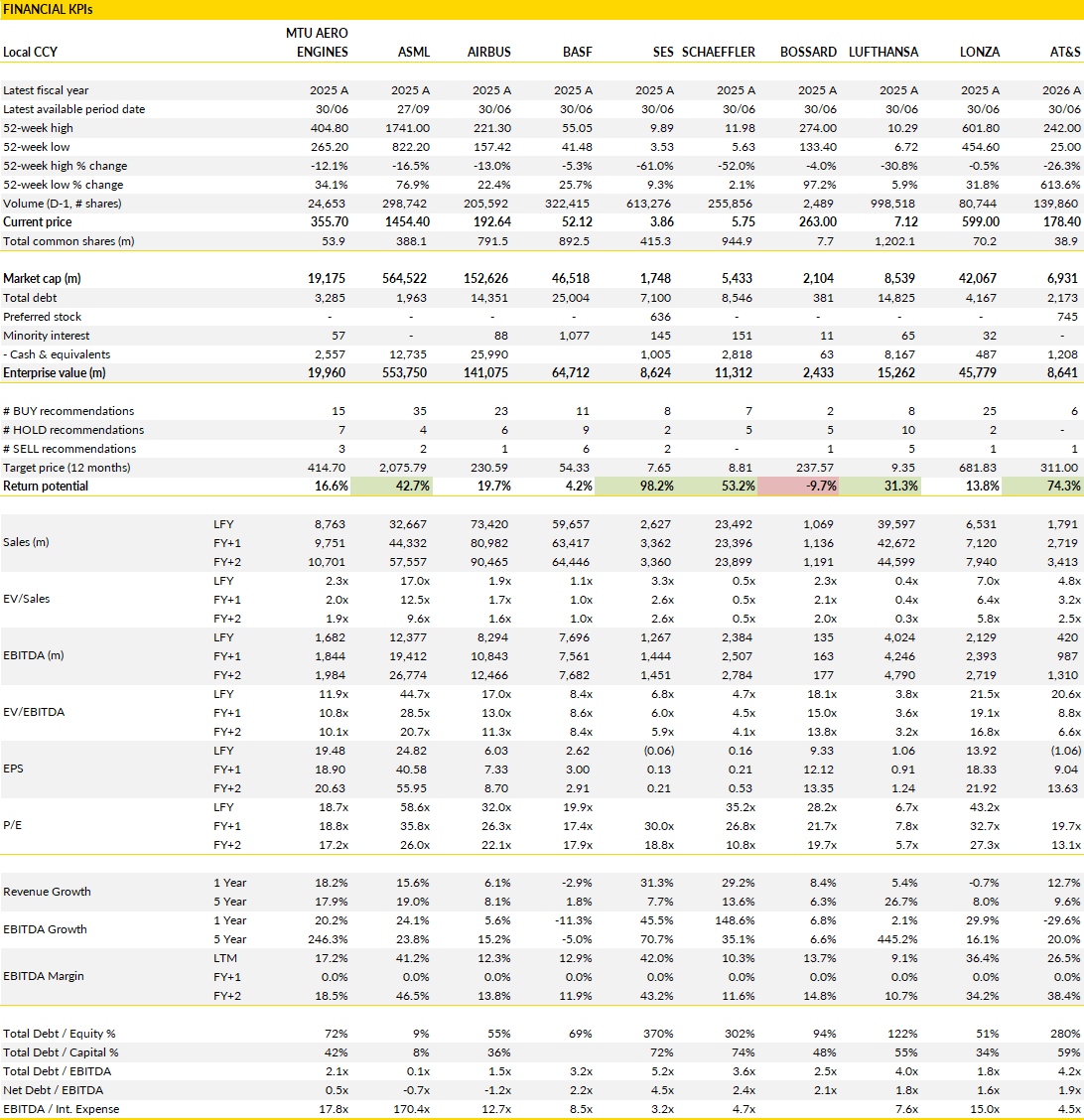
Financial KPIs
Companies covered in this edition: MTU Aero Engines, ASML, Airbus, BASF, SES, Schaeffler, Bossard, Lufthansa, Lonza, AT&S
MTU Aero Engines (MTX Germany): Engine deliveries accelerate
MTU Aero Engines is looking to an improving outlook for original equipment deliveries, supported by higher production of Pratt & Whitney's geared turbofan (GTF) engines for Airbus.
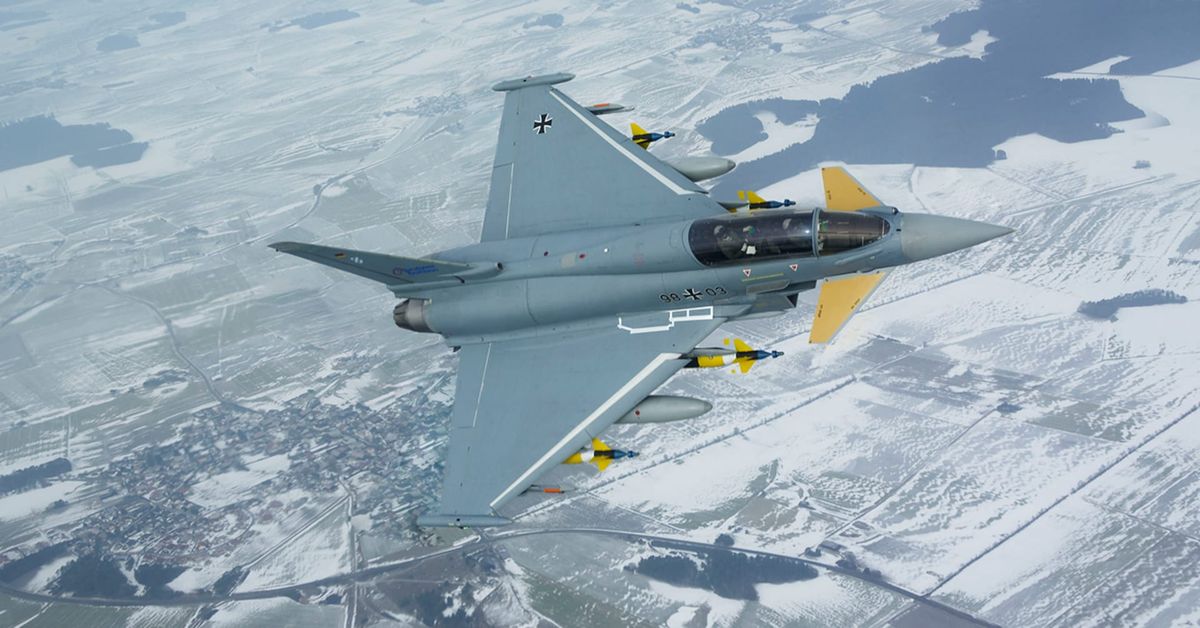
The increase in new engine shipments should strengthen revenue growth, although it will also affect profitability because original equipment typically generates lower margins than spare parts and other aftermarket activities. MTU's OEM division has benefited from an unusually favourable earnings mix, supported by demand for replacement engines and components associated with the GTF fleet inspection program. As deliveries of new engines accelerate, the contribution from these higher-margin activities is expected to become less pronounced. The aftermarket remains healthy, with airlines continuing to purchase spare parts to maintain their existing fleets and protect operational capacity. Some customers have also brought forward purchases to secure component availability, supporting near-term demand. Maintenance activity is expanding, although the exceptional growth recorded during the first half included a temporary benefit from changes in workshop activity. Defence provides another source of revenue, with deliveries of the T408 helicopter engine and EJ200 fighter engine supporting production.
The recovery of the GTF fleet is becoming more and more important for MTU's medium-term earnings profile. Pratt & Whitney has been working through a substantial engine inspection and maintenance program, which has disrupted airline operations but also generated additional aftermarket activity for its industrial partners. Progress in returning aircraft to service should gradually normalise maintenance requirements and improve the availability of engines across the installed fleet. At its recent capital markets day, Wizz Air indicated that Pratt & Whitney had committed to returning all its grounded aircraft to service by the end of calendar 2027, with the number of engines receiving operational support expected to remain stable compared with 2026. This suggests that the exceptional maintenance burden associated with the GTF problems could become more manageable over the coming year.
However, the recovery also has consequences for MTU's older engine programs. Utilisation of the V2500 fleet has declined as airlines bring newer GTF-powered aircraft back into operation and adjust capacity in response to elevated fuel costs. V2500 flight hours have fallen approximately 13% since the beginning of the year, compared with a 7% decline for CFM engines. Lower utilisation could gradually reduce demand for spare parts and maintenance on older aircraft, partly offsetting the benefits of continued GTF-related activity.
The changing aftermarket mix creates a more complicated earnings outlook for 2027, even as aircraft manufacturers increase production. MTU should benefit from the continued expansion of the GTF installed base and its long-standing participation in the engine program, while the return of grounded aircraft could reduce operational disruption for airline customers. However, a higher proportion of new engine deliveries and slower growth in spare parts may constrain margin development. Defence revenue could also face a demanding comparison following strong contributions from the Future Combat Air System development program.
Cash generation will remain an important measure of operational progress, particularly as the company balances higher production volumes with the working capital requirements of its maintenance activities. MTU's competitive position remains supported by its engineering expertise, manufacturing partnerships and substantial exposure to the global commercial aircraft fleet. The transition towards a more normal GTF operating environment should improve the stability of its activities, although the associated shift in revenue mix will influence profitability.
Management's capital markets day in Munich on 30 November should provide further detail on production expectations, aftermarket demand and the (financial) implications of the GTF recovery. The central operational challenge is converting higher engine volumes into sustainable earnings and cash flow as the unusually strong contribution from certain aftermarket activities begins to moderate.
ASML (ASML Netherlands): Semiconductor capacity shortages extend growth even more
ASML delivered a strong third quarter, with revenue reaching €11.7bn and gross margin expanding to 57.5%, exceeding the company's previous margin guidance of 55-57%. This improvement was supported by exceptionally strong demand for productivity upgrades across its installed equipment base. Service and upgrade revenue reached €3.3bn, increasing 19% sequentially and substantially exceeding management's earlier expectation of approximately €2.9bn.
Semiconductor manufacturers are seeking to extract more output from existing production lines as demand for advanced computing capacity continues to increase. Equipment sales also accelerated, rising 27% from the previous quarter to €8.4bn, with 121 lithography systems delivered, including 17 extreme ultraviolet (EUV) machines. Logic customers represented 54% of system sales, with memory manufacturers accounting for the remaining 46%, indicating substantial investment across both major semiconductor segments. Taiwan and South Korea accounted for the largest geographic contributions, at 32% and 31% respectively, followed by China at 23% and the US at 13%. The higher Chinese contribution reflected a shift in the regional sales mix, although management continues to expect China to represent approximately 20% of annual revenue. Reported earnings per share reached €12.95, including a €500m revaluation gain on ASML's investment in Mistral AI. Excluding this non-operating contribution, underlying earnings remained strong, supported by equipment deliveries and the higher-margin installed base business.
Management has strengthened its full-year outlook following the Q3 performance. Revenue for 2026 is now expected to reach €44-45bn, compared with the previous range of €43-45bn, while the gross margin is expected to finish near 56%, at the upper end of the earlier guidance. The fourth quarter should deliver revenue of €14.2-15.2bn, including approximately €3.7bn from installed base management, with a gross margin of around 57%. For the full year, ASML expects installed base revenue to grow approximately 50%, a substantial increase from its previous expectation of more than 30%.
EUV revenue should expand by over 45%, supported by shipments of approximately 65 systems, representing a 50% increase in unit deliveries. Non-EUV equipment is expected to grow around 20%, slightly below management's earlier indication of approximately 25%. The shift reflects differences in customer investment schedules and equipment mix, but demand for advanced lithography remains exceptionally strong. ASML has also completed discussions with its major customers on value-based pricing, with the financial benefits expected to begin in 2027 and become fully reflected in revenue from 2028 onwards. These agreements should allow the company to capture a greater share of the productivity improvements delivered by its technology, supporting profitability alongside rising equipment volumes.
The longer-term demand environment has strengthened considerably, with customers increasingly planning capacity investments several years ahead. ASML reports that its major clients expect semiconductor supply to remain insufficient to meet demand through at least 2028. Orders are already being placed for equipment deliveries in that year, while some customers are seeking commitments extending into 2029 and 2030. This creates pressure on ASML to expand its own manufacturing capacity beyond existing plans. The company is targeting a 30% capacity increase in 2027 and examining another 30% expansion in 2028, particularly for EUV low-numerical-aperture systems and deep ultraviolet immersion equipment.
Management now believes these additions may still be insufficient, prompting further work on production expansion and equipment productivity. The NXE:3800F, scheduled for limited introduction in 2027, is designed to process approximately 260 wafers per hour compared with around 230 currently, while new immersion tools are expected to reach 330 wafers per hour. Higher throughput allows semiconductor manufacturers to expand effective capacity without increasing their installed equipment base proportionately.
ASML's technological leadership, extensive installed base and customer relationships provide a strong base for continued growth, but meeting the industry's expanding requirements will demand substantial operational execution.
Airbus (AIR France): Delivery recovery keeps annual targets within reach
Airbus is heading for a weaker third quarter after aircraft deliveries fell short of expectations, with the main pressure coming from its commercial aircraft business.
The company will report its results on 28 October, and the lower delivery volumes are likely to weigh on revenue, margins and cash generation. Commercial Aircraft has been affected by a less favourable aircraft mix, including fewer A330 and A320 family deliveries, alongside higher research and development spending. Quality issues during the quarter have added costs, while the integration of manufacturing activities acquired from Spirit AeroSystems is creating further operational pressure. Helicopters is also expected to report weaker profitability because of an unfavourable product mix. Defence & Space should perform better, continuing the recovery seen earlier in the year, but its earnings growth is likely to slow compared with the first half. Cash flow will also be under pressure as Airbus builds inventory ahead of a particularly busy final quarter and deals with delayed A330 deliveries. These developments reflect the difficulties of increasing aircraft production across a supply chain that is still struggling with capacity constraints and inconsistent component deliveries. The weaker quarter is therefore disappointing, but it doesn't necessarily indicate any deterioration in underlying demand for Airbus aircraft.
Management remains confident that Airbus can deliver 870 commercial aircraft in 2026, despite the slower pace during the first nine months. Lars Wagner, CEO of Airbus Commercial, recently confirmed that every aircraft needed to reach this target has already entered final assembly. That is an encouraging indication of production progress, but completing the aircraft and handing them over to customers will still require a substantial effort before year-end. Airbus currently has 68 aircraft that have completed their maiden flights but have yet to be delivered, including 31 A321s, nine A350s and 20 A320s. More than half are intended for Asian customers, where delivery schedules can also depend on airline acceptance procedures and regulatory requirements.
The company is preparing for a very busy fourth quarter, with approximately 37% of annual commercial aircraft deliveries expected during the final three months. A similar proportion of annual revenue is also expected in Q4, making the year-end delivery performance particularly important for profitability and cash flow. The annual target includes approximately 650 A320 family aircraft, which remain central to Airbus's production plans. The growing number of completed aircraft awaiting delivery suggests that manufacturing activity is picking up, but the company still needs to convert this inventory into customer handovers. Any further disruption involving suppliers, quality inspections or certification procedures could make the final quarter more difficult.
Beyond the near term delivery challenges, the longer-term outlook remains supported by strong demand for both narrowbody and widebody aircraft. One particularly interesting development is management's growing confidence in the A350 production program. Wagner recently suggested that production could eventually exceed the existing target of 12 aircraft per month in 2028, reflecting the strength of airline demand for long-haul capacity. Higher production rates would allow Airbus to spread manufacturing costs across more aircraft, improve margins and benefit from the pricing power that comes with limited industry supply. The A350 also offers attractive opportunities as airlines replace older widebody fleets with more fuel-efficient aircraft.
At the same time, the A320 family remains the backbone of Airbus's commercial business, with its large order backlog supporting production for years ahead. Turning that demand into stronger earnings will depend on improving manufacturing efficiency, stabilising suppliers and reducing the number of aircraft held in inventory before delivery. The integration of Spirit's activities should eventually give Airbus greater control over important parts of its supply chain, but it will take time before the operational benefits become clear. Currency movements remain another consideration, particularly given the company's substantial dollar exposure, although its hedging arrangements limit the immediate earnings impact.
BASF (BAS Germany): More Evonik speculation
BASF's potential acquisition of Evonik remains under consideration following (more) reports that the company is prepared to reopen discussions with Evonik's management and address concerns raised by employee representatives.
Evonik previously rejected an indicative offer of €22.15 per share, leaving a substantial gap between the two companies before formal negotiations can progress. Recent newspaper reports suggest that BASF is willing to preserve Evonik's German employment guarantees through 2032, which protect employees against compulsory redundancies without compensation. This would extend beyond the employment protections currently in place at BASF's Ludwigshafen complex, which run until 2028. BASF is also reportedly seeking to avoid closing Evonik production sites, with efficiency improvements expected to come from operations across both businesses. Such commitments could help secure support from employee representatives, although they would also limit the scope for conventional restructuring savings.
The industrial rationale here rests on opportunities to improve purchasing, production efficiency, infrastructure utilisation and administrative functions across two major German chemical groups. BASF's willingness to discuss these conditions suggests that management sees sufficient strategic value in a combination to accommodate some of the political and labour considerations surrounding a transaction.
The position of RAG Stiftung, Evonik's largest shareholder with a 43.8% stake, could prove decisive. According to German press reports, the foundation's supervisory bodies discussed BASF's approach last week without rejecting the possibility of a transaction. RAG has been seeking to diversify its approximately €16bn investment portfolio, in which Evonik remains its largest individual holding, representing around 27% of assets. A sale could accelerate that diversification and reduce the foundation's exposure to the cyclical chemicals industry.
However, the absence of a rejection does not constitute formal support, and the foundation has yet to disclose a definitive position on the proposed combination. Its willingness to consider the transaction could nevertheless encourage Evonik's management to return to negotiations. BASF would still need to agree on an acceptable purchase price and establish a credible integration plan, particularly given the employment commitments under discussion. There may also be opportunities to reassess certain portfolio transactions if the acquisition proceeds. These include Evonik's Syneqt industrial park services business and BASF's proposed disposal of Oxeno. Retaining selected activities could preserve infrastructure capabilities or create additional operational benefits within a combined group, although no decisions have been announced.
Financing the acquisition without undermining BASF's existing shareholder return commitments is another important consideration. Handelsblatt reports that BASF intends to maintain its dividend policy, including a minimum annual payment of €2.25 per share, alongside its share repurchase program. The company has an additional €1.5bn repurchase budget beyond the €1bn program already underway. Its financial flexibility has improved following the completion of major investment spending at the new Chinese Verbund complex and progress in monetising non-core assets, including the disposal of a majority interest in Coatings. Net financial debt relative to EBITDA stood at 2.8x at the end of 2025, reflecting the earlier investment cycle.
An Evonik acquisition would increase indebtedness again, making subsequent asset monetisation particularly important. BASF's planned minority flotation of Agricultural Solutions in 2027 could provide a substantial source of proceeds, with a potential transaction generating several billion euros depending on the valuation and size of the stake sold. The company would also need to demonstrate that integration savings and cash generation can support both debt reduction and shareholder distributions.
At the moment, the reported willingness of RAG Stiftung to consider a sale and BASF's efforts to address employment concerns have improved the prospects for renewed negotiations.
SES (SESG France): Spectrum proceeds could ease financial pressure
SES has several potential catalysts over the coming months following a difficult period for the satellite operator. Its shares have fallen approximately 50% over the past three months, reflecting concerns about weak operating performance, debt levels and growing competition in satellite communications.
One of the most significant developments could be the early monetisation of the company's future US C-band spectrum proceeds. SES expects to receive approximately $5.6bn in gross payments for clearing spectrum by 2030-2031, although taxes and payments to other eligible parties will reduce the amount available to the company. The net proceeds could reach approximately €3.1bn, providing a substantial source of cash relative to its current financial obligations. SES may decide to sell or finance these future receivables through a financial partner, allowing it to receive much of the money several years before the scheduled payments. Such a transaction would involve a financing cost, but it could help address concerns about upcoming debt maturities and the sustainability of shareholder distributions. The timing will depend partly on the US spectrum auction process, currently expected between April and July 2027. An agreement ahead of the final spectrum payments could give SES greater financial flexibility while it works through the integration of Intelsat and adjusts its business to a more competitive market.
Operating performance could also improve after a particularly weak first half of 2026. Revenue declined 5% on a comparable basis during H1, with the contraction accelerating to 13% in the second quarter. EBITDA fell 6% over the first six months and 17% in Q2, showing the pressure on profitability from weaker activity and the company's changing business mix. The second half should benefit from new business in aviation connectivity and contracts with the US Space Force, alongside easier comparisons in the traditional media segment. Currency movements may also become more favourable.
Another important factor is the integration of Intelsat, which gives SES a much larger satellite network and creates opportunities to eliminate overlapping costs. The planned merger savings are substantial, with the full benefit equivalent to approximately 14% of the combined group's pro forma EBITDA. These savings should build through 2027 as SES combines infrastructure, simplifies operations and removes duplicated functions. The company therefore has several ways to improve earnings even if underlying market growth remains modest. However, the decline in Q2 demonstrates that SES still faces considerable commercial pressure, particularly in established satellite services where customers are changing their distribution and connectivity requirements. A recovery in EBITDA would help stabilise cash generation, but the company will need to demonstrate that new contracts and integration savings can offset the weakness in its traditional activities.
Management is expected to provide more detail on its longer-term strategy at the Capital Markets Day scheduled for 9 December 2026. One possible development is greater vertical integration, with SES reportedly building manufacturing capabilities for satellite payloads. Producing more of its own technology could improve control over equipment costs, product development and the deployment of new services. The company may also expand its commercial offering beyond conventional satellite capacity, using the combined SES and Intelsat networks to provide more integrated connectivity solutions. These initiatives could strengthen customer relationships in government communications, aviation and other specialist markets where service quality and network reliability remain important.
Nevertheless, the competitive environment is becoming more demanding. Starlink, Amazon Leo, Telesat and several Chinese operators are investing heavily in new satellite constellations, creating the risk that industry capacity grows faster than demand. SES may benefit from European governments seeking secure communications infrastructure and alternatives to US-controlled networks, but public-sector demand alone may not absorb the additional capacity entering the market.
So the near-term outlook depends heavily on financial and operational execution. Early access to C-band proceeds could reduce balance sheet concerns, while stronger earnings and Intelsat cost savings would help rebuild confidence in the business. The December strategy presentation should clarify how SES intends to compete in a market where satellite capacity is becoming more abundant and customers have more choices.
Schaeffler (SHA0 Germany): Further restructuring targets weaker EV demand
Schaeffler's preliminary third-quarter results show that profitability and cash generation have held up reasonably well despite continued pressure on the automotive supply industry.
Revenue was broadly unchanged year-on-year at approximately €5.8bn, reflecting a difficult operating environment in which manufacturers remain cautious about production volumes and new vehicle programs. Adjusted EBIT declined around 7% to €245m, with the corresponding margin falling 30 basis points to 4.2%. The decline was relatively contained given the weakness in several end markets, with the E-Mobility and Bearings & Industrial Solutions divisions contributing to the group's operating performance. Cash generation was particularly encouraging, with adjusted free cash flow reaching approximately €260m, compared with €175m a year earlier. This improvement provides some financial flexibility as Schaeffler continues to reorganise its operations following the integration of Vitesco.
The first nine months generated approximately €17.5bn in revenue and an adjusted EBIT margin of 4.2%, consistent with management's existing full-year objectives. Nevertheless, the relatively modest profitability of the combined business demonstrates the continuing pressure from subdued automotive production and the costs associated with adapting manufacturing capacity to changing customer requirements.
The most significant announcement concerns additional restructuring within E-Mobility, where Schaeffler has reassessed the outlook for several electric vehicle programs. European automotive manufacturers have reduced expected production volumes on certain projects, particularly those serving the Chinese market, where competition has intensified and local manufacturers are gaining ground. These changes have reduced the economic attractiveness of some previously planned activities, prompting Schaeffler to adjust its cost base and manufacturing footprint.
The new measures will result in approximately €240m of exceptional charges, most of which will be recognised in Q3 2026. In addition, the company has agreed approximately 1,800 further partial-retirement arrangements, with implementation costs of around €70m spread through 2030. These measures should begin benefiting cash flow in 2027 and are expected to generate approximately €55m in annual earnings improvements from 2029. Together with previously announced workforce reductions, Schaeffler now expects annual savings to exceed its original €290m target for 2029 by more than 20%, implying over €348m in recurring benefits. The scale of the additional measures illustrates how rapidly the electric vehicle supply chain is changing, with suppliers having to adapt to lower volumes and greater pricing pressure from customers.
Management has maintained its 2026 guidance, targeting revenue of €22.5-24.5bn, an adjusted EBIT margin of 3.5-5.5% and adjusted free cash flow of €100-300m. The group has also reaffirmed its medium-term objectives for 2028, which were revised earlier this year. Although adjusted free cash flow remained negative at approximately €40m for the first nine months, the strong third-quarter contribution provides a better starting point for the final quarter. Schaeffler must still navigate a demanding industry environment, particularly as European carmakers reassess their electric vehicle strategies and Chinese competitors expand their presence.
The integration of Vitesco offers opportunities to simplify production, eliminate overlapping functions and improve purchasing efficiency, but the benefits will take time to emerge and require further restructuring expenditure. The newly announced charges will reduce reported profitability in the near term, even though the underlying cost reductions should strengthen margins from 2027 onwards. The group's industrial bearings activities provide some diversification beyond automotive applications, while its established relationships with vehicle manufacturers remain valuable across conventional, hybrid and electric powertrains. Schaeffler's priority is to align capacity with realistic customer demand, preserve cash generation and deliver the savings already identified.
Bossard (BOSN Switzerland): Industrial recovery keeps going
Bossard delivered an exceptionally strong third quarter, with revenue increasing 11.8% to CHF 296.1m, supported by a broad recovery in industrial demand and particularly strong growth in Asia. Organic sales rose 11.2%, a substantial acceleration from the 4.0% recorded a year earlier, with acquisitions making no contribution and currency movements reducing reported growth by just 0.6 percentage points.
Asia was the strongest region, generating revenue of CHF 63.2m, up 31.7%, with organic growth reaching 29.9%. Demand improved across several markets, particularly semiconductor manufacturing, electronics and industrial machinery, suggesting that the recovery is extending across a wider range of customers. The Americas also performed well, with sales increasing 10.2% to CHF 62.7m and organic growth of 8.7%. Data centre investment contributed to demand, while Bossard continued gaining market share among agricultural equipment manufacturers. The US business also benefited from approximately CHF 2m of remaining tariff-related effects. Europe generated CHF 170.2m in revenue, an increase of 6.4%, with organic growth of 6.5%. Activity strengthened across railway equipment, aerospace, industrial machinery and electronics, indicating that the improvement is reaching several important European manufacturing sectors. The acceleration is particularly encouraging after several years of subdued industrial investment and inventory adjustments.
The strength of the third quarter has prompted Bossard to introduce formal guidance for 2026, with management expecting annual revenue of CHF 1.14-1.16bn and an EBIT margin above 12%. The guidance suggests that higher volumes are translating into improved operating profitability as the company benefits from greater utilisation of its distribution and logistics infrastructure. Pricing provided an estimated contribution of approximately 1% to organic growth, leaving volume expansion as the principal source of the improvement.
The broader industrial environment has also become more supportive, with purchasing managers' indicators improving across several major economies. After an extended period of weak manufacturing activity, customers appear to be increasing orders as production requirements recover. Some inventory rebuilding may also be contributing, although the geographic breadth of growth suggests that underlying demand is improving. Bossard's business model benefits from these conditions because its fastener distribution, engineering services and inventory management solutions are closely integrated into customers' manufacturing processes. As production volumes increase, demand for components rises alongside the need for reliable supply and efficient inventory management. The company can also deepen existing relationships through its logistics and automation services, which help customers reduce procurement complexity and improve factory efficiency.
Management has maintained its medium-term objectives of 5% annual organic sales growth and an EBIT margin of 12-15%, despite the much stronger expansion currently being achieved. This reflects the cyclical nature of industrial demand and the possibility that some of the recent acceleration includes temporary benefits from customer restocking and a relatively weak comparison base. Nevertheless, the improvement across all three regions suggests that Bossard is benefiting from a more balanced recovery than in previous quarters. Asia offers substantial opportunities as investment in semiconductor equipment and advanced manufacturing expands, while the Americas provide exposure to data centre infrastructure and opportunities to gain customers in established industrial markets. In Europe, the return of demand from machinery manufacturers and other industrial customers should help improve operating leverage.
The main consideration is how much of the current growth can be sustained once inventory levels normalise and comparisons become more demanding.
Lufthansa (LHA Germany): TAP acquisition expands its South American network
Lufthansa has emerged as the preferred buyer for a 44.9% stake in TAP Air Portugal following a lengthy privatisation process, giving the German airline group an opportunity to strengthen its position in one of Europe's most attractive long-haul markets.
The proposed transaction values TAP at €2.55bn and would require Lufthansa to invest approximately €1.03bn, with another 5% of the airline reserved for employees. The price is substantial, particularly given the deterioration in TAP's recent financial performance. As recently as late 2025, Portuguese media reports suggested a valuation closer to €1.5bn. Based on TAP's 2025 financial results, the agreed valuation represents approximately 5.9x recurring EBITDA, including relevant lease liabilities, and 1.1x revenue. The earnings multiple could rise considerably if the weaker performance seen during the first half of 2026 persists. Lufthansa is therefore paying a premium for TAP's strategic importance and the limited number of independent European airlines still available for acquisition. The deal would also extend Lufthansa's European consolidation strategy following its investment in ITA Airways. However, the Portuguese government has so far selected Lufthansa for exclusive negotiations, meaning the transaction remains subject to final agreements and regulatory approval. Competition reviews could be lengthy, with completion potentially extending into 2028.
The biggest attraction is TAP's strong position between Europe and South America, particularly Brazil. TAP controls approximately 22% of passenger traffic between Europe and Brazil, benefiting from Portugal's geographic location and longstanding commercial connections with the region. Adding TAP could increase Lufthansa's share of the broader Europe-South America market from around 9% to nearly 20%, giving the group a much stronger network in a region where its existing presence is relatively limited. Lisbon would also become an important additional hub, with TAP controlling approximately half of the airport's slots. This provides access to scarce airport capacity and an established network of connecting passengers, both of which would be difficult to replicate organically. TAP operates 108 aircraft, with an Airbus-heavy fleet supplemented by Embraer regional jets. Its Airbus aircraft have an average age of approximately ten years, and the relatively consistent fleet structure should help simplify maintenance and operational planning. All aircraft are leased, which limits the need for immediate fleet ownership investment but creates ongoing financial commitments.
Lufthansa could benefit from combining TAP's network with its existing operations through coordinated schedules, improved connections, joint purchasing and stronger commercial agreements. The acquisition would also give Lufthansa more opportunities to attract passengers travelling between European cities and South America through Lisbon, potentially improving aircraft utilisation and yields across the wider group.
The financial success of the transaction will depend heavily on the savings and additional revenue Lufthansa can generate after taking control. The company has not yet disclosed a synergy target for TAP, but its integration of ITA Airways provides a useful reference for the types of improvements available. A comparable program could potentially deliver several hundred million euros in annual benefits over three years, with early savings coming from purchasing, distribution and commercial coordination. Larger improvements would take longer as Lufthansa integrates operating systems, adjusts schedules and develops the combined network. Given TAP's recent earnings weakness and the acquisition price, these benefits will be essential to offset the financing costs and make the investment attractive. The balance sheet impact appears manageable, with the transaction potentially increasing Lufthansa's financial leverage from around 1.5x to 1.8x. The expected cash investment is also broadly equivalent to one year's free cash flow generation, and a closing in 2028 would give Lufthansa more time to prepare its financing.
In the meantime, the group is working to improve profitability in its existing operations through its turnaround program, with more substantial benefits expected in 2027. Better recovery of fuel costs through ticket pricing should also help earnings in the second half of 2026. TAP would give Lufthansa a much stronger position in South America and another established European hub, but the price leaves limited room for operational disappointment.
Lonza (LONN Switzerland): Higher margins and capital returns
Lonza raised its medium-term financial ambitions following the completion of its transformation into a pure-play contract development and manufacturing organisation (CDMO).
At its Capital Markets Day in Vacaville, management introduced a new organic growth framework targeting average annual sales expansion of 10-13% at constant exchange rates, alongside a core EBITDA margin of 37-39%. The margin target represents a substantial improvement from the 33-34% expected for 2026 and reflects management's confidence in the profitability of its existing manufacturing network. Lonza has invested heavily in new facilities and production capacity over recent years, creating a larger industrial platform that can support higher revenue without a corresponding increase in fixed costs. As these investments mature, better utilisation, manufacturing productivity and a more favourable business mix should contribute to margin expansion.
The company's exclusive focus on pharmaceutical development and manufacturing services also allows management to allocate capital and operational resources more directly towards activities with attractive long-term demand. The new targets suggest that Lonza expects to capture a greater share of the economic benefits from its expanded production base as customer programs progress from development into commercial manufacturing.
Improving capital efficiency is another central element of the strategy. Lonza now aims to generate a return on invested capital equivalent to two to three times its weighted average cost of capital, which management estimates at approximately 7-8%. This implies a medium-term ROIC objective of roughly 14-24%, compared with a return below 12% in 2025. Achieving that improvement will require higher earnings from recently commissioned facilities and a reduction in capital expenditure intensity following several years of substantial investment.
The Vacaville site is particularly important in this respect. Management expects the facility to generate approximately CHF 2bn in annual sales in the early 2030s, demonstrating the revenue potential of the existing asset base as production activity expands. Higher utilisation should improve returns on the capital already committed, while a more normal investment cycle would allow a larger proportion of operating cash generation to translate into free cash flow. Lonza's manufacturing capabilities span complex pharmaceutical processes that require specialised equipment, technical expertise and rigorous regulatory compliance. These characteristics create substantial barriers to entry and encourage long-term customer relationships, particularly once products have entered commercial production.
Near-term trading remains consistent with management's expectations. Lonza confirmed that all business platforms performed in line with plan during Q3 and reiterated its upgraded 2026 guidance. The company expects constant-currency sales growth of 11-12% and a core EBITDA margin of 33-34%, with foreign-exchange movements anticipated to reduce reported growth by approximately 2-3 percentage points. This provides a solid starting point for the new medium-term objectives, although the targeted improvement in profitability will depend on continued execution across the manufacturing network.
The company's longer-term growth is supported by pharmaceutical companies increasingly relying on specialist partners for complex manufacturing processes, allowing them to access technical capabilities and production capacity without building every facility internally. Lonza's expanded asset base gives it the opportunity to accommodate additional customer programs as demand develops, while its focus on CDMO activities simplifies strategic priorities and investment decisions. The scale of the new margin and capital return ambitions indicates that management expects meaningful benefits from investments already made.
AT&S (ATS Austria): AI forcing massive change
AT&S is undergoing a substantial change in its business model as demand for advanced semiconductor substrates accelerates and customers increasingly commit to long-term manufacturing capacity.
Management recently flagged how the company is benefiting from a structural increase in substrate complexity, particularly in applications supporting artificial intelligence and high-performance computing. Larger package formats, additional ABF layers and advanced interconnect technologies such as EMIB-T are making substrates more technically demanding and strategically important to semiconductor manufacturers. This increases the value of AT&S's manufacturing capabilities and strengthens its negotiating position with customers seeking reliable access to scarce production capacity.
Management estimates that demand for its substrates is currently two to three times available capacity, creating favourable conditions for new supply agreements. Contracts are increasingly extending to approximately five years and can include customer prepayments covering capital expenditure, take-or-pay commitments for 70-80% of contracted volumes and mechanisms allowing AT&S to recover cost increases. These arrangements materially reduce the financial risks associated with expanding production and should improve cash generation as new facilities reach higher utilisation. The company is targeting an EBITDA margin of 32-37%, compared with approximately 23% in FY2025/26, reflecting the higher value of its products and the increasingly attractive economics of its customer relationships.
The next major development could be the allocation of the fifth and final production line at Kulim 2 in Malaysia. A contract has yet to be announced, but the strong demand environment provides AT&S with considerable flexibility in selecting customers and negotiating commercial terms. The additional line could represent approximately €300m in annual revenue, depending on its eventual configuration and utilisation. Beyond this expansion, the proposed Kulim 3 facility offers a potentially much larger opportunity, with production unlikely to begin before FY2029/30. Given the scale of customer demand, AT&S may be able to negotiate substantial upfront financing for both manufacturing equipment and construction, limiting the capital it must commit independently.
The company's customer base is also becoming more diversified. Intel remains an important partner, but AT&S is expanding its activities with AMD and Marvell, while potential relationships with hyperscalers and other advanced computing customers could broaden its exposure further. No agreements with prospective customers such as AWS, Microsoft or NVIDIA have been confirmed. Outside semiconductor substrates, opportunities are developing in photonics and power electronics, where more sophisticated printed circuit boards are required to support new technologies. Additional PCB capacity could allow AT&S to participate in these markets while reducing its dependence on individual semiconductor programs.
Existing production investments should support substantial growth before the next major expansion phase begins. At Kulim 1, the ramp-up of additional lines serving AMD is expected to increase output, while improvements at the Chongqing facility should strengthen manufacturing efficiency for Intel-related products. Demand for PCBs used in photonics and power applications provides another source of expansion, alongside the commercial benefits of capacity reservation payments and improved pricing. The growing technical complexity of substrates also raises barriers to entry, as manufacturers must maintain demanding production standards and invest heavily in process development. AT&S has already committed significant capital to building this manufacturing platform, and higher utilisation should allow more of the resulting earnings to convert into free cash flow.
The contractual structure of future expansions could further improve capital efficiency by transferring a greater share of investment risk to customers. Nevertheless, the business remains exposed to the timing of semiconductor capacity additions, manufacturing yields and the execution of technically demanding production ramps. The next important milestones thus include securing the remaining Kulim 2 capacity, clarifying the development plans for Kulim 3 and determining whether additional PCB lines are required.