Casino mergers, tyres and turnarounds
Cirsa Enterprises, Soitec, Strabag, Worldline, Continental, Belimo, BKW, Dormakaba, Figeac Aero, Bolloré, WDP, Investis Holding

At Lux Opes, we break down companies into quick takes that get straight to the point - what is happening, why it matters, and what to watch next. We publish 2-3 times per week, depending on the news flow.
For the best reading experience, we recommend reading at Lux Opes
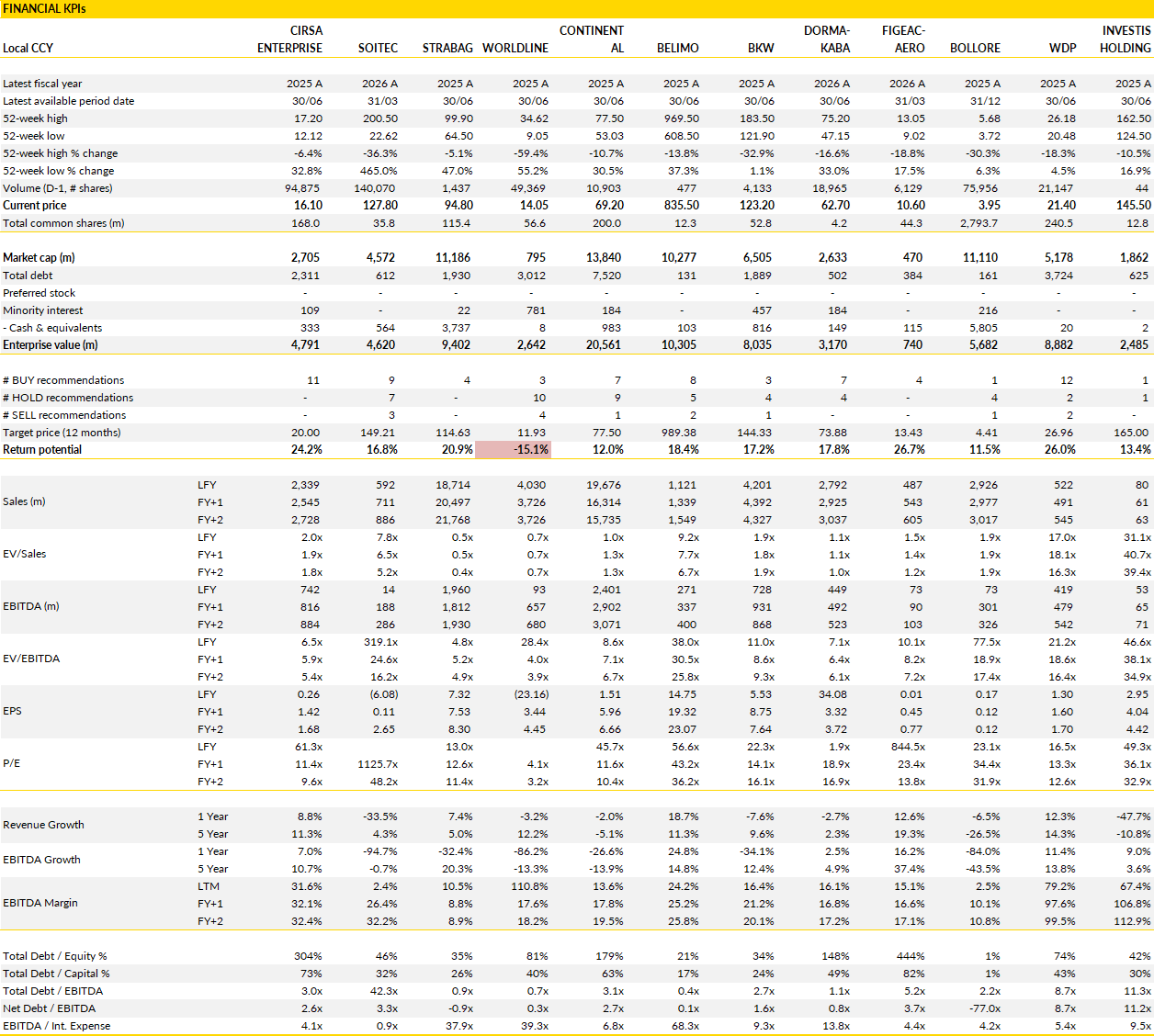
Financial KPIs
Companies covered in this edition: Cirsa Enterprises, Soitec, Strabag, Worldline, Continental, Belimo, BKW, Dormakaba, Figeac Aero, Bolloré, WDP, Investis Holding
Cirsa Enterprises (CIRSA Spain): Lottomatica merger adds scale, online capabilities and substantial synergies
Cirsa has agreed to merge with Lottomatica in an all-share transaction that will create one of the world's largest listed gaming groups, with approximately €2bn of pro forma adjusted EBITDA.
Cirsa shareholders will receive 0.668 newly issued Lottomatica shares for each Cirsa share, together with a €1.56 extraordinary dividend paid before completion. Cirsa shareholders will own approximately 32.5% of the post-merger company, and ~24% for Blackstone. At Lottomatica's pre-announcement share price of €24.77, the terms correspond to approximately €18.1 per Cirsa share including the dividend, around 33% above Cirsa's unaffected price. Completion is planned for Q2 2027, subject to regulatory and shareholder approvals. Because the consideration consists of Lottomatica shares, the eventual value received by Cirsa shareholders will of course move with Lottomatica's share price through closing.
The logic here is strongest in digital gaming and geographic diversification. Lottomatica contributes its leading Italian position, established online technology and omnichannel expertise, while Cirsa adds Spain and a sizeable presence across regulated Latin American markets. Together, the companies will hold nine leading market positions across an addressable gaming market estimated at €34bn. Lottomatica's technology and digital product capabilities should help Cirsa accelerate online development in Spain and Latin America, where Cirsa can combine those tools with its existing retail network and local customer relationships. Geographic overlap is limited, which should simplify integration and reduce competition concerns.
Management identified €115m of annual pre-tax cash synergies by the third full year following completion. Of this, €101m comes from operations, including technology, gaming-content procurement, marketing, corporate functions and supplier purchasing, with another €14m expected from lower financing costs. The total represents around 6% of combined pro forma EBITDA, giving the synergy target meaningful financial relevance without requiring aggressive revenue assumptions.
The enlarged group should also have considerable capacity for distributions once the transaction closes. Pro forma leverage is expected at 2.7x, with management planning to bring this back towards its 2.0-2.5x long-term range. Up to €4bn could be returned to shareholders during the following three years, including a planned €744m distribution after completion, alongside a 30% adjusted net profit payout and share repurchases.
Bottom line, for Cirsa shareholders this effectively means a shift from ownership in a smaller, more leveraged gaming company into a 32.5% interest in a larger and more diversified platform, while retaining participation in Cirsa's growth markets and adding exposure to Lottomatica's digital capabilities. The €115m synergy program comfortably supports earnings growth after closing.
Until then, the principal variables are Lottomatica's share price, regulatory approval and execution of the transaction, since these will determine both the eventual value of the consideration and the timing of the combination.
Soitec (SOI FP): Capacity commitments improve the growth outlook
Soitec has raised its near-term revenue outlook after another acceleration in Photonics-SOI demand. Q2 organic growth is now expected to reach approximately 50%, compared with the previous indication of more than 30%. The change is concentrated in Photonics-SOI, where FY 2026/27 revenue is now targeted at $250-300m, up from the previous objective of more than $200m and just above $100m last year. Guidance for the other businesses remains broadly unchanged.
Photonics is rapidly becoming a much larger part of Soitec's revenue base as optical connectivity gains adoption in AI and data-centre infrastructure. The financial contribution should be disproportionately large because Photonics-SOI carries margins above the group average. This provides Soitec with a source of both revenue growth and favourable mix at a time when several of its more established end markets remain subdued.
The manufacturing footprint gives Soitec considerable flexibility to accommodate higher photonics volumes without immediately committing to another major fab. Production lines at Bernin 1, Bernin 2 and Singapore can be reassigned from products where utilisation is currently low, while Bernin 4 provides additional available infrastructure following the slower-than-anticipated development of SmartSiC demand. Beyond those facilities, the unequipped Singapore extension offers another layer of capacity before construction of a new plant becomes necessary.
Customer commitments are also becoming firmer. Soitec expects to complete multi-year capacity reservation agreements with eight of its ten largest Photonics-SOI customers in the coming weeks. These contracts establish pricing for agreed volumes, require deposits and include inventory disclosure provisions designed to limit double ordering and excess stock accumulation. This structure gives Soitec a stronger basis for production planning and capacity allocation as the business scales.
Technology adoption could broaden the opportunity further. Soitec is currently undergoing a major qualification process with TSMC for Photonics-SOI in co-packaged optics, an architecture designed to place optical connectivity much closer to advanced computing chips. Successful qualification would extend Soitec's exposure beyond the current photonics ramp and into an area that could become increasingly important as AI clusters require higher bandwidth with lower power consumption. Competitive intensity in these specialised substrates also remains limited, preserving attractive economics as volumes expand.
The increase in FY Photonics-SOI guidance is particularly important given that the business generated only slightly above $100m last year: even the bottom of the new range implies more than a doubling in revenue. Existing spare capacity means much of that growth can be accommodated without a corresponding increase in fixed investment, while the reservation agreements reduce some of the demand risk associated with adding production.
Strabag (STR Austria): Higher 2030 ambitions
As expected, Strabag has raised its long-term ambitions after reaching several milestones of its 2030 strategy earlier than originally envisaged.
At its Capital Markets Day in Hamburg, management increased the 2030 output objective from approximately €28bn to around €30bn, compared with roughly €20bn in 2025. The new target implies average annual growth of about 8% through the remainder of the decade. The profitability objective was strengthened as well. The previous 6% EBIT margin target is now regarded as a sustainable minimum, with further upside possible depending on business mix and productivity improvements. Cost discipline, selective bidding and rigorous project-risk management remain central to maintaining profitability, supplemented by greater use of technology and AI across project execution.
The revised targets follow a strong H1 and the recent increase in 2026 guidance, with output now expected close to €23bn and the EBIT margin between 5.5% and 6%. Strabag is consequently approaching its previous long-term profitability target several years ahead of 2030.
Growth will require substantial capital deployment, with management indicating that acquisitions could contribute as much as half of the expansion needed to reach the €30bn output objective. Strabag expects to invest at least €1bn annually across acquisitions, PPP projects, real estate and the broader operating platform. Europe remains the core market, where bolt-on transactions can expand capabilities and strengthen existing regional positions, but Australia has become a larger strategic priority. Strabag currently ranks around the top 15 contractors there and wants to reach at least the top five. The acquisition of Georgiou has already provided a larger base, with its backlog doubling since Strabag took control. The UK is another focus market outside the group's traditional German and Central European footprint.
Financial capacity is ample to pursue these opportunities, although the sizeable investment program means excess cash is likely to be directed primarily towards growth. Dividend distributions could move towards the upper end of the company's 30-50% payout range once the outstanding Rasperia shareholder situation is resolved.
Infrastructure spending provides a favourable backdrop for the plan, particularly in transport. Management sees mobility infrastructure as the central component of the current investment cycle, with German tender activity already becoming more robust as additional public funding enters the market. Strabag's scale, vertical integration and balance sheet allow it to bid selectively for large projects and participate across multiple stages of construction, which has contributed to the margin improvement achieved in recent years. PPP activity should broaden the opportunity further. Strabag currently has roughly €660m invested in these projects and intends to expand beyond transport into areas such as energy and water infrastructure, adding longer-duration assets alongside contracting earnings.
The combination of a €30bn output objective, a sustainable EBIT margin of at least 6% and continued expansion into Australia, the UK and PPPs represents a meaningful increase in the group's earnings potential through 2030. The main execution requirement will be maintaining the bidding and risk discipline that produced the recent margin gains as Strabag deploys more capital and materially increases its scale.
Worldline (WLN France): Is it time for an operational turnaround?
Worldline seems to finally have moved beyond the balance-sheet and portfolio problems that dominated the past several years, allowing management to concentrate again on improving the underlying payments business.
Leverage had already fallen below 2x by the end of June, six months earlier than planned, following the capital increase, disposals, reduced use of notional cash pooling and removal of selected clients. For 2026, management continues to expect revenue to be stable or slightly higher, after a 0.2% decline in H1, with EBITDA of €630-650m. Free cash flow remains negative, with guidance of minus €60-40m for the year after a €27m outflow in H1, but management expects this to turn positive from 2027.
Restructuring is beginning to lower the cost base. Western European headcount fell 3% in H1, legacy platforms are being consolidated and customer portfolios are moving onto common infrastructure. Wopa has been discontinued following migration to Global Collect, the Ogone-to-Gopay migration is 80% complete, SIPS is moving to Gopay and Italian customers are being transferred more rapidly onto Worldline's internal acquiring platform. Generative AI is also being introduced across operations.
Merchant Services, which represents around 80% of revenue, is showing several signs of stabilisation. Merchant sales volume increased 4% in H1, pricing actions have helped stabilise take rates across customer segments and churn among smaller merchants is gradually improving. Worldline is preparing to introduce its LaunchPad digital onboarding platform to simplify customer acquisition and improve service. Underlying Merchant Services revenue still declined 1.4% in H1 after portfolio effects are stripped out, with weakness concentrated particularly in Belgium and Switzerland, historically two profitable markets. The wider European economic environment also limits the pace of a volume recovery. Financial Services has a longer path back. H1 revenue declined 7.1% following the loss of longstanding contracts, with management expecting a €60m revenue impact in 2026 and another €30m in 2027. New contract wins are taking longer to convert into reported sales, although recent mandates include outsourced payment operations for ABN Amro and participation in the ECB's Digital Euro pilot. Management is aiming for Financial Services revenue to stabilise or return to modest growth during H2 2027.
The longer-term North Star plan requires a much larger improvement than the initial stabilisation now underway. Worldline is targeting annual revenue growth of around 4% between 2027 and 2030, EBITDA of €900m in 2030 and free cash flow of €300-350m. Reaching those figures will depend on extracting the benefits from platform consolidation, rebuilding growth in Merchant Services and replacing the Financial Services contracts that have been lost. Worldline also needs to compete across several different parts of payments, including partnerships with banks such as Crédit Agricole, established European consolidators such as Nexi and technology-led competitors including Adyen and Stripe.
The balance-sheet restructuring has removed a major constraint and management now has tighter control over costs, platforms and customer profitability. The next evidence needs to come from the numbers: positive underlying revenue growth, a recovery in Financial Services and a sustainable return to positive free cash flow from 2027.
Continental (CON Germany): Regional structure exposes the earnings potential of the tyre portfolio
Continental’s transition into a focused tyre company is making the underlying economics of the business easier to assess.
Following the disposal of OESL and the planned sale of ContiTech, the group will report Tires through EMEA, the Americas and APAC, giving the regional organisations greater commercial responsibility while keeping production, supply chain management and R&D coordinated globally. The new structure reveals a sizeable profitability gap between regions and identifies the Americas as the clearest internal improvement opportunity.
Near-term trading remains healthy despite softer volumes. Management indicated that Q3 is developing according to plan, with lower unit sales being offset by favourable price and product mix. The adjusted EBIT margin for the quarter is expected around the upper end of the 13.0-14.5% full-year range. Continental also retains a highly efficient industrial and distribution platform: 75% of tyre production is located in low-cost countries across 19 plants, while its logistics network serves more than 150,000 direct customers and delivers over 95% of orders within 24 hours in EMEA.
Europe currently provides most of the group's earnings. EMEA generated €7.4bn of sales in 2025 at a 16.7% adjusted EBIT margin, accounting for slightly more than half of tyre revenue and almost two-thirds of adjusted EBIT. Continental combines an efficient manufacturing footprint with dense distribution and a growing premium mix, and intends to increase its exposure to ultra-high-performance tyres further. Chinese vehicle manufacturers expanding into Europe provide another potential source of original-equipment and replacement demand. APAC already achieves similarly strong economics on a much smaller revenue base. The region generated €1.9bn of sales in 2025 with a 16.9% adjusted EBIT margin, supported by strong brand recognition and particularly high premium exposure, including a 70% UHP mix. Expansion by Chinese OEMs outside their domestic market, together with growth in Southeast Asia, India and Japan, gives Continental several avenues to increase regional sales. Additional local manufacturing capacity and a more resilient supply chain will be required as the business expands.
The Americas generated €4.5bn of sales in 2025 but only an 8.0% adjusted EBIT margin, leaving a substantial gap with EMEA and APAC. Tariffs, higher operating costs and weak utilisation in truck tyres have weighed on returns, with truck capacity running below 80% compared with more than 90% in passenger and light-truck tyres. Continental plans to address this through greater localisation of sourcing and manufacturing, industrial-footprint optimisation and a richer mix across UHP, SUV and EV products. Management is targeting double-digit regional margins over the medium term and sees scope for profitability eventually to approach the levels achieved elsewhere.
Even partial convergence would have a meaningful effect given the Americas' existing revenue base. Continental's value creation after the portfolio separation consequently has several internal sources: maintaining mid-teens profitability in Europe, expanding the smaller but highly profitable Asian operation and repairing margins in the Americas. The new regional reporting structure will make progress on each of these objectives considerably more transparent.
Belimo (BEAN Switzerland): New product architecture adds another layer to a strong growth model
Belimo used its Investor Day to demonstrate how the next generation of its product portfolio can support growth and operating efficiency over the coming years.
Demand conditions remain unusually strong, with H1 2026 organic sales up 30% and EBIT increasing 19%. Management maintained its full-year expectation for an EBIT margin above 20%, with current trading still described as dynamic. Several long-term demand drivers remain intact. Tighter building-efficiency standards are increasing the need for better control of heating, ventilation and cooling systems, climate change is raising cooling requirements, and indoor air quality is receiving greater attention. Building automation and connectivity add further content per installation. Data centres provide an additional source of growth, particularly because their high cooling intensity creates substantial demand for Belimo's valves, actuators and sensors. Management expects growth during the next two years to remain above the company's historical 9-11% annual rate as this market develops.
A central part of the Investor Day was Belimo's New Digital Generation platform, which is designed around a much more modular product architecture spanning multiple categories. Implementation will take several years, but a greater number of common components should simplify procurement, reduce complexity and allow more production processes to be automated. Digital functionality also expands the role of Belimo's products inside connected building systems and creates scope for higher-value products.
Management indicated profitability to improve gradually as the portfolio migrates towards the new platform, although it has not quantified the potential margin contribution. The recently completed production and logistics facility in Hinwil gives Belimo sufficient capacity in Switzerland for approximately the next decade, allowing the company to pursue these efficiency gains without another major expansion of its domestic footprint. Greater standardisation should also make this capacity more scalable as volumes increase.
Belimo enters this transition with an unusually strong growth record and significant exposure to markets where demand is expanding structurally. Data centres can sustain growth above the company's historical range in the near term, while building renovation, energy efficiency and automation provide a broader base once the current data-centre expansion moderates. The economic proposition for customers remains attractive because field devices represent a relatively small part of overall building-system costs but can materially affect energy consumption, with Belimo citing potential energy savings of 29-52% from its devices.
The next phase adds an internal efficiency opportunity to these external growth drivers. Higher volumes can be absorbed by the existing production footprint, modularity can reduce purchasing and manufacturing complexity, and a richer digital mix can gradually improve unit economics.
H1 demonstrates that Belimo is already growing rapidly before these benefits have been fully realised, leaving the NDG rollout as an additional source of productivity and margin improvement over the remainder of the decade.
BKW (BKW Switzerland): Weak hydropower raises the hurdle for a H2 earnings recovery
BKW enters H2 with a demanding earnings requirement after weak hydropower production and subdued trading weighed on the first half.
H1 EBIT was CHF263.7m, prompting management to reduce its full-year expectation from the original CHF650-750m range to the lower end of that corridor. Hydrological conditions have remained difficult through July and August, with the Swiss drought continuing to restrict hydro generation. H1 also benefited from a strong contribution from the KKL nuclear decommissioning fund STENFO, whose 6.1% performance was well above its 2.8% target return. A repeat of that contribution cannot be assumed.
The Energy Solutions division therefore needs a substantial improvement elsewhere during H2. Its H1 EBIT of CHF156.9m included only CHF10.3m from proprietary trading, down from CHF54.9m a year earlier. With hydro volumes still constrained, ancillary services and intraday and proprietary trading will need to compensate for part of the production shortfall if BKW is to reach its reduced annual objective.
The earnings environment becomes more difficult again in 2027. Electricity tariffs for BKW's basic-supply customers will fall 7.6%, creating a direct drag on Energy Solutions earnings, while lower previously hedged power prices are also expected to reduce group profitability. Recent increases in market electricity prices could soften the impact depending on BKW's hedging and trading positions, but the comparison with 2026 will remain demanding. Power Grid faces a separate set of pressures. Investment in smart meters and broader energy-transition infrastructure is increasing operating costs, while continued network investment raises depreciation. At the same time, the regulatory framework is becoming somewhat less favourable through a lower allowed WACC. These factors should constrain segment profitability even as BKW deploys more capital into the grid. The investments remain necessary to accommodate electrification and decentralised generation, but their near-term earnings contribution will lag the associated spending and depreciation.
Infrastructure & Buildings offers a more encouraging internal development. BKW is concentrating the business on engineering, hospital infrastructure, high-voltage transmission projects and higher-margin building-technology services, allowing profitability to improve even with softer revenue. This portfolio shift can gradually make the division a more meaningful contributor to group earnings and reduce some dependence on volatile energy-market conditions. For 2026, however, the outcome is still heavily dependent on the next several months in Energy Solutions. BKW needs a sharp sequential improvement from the CHF263.7m group EBIT generated in H1 at a time when hydropower conditions remain poor and the unusually strong STENFO contribution provides a difficult reference point. Better trading, ancillary-service income and any normalisation in hydro production can close part of the gap.
Beyond the current year, the expansion of higher-margin infrastructure services and continued grid investment provide more structural sources of growth, although lower electricity tariffs and hedged energy prices create a meaningful earnings reset before those activities can become more prominent.
Dormakaba (DOKA Switzerland): Margin recovery advances as ownership structure is simplified
Dormakaba closed FY 2025/26 with organic growth of 3.0%, reaching the lower end of its annual target after a stronger second half. Organic growth accelerated from 2.0% in H1 to 4.0% in H2, helped by a recovery in volumes and a clear improvement in North America. Group volumes increased 0.4% for the full year after declining 0.6% during H1, with North American growth reaching 5.5% in H2 as hospitality demand recovered. Profitability developed more strongly, with the adjusted EBITDA margin rising 60bp to 16.1% on favourable pricing relative to input costs and benefits from the restructuring program. EBIT was CHF286.5m at a 10.3% margin, with additional operating expenses limiting the conversion of the EBITDA improvement further down the income statement. Net profit reached CHF185m and free cash flow remained healthy at CHF163m. The second-half acceleration and a backlog that grew at a high-single-digit rate provide a firmer starting point for the new financial year.
For FY 2026/27, Dormakaba expects organic sales growth of at least 3%, with pricing likely to contribute most of the increase. Management currently envisages price increases of around 2-2.5%, leaving approximately 1% from higher volumes. Trading during July and August was described as good, suggesting that the improvement seen during H2 has carried into the new year. Profitability remains the larger internal opportunity. Dormakaba is targeting an EBIT margin above 11%, compared with 10.3% in FY 2025/26, despite an approximately 30bp accounting headwind from the IFRS transition. On a comparable basis, this requires underlying margin expansion of at least 100bp. Operating cash flow is targeted at 10.5-11.5% of sales, including a temporary tax payment associated with the centralisation of intellectual-property rights. Excluding this item, the underlying objective is 11.5-12.5%. The Shape4Growth program has already delivered the CHF220m of savings originally targeted for FY 2027/28, giving management scope to define the next stage of efficiency measures at the November Capital Markets Day.
A significant corporate change will accompany the operational improvement. Dormakaba plans to simplify the existing ownership structure by eliminating the Mankel family's 47.5% minority interest in the operating business in exchange for newly issued listed shares. Around 36m shares will be created compared with approximately 42m currently outstanding, but the transaction transfers an existing economic interest into the listed entity and should therefore be broadly neutral for existing shareholders from an economic dilution perspective. Following completion, scheduled for January 2027, the Mankel family is expected to own 52.09% of Dormakaba, with the remainder forming the free float, including the Kaba family's 9.05% stake.
The simpler structure removes a longstanding complexity and arrives as the operational restructuring enters a more mature phase. The November Capital Markets Day should provide the next strategic framework, including management's plans for acquisitions and the successor to Shape4Growth. With the existing savings target already achieved, the next phase depends on translating a stronger backlog and modest volume recovery into further margin gains.
Figeac Aero (FGA France): Aerospace ramp-up supports another year of double-digit organic growth
Figeac Aero started FY 2026/27 with revenue of €111.8m, an increase of 9.7% and 11.6% on an organic basis. Aerostructures & Engines accounted for €104.1m and grew 10.4%, benefiting from higher production across the A350, A320 family and LEAP programs. These platforms remain central to Figeac's growth as Airbus and engine manufacturers progressively raise output and aerospace supply chains recover from the disruptions of recent years. Defence & Energy contributed €7.7m, up 1.1%, with Defence growing 12% and offsetting temporary delays in hydro and nuclear activities. The order backlog increased another 3.3% during the quarter to a record €5.0bn, equivalent to more than eight years of current revenue.
This gives Figeac a substantial base of contracted activity as customers increase production, although the immediate challenge remains converting that backlog into output efficiently.
Management retained its FY 2026/27 targets of €530-560m in revenue and €86-94m of recurring EBITDA, despite an estimated €4m currency headwind to profitability. The guidance implies a further acceleration in activity as the year progresses, supported by increasing A320, A350 and LEAP production. Free cash flow is targeted at €35-40m, with leverage expected below 3.1x by the end of March. This cash generation is particularly relevant after years in which Figeac's growth required heavy investment and left the balance sheet carrying substantial debt. The current expansion is being accompanied by another €20-30m of additional capex, directed towards automation, industrialisation and improvements to the manufacturing footprint. Management expects these projects to generate payback within 2.5-3 years, substantially shorter than the 5-7 years historically associated with investment projects. Faster returns on new equipment should allow production capacity to expand without recreating the weak cash conversion that characterised earlier aerospace cycles.
Management is targeting an EBITDA margin above 17% by March 2028, with automation, operational leverage and a favourable program mix providing the main levers. The A350 is particularly useful because its production recovery adds volume to an established industrial base, while continued increases in A320 and LEAP output provide a much larger recurring workload. Defence offers another growth avenue and could gradually reduce dependence on commercial aerospace, with bolt-on acquisitions potentially adding further capabilities.
The €5.0bn backlog gives Figeac sufficient demand to support these investments for many years; execution inside the factories is now more consequential than securing additional orders. If the company can combine the current production ramp with shorter investment paybacks and the targeted improvement in margins, the resulting free cash flow should accelerate deleveraging and leave the group with considerably greater strategic flexibility by 2028.
Bolloré (BOL France): Cash circulation and the Vivendi ruling reopen the path to simplification
Bolloré has gained considerably more flexibility during 2026 to simplify a corporate structure that still contains multiple layers of cross-holdings and listed assets.
The €1.50 per share special dividend paid in June triggered a large movement of cash through the group, with a meaningful portion ultimately flowing back to Bolloré through the various holding companies. At the same time, Compagnie de l’Odet has continued buying Bolloré shares, increasing its ownership from 71.6% at the end of 2025 to approximately 74.2% by the end of August after spending €409m this year. Sofibol has also modestly increased its position in Odet. These transactions further concentrate control and gradually reduce the proportion of Bolloré held outside the controlling structure.
The mechanics of the special dividend have temporarily complicated the assessment of Bolloré’s underlying asset value because the cash payment reduced the quoted share price immediately, even though part of that cash is circulating back into the group.
Vivendi could provide the next major step. In July, the Paris Court of Appeal confirmed that Bolloré does not exercise control over Vivendi and consequently is not obliged to make a mandatory offer for the remaining shares. This removes an important legal constraint and gives Bolloré the option to launch a voluntary offer at a later stage. There is no indication that such a transaction is imminent, but 2027 provides a plausible window if management decides that Vivendi’s valuation offers an attractive opportunity. Vivendi retains a 10% interest in Universal Music Group, and weakness in UMG shares has reduced the value of that holding and consequently Vivendi itself. Acquiring additional Vivendi shares could ultimately allow Bolloré to increase its economic exposure to the assets distributed through the former Vivendi structure and subsequently eliminate another holding-company layer. Following such a simplification, Bolloré could own roughly 30% of Vivendi’s former holdings directly, removing the discount currently embedded through Vivendi.
The question is how quickly management intends to use the strategic flexibility created during 2026. Bolloré’s holding-company discount has widened to almost 49%, close to historical extremes, partly following the special dividend and partly because of the decline in UMG. Around €0.8 per Bolloré share is expected to return to the company through the internal circulation of the special dividend, which means the headline reduction in the share price overstates the economic cash leakage from the group. Further purchases by Odet can steadily increase control, but a larger reorganisation involving Vivendi would have a much greater effect on structural complexity.
Bolloré’s results on 16 September may provide more information on capital allocation and the next stage of the simplification process. After the dividend, continued Odet purchases and the favourable Vivendi court ruling, management now has several routes available. A voluntary Vivendi transaction during 2027 would be the most significant of these and could materially reduce the layers separating Bolloré shareholders from the group’s underlying assets.
WDP (WDP Belgium): ARGAN expands the development platform and raises investment capacity
WDP expects the proposed combination with ARGAN to accelerate its existing growth plan, with the acquired French portfolio adding to the 2030 objectives already in place.
Management indicated that the expected 3% EPRA EPS accretion from 2028 is incremental to its existing ambition of more than €2.00 of EPRA EPS by 2030. The larger balance sheet should increase annual investment capacity from approximately €500m to €700m from 2027, allowing WDP to pursue bigger developments and cross-border customer projects. Longer term, management is aiming for a portfolio of around €20bn and a market capitalisation of roughly €10bn by 2035. This fits WDP's established development-led approach, where internally generated projects provide a significant part of portfolio growth. The remaining fiscal ruling is the principal condition still hanging over completion of the ARGAN transaction, although management's advisers remain confident that it can be resolved satisfactorily.
France offers WDP an entry point at a relatively weak stage of the logistics property cycle. Vacancy has increased and occupier demand remains softer than in several of WDP's existing markets, but ARGAN enters the transaction fully occupied and its exposure around Paris should provide additional resilience. Management also sees early indications that supply conditions are improving as speculative construction declines. The acquisition was agreed at an implied net initial yield of approximately 6% and gives WDP an established national platform, local operating capabilities and a substantial development pipeline. Founder succession at ARGAN created an opportunity to acquire the business bilaterally without first having to assemble a French portfolio asset by asset. WDP does not need a rapid recovery in French leasing markets for the initial economics to work, given ARGAN's existing occupancy and contracted rental income. Greater scale should also improve access to capital and funding efficiency across the enlarged group.
ARGAN's landbank provides the larger opportunity beyond the existing rental portfolio. The company brings approximately 750,000 sqm of potential developments, divided roughly equally between extensions to existing assets and new locations. Many of the new sites are controlled through purchase options, limiting the amount of capital committed before planning permission is secured. French permitting typically takes around two years, which means initial projects could start during 2027 and contribute more meaningfully from 2028 onwards. Several locations are also close to existing WDP assets, creating opportunities to use the combined operating network and development organisation more efficiently. The additional €200m of annual investment capacity from 2027 gives WDP the financial resources to convert this pipeline while still pursuing projects elsewhere in Europe.
ARGAN consequently adds three elements simultaneously: an occupied French logistics portfolio, an established local organisation and a sizeable pipeline that can be developed gradually. Successful completion would give WDP a larger platform for its existing development model and allow the company to compete for projects and customer relationships across a broader European footprint.
Investis Holding (IREN Switzerland): Balance sheet capacity grows as management waits for better acquisition returns
Investis is maintaining a highly selective approach to acquisitions as residential property pricing around Lake Geneva leaves little room for attractive returns.
Gross acquisition yields in Geneva and Lausanne are currently around 2.5-3.0%, levels at which management sees limited reason to deploy its available capital. The company has previously shown a willingness to sell when property pricing becomes unusually strong, most notably through CHF377m of disposals in 2022, and further sales remain possible if buyers offer sufficiently attractive terms. H1 2026 illustrates the financial flexibility created by this approach. The portfolio increased to CHF2.29bn from CHF2.24bn, while interest-bearing debt remained broadly unchanged at CHF625m. Loan-to-value consequently declined from 28.0% to 27.3% and the equity ratio increased to 63.9%, despite CHF38.3m being distributed to shareholders. Financing costs are also moving favourably, with the weighted average interest rate falling to 0.92% from 1.10% a year earlier.
The current balance sheet leaves Investis with considerable capacity to act when acquisition economics improve. Management does not need to add properties simply to generate portfolio growth and can instead wait for periods when sellers face greater pressure or financing conditions create more attractive entry yields. Further disposals at today's strong property values could increase that flexibility again, crystallising gains and creating additional cash for future purchases or debt reduction.
This capital-allocation discipline is particularly relevant in the tightly supplied Lake Geneva residential market, where underlying asset quality is high but acquisition prices can make incremental returns unattractive. Founder and CEO Stéphane Bonvin owns 77.7% of the shares, creating a strong economic incentive to prioritise returns on capital over portfolio size. The same approach supports the dividend policy. Investis pays at least 80% of average FFOI over three years, and the current CHF3.00 per share dividend remains covered by recurring income even if selected properties are sold.
Regulation, politics and interest rates remain the main external variables for the portfolio. Changes to Swiss residential regulation could affect rents or asset values, while movements in interest rates influence both financing costs and the relative attractiveness of property yields. Investis enters that uncertainty with low leverage and a predominantly residential portfolio in one of Switzerland's most supply-constrained regions. H1 NAV excluding deferred taxes increased 2.3% to CHF130.6 per share, alongside further improvement in balance-sheet metrics.
The strategic opportunity comes from the gap between the company's current financial capacity and its limited willingness to deploy it at prevailing property prices. Investis can sell selectively into a strong market, maintain its dividend from recurring earnings and preserve borrowing capacity until acquisition yields improve. That leaves the company well equipped for a weaker property market, when its low leverage and access to capital could allow it to acquire assets on materially better terms.