
Toys, insurance and shower toilets
tonies, Straumann, Moderna, Steyr Motors, UNIQA, Talanx, Carlsberg, Geberit, Implenia, NEPI Rockcastle, Bucher Industries, Emmi

At Lux Opes, we break down companies into quick takes that get straight to the point - what is happening, why it matters, and what to watch next. We publish 2-3 times per week, depending on the news flow.
For the best reading experience, we recommend reading at Lux Opes
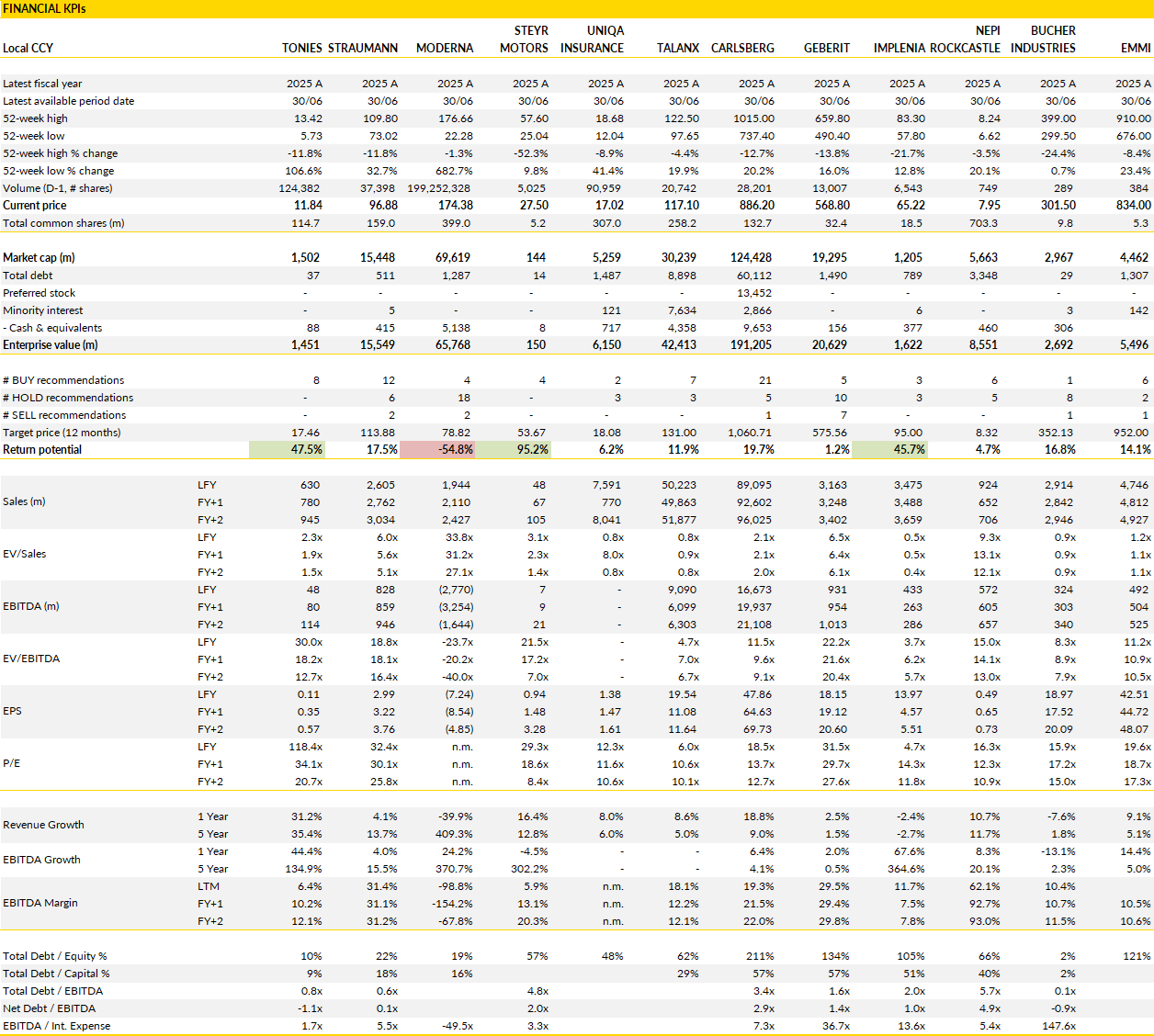
Financial KPIs
Companies covered in this edition: tonies, Straumann, Moderna, Steyr Motors, UNIQA, Talanx, Carlsberg, Geberit, Implenia, NEPI Rockcastle, Bucher Industries, Emmi
tonies (TNIE Germany): Toniebox 2 accelerates installed-base growth ahead of a content-heavy second half
tonies delivered another strong quarter, with Q2 revenue increasing 47.7% to €117.3m as Toniebox 2 adoption accelerated and growth remained broad across geographies.
North America was the main driver, with revenue rising 82.5% to €56.5m, while DACH grew 22.6% to €39.0m and Rest of World increased 31.3% to €21.8m. The strength in North America is particularly significant given the size of the opportunity and tonies' relatively low household penetration compared with its established German-speaking markets. Toniebox revenue increased 75% to €31.8m as the second-generation device continued to attract new households. This hardware expansion is already feeding into content consumption, with Tonie figurine revenue growing 41.3% to €81.7m. The combination strengthens the economics of the model: every additional Toniebox expands the addressable installed base for recurring, higher-margin figurine purchases.
The rapid hardware rollout temporarily weighed on profitability. H1 gross margin after licensing costs declined 570bp to 53.1%, primarily because lower-margin Tonieboxes represented a larger share of sales, while US tariffs created an additional drag. Adjusted EBITDA was €1.8m, corresponding to a 0.7% margin. Free cash flow was negative €64.3m, largely reflecting the seasonal inventory build ahead of several major launches in Q3.
These effects should be concentrated in H1, with the mix expected to shift back toward higher-margin content as recently acquired Toniebox users expand their figurine collections. Operational efficiencies across fulfilment, marketing and SG&A are also beginning to offset some of the gross-margin pressure. The focus in H2 is therefore on whether strong hardware adoption converts into the expected increase in figurine attach rates quickly enough to deliver the planned margin recovery.
Management maintained its FY 2026 guidance for more than 20% constant-currency revenue growth to €760m, including more than 30% growth in North America, alongside an adjusted EBITDA margin of 9-11% and positive free cash flow. Delivery requires a substantial H2 earnings acceleration, but the commercial setup is supportive. The product pipeline includes Bluey, Pokémon and Hasbro content alongside Toniebox Lite, giving the company several opportunities to increase both household penetration and spending within the existing installed base. North America is scaling rapidly while DACH continues to grow at double-digit rates from a much more mature base, suggesting that the format retains considerable longevity beyond its initial adoption phase.
With Toniebox 2 expanding the ecosystem and major licensed franchises arriving during the second half, tonies enters the important year-end trading period with a significantly larger installed base and a broader content catalogue from which to monetise it.
Straumann (STMN Switzerland): Improving US momentum
Straumann maintained strong organic momentum in Q2, with revenue increasing 8.5% organically to CHF707m despite a 320bp currency drag. Performance was broad-based, with Europe growing 8.6%, North America 8.4%, Asia-Pacific 7.4% and Latin America 11.8%. The continued sequential improvement in North America is particularly encouraging following the softer environment experienced previously, while Asia-Pacific performed well despite slower Chinese demand ahead of the introduction of VBP 2.0 and continued caution among patients.
Profitability also remains healthy despite the currency pressure. H1 core EBIT reached CHF355m, corresponding to a 25.7% margin, with the underlying development benefiting from operational improvements, geographic mix and lower tariff costs than initially anticipated. Management had already increased its FY 2026 profitability guidance in June and has now confirmed that outlook. Straumann expects constant-currency core EBIT margin expansion of 140-170bp, substantially above the previous 30-60bp expectation.
The combination of high-single-digit organic growth and meaningful underlying margin expansion points to a strong earnings trajectory, while the geographic breadth of Q2 growth reduces dependence on any individual dental market. China remains a source of uncertainty around VBP 2.0, but the performance elsewhere in Asia-Pacific indicates that the region can continue growing even with more subdued Chinese conditions.
Overall, growth is being supported across digital solutions, implantology and orthodontics. Within premium implants, iEXCEL continues to generate customer conversions and new account wins, supporting market-share gains across key geographies. Neodent is simultaneously expanding geographically in the challenger segment, giving Straumann complementary premium and value offerings and allowing the group to address a broader range of customers and price points.
The main new development is the planned CEO transition. Guillaume Daniellot will step down on 1 December after almost two decades at Straumann, including seven as CEO, and will be succeeded by Christopher Norbye. Norbye joins from Beijer Ref, where sales more than doubled and profit tripled during his tenure. His appointment introduces some uncertainty after a successful period under Daniellot, but Straumann enters the transition from a position of considerable operational strength. The company has a diversified geographic footprint, strong premium and challenger implant franchises, growing digital capabilities and established management structures around its individual businesses.
Continued North American improvement, further iEXCEL adoption and resilient growth outside China provide several drivers for the remainder of 2026. With organic growth remaining strong and profitability developing substantially better than initially planned, the CEO transition is currently the principal new uncertainty in an otherwise healthy operating environment.
Moderna (MRNA US): mRNA oncology has its first major validation
Moderna and Merck have delivered a significant clinical success for V940/intismeran, with the personalised mRNA cancer vaccine meeting the primary endpoint in the phase III INTerpath-001 melanoma trial.
The study enrolled 1,137 patients with completely resected stage IIB-IV melanoma and compared V940 plus Keytruda with Keytruda alone as adjuvant therapy. The combination produced a statistically significant and clinically meaningful improvement in recurrence-free survival, alongside a significant improvement in distant metastasis-free survival, with no new safety signals identified. Detailed results have not yet been disclosed and overall survival continues to be assessed, but Moderna and Merck are already preparing discussions with regulators regarding potential submissions. The result moves V940 substantially closer to becoming Moderna's first commercial oncology product.
The phase III outcome also confirms the strong efficacy signal previously seen in the phase IIb KEYNOTE-942 study. At five years, V940 plus Keytruda reduced the risk of recurrence or death by 49% and the risk of distant metastasis or death by 59% compared with Keytruda alone. Reproducing the direction of those results in a much larger phase III trial substantially reduces the clinical risk around the program, even though the magnitude of the phase III benefit remains unknown. INTerpath-001 is the first successful phase III study of a personalised neoantigen therapy and the first phase III validation of an mRNA-based oncology treatment. V940 is individually manufactured based on the mutational profile of each patient's tumour, encoding selected neoantigens intended to stimulate a targeted immune response. Keytruda then helps sustain that response by removing PD-1-mediated inhibition, providing a clear biological rationale for the combination.
The implications extend beyond melanoma. Moderna's central strategic challenge since the pandemic has been demonstrating that its mRNA technology can produce commercially meaningful products outside respiratory vaccines. V940 now provides the strongest evidence yet that the platform can work in oncology, where Moderna and Merck are pursuing a broader INTerpath program encompassing nine phase II and III studies across multiple tumour types.
Success elsewhere cannot be assumed from melanoma, and detailed recurrence-free survival data, eventual overall survival results and regulatory feedback remain important next steps. Manufacturing personalised vaccines at commercial scale will also be considerably more complex than producing standardised vaccines.
Even with those uncertainties, INTerpath-001 removes one of the largest clinical risks surrounding Moderna's non-respiratory pipeline and gives the company a credible late-stage oncology franchise at a time when setbacks elsewhere, including questions around the norovirus program, had increased doubts over pipeline diversification.
Steyr Motors (4X0 Germany): Defence delays expose the cost of strong building ahead of demand
Steyr Motors’ H1 results showed a sharp deterioration in profitability as expected defence orders failed to convert into revenue while the company had already expanded its cost base for higher production.
Q2 revenue declined 4.5% to €11.1m, taking H1 revenue to €22.8m, down 1.4%. The more significant change was in earnings, with Q2 EBIT falling to negative €2.0m from positive €1.3m a year earlier and H1 EBIT moving to a €1.1m loss from a €3.4m profit. Operating costs increased 21.1% during H1 as Steyr added capacity and resources in anticipation of defence programs that have subsequently been delayed. The civil business provided a useful counterweight, growing 38% to €13.4m, but was insufficient to absorb the higher group cost base.
The results highlights the operating leverage inherent in Steyr’s model in both directions: margins can expand rapidly when production increases, but the current low utilisation rate leaves earnings particularly sensitive to project timing.
The deterioration has forced management to materially reset its near-term ambitions. FY 2026 revenue guidance has been reduced from €75-95m to €56-61m, while the EBIT margin target has been cut from above 15% to 8-12%. More significantly, Steyr withdrew its FY 2027 targets of €140m revenue and €40m EBIT, with the €140m revenue ambition now postponed to 2029. The change suggests that the delays are sufficiently substantial to affect the original multi-year ramp-up trajectory instead of simply shifting a few orders between quarters.
At the same time, the underlying issue is described as delayed defence projects, with Steyr continuing to point to a healthy backlog and project pipeline. This is important. If contracts remain intact and delivery schedules have merely moved to the right, much of the investment in additional capacity should eventually support a sharp earnings recovery as utilisation improves. If not, and order conversion continues to disappoint, well, the enlarged fixed-cost structure becomes a more 'persistent burden'.
So, performance over the next few quarters depends heavily on evidence that the defence backlog is at least beginning to translate into production and recognised revenue. The 38% growth in the civil segment demonstrates that demand is not weak across the entire business, but defence is central to the scale and profitability Steyr is targeting. Management’s decision to postpone the €140m revenue objective by two years materially reduces confidence in the original growth timetable, even if it does not necessarily undermine the longer-term opportunity.
After the guidance reset, order execution and capacity utilisation are the key operational indicators, with actual deliveries now considerably more important than the size of the project pipeline alone.
UNIQA (UQA Austria): Strong premium growth continues as investment gains offset softer underwriting
UNIQA maintained strong commercial momentum in Q2, with insurance revenue increasing 8% to €1.89bn and growth across all major business lines. Health insurance led with an 11% increase, followed by Life at 10% and Non-life at 7%. The underwriting performance was less convincing, however. The technical result declined 25% to €150m, while the H1 combined ratio deteriorated by 1.1 percentage points to 91.6%. Management attributed the weaker result to measures aimed at strengthening technical resilience in P&C, suggesting deliberate actions around reserving and pricing instead of an unexpected deterioration in claims. Further detail will be needed to determine how much of the Q2 weakness reflects conservative reserving and how much represents underlying pressure on technical profitability.
The weaker underwriting contribution was more than compensated by an exceptionally strong investment result. Net investment income reached €436m in Q2, around four times the prior-year level, supported by realised and unrealised equity gains and favourable capital markets. This lifted EBT to €167m, up 10% year-on-year despite the weaker technical result. UNIQA's capital position also remains very strong, with the Solvency II ratio at 271%, broadly unchanged from Q1. This provides substantial protection against market volatility and comfortably supports the company's 50-60% dividend payout policy. The balance between recurring insurance profitability and investment income nevertheless deserves attention, as the magnitude of Q2 investment gains is unlikely to represent a normal quarterly contribution.
Management maintained FY 2026 guidance for EBT of €540-570m, despite already reaching 57% of the upper end during H1. This leaves a relatively modest earnings requirement for the second half, although the composition of H1 profits makes straightforward extrapolation difficult. The underlying business continues to benefit from rising insurance penetration across Central and Eastern Europe, while growth across Health, Life and Non-life indicates that expansion is not dependent on a single product category.
The main issue after Q2 is thus underwriting quality, particularly within P&C. If the weaker technical result primarily reflects deliberate reserve strengthening, the quarter should leave UNIQA in a stronger position for future periods. If the combined-ratio deterioration persists, greater reliance on investment income would make earnings less predictable.
Talanx (TLX Germany): Strong despite softer pricing
Talanx delivered another strong quarter, with Q2 net profit of €724m supported by healthy underwriting profitability across most of the primary insurance businesses and strong investment income.
Corporate & Specialty produced a combined ratio of 90.4% despite an increasingly soft commercial insurance market, while Retail International remained particularly strong with a combined ratio of 91.2%. Group investment returns also provided meaningful support, with the Q2 return on investment reaching 3.8%. This performance prompted management to raise FY 2026 guidance from net profit of around €2.7bn to significantly above €2.7bn. Capitalisation remains strong, with the Solvency II ratio at 246%, although this declined somewhat as currency movements increased the group’s solvency capital requirement. The overall result shows that Talanx continues to generate strong technical profitability even as conditions become less favourable in parts of the insurance market.
Corporate & Specialty is already adapting to that change in the cycle. Revenue declined 1.2% to €2.52bn as management prioritised underwriting profitability while commercial insurance pricing weakened, particularly in property. The 90.4% combined ratio indicates that portfolio management remains effective, while the business continues to add resiliency reserves, albeit at a slower pace than in 2025. Retail International provides a separate source of growth, with revenue increasing 10.1%, or around 8% adjusted for currencies, to €2.61bn. The division is benefiting from both strong underwriting and higher investment income, particularly in Latin America and Turkey, where elevated yields are boosting returns on a growing asset base. Its return on investment reached 6.5% in Q2 and 6.0% for H1. This combination of premium growth, disciplined underwriting and investment income makes Retail International an increasingly important contributor to Talanx’s primary insurance earnings.
Retail Germany remains the weaker part of the portfolio. Its Q2 combined ratio deteriorated to 95.7% due primarily to unusually high large fire claims, although underlying profitability excluding these losses was closer to normal levels. There were also early signs of better commercial momentum, with P&C revenue growth improving to 1.4% from 0.2% in Q1 and the decline in Life narrowing to 0.3% from 5.9%. Rebuilding the Life franchise following the end of the Targobank distribution agreement will take longer, however, with new business value still well below the historical quarterly run-rate.
Talanx nevertheless enters H2 with strong profitability across Corporate & Specialty and Retail International, improving trends in Germany and substantial capital strength. Softer commercial pricing and the rebuilding of German Life are the principal operational challenges, but current underwriting discipline and the growing contribution from investment income provide considerable protection against both.
Carlsberg (CARLB Denmark): Britvic integration and cost control lift the outlook
Carlsberg delivered a solid H1, with earnings growth running ahead of the underlying top-line performance as cost discipline and the integration of Britvic supported profitability.
Organic volumes increased 1.7%, while organic revenue grew 2.7% and reported revenue reached DKK 47.1bn. Operating profit increased organically by 5.9% to DKK 7.45bn, leaving the operating margin broadly stable at 15.8%. Cash generation was also healthy, with free operating cash flow of DKK 3.69bn, although leverage remains elevated following the Britvic acquisition, with net interest-bearing debt of DKK 56.8bn and net debt/EBITDA of 3.0x. The combination of modest volume growth and faster profit growth illustrates the benefits Carlsberg is extracting from its enlarged portfolio while keeping a tight grip on costs.
Regional performance was relatively balanced, although Central & Eastern Europe and India continued to provide the strongest growth. Organic volumes in the region increased 6.2%, with revenue reaching DKK 9.75bn and operating profit of DKK 1.74bn. Western Europe was more subdued, with volumes increasing just 0.3%, but the region remains central to the integration of Britvic and the expansion of Carlsberg's non-alcoholic beverage exposure. Asia delivered 1.5% organic volume growth, but China remains the main weak point within the portfolio and limits the contribution from a region that has historically been an important growth engine. This contrasts with the continued strength in India, where Carlsberg has also been considering an IPO of the local business. No additional details on that process were provided with the H1 results, leaving a potentially significant corporate catalyst unresolved.
Management nevertheless became more confident on FY 2026 earnings, narrowing organic operating profit growth guidance to 4-6% from 2-6%. A major contributor is faster delivery of the Britvic integration, with Carlsberg now expecting around 50% of the targeted GBP 110m of synergies to be realised during 2026, up from the previous expectation of 30-40%.
Britvic therefore offers a substantial self-help component at a time when underlying beer demand remains uneven across markets. Continued cost discipline adds another lever, while stronger cash generation should allow leverage to decline progressively after the acquisition. China remains the clearest drag and could keep Asian growth subdued, but the combination of Britvic synergies, strong momentum in Central & Eastern Europe and India, and improving cash generation gives Carlsberg several internal earnings drivers that do not depend on a broad acceleration in beer volumes.
Geberit (GEBN Switzerland): Volume growth accelerates on improving European construction markets
Geberit delivered a strong acceleration in Q2, with organic sales growth reaching 8.8% and taking H1 growth to 5.9%, the strongest performance since the Covid-era home improvement boom.
The quality of growth was particularly encouraging, with volumes increasing 7.5% in Q2 and pricing contributing roughly 1.5%. This reflects improving conditions across several European construction markets alongside good demand for recently launched products. Management nevertheless remains cautious on the broader market, expecting only slight European growth in 2026 and stopping short of calling a widespread recovery. The Nordics have improved since the spring, while Germany is also developing favourably, supported by higher installer backlogs. Wholesaler inventories remain broadly normal, reducing the risk that recent growth has primarily come from restocking.
Pricing should provide additional support over the remainder of the year. Geberit introduced a general 1% increase in April alongside additional increases for copper-related products and, subsequently, plastic-based products in June. The cumulative annualised pricing contribution should reach around 2.5%, with management currently seeing no need for further increases. Pre-buying ahead of these measures was limited at group level and mainly concentrated in plastic piping, suggesting that underlying Q2 demand was genuinely strong. Product innovation is contributing as well. Shower toilets continue to record double-digit volume and sales growth, led by the Alba range, while the more premium Mera range is also growing at double-digit rates. EBITDA margin was 29.4% despite higher material costs, and management expects the full-year margin to remain around the 2025 level of 29.4%.
For 2026, Geberit should indeed see organic sales growth of >5%, implying that the stronger Q2 momentum can moderate substantially without jeopardising the full-year target. The improving demand backdrop is also arriving alongside a less adverse currency environment. The recent weakening of the Swiss franc should reduce the FX drag during 2026 and could become supportive in 2027. Higher volumes, continued pricing and a normalised construction environment provide a healthier earnings base, even if elevated material costs limit near-term margin expansion. Accelerated share repurchases add another source of EPS growth.
Geberit does not require a powerful European construction rebound to deliver better earnings: current growth is already being generated predominantly through volumes, installer activity is strengthening in important markets such as Germany, inventories remain controlled and newer products are gaining traction. A broader recovery in European residential construction would provide additional growth beyond this improving underlying base.
Implenia (IMPN Switzerland): Higher-quality backlog should lead to further margin improvement
Implenia's H1 results (and subsequent conference call) indicate that the group remains on course for further profitability improvement, even though revenue growth will remain subdued in 2026.
Management expects group sales to be broadly stable this year because several recently secured large contracts will only begin contributing materially from 2027 or even 2028. The more relevant development is the quality of the incoming work. New contracts are being signed at higher margins than the projects they replace, which should progressively lift the group EBIT margin towards its medium-term target of 4.5%. Recent wins in data centres and defence are examples of this shift towards more attractive projects, and management expects additional contracts in these areas during H2. Germany is also developing well, with H1 order growth led by Buildings and supported by Civil Engineering.
Service Solutions provides further evidence that profitability is improving structurally. Its margin increased to 9.7% in H1 from 7.5% a year earlier, and management expects at least to sustain the current level. The improvement reflects lower SG&A, the combination of two entities and associated synergies, alongside broader efficiency measures. Implenia is simultaneously spending CHF 10-20m during 2026 on growth initiatives. Much of the hiring program has already been completed, with only several specialist positions remaining, while part of the budget is available for acquisitions. Management continues to evaluate M&A opportunities within Service Solutions. These investments will burden reported earnings particularly during H2, but they expand Implenia's capacity in markets where demand is developing strongly and where the group can increasingly be selective on contract economics.
Cash flow remains seasonal despite the operational improvements. Roughly two-thirds of the backlog comes from public-sector customers, where payments remain concentrated towards year-end, so management does not expect free cash flow to become fully smooth between reporting periods. The longer-term cash conversion objective remains at least 80%, with capital employed now incorporated into internal incentive structures to strengthen working-capital discipline. H1 working capital benefited from higher commitments to subcontractors, offsetting temporarily lower customer advances caused by the timing gap between recent contract awards and construction starts. Those advances should recover in H2 and more significantly during 2027 as major projects move into execution.
In short, Implenia is experiencing a growing, higher-margin backlog, stronger German demand and improving profitability in Service Solutions. Reported growth may remain modest in 2026, but the contract mix and timing of project starts provide a good starting point for revenue and earnings growth from 2027 onwards.
NEPI Rockcastle (NRP Netherlands): Portfolio strength supports another guidance upgrade
NEPI Rockcastle delivered a strong H1, with continued rental growth, high occupancy and further appreciation of its Central and Eastern European shopping-centre portfolio.
Net operating income, including energy activities, increased 3.8% to €317.7m, while like-for-like property NOI grew 3.3%. Tenant turnover increased 2.7%, driven by a 3.3% increase in average basket size as footfall remained broadly stable. Occupancy stayed high at 98.2%, while new leases and renewals were signed at an average 3% uplift above indexation. The occupancy cost ratio was unchanged at 13.2%, indicating that rental growth continues to be absorbed comfortably by tenants. Renewable energy is also becoming a more meaningful contributor, with NOI from energy production increasing 38% to €5.7m as additional photovoltaic capacity came online.
Asset values continued to move higher alongside the operating performance. The portfolio recorded a positive €126m revaluation in H1, equivalent to a 1.6% like-for-like increase from year-end, taking total portfolio value to approximately €8.4bn. EPRA NTA per share increased 4.2% year-on-year to €7.86. Balance-sheet leverage remains moderate despite continued investment, with reported LTV of 33.1%. Distributable earnings increased 3.0% to €227.3m, while distributable earnings per share rose 3.5%. NEPI maintained its 90% payout policy and declared an interim distribution corresponding to that payout level. The combination of positive rental growth, rising asset values and relatively conservative leverage gives the company considerable flexibility to continue investing in its existing portfolio and development pipeline without putting pressure on shareholder distributions.
Following the H1 performance, management raised FY 2026 guidance and now expects distributable earnings per share growth of 3.5-4.0%, compared with approximately 3% previously. With H1 growth already at 3.5%, the new range implies a modest acceleration during the second half. The underlying operating indicators provide a solid foundation for that target: occupancy remains close to full, tenant sales continue to rise, rental renewals remain positive and the energy portfolio is adding incremental income. Rental uplift above indexation has moderated from last year, but this comes against an already strong leasing environment and has not translated into weaker occupancy or affordability metrics.
NEPI therefore continues to combine steady organic property growth with asset appreciation and a high cash payout, while its moderate leverage leaves room for further portfolio investment and expansion.
Bucher Industries (BUCN Switerland): Please be patient
Bucher continues to wait for a convincing cyclical recovery across its end markets, with H1 showing weaker operating momentum than expected despite an already moderate comparison base.
Order intake and sales were around 1% below expectations, but profitability was considerably weaker. Part of the shortfall came from CHF 8m of restructuring charges at Bucher Specials, although underlying performance was also disappointing across several businesses. Kuhn, Bucher Municipal and Emhart Glass all delivered weaker profitability, leaving group earnings well below expectations.
Management consequently reduced its 2026 outlook and now expects organic sales to decline slightly, compared with its previous expectation for stable revenue, alongside a lower adjusted EBIT margin year-on-year. The downgrade suggests that the current downturn is proving more persistent than anticipated and that operating leverage remains negative at subdued activity levels.
An important swing factor of course remains agricultural equipment, which typically represents around half of Bucher's revenue through Kuhn. European agricultural machinery sentiment has begun to improve at the margin, but current conditions remain weak and the recovery is uneven geographically. Scandinavia, the UK and Ireland are showing healthier confidence, whereas France, a considerably more important market for Bucher, remains depressed after several years of weak demand. This makes a rapid improvement in Kuhn difficult to envisage.
Conditions outside agriculture are also inconclusive. Headline industrial PMIs have moved into expansion territory across Europe, the US and globally, but underlying indicators provide a less convincing picture once unusually long supplier delivery times are considered. The weaker H1 performances from Municipal and Emhart Glass reinforce the absence of a broad industrial recovery capable of compensating for continued softness in agricultural machinery.
Near-term growth is therefore likely to remain limited. The reduced 2026 guidance establishes a weaker base, with the agricultural business carrying most of the pressure and few obvious catalysts elsewhere in the portfolio. Bucher's diversified structure provides resilience across cycles, but diversification currently offers limited benefit because several businesses are simultaneously operating below stronger historical demand levels.
Let's see what will become of the next trading update (end of October), when reported and currency-adjusted revenue should be broadly flat as foreign-exchange pressure moderates. A more constructive outlook ultimately requires clearer evidence that agricultural equipment demand has bottomed in Bucher's core European markets, accompanied by firmer activity across its industrial divisions. Until that recovery broadens, earnings improvement is likely to remain gradual and dependent primarily on easier comparisons instead of a meaningful acceleration in end-market demand.
Emmi (EMMN Switzerland): Premium niches sustain growth. US demand prepares to recover
Emmi continues to generate healthy underlying growth despite currency pressure, lower Swiss milk prices and temporary weakness in parts of its US business. The strongest performance remains concentrated in premium niches including speciality cheese, rtd coffee, premium desserts and Nutrition+, which together represent around 40% of group sales and grew faster than the company average in H1. Nutrition+ was particularly strong, recording double-digit growth as demand for high-protein, lactose-free and functional products continued to expand. Management now expects annual organic growth around the middle of its 2-3% range. Underlying growth was approximately 3.3% after excluding the impact of lower Swiss milk prices and a one-off transaction effect. Switzerland remains healthy, with volume-led underlying growth of 2.7% in H1 and around 2.1% expected for the full year.
International performance should improve during H2. US volumes declined modestly in H1 as tariffs and the strong Swiss franc weighed on imports of Swiss cheese, compounded by the termination of non-strategic contract manufacturing after a customer's bankruptcy. Neither issue suggests a deterioration in Emmi's core US franchises, and management expects stronger seasonal demand for desserts and cheese during the second half. Caffè Latte was also sluggish across several European markets early in the year, although commercial measures and better weather have produced a clear improvement since June. Profitability remains resilient despite continued pressure from logistics and packaging costs. Management appears comfortable around the middle of its CHF 335-355m EBIT guidance range, supported by targeted pricing, a richer product mix and further operational efficiencies. Currency pressure should also moderate, with the full-year sales impact expected at around -1.5% compared with -2.1% in H1.
Emmi's portfolio has gradually shifted towards categories where brand, convenience, functionality and premiumisation provide better growth and margin characteristics than traditional dairy products. Nutrition+ adds a particularly attractive growth platform, complementing established positions in premium desserts, coffee and speciality cheese.
The company is also converting earnings into cash and reducing leverage, with net debt/EBITDA falling to 1.7x in H1 from 1.8x at the end of 2025. This leaves room for further investment and selective acquisitions, historically an important part of Emmi's expansion outside Switzerland. H1 contained several temporary pressures, but core volumes in Switzerland remain healthy, premium categories are expanding faster than the group, US conditions should improve in H2 and EBIT guidance remains intact. The operating profile therefore remains solid despite a somewhat uneven first half.