
Shoes, lockers and inflections
Evonik Industries, Adidas, AkzoNobel, R&S Group, Roche Holding, Allegro, Guerbet, Erste Group, Quadient, Siemens, ArcelorMittal, WPP

At Lux Opes, we break down companies into quick takes that get straight to the point - what is happening, why it matters, and what to watch next. We publish 2-3 times per week, depending on the news flow.
For the best reading experience, we recommend reading at Lux Opes
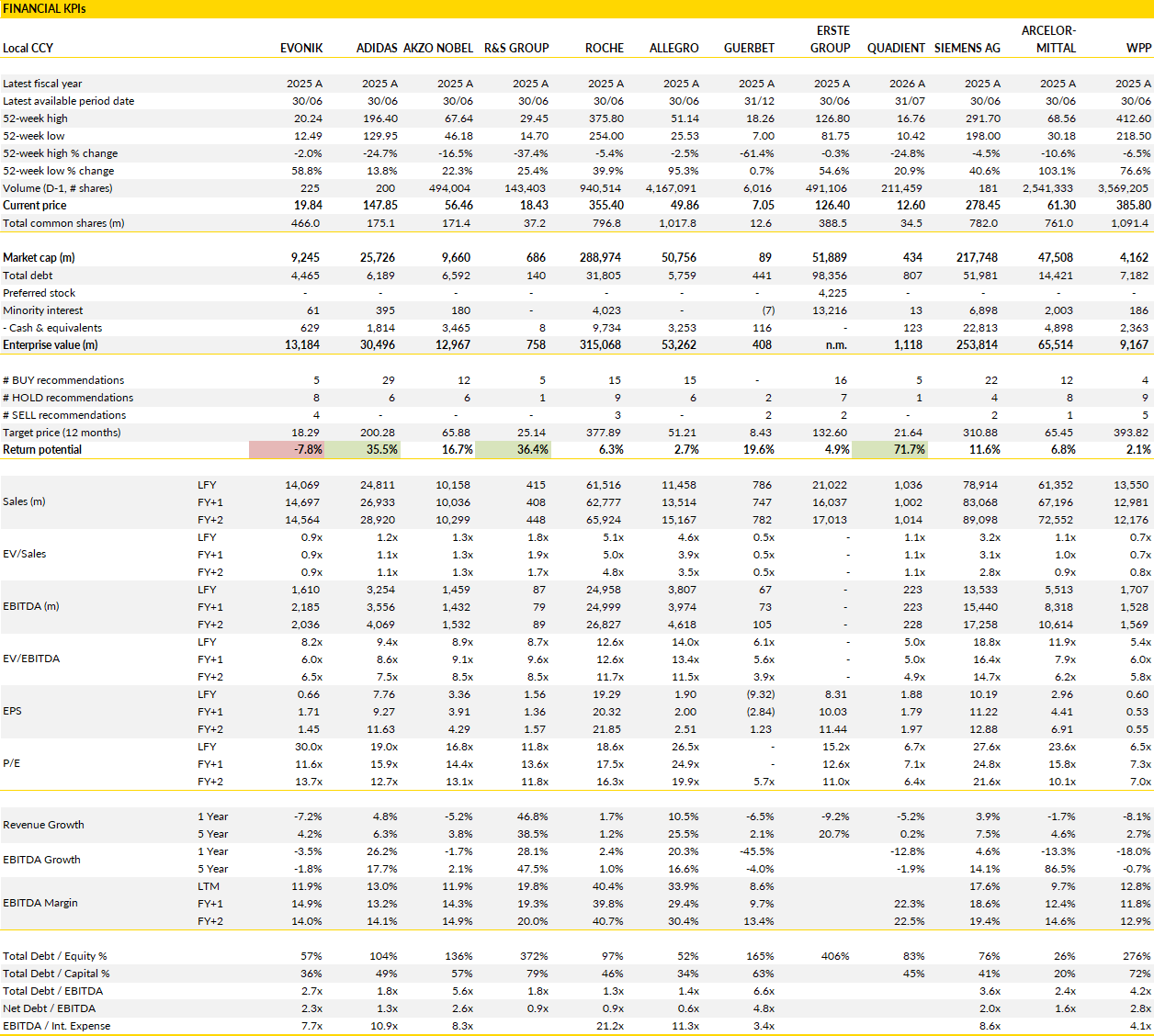
Financial KPIs
Companies covered in this edition: Evonik Industries, Adidas, AkzoNobel, R&S Group, Roche Holding, Allegro, Guerbet, Erste Group, Quadient, Siemens, ArcelorMittal, WPP
Evonik Industries (EVK Germany): A deal finally getting done?
BASF confirmed that it previously held talks with Evonik and its 43.8% shareholder RAG-Stiftung on a possible voluntary takeover offer. Evonik has clarified that no discussions are currently taking place, so there is no active transaction at this point.
That said, the industrial logic is nevertheless easy to understand. Evonik would add a sizeable specialty chemicals portfolio to BASF at a time when BASF is reshaping its own asset base and preparing AgSolutions for an IPO. Evonik has generated average adjusted EBITDA of around €2.1bn over the past decade, with roughly 85% coming from activities excl. the more cyclical methionine business. This is unusually stable for the chemicals sector. Its operations also overlap geographically with BASF across Europe, the US and Asia, creating scope for procurement, production, commercial and corporate cost synergies. A combination would effectively replace part of the earnings BASF may eventually lose through further monetisation of AgSolutions with a similarly sized specialty chemicals business.
RAG-Stiftung will have a decisive influence over whether the idea develops further. Its ~44% holding makes a transaction difficult without its support, and Evonik provides RAG with an important recurring source of income. The foundation received around €252m of Evonik dividends in 2025, against perpetual obligations associated with Germany's former hard-coal industry of roughly €200m annually.
Any deal therefore needs to preserve a dependable income stream, which makes an all-cash exit only one possible structure. A share-based component giving RAG a meaningful holding in a combined BASF-Evonik could potentially address that requirement while limiting the financing burden for BASF. Funding is relevant because BASF is simultaneously restructuring its portfolio and has indicated a preference for disciplined acquisitions with clear synergies over another round of large greenfield investments. The planned AgSolutions IPO could improve its financial flexibility, although the timing of any renewed approach to Evonik remains uncertain.
For Evonik, the approach also highlights how much the portfolio has changed after years of restructuring. The company has moved away from several commodity-oriented activities and concentrated resources on specialty businesses with more stable margins and cash generation, while methionine remains a global market-leading operation with a competitive production footprint. BASF's interest suggests these assets could have strategic value inside a larger integrated chemicals group, particularly if overlapping infrastructure and functions can be consolidated.
But as mentioned, there is still a considerable distance between exploratory discussions and an offer. Talks have stopped, RAG's intentions are unknown and BASF would need to settle both financing and transaction structure. Even so, confirmation from BASF changes the situation from market speculation to evidence that a combination has been seriously considered.
Adidas (ADS Germany): Localisation is the next driver
Adidas is giving its regional businesses considerably more control over product, design, marketing and sourcing, extending the decentralisation process introduced under CEO Bjørn Gulden.
This is the recent message from the company, i.c. an approach is designed to make a global brand more responsive to local tastes instead of pushing essentially the same assortment across markets. China shows how far the model can go: around 65% of products sold there are created by Chinese designers and 95% are sourced locally. Greater regional autonomy also means Adidas has moved away from its previous emphasis on reducing the number of SKUs, accepting a broader assortment where this helps individual markets address local demand.
The early evidence in Europe is encouraging, with market share rising from 14% in 2023 to 18% today and a greater proportion of sales taking place at full price. After several quarters of double-digit revenue growth, management is becoming more selective about volume. The 2027 objectives remain high-single-digit sales growth and a 10% EBIT margin, with H1 2026 already reaching the latter level.
Priorities differ substantially by geography. Latin America has developed into a particularly strong market, where Adidas has reached a 35% share through its football franchise and growing presence in running. China is performing well overall, although lower-tier cities remain harder to penetrate given the strength of domestic competitors such as Anta and Li Ning. Resources in emerging markets have shifted towards India and other parts of Asia as the conflict involving Iran has disrupted the Middle East. North America requires a different strategy. Nike remains sufficiently far ahead that Adidas is concentrating on closing the gap instead of targeting market leadership, with additional investment going into sports with strong local relevance, particularly basketball and American football. Elsewhere, management still wants Adidas to become the leading sports brand in each major region. Giving local teams greater authority should make that ambition more realistic, provided the resulting product complexity does not weaken sourcing discipline or inventory control.
The 2027 product calendar gives Adidas several ways to sustain growth without relying on another broad volume push. Running remains central, with EVO SL, Supernova and Hyperboost supporting a category where the brand has rebuilt credibility. Formula One will expand with the addition of a third team next year, while Adidas is also broadening its offering in smaller areas such as cycling shoes and basketball apparel. These initiatives sit alongside the company's established strength in football and create a more diversified sports portfolio after the lifestyle-driven recovery of recent years.
Management's emphasis on healthier growth is sensible after a period of rapid expansion, particularly with the EBIT margin already back at 10% in H1. The challenge for 2027 is to preserve that profitability while keeping product momentum high across very different regional markets. A strong innovation pipeline, greater local control and continued full-price selling give Adidas several levers to do so without depending on aggressive inventory growth or widespread discounting.
AkzoNobel (AKZA Netherlands): Merger clears another hurdle
AkzoNobel's proposed combination with Axalta has now moved beyond the shareholder approval stage, with both sets of shareholders backing the transaction on 5 August. Regulatory clearance is now the main condition still standing between the companies and completion.
Some disposals look probable given the overlap between the two coatings portfolios, particularly in North American Wood Coatings and potentially European Refinish. Powder Coatings could also attract scrutiny under a more demanding regulatory outcome. The businesses ultimately sold will determine how much of the original industrial logic and expected synergies survives, although the likely remedies cover only a relatively small portion of combined sales.
As a reminder, AkzoNobel shareholders are due to own 55% of the merged company, which will be US-listed, and will receive a substantial cash distribution before completion. In total, regular and special dividends are expected to amount to €2.5bn, returning a sizeable portion of AkzoNobel's current equity value before shareholders move into the new structure.
There could be another portfolio decision after the merger. Nippon Paint's rejected €7.5bn approach for Decorative Paints established clear external interest in the division, but AkzoNobel considered the price inadequate. A future disposal at materially better terms would transform the combined portfolio into a much more concentrated coatings business and could fund another large distribution to shareholders. Selling only part of Decorative Paints remains an alternative. Southeast Asia, for example, could potentially be separated without giving up the entire franchise, while providing cash to reduce leverage following the transaction. The strategic choice will depend on the price available and how management wants to shape the new company. Decorative Paints is a sizeable and valuable asset, so there is no obvious need to sell quickly. The rejected Nippon approach nevertheless provides evidence that credible buyers exist, leaving AkzoNobel with a meaningful source of optionality once the Axalta combination is completed.
Operationally, AkzoNobel is also heading towards the merger from a somewhat firmer position, with margins improving despite a still subdued demand environment. This is useful because the transaction will already involve considerable integration work, possible regulatory disposals and a new capital structure. The large pre-completion distribution reduces the amount of shareholder capital remaining exposed to that process, while the US listing changes the peer group against which the combined coatings company will be compared.
Much still depends on regulatory negotiations, and remedies could become more extensive if authorities take a narrow view of individual coatings markets. The more likely outcome, based on the overlaps identified so far, is a package of targeted disposals that preserves most of the combined portfolio. Once those negotiations are resolved, attention can move to integration, synergy delivery and the future of Decorative Paints. A successful sale of that business at terms AkzoNobel considers appropriate would leave a simpler global coatings group and provide substantial additional financial flexibility after the merger.
R&S Group (RSGN Switzerland): H2 needs a strong recovery
R&S Group has a demanding second half ahead if it is to reach its 2026 sales guidance of CHF410-420m.
H1 revenue came in at CHF179.2m, leaving a sizeable step-up required during the remainder of the year. Several pieces are moving in the right direction. Around CHF9-10m of revenue slipped into July, the Swiss operations are improving, Tesar's cast-resin transformer business is developing better than anticipated earlier in the year and the Bochnia facility in Poland continues to ramp. ZREW can also recognise additional power transformer revenue as projects reach the relevant milestones under percentage-of-completion accounting. Kyte is the bigger uncertainty after a weak first half in the UK, and a meaningful recovery there is needed if R&S is to reach its stated range. The company had already warned that 2026 would be more difficult, but the weakness at Kyte and in Switzerland was considerably more pronounced than expected.
Orders provide a better idea of the underlying demand environment. The H1 backlog stood at CHF358m, with power transformers accounting for CHF218m, or 61%. A large part of that work relates to 2027 and 2028, giving ZREW good forward coverage as R&S expands its exposure to larger transformers. More recent developments are also encouraging: management indicated that the backlog increased again during Q3, implying that orders continued to run ahead of sales.
The framework agreement announced with NeXtWind adds another source of demand. The mix is gradually moving towards power transformers, where the group should benefit from attractive margins as capacity ramps. Poland remains important here, and the expansion appears to be progressing according to plan. H1 personnel expenses were also lower than might have been expected during this build-out, suggesting that the additional capacity is being brought online without an excessive increase in the cost base.
Execution still needs to improve. Kyte has yet to demonstrate that the acquisition can deliver the contribution originally envisaged, and the departure of CEO Eduardo Terzi after only a year creates another management issue at an inconvenient time. R&S also has to absorb around CHF20m of investment in its SAP S/4HANA implementation over the coming years. Against this, financing costs have developed favourably and the shift towards power transformers should improve the quality of the revenue mix as those projects move through production.
The next few quarters should give a much clearer idea of whether the H1 weakness was mainly a temporary operational setback or points to deeper problems in parts of the group. A stronger Kyte performance, continued progress in Switzerland and a smooth Polish ramp would go a long way towards restoring confidence. Healthy order intake is already providing some support, but R&S now needs to turn that demand into revenue and show that the expanding power transformer business can deliver the margins expected.
Roche Holding (ROP Switzerland): Pipeline breadth continues to improve
Roche used its Pharma R&D Day to show how much depth it has rebuilt across the pipeline, with 65 molecules now in clinical development and 40% already in Phase II or III.
Roche now expects up top 20 new products to reach the market by the end of the decade, one more than previously indicated. Recent changes have generally been favourable. Emugrobart was discontinued in obesity after failing to preserve sufficient muscle mass, but it carried limited expectations. More significant is the progress of Tam-Peli, a next-generation antibody-drug conjugate that is advancing into Phase III for lung cancer. Divarasib has also gained importance following encouraging July data, with Roche raising its peak-sales ambition for the KRAS-targeted lung cancer treatment to CHF2-3bn. Trontinemab remains a higher-risk project given the history of Alzheimer's drug development, although faster recruitment means Phase III results are now expected in H1 2028.
Several nearer-term programs could start converting that pipeline into commercial products. Roche remains confident that giredestrant can gain approval by year-end for a broad population of patients with early-stage breast cancer, potentially covering around 70% of patients in the adjuvant setting. Fenebrutinib could follow in early 2027 in multiple sclerosis, although tolerability remains an important issue to watch. Further out, zemocimig is intended to extend Roche's haemophilia franchise beyond Hemlibra, which is expected to generate around CHF6bn of sales in 2026. Afimkibart gives the group another route into gastroenterology through the emerging TL1A class, with important clinical data due in 2027. Roche also has considerable financial capacity to supplement internal research, with management indicating that acquisitions of CHF5-7bn could be absorbed without increasing net debt from its current CHF16bn. The breadth of the pipeline therefore comes from both a large internal research organisation and the ability to add external assets where Roche sees a scientific fit.
AI is increasingly embedded in that research process, although management was appropriately cautious about how quickly the benefits can be demonstrated. Roche began building its AI capabilities in 2020 and is applying them across target discovery, molecule identification and optimisation before candidates enter clinical development. The company sees ownership of its underlying data and control over the learning process as critical, particularly because repeated feedback between laboratory work and computational models should improve the quality of future candidates. There are already practical applications in molecule optimisation, but the real test will come when AI-assisted programs produce human clinical data later in the decade.
Financially, Roche believes it can fund this level of research and the associated product launches while maintaining a margin of around 35%. This becomes more important as biosimilar competition reaches established oncology and neurology products towards the end of the decade. Roche has assembled a broad set of potential replacements (e.g. with giredestrant, trontinemab, zemocimig, divarasib). Now they just need to pull it off.
Allegro (ALE Poland): Polish growth accelerates
Allegro has entered the second half with considerably stronger momentum, prompting management to raise its full-year targets across GMV, revenue and adjusted EBITDA.
Q2 group GMV increased 14.4% to PLN19.6bn and revenue rose 16.1% to PLN3.34bn, with adjusted EBITDA exceeding PLN1bn in a quarter for the first time. Poland remains the main earnings engine and is still gaining share, with GMV up 12% to PLN18.5bn against nominal Polish retail sales growth of 3.5%. The improvement was mainly volume-led: active buyers increased 3.1% to 15.6m, annual spending per buyer rose 7.3% and the number of items sold grew 9.1%. Revenue growth of 14.4% comfortably exceeded GMV despite the take rate falling 42bp to 12.59%. Advertising expanded 31.1% and logistics service revenue more than doubled as a greater proportion of parcels moved onto the principal model. Polish adjusted EBITDA reached PLN1.15bn, up 11.3%, with the margin at 6.23% of GMV and still above the company's medium-term 5.7-6.0% range.
Several additional businesses are becoming large enough to influence the economics of the Polish platform. Allegro Pay originations increased 35% to PLN4.5bn and now finance 16.4% of GMV, while newer products include Allegro Klik, the Allegro Pay Card and merchant financing. Logistics is also moving further inside Allegro's ecosystem. Allegro Delivery handled around half of parcel volumes in Q2, up from 34% a year earlier, supported by more than 40,000 automated parcel machines and 35,000 pick-up and drop-off locations. Negotiations with InPost over a contract extending to 2031 are progressing, with proposed terms covering lower delivery prices, revised indexation and multi-year volume commitments.
At the same time, regulatory changes affecting Chinese marketplaces have reduced some competitive pressure. Management estimates these platforms represent 5-6% of the market and does not expect a major direct transfer of sales, since the product assortments differ. The more direct benefit is cheaper customer acquisition as Chinese competitors adjust marketing spending and their European operating models.
International expansion is developing faster than Poland did at the same stage, although profitability still has some distance to go. GMV rose 82.4% to PLN1.06bn in Q2, with the Czech, Slovak and Hungarian marketplaces up 85%. Active marketplace buyers increased 36% to 5.3m and purchases per buyer rose 18%, while Czech customer satisfaction improved and local merchant participation continued to build. The adjusted EBITDA loss reached PLN122.8m, but fell sharply relative to GMV to 11.6%, and management continues to target international breakeven in 2029.
Early Q3 trading has strengthened further, with Polish GMV growing 14-15% and international GMV roughly doubling during the first ten weeks. Full-year group GMV growth guidance has consequently moved to 13-15% from 10-12%, revenue to 14-16% from 12-15%, and adjusted EBITDA growth to 13-17% from 9-13%.
Allegro is also returning capital through the second phase of its buyback, covering up to PLN800m. The stronger Polish marketplace is providing the cash and infrastructure to fund international expansion, fintech and logistics simultaneously, and the latest trading suggests those investments are beginning to broaden the group's sources of growth.
In short, Allegro's core business is moving upwards again with solid profitability, International is strongly back on track and the valuation remains quite healthy.
Guerbet (GBT France): Recovery remains difficult to time
Guerbet's first-half figures just show the extent of the operational and financial strain created by the problems at its Raleigh production site.
Sales declined to €379.2m, while EBITDA fell 33.5% to €30.6m and the margin contracted by almost 380bp to 8.1%. EBIT moved to a €18m loss, with profitability affected by lower volumes and €14m of exceptional remediation costs. A further €17m provision related to the Raleigh compliance program contributed to a negative net result. Management nevertheless maintained its 2026 guidance, calling for revenue between stable and slightly lower on a comparable basis and an EBITDA margin of around 8%, including approximately €35m of Raleigh-related compliance expenditure. Normalisation of the site is still planned for late 2026. That timetable is important because the current cost burden leaves little room for operational setbacks elsewhere in the group.
Cash generation has deteriorated alongside earnings. Free cash flow was negative €30m in H1 as lower EBITDA was compounded by higher capital expenditure and restructuring costs associated with the wider transformation plan. Net debt consequently increased to €356m from €329m at the end of 2025, taking leverage to 5.3x. Guerbet expects full-year free cash flow of between negative €50m and negative €70m, so the balance sheet is unlikely to improve materially before operations begin to stabilise. Discussions with lenders are underway, with the company aiming to agree sustainable refinancing terms before 31 October. The refinancing therefore comes at a difficult point, when debt has increased and the business is still absorbing substantial exceptional expenditure. Management changes add another element to the transition. A new CTO has been appointed, while the CFO has announced his departure, reinforcing the impression of a company still working through a broad operational reset rather than one that has already moved into recovery.
The restructuring extends beyond Raleigh. Within Radiology, Guerbet is giving its three regional organisations greater commercial autonomy while simplifying the organisation and pursuing operating efficiencies. Interventional Radiology is being broadened beyond existing applications in liver cancer and vascular embolisation, with musculoskeletal disorders among the additional indications under development. There was no update on the future of the AI diagnostic algorithms, leaving their role in the portfolio unresolved. Management's longer-term objective is to restore sustainable growth and rebuild margins, but H1 provides little evidence yet on the pace at which either can happen.
Raleigh needs to return to normal operations, exceptional costs must fall and cash flow has to recover before the higher debt burden becomes easier to manage. The refinancing should address the immediate funding structure, but it does not solve the operational issues by itself.
Erste Group (EBS Austria): Poland stake could rise to 75%
Erste Group is moving to take majority control of Erste Bank Polska (EBP Poland), launching a voluntary cash tender that could increase its ownership from 49% to as much as 75%. The offer is priced at PLN713 per share and covers between 1% and 26% of the Polish bank. Completion requires enough acceptances to take Erste above 50%, approval from the Polish Financial Supervision Authority and a minimum 25% free float after the transaction.
The latter is an important constraint: if too many shares are tendered and the required free float cannot be maintained, the offer will fail. Management has coordinated the planned process with the Polish regulator, with the tender expected to begin in early November and settle in December. The price is 22% above the PLN584 paid for Erste's original 49% holding, although it sits below the current market price of Erste Bank Polska. That could make it difficult to reach the full 75% ownership level without a higher offer, particularly after the strong performance of Polish bank shares this year.
Moving above 50% would give Erste control of a sizeable banking franchise in one of Central Europe's stronger banking markets and increase its exposure to Polish corporate lending. Banco Santander, which retained 9.7% after selling the initial 49% stake in January, is one potential source of additional shares, alongside other larger shareholders that Erste can approach during the tender process. Full acceptance is not essential to the strategic logic. Even a more modest increase would give Erste majority control, while a stake closer to 75% would allow a larger share of the Polish bank's earnings to accrue to the group. Management says the transaction will be accretive to earnings from 2027 and intends to finance the purchase entirely from internal resources. The Polish backdrop is also relatively supportive, with strong corporate loan demand, easing cost inflation and fewer legacy issues from Swiss-franc mortgages.
Capital is the main trade-off. Erste intends to keep its CET1 ratio above 14.25% after the transaction, leaving a reasonable buffer but reducing some of the excess capital that could otherwise support distributions. The recently announced 50bp reduction in Austrian bank capital buffers provides additional room. A higher tender price would naturally consume more capital, so any increase from PLN713 needs to be balanced against the benefit of acquiring a larger stake and the implications for dividends. There has been no indication from Erste that its distribution plans need to change at the current offer terms.
Strategically, Poland adds another meaningful earnings pool to Erste's established Central and Eastern European network and gives the group greater participation in a banking market with healthy loan growth. The tender will show how much of that opportunity Erste can capture immediately. Crossing 50% is the essential step; moving towards 75% would increase the earnings contribution further, provided it can be achieved without paying too much or putting unnecessary pressure on capital.
Quadient (QDT France): Lockers sale unlocks cash
Quadient is making tangible progress with the disposal of its parcel locker activities, starting with an agreement to sell the UK operation for an enterprise value of €65m. This business comprises around 3,000 lockers, and management indicated that several bidders participated in the process.
But attention now shifts to the much larger operations in the US and Japan, where Quadient has approximately 16,000 and 7,500 lockers respectively. These businesses are profitable and have established positions in their local markets, including around 40% of the US residential segment and 70% of the Japanese market. Roughly half of the installed lockers are leased, giving the businesses a recurring revenue component. Quadient could sell the remaining operations together or pursue separate transactions depending on buyer interest. The successful UK process is an encouraging first step, although its transaction terms should not simply be extrapolated to the other regions given differences in profitability, market structure and ownership models. That said, a full disposal will most probably comprise of a big chunck of the current market cap.
Exiting Lockers will also change Quadient's capital requirements materially. Management expects the disposal to remove around €120m of planned investment over five years, freeing resources for the Mail and Digital businesses. The company has identified debt reduction, investment in organic growth and shareholder distributions as the main uses for the proceeds. Organic development is sufficient to support the existing 2030 plan, so acquisitions are not required to reach the long-term targets. This increases the likelihood that part of the disposal proceeds eventually finds its way back to shareholders after the balance sheet has been strengthened.
The remaining group should also become simpler. Mail remains highly profitable despite its structurally declining market, while Digital becomes increasingly important to both revenue and earnings. By 2030, Quadient is targeting around €500m of Mail revenue and €550m from Digital, with EBITDA margins of 20-25% and around 30% respectively. Digital would consequently account for more than half of group revenue and over 55% of EBITDA, compared with roughly one-third and one-quarter today.
Before that longer-term mix change becomes visible, Quadient needs a much better second half. H1 profitability in Digital was held back by Serensia integration, currency movements and spending on electronic invoicing, leaving the reported stable-business EBITDA margin at 14.5%. Management expects a substantial improvement during H2 and continues to target a full-year Digital EBITDA margin above 19%. Mail remains much steadier, with its margin expected above 24%.
The locker disposal helps here because it removes a capital-intensive activity and allows management to concentrate resources on two businesses with very different but complementary financial characteristics: a mature Mail franchise generating high margins and cash, and Digital with greater long-term growth potential. The UK transaction has established that buyers are willing to pay for the locker assets, and the US and Japanese operations represent most of the remaining footprint.
Completing those sales on attractive terms, reducing debt and showing that Digital can reach its margin targets would leave Quadient with a considerably cleaner business and more flexibility over future cash returns.
Siemens (SIE Germany): Orders remain strong
Siemens is approaching the end of FY2025/26 with demand still healthy across much of the portfolio and a large backlog supporting growth into the new financial year.
Management's current full-year targets call for a book-to-bill above 1, organic revenue growth of 6-8% and pre-PPA EPS of €11.20-11.50. Smart Infrastructure remains particularly strong, helped by sustained investment in data centres and electrification. Mobility should also finish the year with substantial order intake following several large contract awards, including Italo. Digital Industries is more balanced. Automation demand has continued to improve, supporting the gradual recovery that emerged earlier in the year, while software faces a demanding comparison in electronic design automation. This all leaves Siemens with three businesses at different points in their respective cycles, but each has a source of growth going into FY2026/27.
Digital Industries is particularly important because a stronger automation recovery would add a cyclical component to growth already supported by structural demand elsewhere in the group. Siemens indicated after Q3 that Q4 organic revenue growth in DI should reach 5-7%, with margins broadly stable sequentially. Orders have remained resilient as automation improves, even as software growth temporarily moderates. The end of the SaaS transition should also remove some of the drag on reported growth during the next financial year. Smart Infrastructure has fewer cyclical issues to work through. Data centres continue to generate substantial demand for electrification equipment, adding to an already strong order book that will convert into revenue over the coming quarters. Mobility offers another layer of forward coverage through long-duration rail contracts. Large orders can make quarterly bookings volatile, but the underlying backlog provides Siemens with a good degree of revenue support well beyond the immediate reporting period.
The mix of backlog execution and improving automation should allow Siemens to carry solid organic growth into FY2026/27, accompanied by further operating leverage if volumes develop as expected. Integration costs are also fading, providing an additional benefit to margins without requiring a significant change in the external environment. The portfolio has become increasingly exposed to areas where customers are investing heavily, including factory automation, grid infrastructure, data centres and transport modernisation. A further strategic step could follow the planned separation of Siemens Healthineers, after which management may provide a broader update on the group's structure and medium-term ambitions.
For the immediate Q4 release, orders will probably attract more attention than any single revenue or margin figure. Continued strength in Smart Infrastructure and Mobility, together with a sustained recovery in automation, would leave Siemens starting the new year with a substantial workload already secured and a healthier contribution from Digital Industries.
ArcelorMittal (MT Netherlands): Ukraine operations suspended
ArcelorMittal has stopped operations at Kryvyi Rih after four missile attacks over the past two months made it impossible to restart production safely. The strikes on 17 August and 14 September were particularly severe and killed four employees and contractors. The company will recognise a non-cash impairment of around $1bn, mainly against the site's fixed assets.
Kryvyi Rih had already been operating far below its pre-war level. Crude steel production fell from more than 5Mt before the Russian invasion to 1.7Mt in 2025, reflecting weaker Ukrainian demand, repeated power disruptions, logistical constraints, workforce mobilisation and damage from attacks. Iron ore production held up somewhat better at 7.6Mt last year compared with more than 11Mt before the war. That upstream operation provided some support to the economics of a site that had become Ukraine's largest remaining steel producer after the loss of the major Mariupol steelworks in 2022.
The closure removes an operation that has required repeated financial support since the start of the war. ArcelorMittal has injected around $700m into the Ukrainian business since 2022, and the latest attacks make continued production impractical under current conditions. Some expenditure will remain necessary to maintain the facilities and preserve the possibility of an eventual restart, but this should be considerably below the funding required to keep a partially utilised integrated steel operation running. Kryvyi Rih still has valuable characteristics if circumstances eventually allow production to resume. Its combination of steelmaking capacity and captive iron ore gives it attractive economics at normal utilisation, and much of its output historically served export markets. The problem is timing. A meaningful recovery depends on the security situation improving sufficiently to rebuild operations, restore reliable infrastructure and bring utilisation back towards historical levels. After the latest attacks, that scenario has moved further into the future.
The immediate effect on European steel markets should be modest. Kryvyi Rih exported much of its steel production to Europe and benefited from exemptions to EU import quotas, but its current volumes are small relative to European steel consumption of almost 150Mt annually. Its production is also concentrated in long products, limiting the direct impact on producers with greater exposure to flat steel. Iron ore and pig iron flows could see some disruption as well, including supplies ultimately serving North American steelmakers, although the quantities involved are not large enough to materially alter the global market.
For ArcelorMittal itself, the $1bn impairment is an accounting recognition of an economic deterioration that has already taken place over several years. The group loses the possibility of near-term improvement from Ukraine, but it also stops committing substantial cash to an operation that cannot currently run reliably. Kryvyi Rih retains considerable industrial value if conditions eventually normalise, though after four attacks in two months it can no longer be treated as a meaningful contributor to ArcelorMittal's near-term operations.
WPP (WPP UK): Account losses still weigh on growth
WPP's Q2 performance showed some improvement, but the underlying revenue trend remains weak heading into the second half. The reported organic decline of 2.8% benefited from around 2.9 percentage points of favourable comparison effects related to exceptional items in the prior year, putting the underlying decline closer to the pace seen earlier in 2026.
Existing client spending stabilised during the quarter and the drag from account losses became somewhat smaller, while China benefited from calendar effects that will not repeat in Q3. Management expects gross account losses to reduce 2026 growth by around six percentage points, with the impact easing modestly during H2. North America remains particularly affected by lost business including Mars and Coca-Cola, while Adidas, Novo Nordisk and LVMH in China are among the other departures still working through the revenue base. The result is likely to be another difficult quarter before the benefit from more recent account wins becomes substantial.
There is at least a growing pipeline of new work to replace those losses. WPP has secured accounts including Honda, Estée Lauder, Heineken, Airbnb, Henkel, Jaguar Land Rover, and Wendy's over the past nine months. These contracts take time to ramp, so their contribution should increase gradually during H2 and become more useful once they are fully embedded. The geographical picture remains uneven. China should normalise after Q2's calendar benefit, India is expected to improve and the Middle East remains difficult. North America and EMEA are carrying the heaviest pressure from account movements, with Asia-Pacific and Latin America showing somewhat better trends.
Management's current guidance calls for a low- to mid-single-digit organic revenue decline during H2, compared with a 4.7% decline in H1. Holding that range would indicate that the deterioration has at least stabilised, even though it would leave WPP some distance from returning to organic growth.
The more important question however is whether spending among retained clients can begin to improve as the account-loss drag fades. WPP cannot rely solely on newly won contracts to repair growth if existing customers remain cautious with marketing budgets. Q2 offered some encouragement on that front, with client spending stabilising, but a single quarter is insufficient to establish a sustained change. The timing also creates a lag between commercial progress and reported revenue: older account losses are still disappearing from the base at the same time that recently awarded business is only beginning to contribute. That should gradually become less punitive, provided the current client base remains stable and the recent wins ramp as planned.
Q3 is therefore likely to remain subdued despite the better Q2 headline. A more convincing improvement will require WPP to combine lower account attrition with stronger spending from existing clients and a growing contribution from the contracts won over the past several quarters.