
RVs, testing and (less) Russia
Trigano, voestalpine, Nordex, Deutz, KWS Saat, Merlin Properties, Bureau Veritas, Raiffeisen Bank International, AT&S, ABB, Burberry, Infotel

At Lux Opes, we break down companies into quick takes that get straight to the point - what is happening, why it matters, and what to watch next. We publish 2-3 times per week, depending on the news flow.
For the best reading experience, we recommend reading at Lux Opes
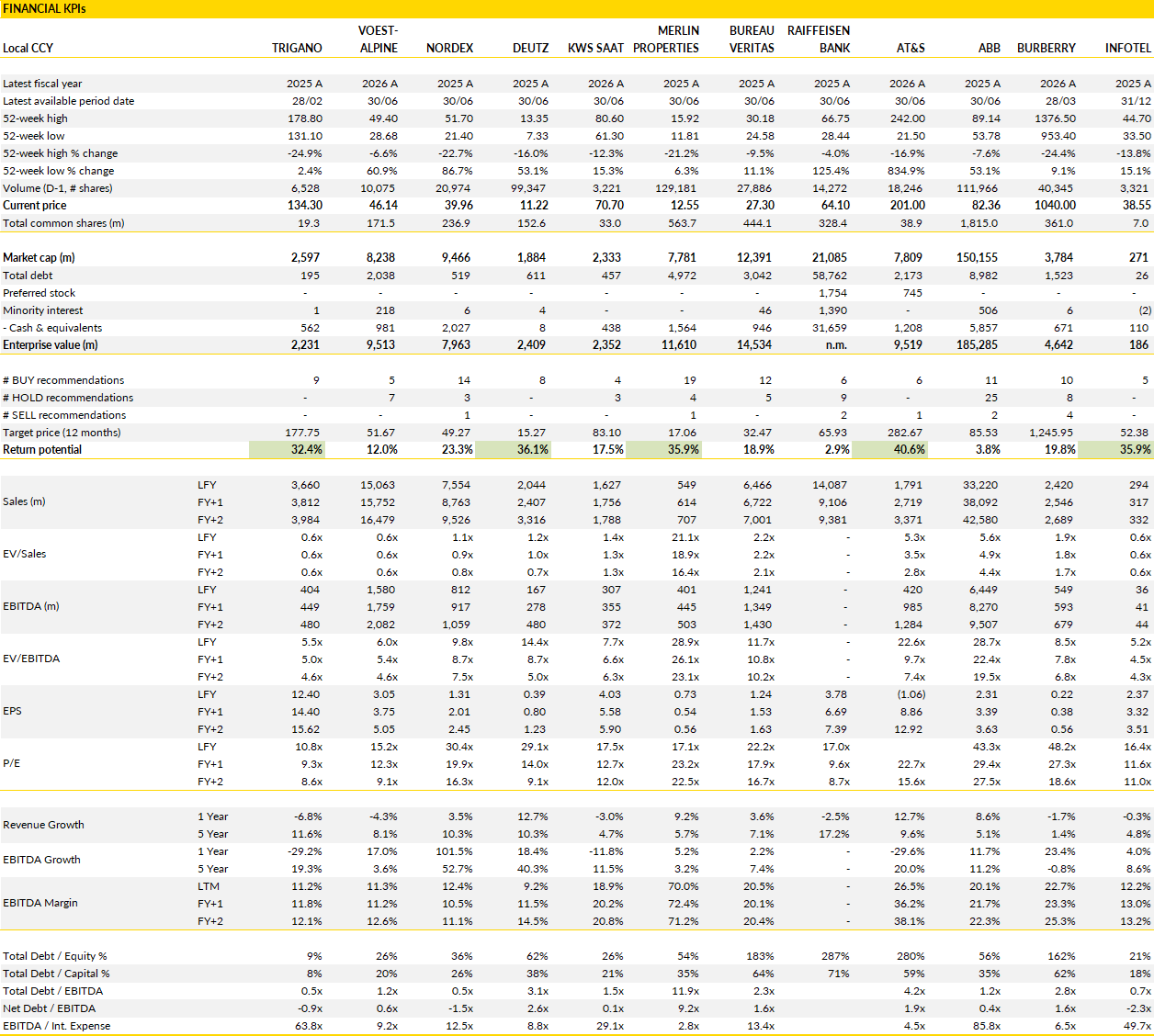
Financial KPIs
Companies covered in this edition: Trigano, voestalpine, Nordex, Deutz, KWS Saat, Merlin Properties, Bureau Veritas, Raiffeisen Bank International, AT&S, ABB, Burberry, Infotel
Trigano (TRI France): Production stays cautious
Trigano finished 2025/26 with sales of €3.8bn, up 3.8%, after Q4 revenue increased 2.1% to €858.4m. Motorhomes remain the main growth driver, accounting for 76% of group sales and growing 4.2% to €2.88bn for the year. Excluding integrated distribution, growth reached 7%, whereas integrated distribution declined 5%, partly reflecting more hesitant purchasing in France. Caravans recovered 14.7% from a weak comparison base. Mobile homes were less convincing: reported sales increased 2.9%, but like-for-like revenue fell 6.1% as lower prices and an unfavourable product mix weighed on a market that remains near the bottom of its cycle.
Despite these differences across categories, profitability has held up well. Management expects the underlying operating margin to finish close to 10%. Inventory was broadly stable, helping Trigano preserve a strong cash position even after substantial distributions to shareholders.
The early picture for 2026/27 is more cautious than the motorhome order book alone would suggest. Orders are growing, giving the company decent coverage for the first half, but management plans to keep H1 production broadly unchanged from last year. Customers remain hesitant in the current environment, and Trigano appears unwilling to build inventory simply because its order book permits higher output. This discipline has served the group well since the large post-pandemic destocking cycle across European recreational vehicles. Mobile-home activity is also expected to remain around last year's level. The Leisure Vehicle Show in Paris from 26 September to 4 October should provide a better indication of consumer appetite and dealer confidence for the new season. A stronger response could allow production to increase later in the year, but Trigano is starting with a conservative manufacturing plan until demand becomes clearer.
Cash generation gives the company considerable flexibility during this slower period. Net cash before IFRS 16 is expected to be around €500m despite €76m of dividends and €60m of share buybacks during the year. That balance sheet allows Trigano to keep returning capital without compromising its ability to manage a weaker recreational vehicle cycle or pursue opportunities in a fragmented industry. The second interim dividend of €2.40 per share follows the €2.10 distributed in April.
For now, it's mainly about protecting margins and cash while waiting for demand to improve. Motorhome orders suggest the underlying market is healthier than the flat H1 production plan might imply, but management is clearly choosing not to anticipate a recovery. If dealer inventories remain controlled and end-customer demand strengthens during the season, Trigano has room to lift production later.
voestalpine (VOE Austria): Railway Systems is leading the big portfolio shift
voestalpine is putting greater weight on the parts of the group that can generate attractive returns without relying heavily on the European steel cycle.
Management wants high-value-added businesses to account for more than 50% of the portfolio by 2030, up from approximately 45% in 2025, alongside a group ROCE target above 12%. Railway Systems illustrates the direction particularly well. The business generates an average ROCE of around 20% and holds strong positions across an integrated range of railway infrastructure products. Growth through 2030 is expected to come mainly from signalling, software and turnouts, complemented by a shift towards premium products within rails. Management currently intends to retain rail business, although it is keeping longer-term strategic options open. Its combination of high returns, specialised technology and structural infrastructure demand is making it an increasingly important contributor as voestalpine reduces its dependence on more volatile commodity steel activities.
There is also considerable scope to improve earnings within the existing portfolio. High Performance Metals generated €216m of EBITDA in 2024/25 and Metal Forming €218m, with management targeting approximately €400m for each division by 2028/29. Most of that improvement is expected to come from restructuring already undertaken, leaving only a modest contribution required from better end markets. This is important given that industrial conditions remain difficult. Conventional North American manufacturing is subdued despite heavy investment in technology and AI infrastructure, and Chinese growth continues to rely heavily on exports against weak domestic demand.
A strategic review is examining the role and performance of individual businesses, with further restructuring or disposals possible where activities cannot meet the group's return requirements. Capital allocation is being assessed against the 12% ROCE objective, creating a clearer hurdle for businesses that consume significant capital without delivering sufficient returns.
Decarbonisation remains a major investment requirement, but voestalpine is taking a more disciplined approach to the timing and scale of spending. Protecting the investment-grade balance sheet and maintaining consistent free cash flow have become central constraints on capital deployment. This should reduce the risk of pursuing expensive capacity or decarbonisation projects without adequate returns and gives portfolio optimisation a larger role in funding the transition.
The strategic direction is gradually changing the earnings mix: Railway Systems provides profitable structural growth, restructuring offers substantial recovery potential in High Performance Metals and Metal Forming, and weaker assets face greater scrutiny under the portfolio review. Steel production will remain fundamental to voestalpine, but a larger contribution from downstream and specialised businesses should reduce sensitivity to steel prices and European industrial production.
Nordex (NDX1 Germany): German regulation overshadows a strong market
Nordex remains confident in its 2026 guidance and its medium-term objective of reaching a 10-12% group EBITDA margin through the cycle.
Demand across its main onshore wind markets provides a solid foundation for further volume growth, with Germany, Turkey and North America all offering substantial project pipelines. Germany alone is expected to auction around 72 GW of new capacity through 2032, including approximately 52 GW by 2030, giving turbine manufacturers a relatively clear view of future installations. Nordex intends to expand broadly in line with its addressable markets instead of pursuing market share through aggressive pricing. North America has also returned as an important source of growth following the company's re-entry into the US last year. Around 16-23 GW of new US wind capacity has been safe-harboured under existing tax-credit provisions, and Nordex's local manufacturing footprint allows it to meet domestic content requirements. The combination of these markets should support higher turbine deliveries over the remainder of the decade.
Germany is also the source of the main near-term uncertainty. Changes to the EEG framework are expected to introduce a two-sided contract-for-difference remuneration model, while a separate grid package currently under discussion includes uncompensated curtailment and redispatch measures that could affect 18-20% of annual electricity production. Both proposals remain under parliamentary review, with greater clarity expected around late October or early November and implementation potentially starting in 2027. A transition period of four to six months could temporarily disrupt project development, although Nordex does not expect a lasting effect if auction volumes remain strong. Some consolidation among German developers appears possible as lower auction prices and higher financing costs put weaker operators under pressure. Nordex nevertheless expects projects that have already secured auction awards to proceed and believes turbine pricing can be defended. Higher auction prices over time would also improve project economics and reduce some of the pressure currently facing developers.
The expanding installed base is steadily increasing the importance of Service within the group. Every additional turbine delivered creates a long-duration maintenance opportunity, allowing the division to grow alongside the equipment fleet without relying solely on new turbine orders. Service generated a 19.1% EBIT margin over the twelve months to Q2 2026, and Nordex expects this to rise above 20% over time. A larger contribution from these activities should improve the quality of group earnings and provide some balance against the more cyclical turbine business.
Current industry conditions therefore remain supportive, with healthy auction pipelines, a recovering US presence and further margin potential in Service. The immediate complication is mostly regulatory though. Germany represents a major part of Nordex's future volume opportunity, so the final structure of the new remuneration and grid rules will influence project economics and the timing of orders. Once those rules are settled, the underlying market outlook remains consistent with Nordex's plan to grow volumes while moving towards its 10-12% group margin objective.
Deutz (DEZ Germany): FFG reshapes the group
Deutz has strengthened its balance sheet ahead of the FFG acquisition with a €179m capital increase, issuing 15.26m shares at €11.70 each. The placement increased the share count by 10% and should keep leverage below 2.5x net debt/EBITDA after the transaction closes, compared with the roughly 2.8x level indicated when FFG was announced in July. It should also reduce the financing burden attached to the acquisition and leave more room for further investment.
As reported earlier, FFG is being acquired for around €1.6bn, with the consideration split between approximately €0.6bn in Deutz shares and the remainder in cash and debt. Closing is expected in late 2026 or early 2027. The selling families will receive around 65m newly issued shares and can potentially acquire another 6.5m at €8.76 per share to maintain a 29.9% holding following Deutz's recent capital increase. If that option is exercised, the corresponding amount would reduce the cash component of the acquisition, leaving the total purchase price unchanged.
FFG changes the scale and earnings profile of Deutz enough that the existing 2030 targets are to become outdated soon after closing. The current plan calls for group revenue to double from €2bn in 2025 to around €4bn by 2030, alongside an increase in the adjusted EBIT margin from 5.5% to roughly 10%. Management has already indicated that consolidating FFG should allow those objectives to be reached earlier, potentially as soon as 2027, with profitability progressing faster than sales. An updated medium-term framework is therefore likely after completion of the deal and could extend the planning horizon to 2032.
This fits with the broader Dual+ strategy, under which Deutz has been reducing its dependence on traditional combustion engines and adding businesses with better growth and margin characteristics. FFG brings a sizeable new earnings base and accelerates that transition in a single transaction, although the much larger share count means the benefits need to be judged on a per-share basis as well as at group level.
The financing structure keeps that transformation manageable but comes with substantial dilution. Including the September placement, the shares issued directly to the FFG owners and the possible additional subscription by the families, Deutz's share count could ultimately reach around 239.5m, roughly 57% above the level before the transaction was announced. In exchange, shareholders get a much larger group with a lower debt burden than initially expected and less pressure on the balance sheet during the integration period.
It's now about converting that larger platform into higher margins and cash generation. The first important indication should come with the revised medium-term targets after FFG closes. If management confirms that the original €4bn sales and 10% margin ambitions can be reached several years early, the acquisition will have moved Deutz well beyond the scale envisaged when Dual+ was originally set out.
KWS Saat (KWS Germany): Reset
KWS Saat closed 2025/26 with a weak fourth quarter that pulled full-year organic sales growth down to -1%, compared with growth of 2.6% after nine months.
Revenue reached €1.64bn, with the shortfall concentrated mainly in sugar beet and corn seeds. EBITDA declined 2% to €343m, including €29m of income from corn licence sales. Excluding this contribution, the EBITDA margin was 19.3%, at the bottom of the company's 19-21% guidance range. Q4 was particularly soft, producing an EBITDA loss of €44m compared with a €10m loss in the prior-year period, partly reflecting a mid-single-digit million euro provision for legal risks. The deterioration late in the year shows how difficult agricultural markets remained despite a relatively resilient performance through the first nine months. KWS nevertheless proposes a dividend of €1.30 per share, an increase of €0.05.
Management expects conditions to improve during 2026/27 and is guiding for organic sales growth of around 3%. This recovery should be broad but uneven. Cereals and vegetables are expected to grow strongly, with more modest increases in corn and sugar beet. Profitability will take longer to recover, with KWS guiding for an EBITDA margin of 19-20%. This compares with an underlying 2025/26 margin of 19.3% after removing the corn licensing income, suggesting that the coming year is mainly about rebuilding sales (without assuming a large improvement in operating leverage).
The company is so starting the new fiscal year from a lower earnings base than appeared likely before the weak Q4. Better agricultural demand should help volumes, but the guidance leaves limited scope for a rapid margin rebound and implies that cost discipline will remain important as KWS works through the current market cycle.
Vegetables will receive greater attention at the capital markets day on 29 September. The business remains in an investment phase, with significant R&D spending required before it can make a meaningful contribution to group profitability. Building a competitive seed portfolio takes years of breeding, testing and commercial development, so the current earnings burden needs to be assessed against the longer-term opportunity to diversify KWS beyond its established crop categories.
The upcoming presentation should clarify the development of the product pipeline and the path towards profitability. Elsewhere, the expected improvement in cereals, corn and sugar beet gives the group a more solid sales backdrop for 2026/27, but the subdued margin target shows that management is allowing for a gradual recovery. After the abrupt weakening in Q4, evidence of better agricultural demand and progress in Vegetables will be needed.
Merlin Properties (MRL Spain): Portugal provides a data centre fallback
Merlin Properties faces a new regulatory complication for its Spanish data centre expansion after the government published a draft Royal Decree in August. The proposal would require new facilities above 1 MW to source at least 80% of their electricity from newly developed renewable generation, matched on an hourly basis. It also introduces demanding efficiency requirements, including a PUE below 1.15 and WUE below 0.1 L/kWh.
The draft has met substantial resistance, generating almost 600 submissions and criticism from data centre operators, energy companies and regional governments. Industry participants are pushing for the renewable requirement to be reduced to 35% and for projects that are already authorised or under construction to receive greater protection. The consultation process is likely to delay the final rules until late 2026 or early 2027. With the text still under discussion, there is considerable scope for the final framework to differ from the initial proposal.
For Merlin the immediate exposure appears manageable but is large enough to affect the timing and location of future investment. Around 30% of the 724 MW of IT capacity planned across phases I to III could be affected under the original wording. This includes 30 MW at MAD-TC I in Madrid and 162 MW associated with the third phase in Bilbao, while later phases would also need to be reassessed. Management believes any disruption would be partial and temporary, partly because Merlin has an alternative route through Portugal. The group has around 1 GW of potential IT capacity in Lisbon and says it can accelerate development there if Spanish regulation becomes too restrictive. Portugal could therefore absorb a meaningful part of the expansion originally intended for Spain, preserving Merlin's ability to participate in growing Iberian data centre demand even if the geographic mix changes. Management's recent purchase of roughly €500k of Merlin shares also indicates confidence in the longer-term plan despite the regulatory uncertainty.
The final wording of the decree will determine how much reshuffling is actually required. Spain remains attractive for data centres because of renewable power availability and Merlin's existing sites and infrastructure, so moving projects is unlikely to be the first choice. At the same time, an 80% hourly matching requirement tied specifically to new renewable generation could make some developments considerably harder to execute. Lisbon gives Merlin a practical alternative instead of leaving the group dependent on a regulatory compromise in Spain. The current Spanish projects are not being abandoned, and the large number of objections to the draft increases the possibility of changes before adoption.
If the rules remain close to their original form, Portugal can take a larger share of Merlin's data centre investment. If they are softened, the existing Spanish pipeline can proceed with less disruption. Either outcome leaves the broader data centre strategy intact, although tougher Spanish regulation could slow the ramp-up and reduce returns on some projects.
Bureau Veritas (BVI France): Growth ambitions move higher
Bureau Veritas is moving beyond the portfolio simplification of recent years and plans to accelerate growth in 2027-28, targeting double-digit expansion (excluding currency effects).
The recent CMD showed highlighted how margin improvement remains an important part of the plan. The company targets a 180bp increase in gross margin by 2028, including 150bp from organic measures, and expects the cumulative improvement to reach 110bp in 2026. Around 115bp of the targeted organic gains have already been secured through operating leverage and efficiencies in support functions. Further progress should come from a better business mix, productivity initiatives and wider use of AI.
The shift in emphasis towards growth follows the completion of most planned disposals and leaves Bureau Veritas with a more focused portfolio and greater scope to deploy capital. Cross-selling is another priority, particularly across defence, sustainability, mining and Mission Critical Assets, where existing customer relationships can support the introduction of additional inspection, certification and technical services.
Acquisitions will play a larger role from here. The outsourced testing, inspection and certification market remains fragmented, with the ten largest participants controlling only around a quarter of the market and Bureau Veritas holding approximately 3.7%. Management intends to pursue bolt-ons and potentially medium-sized transactions that add technical capabilities, strengthen local market positions or extend the geographic network. Renewable energy, cybersecurity, technology and services linked to the energy transition are among the areas identified for expansion. H1 leverage of 1.45x leaves capacity for additional transactions, and Bureau Veritas has set a leverage range of 1.5-2.0x while maintaining discipline on acquisition prices.
Mission Critical Assets offers a particularly large opportunity. Revenue from the activity is currently around €300m and is targeted to reach €800m by 2030, supported by data centres, semiconductor facilities and specialised industrial sites. The LotusWorks acquisition provides expertise that can be deployed more widely across the group, including recurring maintenance and operating services after facilities have been commissioned.
AI is relevant both as a customer market and as a tool for improving Bureau Veritas' own operations. Together with Digital Assurance, where management targets €200m of revenue by 2030 from around €70m currently, the company is aiming for approximately €1bn of AI-related revenue by the end of the decade. Internally, applications such as Smart Cert are digitalising workflows from the initial sales process through certification and invoicing, reducing reporting time and allowing inspectors to handle more work.
Management does not envisage using automation primarily to reduce headcount. The objective is to allow employee numbers to grow more slowly than revenue while retaining the human judgement required to issue independent certifications for which Bureau Veritas carries responsibility. This creates scope for productivity improvements without fundamentally changing the labour-intensive nature of the TIC model.
With most portfolio exits completed, acquisition capacity available and margin initiatives already well advanced, it's now about scaling higher-growth technical services and using the existing global network more intensively.
Raiffeisen Bank International (RBI Austria): Rasperia ruling removes a major hurdle
Raiffeisen Bank International has secured a highly favourable Austrian court decision in its dispute with Rasperia Trading, bringing the bank materially closer to recovering value from assets frozen under EU sanctions.
The Vienna Regional Court for Civil Matters is set to issue a default judgment ordering Rasperia to pay €3.15bn in damages, equal to the full amount sought by RBI when it initiated proceedings in Austria. Rasperia now has four weeks to appeal before the judgment becomes final. RBI can subsequently apply to Austria's Financial Market Authority for permission to release Rasperia's frozen Austrian assets and use them to satisfy the claim. These assets principally comprise 28.5m STRABAG shares, together with accumulated dividends dating back to 2011 and cash resulting from STRABAG's March 2024 capital reduction. The ruling has also arrived considerably faster than originally envisaged. RBI initially indicated that Austrian proceedings of this nature could take 12-18 months, before becoming more confident during the summer that a decision might be reached within roughly six months.
The €3.15bn judgment should not be treated as an equivalent cash recovery at this stage. Rasperia can still challenge the decision, and a final judgment would then need to be followed by regulatory approval to unfreeze the relevant assets. Their ultimate cash value will depend heavily on the value and disposal process for the STRABAG stake. The 28.5m shares represent a substantial holding, so monetisation could take time and may require a structured solution instead of an immediate market sale.
Sanctions add another layer of complexity because the assets cannot simply be transferred or sold without the necessary Austrian authorisations. Nevertheless, the legal position has improved considerably. RBI has obtained a judgment for the entire amount claimed, while the existence of identifiable Austrian assets provides a potential route to enforcement if the ruling becomes final. The remaining uncertainty has consequently shifted towards appeal, sanctions clearance and monetisation rather than the validity of RBI's underlying damages claim in Austria.
Resolution of Rasperia would remove one of the larger legal uncertainties surrounding RBI at a time when the bank is also reducing its exposure to Russia. RBI's next milestones are relatively simple now: expiry of the four-week appeal period, any subsequent legal proceedings if Rasperia contests the judgment, approval from the FMA to release the frozen assets and finally conversion of those assets into cash or another form that can satisfy the award.
Each stage can still delay the eventual recovery, but the Austrian proceedings have advanced much further and faster than appeared likely only a few months ago. A successful enforcement would strengthen RBI's capital position and further reduce the financial significance of the legacy disputes connected with Russia.
AT&S (ATS Austria): Marvell filling another Kulim line
AT&S has secured Marvell as a new customer for its Kulim 2 facility in Malaysia, adding another major semiconductor company to the advanced IC substrate business. The agreement covers additional production capacity backed by long-term commitments and is linked to the continued ramp-up of Kulim 2 and the associated Core plant. Of the five production lines available at Kulim 2, four are now committed, leaving only one without a customer. Marvell's addition also reduces AT&S's historical dependence on a relatively small number of large customers.
More significant is the type of semiconductor demand Marvell brings. Its exposure to custom accelerators, ASIC processors and networking products puts AT&S closer to areas benefiting directly from AI infrastructure spending, including the diversification of computing architectures beyond the largest incumbent accelerator platforms. These applications require increasingly sophisticated substrates as chip packages become larger, incorporate more layers and move towards more complex 3D designs.
Production for Marvell is expected to begin in 2028, so the agreement has little bearing on the current financial year but increases the utilisation potential of the substantial capacity AT&S has built in Malaysia. The economics of Kulim improve materially as additional lines are filled because much of the manufacturing infrastructure is already in place. The Marvell line should ramp progressively after production begins, with a larger contribution once utilisation reaches normal levels.
Securing customers before the facility is fully operational also reduces the commercial risk attached to the investment program. AT&S had committed significant capital to advanced substrates ahead of the current AI investment wave, creating considerable execution and balance-sheet pressure during the construction phase. Four contracted lines now provide a clearer route towards using that capacity. The remaining fifth line offers another opportunity to add a major semiconductor customer without requiring a comparable new site investment.
The underlying substrate market is benefiting from changes in semiconductor architecture that extend beyond simple growth in chip volumes. Larger dies, chiplets, 3D packaging and increasingly complex accelerator and networking designs require greater substrate area and more demanding manufacturing specifications. This increases the value of the substrate content attached to each high-end processor and raises the technical barriers for suppliers. AT&S already has relationships with major computing customers, and Marvell widens its exposure towards custom silicon and networking infrastructure.
Further upside to the industrial plan could come from contracting the final Kulim 2 line, expanding into power-electronics and photonics PCBs, or eventually developing additional capacity at Kulim.
ABB (ABBN Switzerland): Electrification keeps accelerating
ABB is heading into Q3 results with another strong order environment, led by Electrification as investment in data centres and power infrastructure continues to expand. The strength extends beyond hyperscale computing, with utilities and shorter-cycle electrical markets also contributing.
Automation remains healthy, particularly in Marine & Ports, despite weaker conditions in process industries such as chemicals and pulp and paper, while Motion continues to benefit from steady demand. The resulting order intake should remain comfortably ahead of revenue, adding further to an already elevated backlog. Sales growth is also expected to stay firmly in double digits, with Electrification again the largest contributor. Pricing remains positive at around 2%, adding to the volume benefit. ABB is consequently well placed to reiterate its 2026 objectives of a book-to-bill ratio above 1x, low-double-digit to low-teens comparable revenue growth and a further improvement in the operational EBITA margin from 2025.
Electrification has developed into the main growth engine and is also benefiting from an increasingly favourable product mix. Data centres require much greater electrical content as computing density increases, creating demand across power distribution, protection and control equipment. ABB will provide more detail on this opportunity, including the transition towards 800 VDC architectures and its new Infinitus product range. These technologies are designed for the higher power requirements associated with next-generation AI infrastructure.
Utility investment provides a second source of structural demand as grids need additional capacity and resilience to accommodate electrification and rising power consumption. This breadth reduces reliance on data centres alone and supports continued expansion in Electrification even if individual end markets become more volatile. Higher volumes are also translating efficiently into earnings, with divisional margins continuing to benefit from scale and mix.
The larger backlog gives ABB a strong(er) starting point for 2027, particularly in businesses where customers are committing to projects well ahead of delivery. Electrification remains central, but Marine & Ports and Motion provide additional support as Process Automation works through weaker industrial markets. The disposal of Robotics will further simplify the portfolio once completed and increase the relative weight of businesses exposed to electrical infrastructure and industrial automation. Margin progression remains an important part of the current performance, with operational leverage allowing profit to grow faster than revenue despite already high profitability.
ABB's near-term operating story is thus characterised by unusually strong order intake, continued double-digit sales growth and further margin expansion. Data-centre investment is the most visible source of incremental demand, but utility spending, electrification and several industrial applications are contributing as well, giving the backlog a broader base than the AI infrastructure cycle alone.
Burberry (BRBY UK): Recovery meeting a softer luxury market
Burberry's recovery is running into a less supportive luxury market after a relatively encouraging first quarter. The company has not disclosed Q2 trading ahead of its half-year results on 12 November, but conditions have weakened across several important markets.
US luxury spending has slowed, China's economic backdrop remains difficult and Europe and Japan are seeing less support from Chinese tourism. Japan also faces much tougher comparisons after a strong period last year. Burberry may still fare reasonably well against the broader soft-luxury sector in the US and China, helped by the low base created during its earlier downturn, although maintaining Q1 growth rates of 12% in the Americas and 9% in Greater China looks increasingly difficult. Cost control offers some protection, with management still targeting broadly flat operating expenses for 2026/27. That should limit the earnings impact if retail growth moderates over the coming quarters.
The question now is how quickly Burberry can rebuild margins after several years of strategic changes and uneven execution. The brand has historically generated operating margins around 20%, and management still sees a return towards those levels as a long-term objective. Getting there requires a sustained recovery in sales because much of the cost base cannot be reduced indefinitely without weakening the brand, stores or marketing. Recent progress has shown that demand can respond when Burberry puts greater emphasis on recognisable British products and a clearer brand identity, but the external environment now makes the next part of the turnaround harder. Europe remains affected by tourism trends, China is unlikely to provide the growth contribution it did during earlier luxury cycles, and the US is normalising after a stronger period. With operating expenses being held roughly flat, higher sales should still generate useful leverage, but the pace of improvement depends increasingly on Burberry gaining traction within a sluggish category.
This leaves Burberry in an awkward part of the recovery. The initial stabilisation has been achieved, yet profitability remains well below historical levels and the market backdrop offers little help in closing that gap quickly. Continued growth in Greater China and the Americas would show that the brand changes are gaining traction even in softer conditions, while weakness in those regions would make the margin rebuild much slower. Japan and European tourist spending are likely to remain volatile in the near term. Flat operating costs give Burberry some room to rebuild earnings if sales keep growing, but a return towards its historical profitability will ultimately require several years of healthier revenue growth and stronger operating leverage.
Infotel (INF France): Growth acceleration (again)
Infotel has raised its 2026 revenue growth target to 9.5% from more than 5% after a strong first half, pointing to better momentum through the rest of the year than the previous guidance suggested.
H1 revenue increased 9.4% to €160.3m, including around 8.5% organic growth, with software contributing positively to the mix alongside continued expansion in IT services. Current EBIT after share-based compensation rose 31.7% to €13.3m, lifting the margin by 140bp to 8.3%. Excluding share-based compensation, adjusted EBIT reached €14.6m and the margin increased to 9.1%. Part of that improvement came from lower G&A expenses, with the EBITDA margin rising by a more modest 20bp to 11%. Higher subcontracting costs in IT services absorbed some of the benefit from the richer software mix. Net profit reached €11.7m, although the year-on-year increase was amplified by a one-off financial charge in the prior period.
The upgraded guidance is particularly encouraging because H2 faces tougher comparisons, especially towards the end of the year. Reaching 9.5% reported growth for 2026 after the H1 performance implies that underlying activity needs to remain healthy, with IT services expected to contribute more strongly. Profitability guidance looks comparatively conservative: Infotel is targeting a current operating margin excluding share-based compensation above 9%, already broadly achieved in the first half despite the normal seasonal benefit from H2. Cost control should help, but the composition of growth will also be relevant. Software carries better profitability than services, whereas greater reliance on subcontractors can dilute the incremental margin from higher IT services revenue. Infotel nevertheless starts the second half with a strong balance sheet. Net cash stood at €94.3m at the end of June after dividends and share repurchases, and cash generation is traditionally stronger later in the year.
In the longer term, the company wants to reach roughly €500m of revenue by 2030 with a recurring operating margin close to 10%, requiring a sizeable expansion from today's revenue base without sacrificing the margin gains already achieved. The first half suggests that the company is moving that way, with organic growth running well ahead of its original expectations and operating expenses being managed tightly. Its cash position also gives it room to accelerate the plan through acquisitions or return additional capital if suitable opportunities do not emerge.
The main operational challenge is whether faster IT services growth can be delivered without subcontracting costs taking too much of the benefit. For 2026, however, the combination of the substantial revenue guidance increase, a margin already above 9% before share-based compensation and €94m of net cash leaves Infotel in a stronger position than it entered the year.