
Chocolate, brakes and CMD reflections
OPmobility, BMW, Eurofins, Carvolix, Knorr-Bremse, Indra Sistemas, Lindt & Sprüngli, Nestlé, TF1, Legrand, Groupe SEB

At Lux Opes, we break down companies into quick takes that get straight to the point - what is happening, why it matters, and what to watch next. We publish 2-3 times per week, depending on the news flow.
For the best reading experience, we recommend reading at Lux Opes
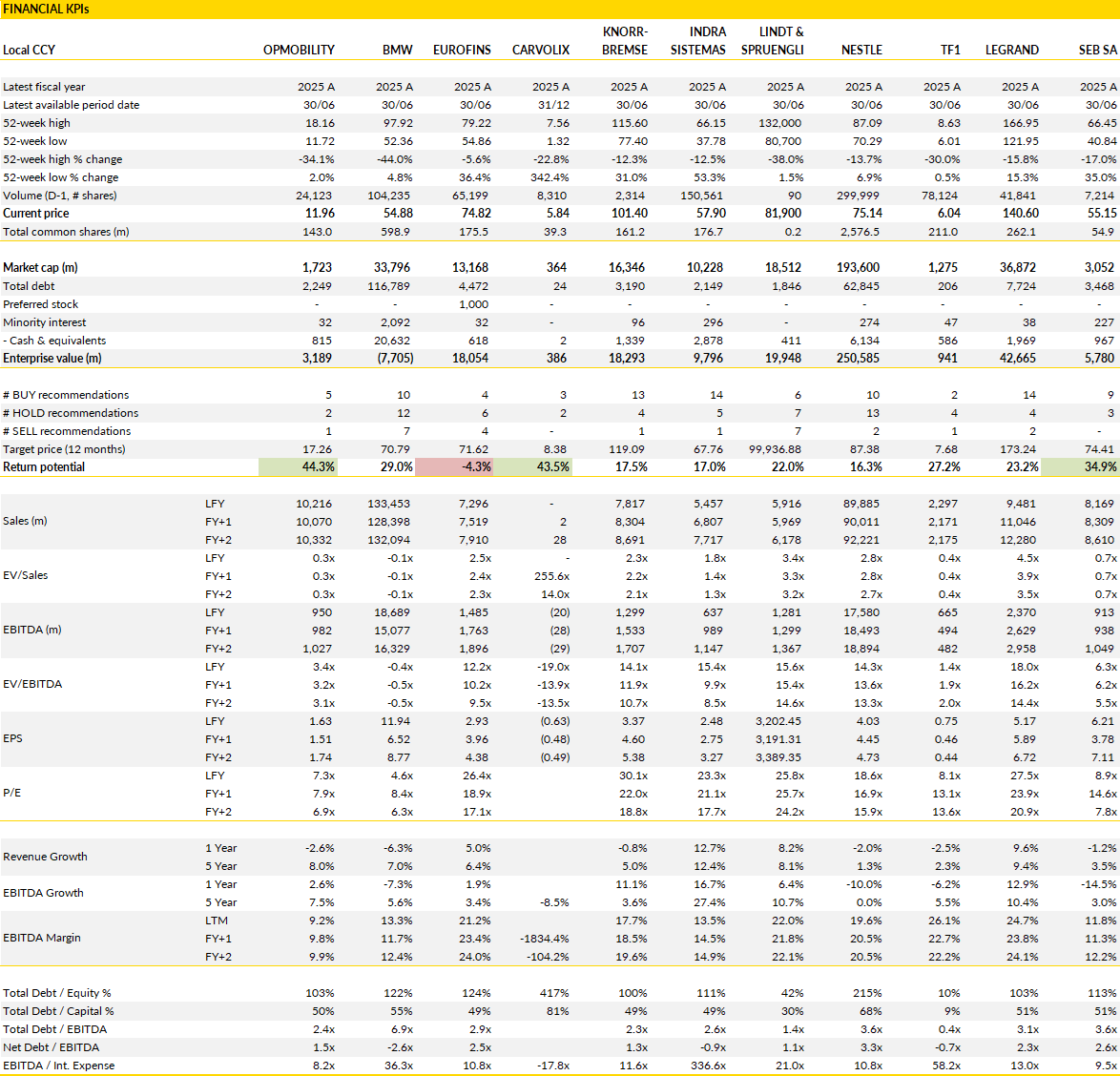
Financial KPIs
Companies covered in this edition: OPmobility, BMW, Eurofins, Carvolix, Knorr-Bremse, Indra Sistemas, Lindt & Sprüngli, Nestlé, TF1, Legrand, Groupe SEB
OPmobility (OPM France): A boost to Lighting
OPmobility is making a substantial expansion in automotive lighting with the acquisition of Hyundai Mobis' entire lighting business for an enterprise value of around €390m.
The acquired operations generated close to €1.6bn of revenue in 2025 and are already profitable, immediately changing the scale and economics of a Lighting division that currently generates a much smaller revenue base and remains slightly loss-making. The deal includes five manufacturing plants spread across Mexico, China, the Czech Republic and South Korea, giving OPmobility a broader production footprint across three major automotive regions. Completion is scheduled for H2 2027. The final scope is also larger than initially contemplated, as earlier discussions had included the possibility of OPmobility taking only a majority interest.
The industrial rationale is simple. Hyundai and Kia account for more than 90% of the acquired business, giving OPmobility a much deeper commercial relationship with two important global manufacturers. This concentration is an obvious risk, but the acquisition also gives the group access to programs and customer relationships that would have been difficult to build organically at comparable scale. OPmobility had spent several months conducting due diligence, with the future program pipeline particularly important given the dependence on Hyundai/Kia.
Geographically, the assets complement the group's existing operations and increase its lighting presence across Asia, Europe and North America. Bringing the two businesses together should also create opportunities across manufacturing, development and technology. For the existing Lighting division, the impact is significant: a relatively small and currently unprofitable activity becomes part of a much larger operation with positive margins and a considerably wider industrial footprint. The acquisition is as such a practical route to improving the division's profitability alongside the increase in scale.
Financing appears manageable. Management stated that the €390m purchase will not derail its debt-reduction trajectory. The purchase price seems also modest relative to the €1.6bn revenue base being acquired, although the heavy Hyundai/Kia exposure and the economics of automotive lighting need to be considered when assessing that price.
Execution will be the bigger issue over the next several years. OPmobility has until H2 2027 before completion and will then have to integrate five plants, protect the Hyundai/Kia program pipeline and improve the performance of its existing lighting activities. If that process goes well, Lighting will emerge as a much larger part of the group with better geographic coverage and a stronger earnings base.
BMW (BMW Germany): All about them cost reductions
BMW's first strategy update under CEO Milan Nedeljkovic acknowledges that restoring profitability will take considerably longer than previously planned.
The company now targets an Automotive EBIT margin of 3-5% in 2028, with the return to its longer-term 8-10% range pushed into the beginning of the next decade. The new plan keeps several established elements of BMW's strategy intact, including flexible manufacturing, technological neutrality and local production across its global footprint. The bigger changes concern how cars are developed and sourced. BMW intends to simplify its model range, buy more standard components from suppliers instead of engineering them internally and increase local sourcing in China. Germany is also undergoing workforce restructuring, with 2026 absorbing €1.4bn of associated costs. These measures should gradually lower the group's fixed and development cost base, although much of the benefit will only become fully apparent towards the end of the decade.
The relatively modest 2028 margin objective indicates that management expects some of the savings to be absorbed elsewhere in the business. Restructuring alone is currently costing around 1.25 percentage points of Automotive margin, and BMW expects a two-year payback on those measures. Another benefit will come from the reduction of purchase-price-allocation amortisation related to the Chinese joint venture. Yet the 2028 target only represents a moderate recovery from the roughly 2% Automotive margin expected for 2026, suggesting that pressures from China, product mix, pricing and input costs could continue to offset part of the improvement.
China is particularly important because BMW is simultaneously dealing with weaker market conditions and changing its industrial model there. Greater reliance on Chinese suppliers should improve local cost competitiveness over time, but the transition will not produce an immediate earnings recovery. The upcoming product cycle provides a more immediate source of support, with the new i3, X5 and iX3 among the models expected to contribute during 2027.
Cash generation is being treated more aggressively. BMW is targeting €5bn of Automotive free cash flow in 2028, a level that will require a meaningful improvement in cash conversion alongside lower investment requirements. This suggests capital expenditure will become an important part of the restructuring effort as the company simplifies development and reduces complexity across the portfolio. Management has not committed to a higher dividend payout and provided no additional detail on future share repurchases, leaving capital returns dependent on progress over the next two years and the eventual supervisory board decision.
The picture is clear after the first da of the CMD: BMW intends to run a simpler development organisation, reduce its German cost base and adapt sourcing more closely to individual markets. The financial benefit will take time to build, however, and the gap between the 2028 margin target and the longer-term 8-10% ambition remains substantial.
Eurofins (ERF France): Biopharma recovery remains delayed
It seems Eurofins' Q3 will be in line with the underlying trends seen earlier this year. Life remains the strongest part of the group and has continued to improve after adverse weather affected activity during Q1. Biopharma is developing more slowly, with management seeing no significant change since Q2. The company still expects conditions to improve gradually from the end of 2026 as already-signed contracts begin contributing and comparisons become easier. Financing conditions for biotech customers remain a constraint, however, and delays affecting individual contracts have also held back growth. Diagnostic Services faces a separate issue in France, where discussions over pricing remain unresolved.
Calendar effects should provide a modest benefit of around 30bp in Q3 and twice that amount in Q4, while currencies are expected to be slightly supportive following the recent strengthening of the dollar. The Q3 release on 21 October will therefore be primarily about whether Biopharma has started to move beyond the subdued growth seen during the first half.
Management continues to target mid-single-digit organic growth for 2026 alongside approximately €250m of acquired revenue. The profitability objective is for the margin to exceed the 22.5% achieved in 2025, accompanied by lower separately disclosed items and stronger free cash flow. These targets imply that Eurofins can continue improving earnings even if the revenue recovery remains uneven between activities. Life is already providing a solid contribution, whereas the timing of the expected Biopharma acceleration remains uncertain. The latter has considerable importance because signed contracts should eventually provide an identifiable source of additional activity, but the external funding environment for smaller biotech companies is outside Eurofins' control. Diagnostic Services also needs to deliver more durable structural growth, with the French pricing discussions adding some uncertainty to the near-term development of that business. Q3 alone may therefore provide limited evidence on the eventual pace of the recovery, particularly as management expects the Biopharma improvement to begin only towards year-end.
Capital allocation is becoming more active in the meantime. Eurofins has considerable flexibility under its share repurchase mandate, including the ability to acquire larger blocks, and purchases accelerated sharply during September. In the second week of the month alone, the company bought 1.422m shares, equivalent to around 0.8% of its outstanding capital. The faster pace of repurchases provides another use for cash as operating profitability improves, although the underlying business trajectory remains the more important issue.
Eurofins has already outlined a path towards higher margins and cash generation, and the Life business appears to be progressing well enough to support that objective. Biopharma still needs to contribute more meaningfully if group organic growth is to return to the level management is targeting. Signed contracts provide a basis for improvement, but there is not yet enough evidence to judge how quickly they will translate into revenue.
The upcoming Q3 update should help establish whether the expected year-end inflection is beginning to appear.
Carvolix (CVX France): Regulatory milestones approach
Carvolix is moving several programs towards regulatory approval at the same time, resulting in a predictable increase in spending ahead of potential commercialisation.
The H1 operating loss widened to €14.4m from €9.1m, while operating cash burn almost doubled to €13m. Much of the additional expenditure relates to faster development of TAVIPILOT and the integration of Artedrone and Caranx Medical, including completion of clinical work and preparation of regulatory submissions. The €7m of cash and liquid investments reported at June understates the subsequent funding position. Carvolix had already raised €20m during H1, with Edwards Lifesciences and Truffle Capital among the investors, and added a €30m bond financing from Claret Capital Partners in August. Drawing the first tranche extends the company's financing horizon to February 2027, while full utilisation would take it to October 2027. That gives Carvolix funding through several important regulatory decisions, although further capital requirements will depend on the pace and cost of the commercial rollout.
TAVIPILOT is the most advanced opportunity. In the 30-patient SAITO dataset, procedures were completed successfully in every case and valve placement was within 1mm of the intended target for all patients, with procedure times reduced by as much as 50%. Separate clinical experience with the robotic system includes successful use in the ten patients enrolled in its initial first-in-human study, while seven patients have so far been treated in the SAIRO trial. Regulatory submissions have progressed alongside the clinical work. The CE-mark application has been filed for the software, with certification expected before year-end and a European commercial launch planned for early 2027. In the US, the robotic system has already been submitted to the FDA, with a decision expected early next year. Commercial preparation is occurring in parallel through a controlled introduction of the software at selected US centres, including ten initial procedures performed at Rush University Medical Center. These activities should give Carvolix practical experience with physician adoption and workflow integration before a broader launch.
Other assets provide additional opportunities beyond TAVIPILOT. Kalios has produced encouraging longer-term results, with all 15 patients assessed at three years showing mitral regurgitation of 2+ or below and no device-related adverse events. A US regulatory filing is planned during 2027. The broader development portfolio also includes Mitrapilot, Artedrone and Artus, although these programs remain behind the immediate TAVIPILOT regulatory timetable.
The next several months are unusually important because Carvolix could move from predominantly clinical development into initial commercial activity if the pending approvals arrive on schedule. European software certification is expected first, followed by the US decision on the robotic platform and the planned European launch, with Kalios adding another regulatory milestone later in 2027. Financing has been strengthened sufficiently to reach the first of these events, but commercial execution and future funding needs will become increasingly relevant once approvals begin arriving.
Knorr-Bremse (KBX Germany): Orders remain healthy
Knorr-Bremse should enter the final quarter with a healthy order book and further progress on profitability, despite some uneven demand across its end markets.
The company raised its 2026 guidance at Q2 and currently targets revenue of €8.1-8.3bn, an operating EBIT margin of 14-14.5% and free cash flow of €750-850m. Rail remains affected by weakness in freight markets in the US and Europe, where freight accounts for around 20% of divisional revenue, while project delays in India are creating an additional temporary drag. Trucks are developing more favourably, helped by North America and an easier comparison with last year. The difference between the two divisions should also be apparent in order intake, with truck bookings likely to grow much faster after the weakness of the previous period. At group level, orders should remain ahead of revenue, keeping book-to-bill above 1 and providing a good starting point for 2027.
Profitability is progressing despite the softer areas within Rail. The division's operating EBIT margin should continue to improve from Q2 levels, reflecting the benefits of the operational measures implemented over the past several years. Commercial Vehicles is also generating better margins as volumes recover. This gives Knorr-Bremse scope to improve group profitability even without particularly strong revenue growth, and the 14-14.5% full-year margin target remains achievable on the current trajectory. The quality of the improvement is important because freight weakness and Indian contract delays are limiting the contribution from Rail at present. A stronger truck cycle can compensate for some of that pressure, but further margin gains also depend on continued cost discipline and execution within both businesses. Free cash flow guidance of €750-850m adds another indication that the earnings improvement is translating into cash rather than relying solely on accounting margin expansion.
The order picture provides the clearest indication of how growth could develop from here. Rail has a large installed base and substantial exposure to long-duration passenger projects, leaving the current freight weakness concentrated in only part of the division. India should also recover once delayed contracts begin moving again. Commercial Vehicles has a more cyclical profile, but a recovery in truck production would add volume to a business that has already improved its underlying profitability.
Knorr-Bremse therefore does not need all of its markets to recover simultaneously to keep earnings moving forward. The immediate Q3 figures may show Rail revenue progressing more slowly than Trucks, but continued margin improvement in both divisions would demonstrate that the restructuring work is holding up under different demand conditions. With orders remaining above sales and management having already increased its annual targets earlier in the year, the main operational question is how much additional growth the existing backlog and a recovering truck market can provide during 2027.
Indra Sistemas (IDR Spain): Cutting management
Indra has made a broad management reshuffle ahead of the new strategic plan scheduled for 25 November, reducing its executive committee to ten members and simplifying responsibilities across the group.
Five senior executives are leaving, including the heads of International and Indra Space alongside Chief Technology Officer Manuel Escalante, Chief Strategy Officer Manuel Ausaverri and the executive responsible for Organisation. Most responsibilities are being reassigned internally. CFO Miguel Forteza adds M&A and management control to his remit, Frank Torres becomes COO and General Counsel David Santos takes on the role of Technical Secretary-General. Víctor Martínez will oversee both Mobility and air traffic management, while Juan Ramón Hernández has been appointed Managing Director of the combined Defence and Space activities. Strategy, Technology and Product becomes a new division under the CEO temporarily while Indra searches externally for a permanent head. The extent of the reshuffle is significant, but reliance on existing executives for most of the new roles should reduce operational disruption.
The organisational changes also give some clues about how Indra intends to run its increasingly international portfolio. Combining Defence with Space should make cooperation easier where the activities naturally overlap, particularly around Hisdesat, although a substantial part of the Space business remains exposed to civilian applications. The decision is notable given the scale of Indra's ambitions in Defence and the management attention required to deliver them. International operations are being handled differently: the previous standalone structure disappears and overseas activities will sit directly within the relevant operating businesses. That should create clearer responsibility as Indra expands internationally across areas including air traffic management, Minsait and Defence. Mobility, which represents around 7% of group sales, is being paired with ATM after previously sitting within Minsait. Its repeated movement within the organisation indicates that Indra is still determining the most appropriate long-term home for an activity that remains relatively small within the overall group.
The reshuffle comes during a period of broader change at Indra and may prepare the organisation for decisions that will be presented with the November strategy. A smaller executive committee with more clearly allocated operating responsibilities could make decision-making faster, particularly as the company expands Defence and manages a wider international footprint.
At the same time, the changes do not amount to a wholesale replacement of the management team. Internal promotions dominate the new structure, preserving experience within the businesses even as responsibilities are consolidated. The most consequential changes concern the way activities interact: Space is brought closer to Defence, international management is embedded within individual divisions, and several corporate functions are combined under fewer executives.
The November strategic plan should clarify whether this structure is primarily intended to improve execution or forms part of a wider portfolio reorganisation.
Lindt & Sprüngli (LISN Switzerland): Volume recovery moves further out
Lindt & Sprüngli recently lowered its 2026 organic growth expectations for the second time this year, with the volume recovery anticipated by management taking longer to materialise.
More significantly, the company has pushed the return to its established 6-8% organic growth range out to 2028. The weaker volume response raises questions about how much further pricing can contribute after several years of unusually high cocoa inflation and substantial increases in chocolate prices. Lindt has historically combined premium positioning with consistent volume expansion, allowing it to grow well ahead of the broader confectionery market. The current environment is testing that model as consumers adjust purchasing behaviour following successive price increases. Management still expects volumes to begin recovering, but the repeated revisions during 2026 suggest the process is proving slower than initially anticipated. Restoring customer volumes therefore becomes increasingly important as pricing contributes less to reported growth.
Profitability has held up better than sales momentum. Lindt continues to expect its underlying operating margin to improve by 20-40bp in 2026 despite weaker organic growth, demonstrating the resilience of the business after the sharp rise in input costs. Maintaining that progression beyond the current year could become harder if management needs to increase promotions, marketing or other commercial investment to regain customers. The company has a net cash balance sheet and considerable financial flexibility, giving it room to prioritise brand investment without creating financing pressure. The more difficult trade-off is between protecting near-term margins and rebuilding volumes after a period dominated by price increases. A return to sustainable volume growth would make the existing 6-8% long-term sales ambition much easier to achieve. If consumer demand remains subdued, Lindt may instead have to accept a period of slower growth while spending more heavily behind its brands and customer proposition.
Management continues to stand behind the 6-8% organic growth framework over the longer term, but reaching it has been deferred and requires volumes to recover from their current weakness. Pricing alone cannot indefinitely provide the level of growth that Lindt has historically delivered, particularly after consumers have already absorbed substantial increases.
At the same time, the underlying strengths of the business remain intact: premium brands, global distribution and a balance sheet capable of funding continued commercial investment. The issue is how quickly these advantages translate back into higher unit sales. With 2026 expectations reduced twice and the previous growth range no longer expected before 2028, evidence of improving volumes will carry considerably more weight than further margin progression.
Nestlé (NESN Switzerland): Volume recovery remains intact
Nestlé's Q3 figures may show slower volume growth than Q2, but the comparison will be distorted by a substantially tougher prior-year base. Q2 2025 volumes declined 0.4%, whereas Q3 2025 recorded growth of 1.5%, making the sequential comparison unusually demanding. Underlying momentum appears to have continued through the quarter when performance is considered over a longer period. Pricing should remain positive in H2, although its contribution will moderate as Nestlé takes a more selective approach to further increases and laps stronger prior-year pricing. The Q3 release on 22 October therefore needs to be viewed against both effects. A lower reported volume growth rate than the 1.8% achieved in Q2 would not by itself indicate that the recovery has stalled. The more useful evidence will come from how volumes develop across the businesses where temporary factors or restructuring affected the first half.
Several of those issues are progressing differently. In US pet food, the inventory adjustment seen during Q2 has finished after production capacity returned to normal and retailers no longer needed the additional safety stocks accumulated during the earlier supply constraints. Elsewhere in North America, further destocking remains possible as retailers manage inventories tightly in a difficult trading environment. China is further advanced operationally after Nestlé completed changes to management, stock levels, distribution and the product portfolio. The underlying Chinese market is still contracting by around 2-3%, so easier comparisons should provide much of the support to reported H2 growth there. Nespresso also faces an unusually difficult comparison in Q3. Taken together, these moving parts make the headline quarterly volume figure a relatively poor measure of whether Nestlé's underlying improvement is continuing. Progress across several quarters will give a cleaner indication of the direction of demand.
Margins should remain broadly stable between the two halves of the year under current company guidance. Potential reimbursement of US trade tariffs could provide some additional support, although Nestlé has not included this in its outlook. The asset seizure in Russia involves operations representing less than 2% of group sales, with the financial impact not yet disclosed. More broadly, the company is balancing the need to restore volume growth with continued pricing discipline after several years of significant input-cost inflation. The improvement in volumes during Q2 was an encouraging step, and the tougher Q3 comparison means the next reported number may understate the progress made since last year. North American inventory movements and the weak Chinese consumer environment still create uncertainty, but the operational changes in China and the normalisation of US pet food remove two company-specific complications.
Q3 should consequently be assessed on the breadth and durability of the volume recovery across Nestlé's businesses, not simply on whether the reported growth rate exceeds the previous quarter.
TF1 (TFI France): Cost flexibility protects earnings
TF1 continues to face a weak television advertising market, but its ability to reduce programming expenditure should limit the impact on profitability.
Linear advertising remained under considerable pressure during Q2, when revenue declined 13.6%, and management has given no indication that advertiser behaviour improved materially over the summer. The World Cup created an additional competitive issue in July because the tournament was broadcast by M6, temporarily affecting TF1's audience share. Management has considerable flexibility over programming costs when advertising deteriorates, having already reduced expenditure by €19m during H1. That response is likely to continue in Q3, although spending can be increased relatively quickly when demand improves. This flexibility allows TF1 to defend earnings through the advertising downturn without permanently reducing investment in content, but the duration of the current weakness will determine how much further the company can rely on tactical savings.
Digital development is more encouraging. TF1+ recorded 8.3m streamers on 25 June, and viewing hours increased by around 30% over the summer. The Netflix distribution agreement, launched at the end of June, should gradually expand the platform's reach, with management describing the initial performance of the partnership as well ahead of its expectations. Its financial contribution will take longer to develop, making Q4 more relevant than Q3 for assessing the agreement. Greater consumption should support digital advertising through higher available inventory and improved fill rates. TF1 had already reached advertising intensity of 5 minutes and 47 seconds per viewing hour during H1, close to its medium-term objective of six minutes, so further monetisation will increasingly depend on expanding usage and selling existing inventory more effectively. Studio TF1 should provide another source of improvement during H2 after an unfavourable delivery schedule weighed on the first half. Activity is expected to normalise as higher-margin television films are delivered later in the year.
The contrast between declining linear advertising and growing digital consumption is becoming more pronounced. TF1+ is expanding rapidly enough to become increasingly relevant to the group's revenue mix, but it is not yet large enough to neutralise a double-digit contraction in traditional television advertising. Programming flexibility provides a useful bridge during that transition, allowing management to protect profitability until either the advertising market stabilises or digital revenue reaches greater scale. Studio deliveries add some support, although their timing can make individual quarters volatile. The Netflix partnership could accelerate TF1+'s development by bringing the platform to a broader audience without requiring TF1 to build that distribution independently. Its contribution to viewing and monetisation over the next few quarters will provide a better indication of the economics of the digital strategy.
For the remainder of 2026, disciplined programming expenditure remains essential because linear advertising is still weak, leaving TF1 dependent on cost control and continued TF1+ growth to preserve earnings until the revenue mix improves.
Legrand (LR France): Data centres lift 2030 ambitions
Legrand has raised its medium-term growth and profitability targets as data centres become an increasingly large part of the group.
For 2027-2030, management now targets annual organic sales growth of 6-8%, compared with 3-5% previously, alongside an adjusted EBIT margin of 21-22%. Free cash flow remains targeted at 13-15% of sales. Acquisitions should contribute around 5% annual growth, complemented by €0.5-1bn of disposals over the period. The portfolio mix is changing quickly: data centres represented 32% of H1 2026 sales and could reach around 40% by 2030, while traditional essential infrastructure is expected to fall to roughly 30%. Energy-transition products, currently 22% of revenue, should grow at a mid-single-digit rate, with the remaining traditional businesses expected to recover only gradually. The higher group targets therefore rely heavily on Legrand sustaining rapid expansion in data-centre electrical and digital infrastructure.
Management expects its data-centre business to grow at a mid-to-high-teens annual rate through 2030 after delivering 21% organic growth between 2021 and 2026. Industry capacity is expected to expand from around 80GW in 2025 to 180GW by the end of the decade, and Legrand intends to grow broadly alongside that build-out. The opportunity per unit of capacity could increase as electrical architectures become more sophisticated. Legrand currently estimates its accessible content at approximately $2.5m per MW, rising beyond $3m for hybrid configurations and full 800VDC systems.
Its view of the technology transition is relatively gradual: hybrid sidecar architectures could account for as much as 35% of newly installed capacity by 2030, whereas full 800VDC adoption is expected to remain below 5% at that point. This gives Legrand time to adapt its portfolio as power density increases, although the eventual move towards new electrical architectures remains strategically important given how large data centres are becoming within the group.
Acquisitions will play a larger role in reaching the new objectives. Legrand plans to allocate around 60% of free cash flow to M&A, up from more than 50% previously, providing roughly €5bn of acquisition capacity through 2030. Management has identified approximately 400 potential targets, with 50-70 specifically related to data centres. Leverage is intended to remain within a 1.5-2.5x range, while the dividend payout should stay around 50%. Share repurchases sit behind acquisitions in the capital-allocation hierarchy and would mainly be considered if deal activity falls short of expectations or cash generation exceeds current plans. Portfolio management also becomes more active through the newly introduced disposal target, allowing capital to migrate towards businesses with stronger structural growth.
Legrand's 2030 profile will consequently look increasingly different from its historical exposure to conventional building infrastructure. Data centres, energy-transition products and acquired technologies should account for a progressively larger share of growth, with the 21-22% margin objective indicating that management expects this shift to occur without sacrificing the group's established profitability.
Groupe SEB (SK France): Cost savings support earnings
Groupe SEB is likely to carry the subdued sales pattern seen in Q2 into the third quarter, with consumer demand remaining uneven and professional customers still cautious about investment.
The professional business, which represents 13% of group sales, continues to be affected by delayed equipment replacement among hotels, restaurants and cafés, with conditions particularly difficult in the Middle East and the US. Major contracts are also making only a limited contribution at present. Consumer products are holding up better, although the regional picture varies considerably. The Americas should provide the strongest growth, helped by easier comparisons in North America and improving conditions in Brazil. France has remained relatively resilient, but Germany is proving more difficult, particularly within SEB's own stores, where operational measures are underway. Distributors across Western Europe are also keeping inventories tight even though underlying sell-out appears healthier. China remains constrained by weak consumer spending and a promotional market, with Supor continuing to protect profitability instead of pursuing volume indiscriminately.
Elsewhere, Turkey is performing well, offsetting some of the pressure affecting the broader EMEA region, while Eastern European markets remain uneven. The Middle East is a more significant drag and is expected to reduce 2026 earnings by around €30m. These conditions leave SEB dependent on internal measures for a meaningful part of this year's profit growth. The Rebond efficiency plan delivered €20m of benefits during H1 and management expects €40-60m for the full year. Currency movements are also becoming more favourable compared with 2025, and better volumes should provide some additional operating leverage. This combination allows profitability to improve despite limited organic sales growth. The timing of earnings remains heavily weighted towards the final quarter, however, with Q4 potentially contributing around half of the year's operating result from activity. That concentration means the important holiday selling period and the execution of cost measures will have a disproportionate influence on the full-year outcome.
SEB has several routes to earnings growth even before consumer demand strengthens materially. Rebond should continue contributing beyond the savings already achieved, foreign exchange has become less punitive and the professional business has scope to recover once customers become more comfortable replacing equipment. China is more difficult to predict, but Supor's emphasis on balancing margins and revenue should prevent a weak market from translating into unnecessary profitability pressure. The group also retains substantial exposure to geographies where demand is currently healthier, particularly the Americas and Turkey. Cash generation should improve as earnings rise and working-capital conditions normalise, helping the balance sheet recover following recent investment and acquisitions.
For the remainder of 2026, the main operational task is to convert modest sales growth into higher earnings through cost savings and better efficiency. A broader acceleration in revenue would provide additional upside, but SEB does not need a strong consumer recovery across every region to deliver meaningful profit growth from the current base.