
CDMOs, live events and transformative acquisitions
Strabag, Dermapharm, Siegfried, QIAGEN, tonies, Deutz, Kardex, CTS Eventim, Scatec, Centiel, Carvolix, FACC

At Lux Opes, we break down companies into quick takes that get straight to the point - what is happening, why it matters, and what to watch next. We publish 2-3 times per week, depending on the news flow.
For the best reading experience, we recommend reading at Lux Opes
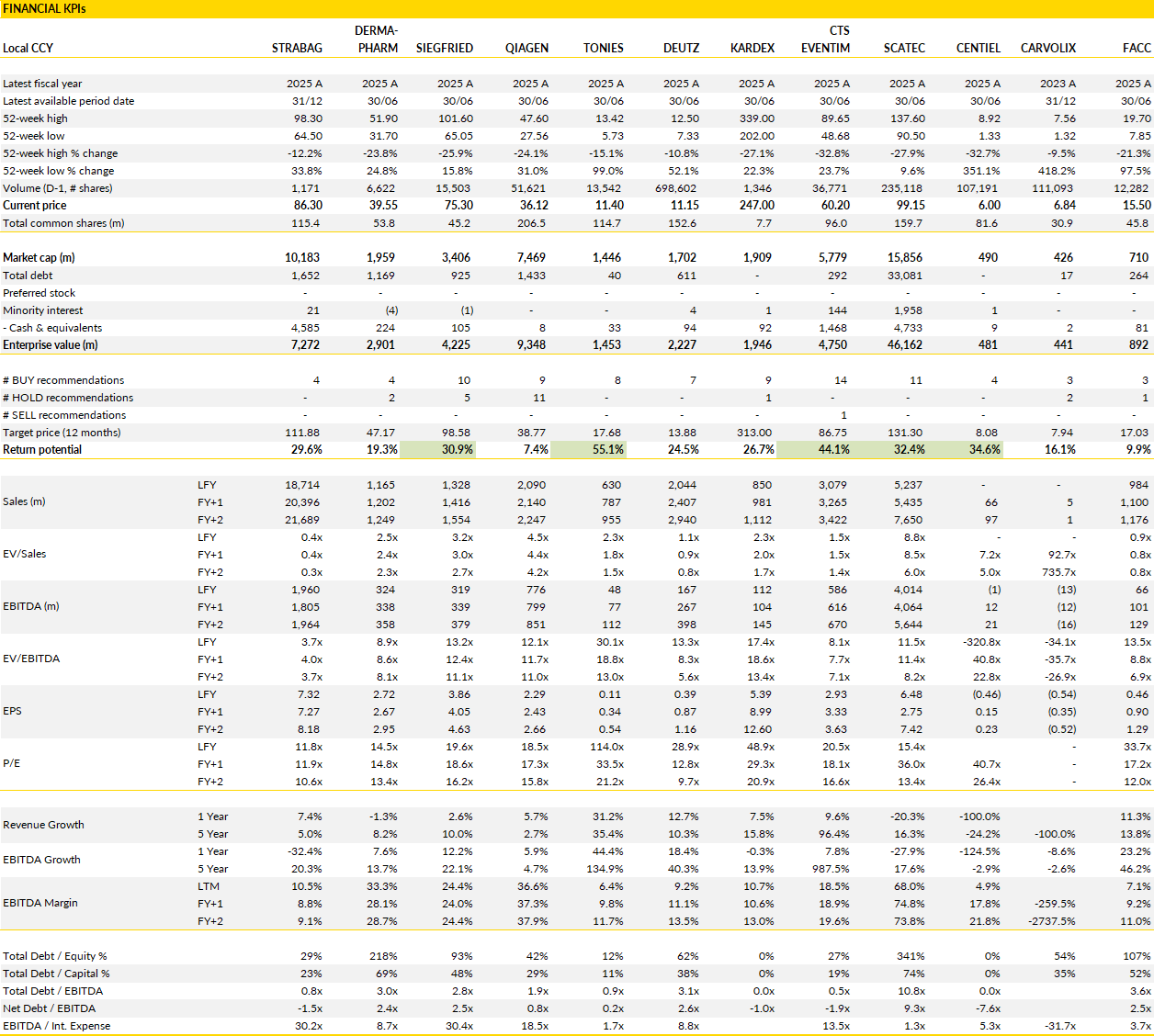
Financial KPIs
Companies covered in this edition: Strabag, Dermapharm, Siegfried, QIAGEN, tonies, Deutz, Kardex, CTS Eventim, Scatec, Centiel, Carvolix, FACC
Strabag (STR Austria): Strong on a record backlog and German infrastructure spending
Strabag enters its H1 results with strong operating momentum after weather disruption held back activity at the start of the year. Q1 output growth was limited to 4%, but Q2 should show a sharp acceleration as construction activity normalised, taking H1 output to around €9.6bn, up ~8%. Profitability should improve faster, with H1 EBIT expected to increase >28% to €165-170m and the margin rising to ~2.0% from 1.6%.
More significant for the coming years is order intake. Strabag announced numerous large projects during Q2, which should push the backlog towards a record €33-34bn. The implied book-to-bill ratio of around 1.25x for H1 indicates that new work is being added considerably faster than existing projects are being executed, providing a strong base for future activity.
Management is likely to retain its 2026 targets of approximately €22bn of output and an EBIT margin of 5-5.5%. There is scope to outperform the profitability target if execution remains strong. Strabag has historically taken a conservative approach to guidance, often becoming more confident on annual output around the Q3 release and only raising margin expectations later. H2 comparisons are considerably tougher, however, after an unusually profitable second half last year, limiting the usefulness of extrapolating H1 earnings growth. The longer-term backdrop remains favourable, particularly in infrastructure. Germany's large infrastructure investment program is creating substantial opportunities across transport and energy, areas where Strabag already has significant scale and technical capabilities. A record backlog also gives the group greater ability to prioritise projects with attractive economics instead of pursuing volume indiscriminately.
The Capital Markets Day on 1 September could prove more interesting than the H1 numbers themselves. Management will provide an update on Strategy 2030, with particular attention to Germany's infrastructure program and the group's infrastructure and energy activities. Strabag's existing strategy was introduced in 2023 and includes a 6% EBIT margin objective for 2030, a level the company has already exceeded during each of the past two years. That makes the existing profitability target outdated and creates scope for management to introduce more ambitious medium-term objectives under CEO Stefan Kratochwill.
The combination of a record order book, accelerating activity, strong infrastructure demand and sustained margins above the original strategic target gives Strabag considerable room to raise its ambitions. H1 results should confirm that current operations remain healthy, but any new medium-term targets at the Capital Markets Day could provide a clearer indication of how much of the recent improvement management believes can be sustained through 2030.
Dermapharm (DMP Germany): Branded Pharma growth lifts margins despite uneven demand elsewhere
Dermapharm delivered a solid H1. Group revenue increased 2.9% to €591.0m, with growth from Branded Pharma and the first contribution from Mucos offsetting the planned contraction at axicorp. Adjusted EBITDA increased considerably faster than sales, rising 10.3% to €163.2m and lifting the margin by 185bp to 27.6%. Branded Pharma remained the largest contributor, generating revenue of €321.9m, up 11.6%, and adjusted EBITDA of €137.0m, up 8.4%.
Allergology continued to perform strongly and international operations added further growth. Mucos, consolidated since January, expanded Dermapharm's OTC presence in pain and inflammation and contributed to the division's revenue increase. The H1 performance leaves the group's largest and most profitable business growing at a healthy pace, with several of its core therapeutic franchises contributing.
Performance across the smaller activities was more varied, although profitability developed better than revenue. Other Healthcare Products recorded a 1.4% decline in sales to €177.4m as weaker consumer demand affected Anton Hübner and medical cannabis. Euromed and Cernelle performed better, and divisional adjusted EBITDA still increased 12.7% to €29.3m. Lower material costs and favourable currency effects helped absorb the weaker sales environment and tariff-related costs. At axicorp, Dermapharm continued to shrink the Parallel Import portfolio deliberately as it removes lower-return products. Revenue fell 14.0% to €91.6m, but the adjusted EBITDA loss narrowed to €0.3m from €1.6m in H1 2025. The division remains a drag on consolidated growth, although the portfolio optimisation is improving its economics. Taken together, these developments explain why group EBITDA expanded by more than 10% despite revenue growth of only 2.9%.
Management retained its 2026 guidance for revenue of €1.182-1.218bn and adjusted EBITDA of €331-341m. The second half should receive further support from seasonal allergy products, international expansion and an expected improvement at Arkopharma. Dermapharm's current growth profile is more and more concentrated in Branded Pharma, where the combination of established niche products, allergology and acquired brands provides a higher-quality earnings contribution than the declining Parallel Import activities. Mucos adds another platform within OTC products and gives the group scope to develop the acquired portfolio through its existing commercial infrastructure. Meanwhile, the improvement at axicorp shows that lower revenue can still contribute positively to group profitability when unprofitable business is removed.
H1 therefore leaves Dermapharm on course for its full-year targets, with the 185bp increase in the group EBITDA margin providing evidence that the portfolio is generating better earnings even as some consumer-facing categories remain subdued.
Siegfried (SFZN Switzerland): Drug Substances drives growth as acquired capacity joins the network
Siegfried, the Swiss contract development and manufacturing organisation for pharmaceuticals, grew first-half 2026 net sales 4.8% in local currencies to CHF 633 million, with currency effects trimming the reported figure to 2.2%. The gain came alongside real margin progress: core EBITDA rose 6.1% to CHF 142 million, lifting the core EBITDA margin by 80 basis points to 22.4%. Sales up and margin wider at the same time points to a business mix shifting toward higher-value work instead of simple volume growth. Core net profit rose a more modest 3.8% to CHF 68.2 million, and core EBIT reached CHF 90.5 million. That group-level picture masks a sharp divergence underneath: one division carried the half, and the other went backward.
Drug Substances, the segment that develops and manufactures active pharmaceutical ingredients for outside pharma customers, generated CHF 431.1 million in sales, up 4.2%. Two forces stack on top of each other there: steady underlying demand for outsourced development and manufacturing work, and a direct addition to scale, with Siegfried closing the acquisition of three drug substance manufacturing sites in the US and Australia on 1 May 2026. Drug Products, the smaller finished-dose segment, reported sales of CHF 201.9 million, down 1.9% in Swiss francs but up 1.5% once currency movements are stripped out, so the underlying business held close to flat.
Siegfried has said the split between the two halves of the year is more skewed toward the second half in 2026 than in prior years, a shift tied to the phasing of its production plan and to timing effects from absorbing the newly acquired sites; Drug Products revenue in particular depends on when specific production campaigns for new products complete, which moves around from year to year. Drug Substances, carrying both the acquisition and the stronger underlying demand, is doing most of the work behind the group's growth and margin gains this half.
On cash, operating cash flow fell to CHF 93.7 million from CHF 149.6 million a year earlier, which management linked to seasonality between the first and second half being more pronounced than in prior years, itself partly a byproduct of absorbing the newly acquired Drug Substances sites, plus production phasing.
None of that changed the outlook. Siegfried reaffirmed full-year guidance for high single-digit sales growth in local currencies and a core EBITDA margin above 23%, and pointed to continued customer demand, integration of the new sites running to plan, and ongoing execution of the EVOLVE+ strategy, the multi-year push into higher-margin manufacturing work that the current portfolio shift is meant to serve.
QIAGEN (QIA Germany): New chief inherits a strategic review and a $225 million single-cell bet
QIAGEN has named Jonathan M. Pratt as chief executive, effective 1 September 2026, succeeding Thierry Bernard in a transition plan the company set in motion back in November 2025.
Pratt spent the past several years as president and CEO of Filtration Group, and before that held the position of president at Beckman Coulter Life Sciences, ran Waters Corporation's Waters Division as senior vice president, and worked in senior leadership roles at Pall Corporation, giving him more than 25 years across filtration, instrumentation and life-science tools businesses adjacent to QIAGEN's own sample-to-insight portfolio. Pratt framed his early priority as listening to QIAGEN's teams and customers and understanding where the company can sharpen its choices, instead of laying out a specific agenda on day one. Meaning he will take it slow(?)
Bernard took the CEO role in 2019, initially on an interim basis, and spent his tenure steering QIAGEN through a hostile takeover attempt by Thermo Fisher that ultimately failed, the swings in molecular testing demand created and then unwound by the COVID-19 pandemic, and a restructuring that followed. His departure was set in motion alongside QIAGEN's announcement that it would pay $225 million upfront for Parse Biosciences, a deal meant to build out a single-cell analysis business inside QIAGEN as that market keeps expanding. Responsibility for growing that new franchise, and integrating it with the rest of the portfolio, now falls to Pratt instead of the CEO who signed the deal, a split that is not unusual in leadership transitions but does mean the incoming chief inherits a strategic commitment he did not personally make.
QIAGEN reaffirmed its financial targets alongside the announcement: third-quarter net sales growth of about 1-2% at constant exchange rates and adjusted earnings per share of at least $0.62, with the full-year 2026 outlook unchanged at roughly the same 1-2% CER sales growth and adjusted EPS of at least $2.43.
The company also confirmed that the strategic review its Supervisory Board launched earlier in 2026, working with independent financial and legal advisors reported to include Moelis and Goldman Sachs, remains active, with the board comparing potential outcomes against QIAGEN's standalone business plan to determine what would generate the most shareholder value. No timeline or preferred outcome has been disclosed.
Pratt therefore takes over a company running two processes at once: an operating plan built around low single-digit growth, and a board-level review that could still reshape QIAGEN's ownership or structure well before his tenure is very old.
tonies (TNIE Germany): Installed-base growth keeps feeding the machine
As mentioned last week, tonies maintained strong growth through H1 as the installed base of Tonieboxes expanded and North America continued to develop into a much larger part of the business. Revenue increased 41.4% at constant currencies to €243m, including growth of 56.6% in North America, 25.6% in DACH and 42.6% across the rest of the world. More than 830,000 Tonieboxes and around 17m Tonies were sold during the period, taking the installed base to approximately 12.6m boxes and cumulative figurine sales above 173m.
The economics improve as that installed base matures because hardware purchases are followed by several years of higher-margin content sales. Customers buy more than 20 Tonies over the lifetime of a box, and management estimates that more than 60% of the expected lifetime value from customer cohorts acquired since 2020 has yet to be generated. H1 profitability was held back by the high proportion of Toniebox sales and US tariffs, leaving the adjusted EBITDA margin at just 0.7%. DACH nevertheless showed the earnings potential of a more developed installed base, with its margin increasing by almost 800bp to 24.4%, and North American profitability remained broadly stable despite tariffs and an unfavourable product mix.
The upcoming Toniebox Lite adds another route for expansion. The cheaper and more portable product targets households for which the existing box is too expensive and could also encourage existing customers to add a second device. Toniebox 2 remains the premium product, allowing tonies to address different price points without abandoning its existing positioning. Lite will initially launch in North America, the UK, Australia and New Zealand, giving management an opportunity to assess demand and cannibalisation before deciding whether to introduce it more broadly. Both devices generate positive hardware margins, although the larger financial contribution still comes from the subsequent purchase of figurines. The main question is whether Lite expands the number of households entering the ecosystem enough to compensate for customers who might otherwise have bought the more expensive Toniebox 2. A successful launch could accelerate installed-base growth and enlarge the pool of customers purchasing content for years afterwards.
Full-year guidance was left unchanged: revenue above €760 million, constant-currency growth above 20%, North American growth above 30%, and an adjusted EBITDA margin of 9% to 11%. Hitting the top of that range from a 0.7% first half implies a second-half margin in the order of 13% to 16%, a step up management said it expects from normal seasonal patterns in the business, with Toniebox Lite's contribution already built into the guidance instead of treated as separate upside.
Free cash flow was negative in the first half because of inventory built ahead of the Lite launch and other planned releases, a build the company expects to unwind into positive full-year free cash flow as that inventory sells through. Memory-chip supply needed for production has been fully contracted for this year with commitments already in place for 2027, tariff exposure is being managed by diversifying where components and products are sourced, and the syndicated credit facility has been refinanced out to 2029 on improved terms. Corporate headquarters costs rose fourfold year on year, which management attributed to the timing of specific projects rather than a change in the underlying cost base, and said the full-year cost trajectory should land close to last year's level.
Overall, the investments case remains intact, with the next leg of growth coming from North America. But H2 is going to be more important than usual, and we won't know until the all important Q4 how the company has been executing. But for now, tonies certainly deserves the benefit of the doubt.
Deutz (DEZ Germany): FFG acquisition brings the 2030 targets within immediate reach
Deutz has cleared an important hurdle in its planned €1.6bn acquisition of FFG after shareholders approved the required capital increase with 99.7% of votes cast in favour. German Federal Cartel Office approval has already been obtained, leaving the transaction on course to close in late 2026 or early 2027.
Around €1bn of the consideration will be funded through cash and debt, with the remaining €0.6bn paid through approximately 65m newly issued Deutz shares. This will increase the share count from roughly 153m to 218m and give FFG's current owner families a stake of up to 29.9%. The dilution is substantial, but FFG brings a very different earnings profile. The defence vehicle specialist generated approximately €760m of revenue in 2025 with an EBITDA margin comfortably above 20%, compared with Deutz's roughly 8-10% historical adjusted EBITDA margin. Management expects FFG revenue to exceed €1bn in 2027 while retaining strong margins, making the transaction EPS-accretive on a pro-forma basis immediately after closing despite the larger share count and additional interest expense.
FFG also changes the composition of Deutz considerably. Defence & Other currently generates around €110m of annual revenue and represents only about 5% of group sales. Following consolidation, divisional revenue should exceed €1bn and its contribution to group revenue could rise to approximately 32%. Its adjusted EBIT margin is expected to increase from around 12% to approximately 20%, lifting group profitability as the higher-margin defence activities become a much larger part of the business. FFG enters the transaction with an order book of approximately €1.9bn extending through 2032, providing a substantial contracted workload alongside the structural increase in European defence expenditure.
Deutz has identified potential synergies across engines, services, energy, NewTech, defence and costs, although management has not yet quantified them. Services could offer particularly meaningful commercial opportunities given the installed base and long operating lives of military vehicles. More detailed synergy targets over the coming months would provide a clearer indication of the earnings potential beyond FFG's standalone contribution.
The acquisition also makes Deutz's existing 2030 objectives outdated. Management previously targeted an increase in group revenue from €2bn in 2025 to around €4bn by 2030 and an adjusted EBIT margin improvement from 5.5% to approximately 10%. Consolidating FFG could bring both objectives forward by several years, with the source estimating 2027 revenue of €3.9bn and an adjusted EBIT margin of 11.9%. Management has already indicated that the existing medium-term targets should be reached earlier, with profitability likely to progress faster than revenue.
The next significant catalyst should therefore be an updated medium-term framework incorporating FFG and quantified synergy assumptions. Execution still requires completing a large transaction, integrating a business equivalent to roughly 37% of Deutz's 2025 revenue and absorbing a material increase in debt and shares outstanding. Even so, FFG would immediately give Deutz a much larger defence operation, materially higher group margins and a €1.9bn order book, accelerating the strategic diversification away from its historically more cyclical engine activities.
Kardex (KARN Switzerland): Record orders set up a stronger growth phase
Kardex entered the second half with considerably better commercial momentum than its H1 earnings would suggest. Orders increased 26% and the backlog reached a record level, up 42%, giving the group a substantial base of contracted business for the coming quarters. Revenue increased 6%, but EBIT fell 38% as profitability absorbed delayed deliveries, continued investment and an unfavourable business mix.
The temporary halt in important US government business during Q1 was particularly disruptive to project execution. Remstar improved during Q2 after a more volatile period, allowing the division to deliver 7% growth for H1, and overall sales remained broadly on plan. Management retained its 2026 targets for 15-20% growth in both orders and sales and an EBIT margin of 8-10%. The backlog and recent order development leave these targets achievable despite the weak H1 profit comparison, with postponed projects adding to the work scheduled for subsequent periods.
Standardized Systems has become an increasingly significant contributor to Kardex's expansion, helped by the partnership with AutoStore established in 2021. H1 orders in the division increased 118%, and the business now represents around 24% of group sales. Kardex has become the second-largest AutoStore partner globally, extending the relationship beyond basic system sales through software, automation, lifecycle services and complementary products. The broader Kardex portfolio also creates opportunities to combine AutoStore installations with Mlog solutions and other warehouse technologies. Products such as the Intuitive Picking Assistant and SnapVac grid-cleaning robot broaden the offering around installed systems and strengthen the service component after installation. Standardized Systems could approach one-third of group revenue over the medium term if the current expansion persists. Its margins are structurally below those of the traditional Kardex businesses, so faster growth changes the group mix, but it also gives Kardex greater exposure to larger automated warehouse projects and reduces its dependence on Remstar.
The strength of incoming business provides a useful bridge from the current investment period towards Kardex's longer-term ambitions. Management continues to target €1.5bn of revenue and a 10-14% EBIT margin for 2029-2031, with warehouse automation supported by reshoring, labour shortages and customers seeking more efficient use of logistics space. Recent orders indicate that Kardex is capturing a meaningful share of that spending, particularly through AutoStore, although converting the backlog without further delivery disruption will determine how quickly the revenue and earnings benefits appear. The higher contribution from Standardized Systems also means that revenue growth alone will not translate proportionately into EBIT until scale benefits and operating efficiency compensate for the divisional mix.
For now, the combination of recovering Remstar activity, exceptional Standardized Systems orders and a backlog 42% above last year provides a strong base for the second half and 2027 than the 38% H1 decline in EBIT would imply.
CTS Eventim (EVD Germany): Ticketing growth stays strong ahead of November strategy update
CTS Eventim maintained healthy growth in Q2, with revenue increasing 13% to €899m. Ticketing was particularly strong, with revenue up 26% to €254m, helped by ticket sales for the LA 2028 Olympics. Around 4m Olympic tickets were sold during the quarter alongside roughly 42m retail tickets across the broader platform. The underlying Ticketing business also continued to grow at a mid-single-digit rate despite the reduced Stage Entertainment contract, which has removed an estimated 4-5% of divisional revenue. Live Entertainment revenue increased 9% to €657m despite two festival cancellations caused by extreme heat.
The performance across both divisions shows that CTS continues to benefit from healthy demand for live events and its scale across ticketing and promotion, with Olympic ticketing providing an additional source of activity over the next few years.
Profit growth was more subdued, with adjusted EBITDA increasing 6% to €106m and the group margin declining 80bp to 11.8%. Ticketing accounted for most of the pressure, with its adjusted EBITDA margin falling 600bp to 32.5%. This primarily reflected the changing revenue mix following the reduction in higher-margin Stage Entertainment business and the growing contribution from LA 2028, where profitability appears to be below the divisional average.
CTS is also incurring temporary expenditure related to its Operational Excellence program. Live Entertainment performed more steadily, maintaining an adjusted EBITDA margin of 3.6%. The current margin pressure therefore appears largely connected to mix and investment instead of a deterioration in the underlying economics of the ticketing platform. Management retained its 2026 outlook for slight growth in both revenue and adjusted EBITDA, suggesting no major change in the expected earnings trajectory after H1.
Attention now shifts to the Capital Markets Day scheduled for 20 November, where management is expected to provide more detail on strategy and its growing investment in venues. CTS has increasingly expanded beyond ticketing and event promotion into ownership and operation of entertainment infrastructure, which could deepen its control over the live-event value chain but also requires more capital than its traditional ticketing activities. Greater disclosure around expected returns, investment requirements and the role of venues within the wider group would help clarify the financial implications of this strategy.
In the meantime, the core business remains in good shape: ticket volumes are substantial, organic Ticketing growth remains positive despite the Stage contract reduction, Live Entertainment continues to expand and LA 2028 adds a multi-year source of incremental activity. The November strategy update is the next significant catalyst.
Scatec (SCATC Norway): Obelisk demonstrates the economics of the integrated development model
Scatec’s Q2 numbers were distorted by construction mix and project accounting, but operational progress across the portfolio remained strong.
IFRS revenue reached NOK 1.37bn, while EBITDA of NOK 824m was held back by lower-margin construction revenue from Thakadu. On a proportionate basis, EBITDA was NOK 1.02bn, including a NOK 160m contingency release related to Obelisk. Excluding this benefit, underlying EBITDA was approximately NOK 856m. Power production increased 21% to 1,135 GWh as five recently completed projects contributed 278 GWh, partly offset by poor rainfall in the Philippines, weaker irradiation in South Africa and plant unavailability in Ukraine. Scatec consequently reduced its 2026 production guidance by 50 GWh to 5.05-5.35 TWh, but retained Power Production EBITDA guidance of NOK 3.6-3.9bn as stronger pricing in the Philippine reserve market compensates for the lower volumes.
Obelisk provides a useful demonstration of how Scatec can develop large renewable projects without placing excessive demands on its own balance sheet. The large Egyptian hybrid project (1,125 MW of solar capacity and 200 MWh of storage) was delivered ahead of schedule and below budget. Development & Construction generated a 24% gross margin including the contingency release, with the underlying margin around 11%, consistent with the normal 10-12% range. Crucially, the D&C margin covered Scatec’s remaining 40% equity investment, making the project effectively capital-neutral before any additional execution gains.
The same structure can now be applied to Egypt Aluminium, Energy Valley and Shadwan, where construction is expected to begin during H2. Successful repetition would allow Scatec to convert a much larger project pipeline into operating assets using development profits and subsequent farm-downs to finance much of its equity requirement.
The scale of that pipeline creates considerable growth over the next several years. Operational projects, assets under construction and backlog projects together represent 12.3 GW of generation capacity and 6.8 GWh of storage. Completion would more than double Scatec’s generation capacity and almost quintuple storage capacity within two to three years. Funding remains manageable despite consolidated net debt of NOK 28.3bn and a temporary NOK 873m working-capital outflow (mostly Obelisk). Available liquidity stands at NOK 5.1bn following the extension of the revolving credit facility, and the planned NOK 1bn bond issue should refinance the expensive SCATC 04 bond, extend maturities to 2031 and lower financing costs.
The execution challenge is now converting the backlog into completed projects without materially increasing corporate capital requirements. Obelisk offers tangible evidence that Scatec can do this: development and construction profits fund the retained ownership stake, farm-downs recycle capital and completed assets add recurring power-production EBITDA.
Centiel (CNTL Switzerland): Data-center demand pushes capacity expansion needs
Centiel’s first half-year report showed rapid growth accompanied by strong profitability. Revenue increased 37% to CHF 25.2m, while the adjusted EBIT margin rose 480bp to 20.9% and adjusted net profit more than doubled to CHF 4.6m. Management now expects 2026 revenue of around CHF 65m, implying growth above 40% compared with its previous ambition of roughly 20%. The medium-term plan calls for around 20% annual organic growth, supplemented by expansion in the US, with an adjusted EBIT margin above 20%. Existing production capacity has been increased by 28% during 2026, enough to support the current growth plan and initial US ramp. The next step is already becoming necessary: Centiel is looking for another factory around Lugano and expects additional capacity in 2027 as it works towards revenue above CHF 100m. Headcount is also due to increase another 20% from the mid-2026 level after already rising 46% over the preceding year.
The US represents a potentially substantial addition to the existing business, particularly in critical power infrastructure for data centers. Centiel’s partnership with Neo Critical Power provides access to two partners with complementary capabilities. One has customer relationships and experience across US data-center power projects representing more than 3.2 GW of installed capacity across 17 states, while the other operates 22 critical-power infrastructure facilities with more than 2m square feet of capacity for skids, eHouses, ePODs, containers and switchgear. The associated framework agreement is worth several million US dollars and provides Centiel with an established route into a market where building comparable commercial, manufacturing and service infrastructure independently would take considerably longer. Centiel now needs to scale production and execution quickly enough to convert these opportunities without compromising the high margins achieved to date.
Centiel also appears well prepared for the initial transition towards 800 VDC power architecture in AI data centers. Its existing technology can address both the first stage of NVIDIA’s 800 VDC roadmap and the second stage through reconfiguration of existing core technologies, without requiring an entirely new power-conversion platform. These two stages could represent 7-12% and 2-6% of the global UPS market respectively by 2030. Centiel does not yet have products for the third stage involving native 800 VDC MV/DC and DC stabilisation, although this segment is expected to represent only 0-1% of the global UPS market and commercialisation is not expected before around 2027. Technology and partnership options are being evaluated. This limits the near-term technological risk from the architecture shift and allows Centiel to concentrate investment on capacity, people and US expansion.
With revenue currently growing well above its medium-term target, margins already exceeding 20% and further manufacturing capacity required for the CHF 100m-plus revenue ambition, the next couple of years will primarily test whether Centiel can scale its operations at the pace implied by demand while retaining its current profitability.
Carvolix (CVX France): Looking for a Saudi manufacturing base
Medtech Carvolix has set up Carvolix Saudi LLC, a wholly owned subsidiary in Riyadh, as the vehicle for a potential manufacturing facility in Saudi Arabia that would serve the Saudi market plus Europe, Asia and North America.
The site hasn't been chosen yet and the financing structure isn't finalized, though the announcement already names several Saudi government bodies involved in the discussions, including the Ministry of Investment, the Ministry of Industry, the Ministry of Health, the industrial-zones authority MODON, the Saudi Industrial Development Fund and the regulator SFDA. The financing envisaged would combine equity, debt and government subsidies. For a company that has funded itself mostly through share issuances and structured debt, including a €30 million debt program with Claret Capital Partners and earlier capital from shareholders Truffle Capital and Edwards Lifesciences, access to subsidised industrial funding would be a new source of capital that doesn't dilute existing shareholders.
The project is planned in two phases. The first would bring TAVIPILOT Robot, an investigational robotic system for transcatheter aortic valve implantation, and KALIOS, a percutaneously adjustable mitral annuloplasty ring used to treat mitral regurgitation, into commercial production in Saudi Arabia by 2028. TAVIPILOT Robot builds on TAVIPILOT Software, an AI-guided navigation platform for the same aortic valve procedures that is already cleared by the FDA and being launched commercially in the US. A second phase would extend local production to ARTEDRONE, a magnetically steered robotic device for clot removal in ischemic stroke, and MITRAPILOT, a robotically delivered biomimetic mitral valve replacement built around Carvolix's Epygon valve, along with other products in the portfolio. Most of what the site would produce is earmarked for export instead of the domestic Saudi market alone, giving the facility an international role instead of a purely local one.
The push into Saudi Arabia lines up with the kingdom's Vision 2030 program to build a domestic healthcare manufacturing base, which has translated into political backing and financing tools, including industrial subsidies, that Carvolix is now trying to access. The diplomatic dimension was visible this week when Carvolix founder Philippe Pouletty, who is also chief executive of Truffle Capital and the company's majority shareholder, attended the official dinner President Macron hosted at the Élysée Palace for Saudi Crown Prince Mohammed bin Salman, a sign of how far discussions between the two countries around this kind of project have progressed, even if attendance at a state dinner doesn't by itself determine whether the Saudi facility gets built.
With the site and financing still to be settled and first production not planned before 2028, the Saudi subsidiary is for now an option Carvolix is keeping open, though not yet a committed capital project.
FACC (FACC Austria): Widebody ramp and better execution support even better performance
FACC entered 2026 with healthy aerospace momentum, although quarterly revenue growth slowed from 11.7% in Q1 to 5.7% in Q2. The slowdown came almost entirely from Engines & Nacelles, where revenue declined 12% due to the timing of development revenue that is now expected in H2. Aerostructures and Cabin Interiors both maintained growth of around 10%.
Management has narrowed full-year revenue guidance to 10-15% growth from 5-15%, which implies a clear acceleration from the 8.6% achieved in H1. At the midpoint of the range, H2 growth would reach approximately 16%. The expected improvement is backed by increasing widebody production and the delayed development revenue in Engines & Nacelles, with Aerostructures also benefiting as aircraft production rates increase. FACC expects Q3 to show healthy growth before a stronger year-end finish.
Profitability is developing well across the operating businesses despite some distortion from timing and prior-year items. Engines & Nacelles recorded an 8.6% Q2 EBIT margin compared with 10.1% a year earlier, largely reflecting the delayed development revenue. Cabin Interiors delivered its third consecutive positive quarterly margin at 6.4%. The comparison includes approximately €4m of compensation income in the prior year, and excluding this item the underlying year-on-year improvement was around 330bp. Aerostructures increased its margin to 3.8% from 1.5% despite elevated fastener costs.
FACC's 2026 EBIT margin guidance is now at 5.25-6.25%. The midpoint requires an H2 margin of roughly 6.6%, compared with 4.8% in H1 and H2 2025. This is a sizeable improvement, but the revenue phasing, higher production volumes and better Cabin Interiors profitability provide identifiable sources for the increase. The broader recovery in aerospace production should also improve utilisation of FACC's manufacturing footprint as volumes rise.
Currency movements add another benefit heading into 2027. More favourable EUR/USD hedging rates are expected to add around 20-30bp to margins in 2026 and 2027, complementing the operational gains from higher volumes and improved execution. FACC has a medium-term target for an EBIT margin of 8-10% in 2027, compared with the current 2026 guidance of 5.25-6.25%, so execution over the next 18 months remains serious. The progress in Aerostructures and Cabin Interiors provides evidence that profitability can improve materially as production increases, and the anticipated recovery in Engines & Nacelles should add another source of earnings growth in H2.
With commercial aircraft production still ramping, FACC has a credible path to sustained double-digit revenue growth accompanied by further margin expansion, with H2 2026 providing the first possible significant sign of that.