
IT, Continence Care and more Copper
BHP, Adyen, MBB, NORMA Group, Coloplast, Bechtle, SIG Group, Eurazeo, Wienerberger, STRATEC, Ströer

At Lux Opes, we break down companies into quick takes that get straight to the point - what is happening, why it matters, and what to watch next. We publish 2-3 times per week, depending on the news flow.
For the best reading experience, we recommend reading at Lux Opes
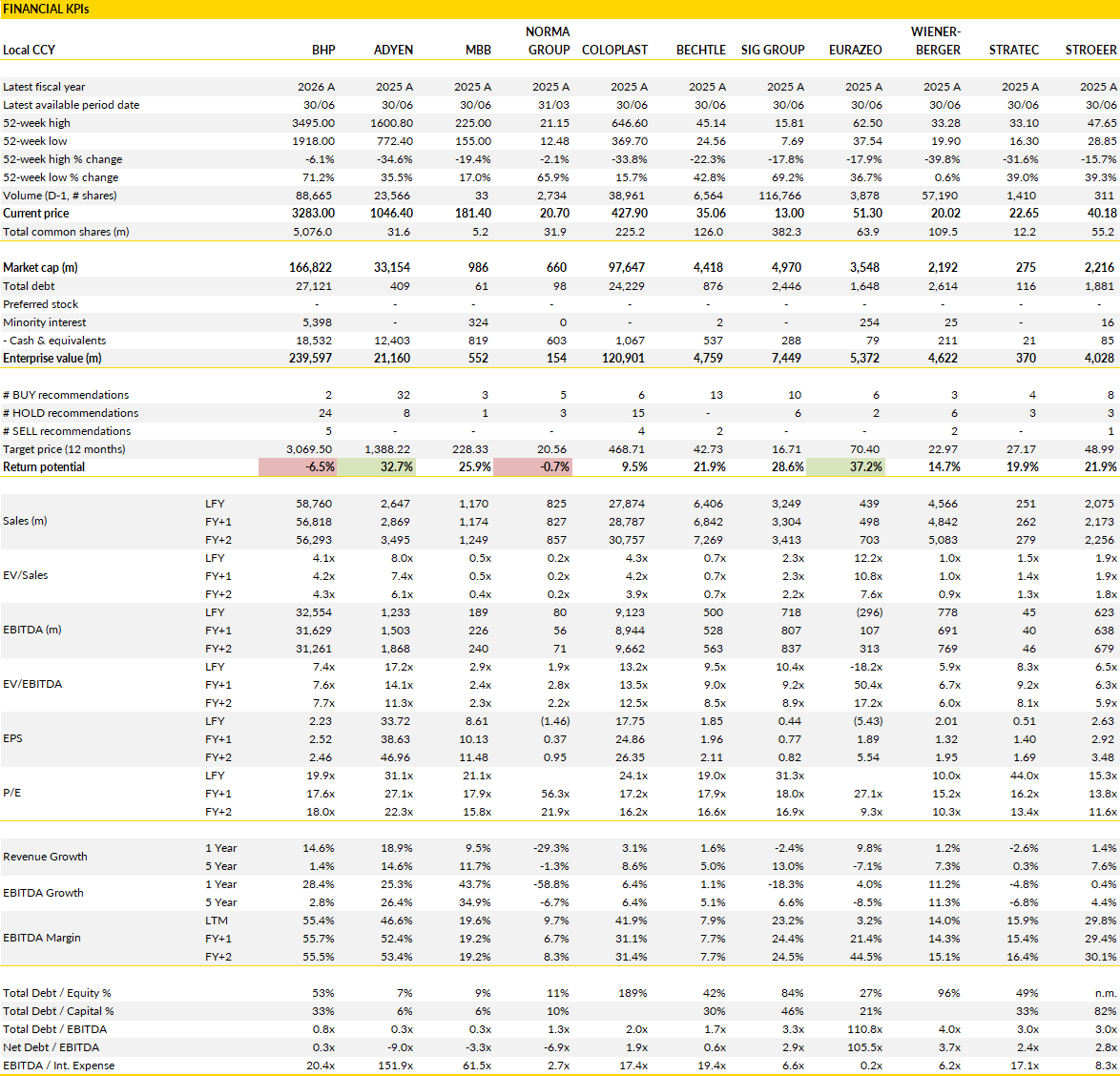
Financial KPIs
Companies covered in this edition: BHP, Adyen, MBB, NORMA Group, Coloplast, Bechtle, SIG Group, Eurazeo, Wienerberger, STRATEC, Ströer
BHP (BHP UK): Copper takes control
BHP closed FY 2025/26 with a strong second half, driven primarily by copper and accompanied by robust cash generation and a larger shareholder distribution.
H2 underlying EBITDA increased 13% sequentially to $17.5bn, with copper contributing $10.2bn, up 29% from H1 and 40% year-on-year. The division benefited from strong production, higher copper and byproduct prices and disciplined cost execution, with FY unit costs at the low end of guidance across BHP’s three largest copper assets.
Copper consequently accounted for 59% of group EBITDA, almost three times its share three years ago, materially changing the earnings composition of what was historically a much more iron ore-dependent miner. Iron ore remained a major cash contributor and achieved record shipments, although EBITDA declined 6% from H1 to $7.0bn as prices softened and unit costs finished at the upper end of guidance. Coal improved as pricing recovered, but cost inflation remained problematic and unit costs exceeded guidance.
The stronger commodity mix translated into substantial cash generation and balance-sheet improvement. H2 operating cash flow reached $12.4bn, up 32% from H1, while net debt declined from $14.7bn at December to $8.7bn at the end of June. BHP used that financial capacity to raise the H2 dividend to $0.99 per share, taking the FY dividend to $1.72 and representing a 73% payout ratio. This is well above the company’s minimum 50% payout policy and the highest annual distribution in four years. The combination of rising copper exposure and a strong balance sheet gives BHP considerable flexibility as it continues investing in its future portfolio, although capital requirements remain substantial. Management maintained FY 2026/27 capex guidance at $11bn.
The immediate operational outlook is less favourable than the FY result suggests. BHP expects only marginal progress in iron ore production during FY 2026/27, while copper production is set to decline by a double-digit percentage as grades fall (Escondida and Antamina). Unit costs are also expected to increase across the portfolio, reflecting lower fixed-cost absorption at Escondida and higher diesel expenses. This creates a kind of transition period in which copper has become BHP’s dominant earnings driver just as production from existing assets faces several years of pressure.
Longer term, BHP has built a differentiated position among diversified miners through its increasing exposure to copper, while retaining the substantial cash-generative capacity of its iron ore operations. The constraint is timing, with meaningful copper volume growth unlikely before the early 2030s. Strong commodity prices can continue to support earnings and distributions in the interim, but the next phase of BHP’s development depends in large part on converting its copper investment program into production growth while maintaining the cost discipline demonstrated in FY 2025/26.
Adyen (ADYEN Netherlands): US acceleration to sustain the 20% growth
Adyen continues to deliver growth around the 20% level, with H1 net revenue increasing 20% to €1.30bn and 21% at constant currencies. Momentum even strengthened during Q2, when constant-currency growth accelerated to 22% from 20% in Q1.
As discussed last week, the underlying business mix remains healthy: Digital grew 15% in Q2, Unified Commerce 27% and Platforms 40%. EBITDA reached €642m, while the margin outlook remains unchanged at around 51.7% for FY 2026. Management also retained its constant-currency revenue growth guidance of 21-23% including acquisitions. Given 21% growth during H1, this translates into 21-25% growth for H2 including Talon.One and Orb, or approximately 19-23% organically.
Geographically, the development in North America is particularly encouraging. Cc revenue growth accelerated to 30% in H1 from 26% in H2 2025, while APAC increased 26% and LatAm remained very strong at 35%. These are still relatively underpenetrated regions for Adyen, giving the company considerable room to expand its merchant base. North America is particularly relevant because Adyen has been investing heavily in local hiring and commercial capabilities, and the acceleration suggests those investments are beginning to translate into revenue. The US should also become increasingly important as payment innovation develops around areas such as agentic commerce. Meanwhile, the recently acquired Talon.One and Orb add capabilities in loyalty and usage-based billing and give Adyen additional ways to deepen its relationships with merchants and SaaS platforms.
Capital allocation remains firmly geared towards growth. Adyen ended H1 with €5.3bn of CET1 capital and continues to hold substantial excess capital, but management does not expect near-term share buybacks and prefers to retain flexibility for investment and acquisitions. Capex is temporarily increasing to around 7% of net revenue in 2026, versus a long-term expectation of approximately 5%, as Adyen expands its proprietary data-centre infrastructure to accommodate growing customer demand. Running its own private infrastructure also differentiates Adyen from payment peers dependent on third-party cloud providers and can support sovereign-data requirements.
With growth accelerating in North America and APAC, Platforms still expanding around 40%, and Talon.One and Orb broadening the product offering, Adyen has several independent routes to sustain growth around or above 20% while maintaining EBITDA margins above 50%.
MBB (MBB Germany): Infrastructure drives another sharp step-up in profitability
MBB delivered a strong H1, with the final figures confirming the preliminary numbers released in July. Revenue declined 1.7% to €536m, but this masks a substantial improvement in the earnings mix. Adjusted EBITDA increased 53% to €117m and the margin expanded from 14.1% to 21.8%.
Q2 was particularly strong, with revenue growing 4.6% to €299m while adjusted EBITDA jumped 62% to €75m, resulting in a 25.1% margin. Service & Infrastructure remained the main earnings driver, with revenue growing 6% to €383m and adjusted EBITDA increasing around 61% to €101m. Consumer Goods also improved, while Technological Applications remained the weak spot, with revenue falling 24% and adjusted EBITDA declining almost 28%.
The increasing weight and profitability of Service & Infrastructure continues to increasingly weigh positively on MBB's earnings profile. The segment includes Friedrich Vorwerk and DTS and accounted for the vast majority of H1 adjusted EBITDA. This means consolidated earnings are more and more driven by businesses exposed to infrastructure investment and IT security, while the weaker Technological Applications activities have become less important to overall profitability. This contrast is considerable: group revenue was slightly lower in H1, yet adjusted EBITDA increased by more than half. Q2 strengthened this trend even further as incremental revenue converted into much higher earnings, taking the group margin above 25%. Maintaining anything close to this level would represent a substantial improvement compared with MBB's historical profitability.
Portfolio optimisation is continuing alongside the operational improvement. MBB has agreed to sell CT Formpolster, its smallest portfolio company. CT Formpolster generated €12.4m of H1 revenue but only €0.4m of EBITDA, equivalent to a 3.2% margin, making it both small and significantly less profitable than the group overall. The disposal will result in a negative deconsolidation effect of €3-5m in H2, but does not alter MBB's FY 2026 revenue or EBITDA guidance. Perhaps more indicative, exiting such a low-margin peripheral asset further concentrates the portfolio around MBB's stronger businesses and is an indication of more to come.
With Service & Infrastructure producing strong earnings growth and the smallest non-core asset now being removed, MBB is becoming a more focused group with a materially higher underlying margin profile.
NORMA Group (NOEJ Germany): Large tender offer completes the Water Management cash return
NORMA Group has provided the final details of the capital return program announced following the disposal of its Water Management business.
The company is launching a public tender offer to repurchase up to 9.31m shares for approximately €208m, equivalent to around 29% of its existing share capital and roughly one-third of its current market capitalisation. The tender price has been set at €22.35 per share, a substantial premium to the share price immediately before the announcement and around 25% above the average Xetra closing price during the preceding three months. The acceptance period runs from 17 August until 15 September 2026, after which the acquired shares will be cancelled and NORMA's share capital reduced accordingly.
The transaction completes the approximately €260m shareholder distribution announced after the Water Management disposal. Around €52m was already returned through the first share buyback during H1, leaving the new €208m tender as the much larger second tranche. The structure is particularly interesting because NORMA is retiring the shares. Full acceptance will therefore reduce the outstanding share count by around 29%, creating a substantial mechanical increase in the EPS of the continuing business. Given the €22.35 tender price compared with roughly €20.75 today, participation is likely to be high and the offer could be oversubscribed.
The tender also marks an important final step in NORMA's portfolio transformation following the Water Management disposal. The company has chosen to return most of the disposal proceeds directly to shareholders instead of retaining excess cash for acquisitions or other investments, showing the company has an eye for the shareholder.
And indeed, for shareholders the immediate decision today is therefore between tendering at €22.35 and retaining exposure to a smaller, more focused NORMA (with materially fewer shares outstanding).
Coloplast (COLOB Denmark): Continence Care strength
Coloplast’s Q3 showed some stabilisation after the weaker first half and the guidance reduction following Q2, although this improvement remains quite uneven across the portfolio.
Revenue increased 5.7% to DKK7.36bn, with organic growth of 6%, while EBIT was broadly unchanged at DKK1.91bn and the margin reached 26.0%. Continence Care was the strongest major franchise, delivering 8% organic growth as the Luja catheter portfolio continued to perform well, particularly in Europe. Ostomy Care remained softer at 5% organic growth, largely because of continued weakness in China. Excluding China, organic growth reached 7%, supported by healthy European demand and double-digit growth in the US. SenSura Mio remained the main product contributor, complemented by Brava support products. The core chronic-care franchises therefore continue to produce respectable underlying growth, but geographic weakness and the slower Ostomy performance are preventing a broader improvement.
The newer and more specialised businesses delivered a mixed quarter. Voice & Respiratory Care grew 6% organically, with high-single-digit growth in laryngectomy offset by weaker tracheostomy sales due to order phasing. Interventional Urology increased 7%, supported by penile implants and easier comparisons in kidney and bladder health. Wound & Tissue Repair improved to 3% organic growth, considerably better than the decline implied by expectations. Advanced dressings grew 4%, driven by the US despite a product return in China. Kerecis remains the most significant problem within the division, declining 6% organically following reimbursement changes. This is particularly relevant because Kerecis was acquired as a higher-growth platform within advanced wound care, meaning that restoring growth after the reimbursement disruption remains important for the contribution of the business.
In short, Coloplast is seeing good momentum in several established franchises while parts of the portfolio that were intended to add incremental growth remain less consistent.
Management maintained FY 2026 guidance for organic revenue growth of 5-6%, reported growth of around 3% and EBIT growth before special items of around 4%. The confirmation is reassuring after the Q2 downgrade, but Q3 does not yet establish a clear acceleration in the group’s growth profile. Continence Care, the US Ostomy business and the improvement in advanced dressings provide a healthier foundation, while China, Kerecis and softer Voice & Respiratory Care growth continue to constrain the overall result. Profitability is also broadly stable instead of expanding meaningfully, with Q3 EBIT essentially unchanged year-on-year despite revenue growth.
So Coloplast appears to have moved beyond the deterioration that prompted the earlier guidance reduction, but a stronger recovery would require better growth across a wider range of businesses. Sustained improvement at Kerecis, stabilisation in China and continued adoption of Luja would provide the clearest evidence that the current stabilisation is moving into a broader operational recovery.
Bechtle (BC8 Germany): Good growth, healthy backlog
Bechtle’s Q2 performance shows that the company is gaining ground despite an IT market that remains difficult, with strong order intake providing a considerably better foundation for the remainder of 2026.
Orders increased around 26%, taking the backlog to a record level, while growth was broad-based across customer groups outside the still-weak SME market. Large corporate customers and the public sector were the principal sources of demand, with Bechtle benefiting from its close relationships with customers and technology vendors. The composition of revenue growth requires some caution, as price increases contributed more than underlying volumes, so the acceleration should not yet be interpreted as a broad recovery in IT spending. Even so, taking market share while underlying demand remains subdued puts Bechtle in a good position to benefit when customer spending improves.
The record backlog is particularly relevant for H2, when public-sector projects and the conversion of existing orders should support further growth. Management now expects business volume to increase by more than 10% in 2026, with revenue and EBT both growing 5-10%. The strength of the order book makes these targets more credible, although the timing of public-sector projects can create considerable quarterly volatility. The other area requiring improvement is cash conversion. Strong reported growth is more valuable if backlog execution translates into cash, and management expects cash flow to normalise during H2.
Continued weakness among smaller customers also remains a useful indicator of the broader economic environment. A recovery there would add another growth driver, but Bechtle currently does not need a meaningful SME rebound to deliver its updated FY targets.
The combination of market-share gains, stronger order intake and an improved backlog leaves Bechtle in a healthier position than it was entering the year. The company is now targeting double-digit business-volume growth despite weak industry conditions, while its scale and broad customer exposure allow weakness in SMEs to be absorbed by stronger corporate and public-sector activity.
There are still important execution points over the coming quarters: price-led growth needs to develop into healthier volume growth, the record backlog must convert into revenue on schedule, and operating cash generation needs to improve. If Bechtle delivers on those elements, the current performance would demonstrate that the company has strengthened its competitive position during the downturn and could enter a broader IT spending recovery with a larger market share and stronger earnings base - and thus with quite some rerating potential.
SIG Group (SIGN Switzerland): C-suite turbulence
SIG has made another abrupt leadership change, with CEO Mikko Keto stepping down only a few months after joining the company in the spring. CFO Erkens will take over as permanent CEO, having already served as interim CEO between August 2025 and February 2026.
The Board explicitly framed the decision around continuity and execution, concluding that SIG has reached a stage in its transformation where leadership stability is more important than another change in direction. Erkens already led the program during her previous interim tenure and delivered a strong operational performance, giving the Board an experienced internal candidate who understands both the organisation and the existing transformation plan.
The speed of Keto's departure of course inevitably raises questions about what the heck happened during his short tenure. The announcement suggests that the issue was not a fundamental change in SIG's strategic direction, but the organisational consequences of introducing another new leadership approach during an already substantial transformation. Keto had been well received externally, but there are indications that his arrival created some internal disruption and potentially increased the risk of further Executive Board departures. So reappointing Erkens appears designed to stabilise ( / please) the management team and preserve execution momentum. Her familiarity with SIG should also reduce the transition period normally associated with a CEO change, particularly since she was running the company less than six months ago.
The Capital Markets Day on 27 October now clearly becomes considerably more important. SIG will need to demonstrate that the latest management change makes sense and that the existing transformation remains on track.
Eurazeo (RF France): Back to NAV growth (?)
Eurazeo’s H1 marked a potentially significant change after roughly two years of portfolio write-downs, with organic value creation returning to positive territory at 0.3%, or €20m. The absolute contribution is small, but the underlying development is more meaningful. Revenue and EBITDA trends across portfolio companies are improving, value creation is increasingly being generated through operating performance, and carrying values appear to have been sufficiently reset after the prolonged period of valuation pressure. NAV per share increased 3.3% from year-end to €105.4, including a 2% contribution from share buybacks.
Management remains cautious about declaring a definitive recovery, but the combination of improving portfolio fundamentals and fewer obvious valuation problems reduces the risk of further material NAV erosion. Sustained positive organic value creation would represent an important change for Eurazeo after several difficult years.
Realisation activity is now the main test of whether that improvement can translate into cash and validate reported NAV. Balance-sheet disposals amounted to only €0.3bn in H1, equivalent to 4.3% of NAV and well below Eurazeo’s historical annual portfolio rotation of around 20%. Management attributes the shortfall primarily to transaction timing and continues to guide towards disposals equivalent to 15-20% of starting NAV for FY 2026. Delivering that target will require a sharp acceleration during H2, with the pipeline weighted towards several larger transactions. Successful exits near carrying values would do considerably more than generate liquidity: they would provide external validation that portfolio marks are realistic following the recent write-down cycle. Eurazeo also continues to expand its third-party asset-management franchise, with fee-paying assets under management of €23bn and H1 asset-management EBITDA growth of 20%. This provides a growing source of recurring earnings alongside the balance-sheet investment portfolio and gradually reduces dependence on portfolio valuation movements.
Capital allocation provides another mechanism for translating the current discount into per-share value creation. Eurazeo remains committed to its 2024-27 program to repurchase 25% of the free float, with around 14% already completed, while maintaining a progressive dividend policy. Repurchasing shares at a substantial discount to NAV is mechanically accretive and has already contributed meaningfully to NAV-per-share growth. The combination of portfolio stabilisation, potential H2 disposals, buybacks and continued expansion of the asset-management franchise creates several routes to improve shareholder returns without requiring aggressive assumptions about portfolio valuations.
The key thing remains execution. Eurazeo still needs to demonstrate that positive value creation can persist and, more critically, that the stronger disposal pipeline can convert into completed transactions. If H2 exits validate carrying values while portfolio earnings continue to improve, the current gap between the share price and reported NAV becomes increasingly difficult to reconcile with the underlying development of the business.
Wienerberger (WIE Austria): Cost actions are the base, but that market needs to turn
Wienerberger remains caught between a significantly improved business mix and end markets that have yet to recover.
After roughly four years of weakness across construction markets, another profit warning has pushed the expected earnings inflection into 2027. Diversification into renovation and infrastructure has reduced the group's dependence on new residential construction compared with previous downturns, but new housing still represents around 40% of sales. High mortgage rates, construction-cost inflation and weak affordability continue to suppress activity in both Europe and the US. The structural shortage of housing provides a favourable longer-term backdrop, but it has yet to translate into a meaningful recovery in construction volumes.
Near-term developments are therefore likely to remain dominated by external demand conditions, with the appointment of a successor to longstanding CEO Heimo Scheuch representing the main company-specific event.
The prolonged downturn has forced Wienerberger to concentrate heavily on its cost base, which should eventually provide considerable operating leverage when volumes recover. For now, however, earnings remains under pressure. Management expects FY 2026 operating EBITDA of €700m, while restructuring charges and the US antitrust fine will weigh additionally on reported earnings. Financial leverage has also increased, with year-end net debt expected around €1.96bn excluding factoring, equivalent to approximately 2.8x operating EBITDA. A gradual improvement in price-cost spreads and consolidation effects could support an EBITDA recovery in 2027, but as discussed the magnitude of any rebound remains heavily dependent on residential construction volumes. This also limits the company's ability to deleverage rapidly without a broader improvement in its markets.
In short, the investment case increasingly depends on timing. Wienerberger has diversified its portfolio, reduced costs and created a stronger operational base from which to benefit when construction activity normalises, but those measures cannot fully compensate for persistent weakness in housing. The recent share-price decline and substantial earnings reductions have removed some expectations, but there is still little evidence of the demand inflection required for a sustained earnings recovery. Easy comparisons could produce better growth rates from early 2027, but an actual improvement in orders and volumes would be more meaningful.
STRATEC (SBS Germany): Systems rebound restores growth and operating leverage
STRATEC’s Q2 performance provides much stronger evidence that the recovery anticipated for 2026 is taking indeed shape after a difficult start to the year.
H1 sales declined 5.1% to €112.5m, or 3.3% at constant currencies, but the quarterly progression improved materially. Q2 sales increased 1.5% to €59.1m and 2.4% at constant currencies, returning the business to growth after the weak Q1. The improvement was considerably stronger at the profit level, with Q2 adjusted EBIT rising 125.3% to €7.0m and the margin recovering to 11.9% from 5.4% a year earlier. This brought the H1 adjusted EBIT margin to 6.9%, only modestly below the 7.2% achieved in H1 2025 despite lower revenue. Cost discipline has played an important role, while operating cash flow also improved sharply to €29.7m from negative €5.8m, helped by tighter working-capital management and lower receivables.
Analyzer Systems remains the main driver behind the improvement, with H1 sales increasing 15.4% at cc to €39.7m as existing platforms ramp up and customer demand remains healthy. The composition of growth is still somewhat uneven, however. Service Parts & Consumables declined 11.9% and Development & Services fell 7.8%, leaving STRATEC without the full benefit of its higher-margin recurring activities. The ability to generate an 11.9% adjusted EBIT margin in Q2 despite this mix is encouraging and indicates meaningful earnings leverage if consumables subsequently recover. Continued demand for lifecycle-management projects provides another source of future activity, while the installed base created by current Analyzer Systems deliveries should ultimately support additional service and consumables revenue. This makes the current systems-led expansion potentially more valuable than the immediate equipment revenue alone suggests.
Management continues to expect cc sales growth in the medium- to high-single-digit range for FY 2026 and an adjusted EBIT margin around the prior-year level of 10.0%. Achieving the revenue target requires a considerably stronger H2, but STRATEC's business has historically been affected by volatile customer ordering patterns and management expects activity to remain weighted toward year-end. Q2 has already demonstrated that profitability can recover quickly as volumes improve, making the unchanged margin guidance now more credible after the weak first quarter.
The principal uncertainty is the pace and composition of the H2 revenue acceleration, particularly whether the Analyzer Systems momentum is accompanied by an improvement in Service Parts & Consumables. If that occurs, STRATEC would enter the next year with a healthier revenue mix, a larger installed systems base and a cost structure already capable of producing double-digit margins.
Ströer (SAX Germany): Core outdoor advertising strength contrasts with persistent portfolio drag
Ströer continues to generate unusually strong growth from its core Out-of-Home advertising activities, with Q2 providing another demonstration of the structural shift of advertising budgets towards OOH and particularly digital formats.
OOH Media organic revenue increased 10.3%, while DOOH expanded 24.3%, and adjusted EBITDA reached €128m. The World Cup contributed around €12m of revenue, although management characterised this primarily as advertising budgets being pulled forward from H2 instead of incremental spending. Even allowing for this effect, underlying demand remains healthy. Management expects OOH growth to moderate to the mid-single digits in Q3, followed by some improvement in Q4, with order books continuing to rise. Profit development should remain stronger than revenue growth as operating leverage and gradually lower rental costs support margins. In H1, cash EBITDA increased 18% against 10% revenue growth in OOH, and management expects a similar relationship during H2. This combination of sustained advertising demand, rapid DOOH adoption and margin expansion remains the strongest part of Ströer's operating performance.
Performance outside OOH is considerably less convincing. Digital & Dialog Media delivered reported growth of 16.6%, including 8.3% growth in Digital and 24.9% in Dialog, although adjusted EBITDA of €30m indicates that revenue growth is not translating fully into profit growth. DaaS & E-commerce remains the main weakness, with revenue declining 8.7% as Statista fell 11.6% and AsamBeauty 6.1%.
Statista is transitioning from subscriptions towards a usage- and token-based commercial model, and early B2B trials suggest revenues can remain broadly stable through the conversion. The financial benefit will take time, however, with margins expected to remain around current levels for another three to four quarters before recovering. AsamBeauty faces a separate structural adjustment as sales migrate away from television towards e-commerce and physical retail, which carry lower margins, while online customer-acquisition costs remain elevated. Management does not expect a meaningful improvement there until H1 2027. These businesses therefore continue to dilute the much stronger economics and growth profile of OOH, although their operational difficulties do not appear to be spreading into the core advertising franchise.
The unresolved strategic question remains whether Ströer will ultimately sell the group or undertake a significant portfolio transaction. Management recently provided no additional information regarding recent press speculation, indicating only that there was nothing new to disclose. A transaction remains plausible given the strength and strategic attractiveness of the OOH assets, but the prolonged process illustrates the complexity created by concessions, long-term contracts and investment requirements.
Operationally, Ströer does not need a transaction to sustain earnings growth. Group adjusted EBITDA reached €154m in Q2, leverage stood at 2.60x, and FY 2026 guidance was maintained. Ad Manager could provide another longer-term growth avenue by opening more of the DOOH inventory to self-service advertisers, although the platform will not be fully operational until the end of 2027.
For now, Ströer's case rests mainly on a high-quality OOH franchise continuing to grow at attractive rates while weaker peripheral businesses obscure some of that progress. A corporate transaction would accelerate the simplification, but continued OOH growth and operating leverage provide a credible way for earnings improvement even without one.