
Specialty chems, hospitals and troubled bakeries
Alcon, IONOS, Jungheinrich, DSM-Firmenich, Fresenius, Tecan, IMCD, Frequentis, Patrizia, PFISTERER, Swiss Re, thyssenkrupp, Amrize, Aryzta, OC Oerlikon

At Lux Opes, we break down companies into quick takes that get straight to the point - what is happening, why it matters, and what to watch next. We publish 2-3 times per week, depending on the news flow.
For the best reading experience, we recommend reading at Lux Opes
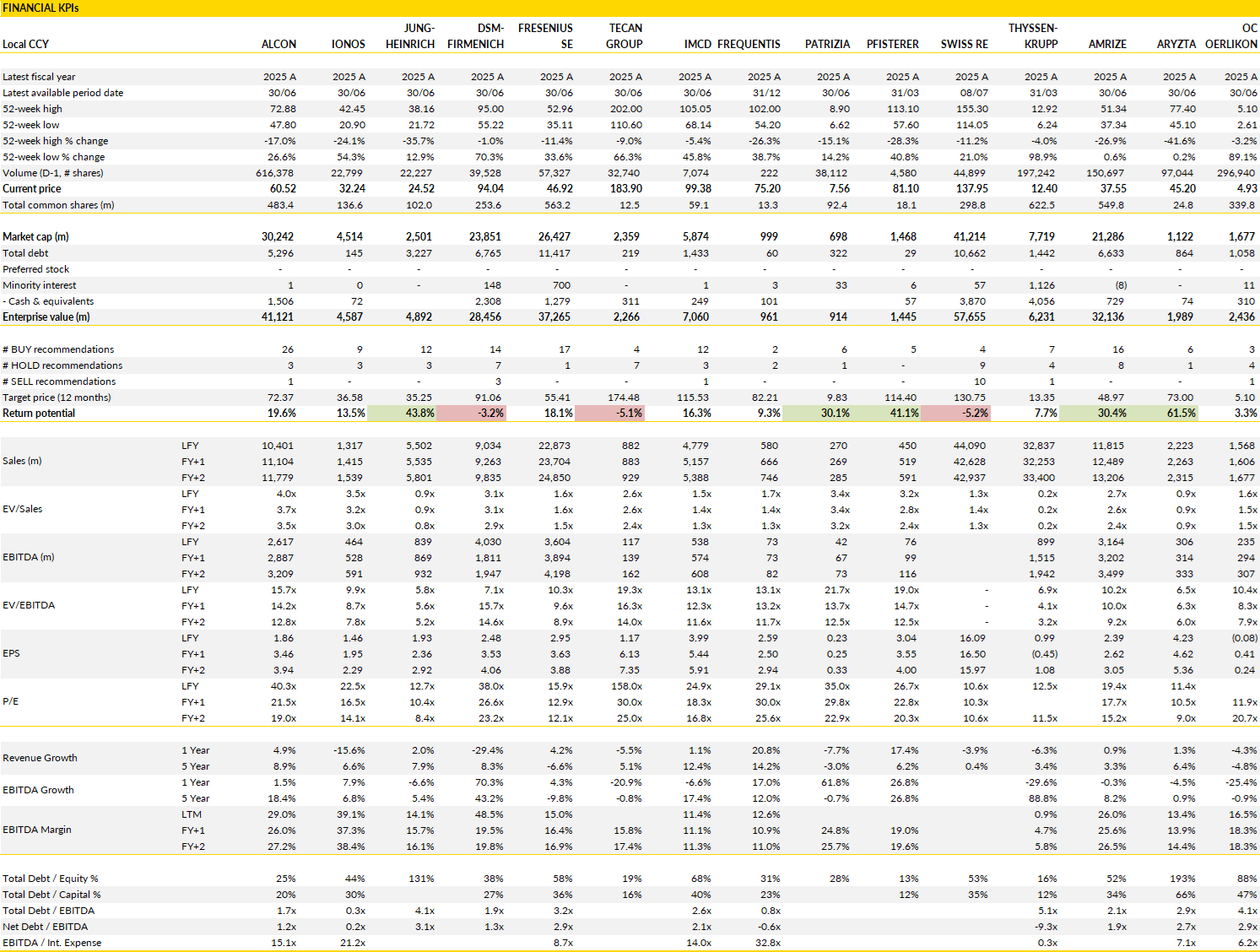
Financial KPIs
Companies covered in this edition: Alcon, IONOS, Jungheinrich, DSM-Firmenich, Fresenius, Tecan, IMCD, Frequentis, Patrizia, PFISTERER, Swiss Re, thyssenkrupp, Amrize, Aryzta, OC Oerlikon
Alcon (ALC Switzerland): New products push growth higher
Alcon delivered a strong Q2, with growth spread across both Surgical and Vision Care and several recent product launches beginning to make a meaningful contribution.
Sales increased 8% to $2.78bn, or 7% at constant currencies, while the core operating margin reached 20.6%. Surgical was particularly strong, with sales up 8% to $1.57bn as equipment revenue jumped 26%. The UNITY platform is gaining adoption and has quickly become an important driver for the division. Consumables continued to benefit from higher procedure volumes and pricing, while Implantables grew a more modest 2%. Within the latter, PanOptix Pro continues to perform well and is helping Alcon strengthen its position in premium intraocular lenses despite competitive pressure in some international markets.
Vision Care kept pace with Surgical, growing 8% to $1.21bn. Ocular Health remains the fastest-growing part of the business, with sales up 13%, supported by Tryptyr and the wider dry-eye portfolio. Contact lenses increased 5%, helped by new products, market-share gains and pricing. The combination gives Alcon a relatively broad set of growth drivers: UNITY is expanding the installed equipment base, which should subsequently support consumables demand, PanOptix Pro is strengthening the premium implantable portfolio, and Tryptyr is building another meaningful franchise within Ocular Health. Management's confidence in these trends is reflected in upgraded 2026 guidance. Constant-currency sales growth remains targeted at 5-7%, while expected core operating margin expansion has been raised to 90-190bp and core diluted EPS growth to 12-15%.
The main blemish is the continuing gap between core and reported profitability. Alcon generated $574m of core operating income in Q2 but only $11m on a reported basis because of $563m of adjustments. Most of this came from the decision to discontinue the PowerVision program, resulting in $402m of impairments and related charges. While largely non-core in nature, the scale of the adjustments remains difficult to ignore and PowerVision itself represents a failed development programme.
Operationally, however, Alcon is moving in the right direction. Growth is diversified, several important launches are scaling simultaneously and higher sales are increasingly translating into better core margins. If UNITY, PanOptix Pro and the dry-eye franchise maintain their current trajectories, Alcon should have enough internal growth drivers to continue expanding above its underlying markets while improving profitability.
IONOS (IOS Germany): Growth accelerates
IONOS is accelerating despite concerns that AI could disrupt the traditional web-hosting model.
Organic growth reached 8.8% in Q2, supported by stronger customer acquisition and a sharp acceleration in cloud. The customer base is currently expanding by 6+% year-on-year, helped by increased investment in the IONOS brand, and management is targeting 450,000 new customers in 2026 compared with 310,000 last year. This creates a healthy foundation for the hosting business, where growth can increasingly come from both customer additions and higher spending per customer. Over 2025-2028, revenue growth could average around 9-10%, including roughly hsd% in web hosting and 15% in cloud.
AI is starting to contribute to that ARPU opportunity. IONOS is developing agent-based products aimed at smaller businesses that may lack the resources to build these tools internally. Its AI Phone Receptionist already has around 15,000 customers paying more than €70 per month, far above the roughly €16 average ARPU in web hosting, while customer satisfaction is strong with an NPS above 50. The broader rollout is taking time, but successful products could provide an attractive additional revenue stream across IONOS's existing customer base. Cloud is developing even faster, growing 20% in Q2, including 48% growth in public cloud. Demand for European sovereign-cloud infrastructure is helping here, while IONOS continues to broaden the services offered on top of its infrastructure.
Profit growth has lagged revenue so far, with adjusted EBITDA increasing only 3% in H1 as marketing expenditure rose. Management nevertheless continues to target 9% EBITDA growth for 2026, implying an acceleration to around 15% in H2. The main weak spot remains AdTech, which is still loss-making and has yet to be sold, removing a potential source of earnings improvement.
Even with that drag, the operating trajectory of the core IONOS business is improving. Customer acquisition is accelerating, cloud growth has moved into the 20% range and AI is emerging as a potential source of additional ARPU instead of simply a competitive threat. The next test is whether the expected H2 acceleration in EBITDA arrives as marketing investment normalises and the recent revenue growth begins to translate more clearly into earnings.
Jungheinrich (JUN3 Germany): Impriving automation but cash generation remains weak
Jungheinrich's final Q2 numbers offered few surprises after the preliminary release in July, but the segment details provided a somewhat better view of its automation activities.
Group order intake of €1.42bn, sales of €1.40bn and EBIT of €88m were confirmed, alongside the reduced 2026 guidance announced last month. The core Industrial Trucks & Services business was broadly as expected, with €1.16bn of revenue and €82m of EBIT, although orders were slightly softer. Automated Warehouse Equipment performed better operationally, with order intake of €311m and sales of €266m coming in stronger than anticipated. The division still recorded a small EBIT loss of €2.5m, showing that higher activity has yet to translate into sustainable profitability.
Cash flow remains the weaker part of the picture. Free cash flow was negative at €99m, although this included roughly €97m spent on the stakes in EP Equipment and automation specialist NavelFlex. Even adjusting for those acquisitions, underlying cash generation remained subdued, consistent with the reduction in full-year FCF guidance announced on 23 July.
Jungheinrich now expects 2026 order intake of €5.5-6.1bn, sales of €5.3-5.9bn and reported EBIT of €340-400m. The stronger AWE performance provides some encouragement because warehouse automation remains strategically important for the group, but further progress in margins and cash conversion will be needed before the improvement becomes more convincing.
Separately, Jungheinrich has extended CEO Lars Brzoska's mandate through July 2030, giving him another four-year term. Brzoska joined the management board in 2014 and has led the company since 2019, so the decision provides continuity following several management-board changes during 2025 and 2026.
That continuity also puts responsibility for the next phase of the group's strategy firmly with the existing leadership. Jungheinrich continues to reference its 2030 ambitions, although the weaker operating environment and recent guidance reduction raise questions over whether those longer-term targets will eventually need to be recalibrated.
For now, improving automation demand is encouraging, but weak cash generation and uncertainty around the medium-term targets leave the operational recovery incomplete.
DSM-Firmenich (DSFIR Netherlands): Better margins and cash generation from the portfolio reshaping
DSM-Firmenich is starting to show a cleaner earnings profile after several years of portfolio changes, with H1 providing further evidence that margins can approach the company's 20% ambition.
Like-for-like sales increased 5% in H1, accelerating to 6% in Q2, while the adjusted EBITDA margin improved from 19.1% in Q1 to 19.5% in Q2. Further progress is expected in H2, particularly from Taste, Texture & Health and Health, Nutrition & Care, with Perfumery & Beauty remaining around its already strong 22% margin level. This would take the group margin to around 20% in H2 and 19.6% for the full year. The improvement is relatively broad-based and should leave DSM-Firmenich entering 2027 with a stronger underlying earnings base.
The disposal of Animal Nutrition & Health is an important part of this transition. DSM-Firmenich expects around €600 million of net cash proceeds while retaining a 20% interest in the business, with a further potential €500 million linked to earn-outs. Removing ANH simplifies the portfolio and directs more capital towards the higher-margin businesses that now drive group earnings.
It also strengthens the balance sheet, with leverage expected at around 2x EBITDA after the transaction. This provides considerable flexibility for shareholder distributions. Annual buybacks of around €500 million can be sustained without materially stretching leverage, while eventual ANH earn-out payments could create room for additional buybacks or dividends.
Cash generation should become a larger part of the attraction from 2027. Adjusted gross free cash flow is expected at roughly €1 billion in 2026, equivalent to around 11% of sales, with conversion improving thereafter as capital expenditure moderates and operating working capital moves below 27% of sales. The combination of margin expansion, lower capital intensity and a simpler portfolio could therefore produce significantly stronger cash generation even without a major acceleration in revenue growth.
The key operational requirement is continued margin improvement in TTH and HNC, while the main financial catalyst is how management deploys the cash released from ANH and future free cash flow. With leverage remaining around or below 2x, DSM-Firmenich should have increasing capacity to return excess capital while continuing to invest in its remaining growth businesses.
Fresenius (FRE Germany): Kabi's growth businesses improve the earnings mix
Fresenius delivered a solid quarter, with revenue broadly in line with market expectations while EBIT and EPS came in ahead. More significant was the composition of growth, with Kabi's higher-growth businesses making an increasingly large contribution. Kabi grew organically by 7%, led by 12% growth across its Growth Vectors, while Helios Germany accelerated to 6% organic growth after 3% in Q1. Fresenius has spent the past several years simplifying the group and concentrating resources on Kabi and Helios, and the latest quarter shows improving performance within both. The shift within Kabi is particularly encouraging because the faster-growing Biopharma, Nutrition and MedTech businesses are also becoming increasingly important contributors to profitability.
Kabi's Growth Vectors were led by Biopharma, where organic revenue jumped 38%, alongside 11% growth in MedTech and 5% in Nutrition. EBIT from these activities increased 41% to €234 million, taking the margin to 17.9%. That growth compensated for a much softer performance in the traditional Pharma business, where organic revenue increased just 1%. US volumes remained healthy, but pricing pressure limited growth and weighed on profitability. This changes the qualitative mix of Kabi in a favourable direction, with a greater share of earnings coming from businesses offering stronger structural growth. Helios Germany also improved, helped by higher pricing and inpatient admissions, while Spain grew by only 3% as weakness in Colombia weighed on the division. Management expects some of that pressure to ease during H2.
Fresenius continues to deliver on the operating improvements behind its recent transformation. The strength of Kabi's Growth Vectors allows weaker Pharma performance to be absorbed without derailing overall earnings growth, while the recovery at Helios Germany adds another source of support. The company is increasing its expectations for Kabi while leaving Helios broadly unchanged, resulting in slightly higher group revenue and EBIT expectations for 2026 and beyond.
Important going forward will be to maintain double-digit growth across Kabi's newer businesses while translating their increasing scale into higher group profitability. With Biopharma expanding rapidly, MedTech growing at a double-digit pace and German hospital activity improving, Fresenius is increasingly benefiting from a stronger mix of businesses than it had only a few years ago.
Tecan (TECN Switzerland): Growth returns as the Rewired program starts to deliver
Despite the disappointment to the markets, Tecan returned to growth across both divisions in H1, providing the first clearer evidence that the business is emerging from the prolonged weakness in laboratory equipment demand.
Sales reached CHF 427.5m, down 2.7% in reported currencies but up 3.4% in local currencies, while the adjusted EBITDA margin edged up to 15.1%. Life Sciences improved as the half progressed, with local-currency growth accelerating from 1.3% in Q1 to 4.6% in Q2. Biopharma, Diagnostics and Tecan Genomics contributed to the recovery, while Academia & Government remained weak. Liquid-handling instruments also returned to growth after several quarters of declines. At the same time, recurring revenues continued to increase and now represent 64.4% of Life Sciences sales, providing a larger recurring base alongside the equipment recovery.
Partnering Business also returned to growth, with sales increasing 3.6% in local currencies, supported by Diagnostics and Medtech customers. Orders provide some confidence that the improvement can continue, with book-to-bill above 1x across both divisions throughout H1. Profitability was particularly encouraging given significant external pressure. Underlying margin improvement amounted to around 180bp, enough to absorb approximately 120bp of FX pressure and another 50bp from tariffs while still producing a small year-on-year increase in the adjusted EBITDA margin.
Higher volumes and a more favourable product mix contributed, alongside the first savings from Rewired. The restructuring program is progressing across its three pillars, including the closure of Tecan's Boston medical-device design operation and the planned disposal of selected Tecan Genomics activities.
Management has kept both its 2026 and medium-term targets unchanged. Full-year sales are expected to grow at a low single-digit rate in local currencies, with an adjusted EBITDA margin of 15.5-16.5%, implying a further profitability improvement during H2. Around CHF 6m of tariff refunds should also arrive in the second half, although these will be excluded from adjusted earnings.
Tecan continues to target CHF 1bn of revenue and a 20% adjusted EBITDA margin by 2028. Reaching that margin will require considerably more progress from Rewired and a continued recovery in instrument demand, but H1 at least moves the business in that direction. Both divisions are growing again, orders remain ahead of sales and underlying margins are already improving despite substantial currency and tariff pressure, giving the recovery a firmer operational base going into H2.
IMCD (IMCD Netherlands): Earnings accelerate while deleveraging restores M&A capacity
IMCD entered the second half with stronger momentum, particularly across EMEA and Asia-Pacific.
After H1 growth of 6.7% in revenue and 3.6% in adjusted EBITA, the second half should see a clear acceleration, with revenue and gross profit growth around 9% and adjusted EBITA growth approaching 13%. Q2 demonstrated particularly strong operating leverage, although its 44.9% conversion margin is unlikely to represent a sustainable quarterly run-rate. Conversion is expected to normalise through Q3 and Q4 while remaining healthy enough for earnings to grow faster than gross profit. EMEA remains the largest contributor to the improvement, helped by better conversion, while APAC is gaining momentum and the Americas should return to positive growth during H2.
Working capital remains of course manageable despite the acceleration in activity (it comes off a low base). IMCD needs to carry sufficient inventory because customer order patterns offer relatively short forward planning, but working capital is expected at around 19% of sales for 2026, broadly stable compared with last year. Inventory pricing effects also appear contained, with exposure mainly limited to parts of the semi-specialty and industrial portfolio.
More significant is the expected improvement in the balance sheet. Leverage stood at 2.8x at the end of H1 but should decline to around 2.5x by year-end and below 2x during 2027. This gives IMCD increasing financial flexibility after a period in which acquisitions and softer earnings kept leverage elevated.
This balance-sheet improvement should gradually reopen the door for M&A, which remains an important component of IMCD's long-term growth model. The company has historically used acquisitions to add specialist product portfolios, supplier relationships and geographic exposure, so renewed financial capacity can complement the improving organic performance.
For now, the near-term driver remains execution in H2, with EMEA and APAC carrying most of the expected acceleration and margins staying above their H1 levels even as the exceptional Q2 conversion normalises. If IMCD can combine high-single-digit revenue growth with double-digit EBITA growth and bring leverage below 2x during 2027, it will enter the next acquisition cycle from a considerably stronger financial position - and thus offering rerating potential.
Frequentis (FQT Germany): An unusually strong first half
Frequentis confirmed an exceptionally strong H1, with revenue increasing 45% to €343m as several large projects progressed faster than originally planned.
Air Traffic Management was the main driver, with revenue up 59%, while Public Safety & Transport grew 11%. Orders were also healthy, rising 17% to €362m, although the divisional split was unusually wide: ATM orders jumped 64%, while PST declined 35% against a strong comparison period. The backlog consequently reached a record €835m, crossing €800m for the first time and providing a substantial base for future deliveries. The acceleration in project milestones also shifted some of Frequentis' normal second-half weighting into H1, which needs to be considered when looking at the unusually strong headline growth.
Profitability improved sharply alongside the higher activity. EBIT reached €15.6m compared with a €4.3m loss a year earlier, lifting the margin from -1.8% to 4.6%. Net income reached €11.3m, while free cash flow improved to €7.9m despite higher capital expenditure. Frequentis therefore finished June with net cash of €107m, slightly above the year-end level. The unusual timing of project milestones complicates the interpretation of H1, however. Revenue recognition moved materially forward, but the EBIT margin remained at only 4.6%, leaving a sizeable profitability increase required during the remainder of the year. Some of the exceptional H1 revenue growth should therefore be viewed as timing-related instead of extrapolated into the second half.
Management nevertheless confirmed the upgraded 2026 outlook introduced in July, targeting revenue growth of around 15%, compared with roughly 10% previously, and an EBIT margin of around 7%.
Given the amount of revenue already recognised, this implies H2 sales below H1 while the second-half EBIT margin needs to rise towards 10% to reach the full-year target. Frequentis has historically generated considerably stronger margins later in the year, so such a step-up is consistent with its seasonal profile, but the unusually early project execution makes this year's progression less straightforward. The record backlog and strong ATM order intake provide a healthy foundation beyond 2026, while the net cash balance gives the company ample financial flexibility.
The immediate test is now profitability: after an exceptionally strong first half for revenue, H2 needs to demonstrate that the operational leverage embedded in the growing business can translate into the margin progression management continues to target.
Patrizia (PAT Germany): Cost cuts lift earnings while fee growth remains elusive
Patrizia's Q2 showed a sizeable improvement in profitability, although it came almost entirely from a lower cost base instead of a recovery in fee income.
Total service fee income declined 6.6% to €58.1m, with management fees down 8.6% to €54.4m. Transaction and performance fees improved from depressed levels but remain small contributors, while assets under management were unchanged at €55.9bn. EBITDA nevertheless increased 54% to €18.9m as Patrizia's efficiency measures started to have a much larger effect. Staff costs declined from €36.7m to €32.0m, while other operating expenses dropped particularly sharply from €15.2m to €10.6m. This was enough to absorb €1.7m of impairments and a €4.0m devaluation of investment properties and still produce net income of €4.7m.
There are some encouraging signs beneath the weak fee development. Transaction volumes signed during H1 increased 16% to €1.6bn, suggesting activity in real assets is gradually recovering, while equity raised from clients increased to €0.8bn from only €0.3bn a year earlier. If these trends continue, they should eventually feed into transaction fees, deployment and the management-fee base.
For now, however, this transmission remains limited. The unusually low level of other operating expenses also raises the question of how much of the Q2 cost improvement can be sustained. Cost discipline can protect profitability while markets recover, but there is a natural limit to how far earnings can progress without renewed growth in fee-generating activity.
Management has maintained its 2026 EBITDA guidance of €60-75m, with the first half benefiting from the restructuring and efficiency measures already implemented. The next stage needs to come from revenue. Patrizia's €55.9bn AuM base has stopped shrinking, fundraising has improved and transaction activity is moving higher, providing the ingredients for a recovery if real-asset markets continue to normalise. The timing remains uncertain, particularly for higher-margin transaction and performance fees, which are inherently more sensitive to investment activity and asset exits.
To conclude, Q2 therefore represents progress in rebuilding the earnings base, but primarily through self-help. A more convincing improvement will require the stronger fundraising and transaction indicators now appearing in the business to translate into sustained growth in management fees and other fee income.
PFISTERER (PFSE Germany): Grid investment remains strong as capacity expands
PFISTERER continues to benefit from the structural expansion and modernisation of electricity grids, with recent updates from Prysmian and Nexans providing encouraging signals for the broader market. Both cable manufacturers raised their 2026 outlooks after strong first-half performances, with particularly healthy demand across transmission and power-grid activities.
PFISTERER should show similar underlying strength when it reports Q2 on 19 August. Sales are expected to grow by around mid-teens% to ~€130m, following an already strong first quarter, while adjusted EBITDA should reach roughly €25m and the margin remain close to 20%. Management currently guides for more than 12% revenue growth in 2026, although the underlying trajectory could ultimately reach 15%+ if current demand continues.
Orders will be the more important number to watch. PFISTERER has indicated that full-year order intake should remain broadly around the €551m achieved in 2025, and Q2 faces a demanding comparison after €146m of orders last year. Order intake around €135m would therefore represent a modest sequential improvement but a decline of roughly 8% year-on-year, leaving book-to-bill slightly above 1x.
A stronger second half will be needed to sustain another year of double-digit growth in 2027. The company's own capacity decisions suggest confidence beyond the next few quarters. PFISTERER recently acquired another 46,000 sqm at its Královský Vrch production hub in the Czech Republic, adding to almost 50,000 sqm secured last year. The expansion fits with its ambition to reach €800-900m of revenue by 2030 and prepares the manufacturing footprint for continued grid investment and the expected increase in HVDC activity from 2027.
The attraction of PFISTERER's model comes from supplying relatively small but technically critical components within much larger grid projects. These products represent a limited share of total installation costs, reducing customer sensitivity to pricing, while demand comes from both new electrification projects and replacement of ageing infrastructure in Europe and North America. North American growth should accelerate into double digits as the Rochester site develops, while Europe continues to expand at a similar pace.
The main question is whether Middle Eastern and African investment, which drove much of last year's growth, begins to moderate. Even so, strong grid spending elsewhere, additional manufacturing capacity and the forthcoming HVDC cycle provide several avenues for continued expansion.
After the recent share-price decline, PFISTERER also trades at a sizeable discount to the levels reached earlier this year, while operating trends across the wider cable and grid-equipment industry remain supportive.
Swiss Re (SREN Switzerland): Cost discipline cushions a softer reinsurance cycle
Swiss Re delivered another strong quarter, with Q2 net profit of $1.33bn coming in ahead of market expectations and taking first-half earnings to 63% of the company's $4.5bn full-year target.
Performance was broad-based across P&C Reinsurance, Corporate Solutions and Life & Health, helped by unusually low natural catastrophe losses and favourable US mortality experience. Capital also remains comfortably above requirements, with the SST ratio at 264%. The more interesting development sits beneath these headline numbers: reinsurance pricing is clearly softening, forcing Swiss Re to become more selective about where it deploys capital. At the June and July renewals, volumes increased 11% to $4.5bn, but net pricing declined 5.3%. Across renewals year-to-date, volumes are broadly unchanged at $19.5bn while pricing is down 4.6%, creating a meaningful drag on the profitability of newly written business.
P&C Reinsurance nevertheless produced an excellent Q2 combined ratio of 74.0%, helped by low catastrophe losses and reserve releases in short-tail lines. Some of these releases were recycled into IBNR reserves for longer-tail exposures, providing additional protection against future claims development. Swiss Re is also shifting the portfolio towards less cyclical areas as pricing becomes less attractive. Corporate Solutions faces a similar backdrop: its 87.0% combined ratio remained healthy, but commercial insurance rates fell 6% year-on-year and new-business CSM declined 31% to $195m. Life & Health provided a useful counterweight, with quarterly profit rising 37% to $546m, supported by $97m of favourable experience variance, predominantly from US mortality. The division appears comfortably on course for its $1.7bn full-year profit target, although its CSM stock declined 1.5% from the beginning of the year to $16.7bn.
Management is responding to softer pricing by pushing cost reductions further. Swiss Re now aims to lower its annual run-rate cost base by $500m by 2028, extending the existing programme that targets $300m of savings by 2027. This gives the group another lever to protect earnings as underwriting conditions normalise after several unusually favourable years.
The central question over the next two years will be how quickly pricing deteriorates relative to Swiss Re's ability to improve its portfolio mix, maintain underwriting discipline and remove costs. Q2 shows that current profitability remains very strong, while the balance sheet provides substantial flexibility. At the same time, the June and July renewals offer a clear indication that the cycle is moving against reinsurers, making continued discipline increasingly important if Swiss Re is to preserve its current level of returns.
thyssenkrupp (TKA Germany): tk accelis spin-off clears another hurdle
thyssenkrupp has moved another step closer to breaking up the group after shareholders approved the spin-off of tk accelis at the 7 August EGM. The transaction will establish the current Materials Services activities as an independently listed materials distributor and supply-chain services company, following the initial spin-off announcement earlier this year and Supervisory Board approval in July.
The business is sizeable, generating €11.4bn of sales and €132m of adjusted EBIT in FY 2024/25, equivalent to roughly 35% and 21% of thyssenkrupp's respective group totals. tk accelis has already begun presenting itself independently, including a July CMD outlining its business model and future growth strategy.
The structure is designed to give thyssenkrupp shareholders direct exposure to the new company without fully separating it from the parent. Existing shareholders will receive 49% of tk accelis shares on a proportional basis, while thyssenkrupp retains a strategic 51% majority holding. The plan is to list tk accelis Group AG & Co. KGaA on the Prime Standard of the Frankfurt Stock Exchange before the end of 2026. The EGM vote was a necessary condition for proceeding, so attention now shifts towards the remaining implementation steps and the listing itself. Retaining control also gives thyssenkrupp flexibility over its stake after the transaction, while allowing tk accelis to establish a standalone valuation and direct access to capital markets.
The transaction is another piece of thyssenkrupp's transformation from a diversified industrial conglomerate into a financial holding company controlling increasingly independent businesses. Separating Materials Services should make its operating performance and capital requirements easier to assess independently, while creating a cleaner structure at the parent. The same logic sits behind the wider restructuring of thyssenkrupp's portfolio, with individual businesses increasingly expected to operate with greater strategic and financial autonomy.
The tk accelis listing therefore advances the broader dismantling of the historical conglomerate structure.
Amrize (AMRZ Switzerland): Strong demand collides with US cost pressure
Amrize is seeing stronger demand than anticipated, but the benefit is being absorbed by a difficult price/cost environment, particularly in the US.
Organic growth and volumes have exceeded expectations, prompting management to raise its sales outlook, yet EBITDA guidance has moved in the opposite direction. Cement pricing has taken longer to recover while freight, diesel and raw-material costs have increased, squeezing margins despite healthy activity. Residential roofing has been particularly strong, with full-year growth now expected in the high single digits compared with an earlier assumption of broadly flat volumes. Cement and aggregates demand is also holding up well, although tougher comparisons mean volume growth should moderate during H2.
Pricing is a large part of the issue here. Cement prices declined another 0.2% year-on-year in Q2, although the sequential picture was considerably better, with prices increasing 2.1% from Q1. Full-year cement pricing is now expected to range between flat and low single-digit growth, down from the previous low single-digit expectation. The other pressure point is US freight, where reduced transportation capacity has pushed costs sharply higher. Management expects the impact to remain elevated through Q3 before easing in Q4, when it also expects the overall price/cost balance to turn positive again.
That leaves H2 dependent on two developments that Amrize cannot fully control: successful implementation of additional price increases and some normalisation in freight costs. Management nevertheless expects margins to improve sequentially from the first half.
Away from these short-term pressures, Amrize continues to deploy its balance sheet into acquisitions. The pipeline is described as healthy and expanding across both businesses, with PB Materials performing ahead of expectations and the recently acquired Rapid Ready Mix business in Dallas-Fort Worth expected to contribute positively from its first year. Further transactions therefore look likely, while the Aspire programme provides another internal source of earnings improvement.
The combination of strong volumes, acquisitions and operational initiatives gives Amrize several routes to grow, but the next few quarters will depend heavily on converting that growth. Full-year EBITDA is now expected at $3.1-3.2bn, and the key test is whether the anticipated Q4 improvement in pricing and transportation costs arrives.
Aryzta (ARYN Switzerland): Germany remains the main problem
Aryzta is sticking with its 2026 outlook, although organic growth is now expected at the lower end of guidance and the route to higher profitability has shifted towards self-help.
H1 organic sales declined 2.7%, but underlying profitability held up considerably better. Reported EBITDA included €5.4m of restructuring costs, equivalent to around 50bp of margin, and excluding these underlying EBITDA declined only around 3.5%, leaving the margin broadly stable. Procurement savings added around 90bp, innovation another 20bp and Project Excellence around 30bp, largely absorbing weaker operating leverage, labour and energy inflation, commodity pressure and slightly negative pricing. Management expects a larger contribution from Excellence in H2, while easier comparisons, innovation and recent investments should also help. Pricing is expected to stabilise and could become slightly positive for the full year.
Germany remains the main problem, with revenue down around 10% and weakness across Retail, Foodservice and QSR. Customer insourcing has also increased as customers make greater use of their own available production capacity. Aryzta is reviewing all options and expects to communicate its conclusions during H2, although the CEO described a complete disposal as an extreme and relatively unlikely outcome. That makes restructuring, footprint optimisation or selective portfolio measures more plausible.
Elsewhere, the operating picture is healthier. APAC continues to perform well, Perth should start contributing to sales during H2 and the recent French distribution acquisition will contribute for the full six months. Project Excellence has now covered around 50% of production volume and identified €8-10m of annual savings, with the remainder of the manufacturing footprint scheduled to be addressed by the end of 2027. Organisational changes should add another roughly €10m annually, keeping the €20-30m net savings target for 2028 intact.
Cash generation and capital allocation are becoming increasingly relevant as the operational restructuring progresses. Management continues to expect lower leverage and has reinstated plans for shareholder remuneration, with the Board intending to propose capital returns at the 2027 AGM based on 2026 earnings. This could take the form of a dividend, share buyback or a combination, with Aryzta planning to move gradually towards payout levels typical of Swiss-listed SMEs.
The next several months have a fairly clear set of operational milestones: stronger H2 savings, the start-up of Perth, a decision on Germany and continued deleveraging. Revenue growth remains subdued, but the ability to preserve margins despite falling volumes suggests the cost programme is gaining traction. If Germany can be stabilised and the €20-30m savings programme continues to come through, Aryzta can enter 2027 with a leaner cost base, improving cash generation and scope to begin returning capital to shareholders.
OC Oerlikon (OERL Switzerland): Pure-play strategy starts to show its earnings potential
OC Oerlikon delivered a strong first half, providing early evidence that the streamlined group emerging from the Barmag disposal can generate better growth and margins.
Orders increased 19% at constant currencies to CHF 920m, while sales rose 6.7% to CHF 790m. Operational EBITDA reached CHF 156m and the margin expanded by 300bp to 19.7%, while net income swung to CHF 40m from a CHF 46m loss a year earlier. Demand is particularly healthy across aerospace, power generation and industrial gas turbines, semiconductors and defence. Aerospace provides an unusually long demand runway, with aircraft OEM backlogs reportedly equivalent to more than ten years of production. The stronger performance prompted management to raise 2026 guidance, with sales now expected to grow at a mid-single-digit rate and the operational EBITDA margin targeted at 18.5-19.5%, up from around 17.5% previously.
The improvement goes beyond stronger end markets. Pricing discipline, portfolio simplification and cost reductions are feeding through, although favourable critical-material pricing also contributed. Coating Services increased its operational EBITDA margin from 18.0% to 18.8%, with scope for further improvement if aerospace and other high-value markets remain strong. Materials & Equipment reached 23.8%, up 690bp, although inventory revaluation provided a benefit and this level should not be treated as a sustainable run-rate. Components remains the main area requiring work, with its margin slipping 50bp to 11.9%, and management has launched measures to improve profitability.
The strong H1 order intake also gives Oerlikon a solid base for continued growth into 2027, particularly as the portfolio increasingly concentrates on higher-value coatings, materials and components.
The next important event is the Capital Markets Day on 8 September, when Oerlikon will introduce new segment targets and could also revisit its group ambitions. Following the Barmag disposal, management had indicated medium-term organic sales growth of 4-6% and an EBITDA margin around 200bp above the 2024 level of roughly 18.6%. H1 performance suggests there may already be room to become more ambitious, particularly on profitability. The combination of a 19% increase in orders, strong aerospace and defence demand, better pricing and a simpler portfolio makes the post-Barmag earnings profile increasingly credible. Components still needs improvement and some of the Materials & Equipment margin expansion is temporary, but the underlying direction is encouraging.
September’s CMD should provide a clearer indication of how much of the H1 margin improvement can be sustained and how far management believes the pure-play Oerlikon model can ultimately go.