
Pharma, CMDs and a lot of defense
Vincorion, Infineon Technologies, Novo Nordisk, Cosmo Pharmaceuticals, Puig, Kontron, Amrize, Bechtle, Vusion, Volkswagen, RENK, Hermès International

At Lux Opes, we break down companies into quick takes that get straight to the point - what is happening, why it matters, and what to watch next. We publish 2-3 times per week, depending on the news flow.
For the best reading experience, we recommend reading at Lux Opes
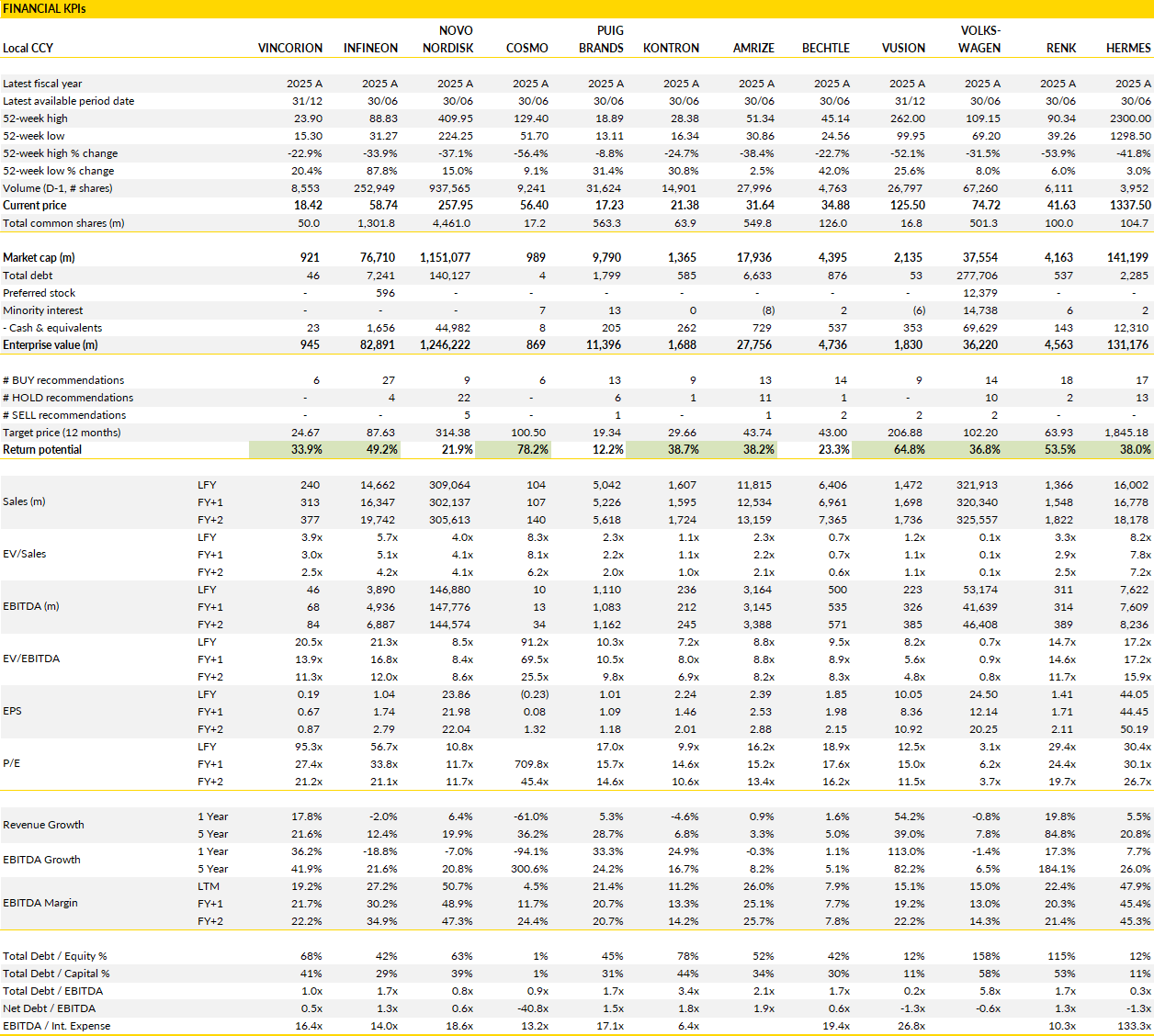
Financial KPIs
Companies covered in this edition: Vincorion, Infineon Technologies, Novo Nordisk, Cosmo Pharmaceuticals, Puig, Kontron, Amrize, Bechtle, Vusion, Volkswagen, RENK, Hermès International
Vincorion (V1NC Germany): Defence ramp-up on track
Vincorion moved into H2 2026 with €1.2bn of backlog, including €615m of firm orders, giving the company a substantial base from which to continut to expand.
Vehicle systems benefited from Leopard 2 orders during Q2, and additional conversions from the softer backlog are expected during H2, including demand associated with Schakal and Leopard platforms. Arminius represents further potential but remains outside the backlog because the timing is still uncertain. Power systems are also seeing healthy demand, including exposure to the next-generation hybrid Patriot system. Aviation is moving closer to series production, with first flight tests for the electric rescue hoist scheduled for October and initial deliveries for the H145 planned for H1 2027. Production is ultimately intended to reach around 100 units annually. These programs broaden the sources of revenue across land, air and air-defence applications and provide a sizeable workload beyond the current year.
The industrial expansion required to service these orders is progressing according to plan. Vincorion expects around €30m of capital expenditure in both 2026 and 2027, but existing facilities still offer room to increase output through additional shifts and selective site expansion. Supply availability remains an issue for permanent magnets containing rare earth materials and some electronic components. The company is reducing its dependence on selected Asian suppliers and has so far kept these constraints manageable. Contractual indexation now allows higher input costs to be passed through, limiting the effect on profitability.
For 2026, management reiterated revenue guidance of €280-320m in August and indicated that sales should finish towards the upper end of that range. The current adjusted EBIT margin guidance remains 18-19%. Higher R&D spending and the full effect of recruitment following the IPO will increase the cost base during H2, alongside continued investment in additional manufacturing capacity. Vincorion nevertheless expects positive free cash flow for the full year, helped by an improvement in working capital after it reached 44% of sales in H1.
TPS could add a sizeable new business outside Vincorion's established platform programs. Development has been financed by the Bundeswehr and recent testing has been completed successfully. A German tender is expected in the coming months as the country looks to replenish equipment supplied to Ukraine, with a potential decision during H1 2027 and production ramp-up from 2028. Management believes TPS could eventually develop into a business comparable in size to the existing power systems division, which is expected to generate around €97m of revenue in 2026. Export demand could expand the opportunity further if the system gains adoption outside Germany.
This gives Vincorion another potential growth leg at a time when its existing defence programs are already moving through a substantial production increase. The immediate priorities remain converting firm orders into revenue, managing working capital and executing the capacity expansion without disrupting margins.
Infineon Technologies (IFX Germany): AI growth broadens into next year
Infineon is approaching FY 2027 with AI-related power semiconductors still expanding rapidly and signs of recovery emerging across automotive and industrial markets. The AI opportunity has already contributed to a backlog of around €30bn, but the next phase of growth should have a wider base as customer inventories normalise and weaker end markets recover.
Near-term trading also remains healthy. Infineon is targeting approximately €4.7bn of revenue in Q4 FY 2026, equivalent to 13% sequential growth, with the first benefits from price increases implemented during the spring and summer starting to appear. Performance is improving across the portfolio. Automotive should exit the year with a margin above 20%, Power & Sensor Systems is approaching 30%, Green Industrial Power has recovered towards the high teens, and Connected Secure Systems has moved above 10%. This gives the company a much stronger starting point for FY 2027 after several quarters in which weak utilisation and inventory corrections weighed heavily on profitability.
Several internal factors should lift margins further during the coming year. Underutilisation costs are currently around €650m and should decline sharply as production volumes increase, with Infineon indicating that €150-200m represents a more normal minimum level. Pricing is also becoming unusually supportive for a semiconductor manufacturer. Increases introduced in April and July will contribute for a full year in FY 2027, potentially allowing average selling prices to remain stable or even rise instead of following the industry's normal annual erosion. Product mix is moving in the same direction as Power & Sensor Systems becomes a larger contributor, helped by the rapid expansion of Power AI. The division is already expected to exit FY 2026 at around a 30% margin. Execution at the new Dresden capacity will be important because stronger demand needs to be matched with a sufficiently rapid manufacturing ramp, while energy costs remain another variable. Infineon is due to provide its FY 2027 framework on 10 November.
The underlying demand mix is also becoming healthier. AI infrastructure remains the strongest individual growth engine, particularly for power-management products used in increasingly energy-intensive computing systems, but automotive and industrial demand are no longer moving in the opposite direction. A broader cyclical recovery would allow Infineon to fill existing capacity more efficiently and reduce the earnings drag from idle manufacturing assets at the same time that AI products improve the sales mix. This creates a favourable operating setup because much of the capacity and associated fixed cost is already in place. Q1 FY 2027 could also prove stronger than the normal seasonal pattern if current demand persists, potentially avoiding the sequential decline usually seen after the September year-end.
The combination of AI expansion, recovering utilisation, firmer pricing and improving legacy markets gives Infineon several independent sources of earnings improvement heading into FY 2027, with the November outlook likely to provide the first detailed company framework for the next stage of the cycle.
Novo Nordisk (NOVOB Denmark): Pipeline takes centre stage
Novo Nordisk expects sales to grow by around 5% annually through 2030, with operating margins broadly stable as higher R&D spending absorbs savings in marketing and overheads. The company is preparing for at least five new blockbuster launches and wants its pipeline to generate DKK150bn of sales by 2035. Obesity and diabetes will remain central, although management intends to build larger businesses in haemophilia, endocrinology, MASH and cardiovascular disease. This diversification is key given that semaglutide products still account for more than 70% of group sales. Novo has also expanded manufacturing substantially, including a tenfold increase in capacity for oral GLP-1 products. Strong cash generation and low debt leave considerable financial flexibility, and management has indicated that a large acquisition cannot be excluded, despite Novo having limited experience with transactions of that scale.
Much of the longer-term opportunity sits in products that still require considerable clinical development. One of the more differentiated early programs is an oral ACSL5 inhibitor for obesity, designed to deliver weight loss with fewer gastrointestinal side effects and without the titration required for current GLP-1 therapies. Phase I has only recently started, with initial data expected next year, so its eventual efficacy and commercial relevance remain unproven. CagriSema is much further advanced and could broaden Novo's obesity and diabetes offering by combining semaglutide with cagrilintide, although available clinical results have not established an efficacy advantage over Eli Lilly's tirzepatide. Other pipeline assets include cagrilintide, zenagamtide and Frehemgo. Novo is effectively trying to create several treatment options across different mechanisms, formulations and patient groups, reducing the reliance on a single GLP-1 franchise over time. The commercial contribution from many of these programs will only become clearer as later-stage data emerge.
Oral semaglutide could extend the longevity of the existing franchise. Novo's proprietary SNAC technology enables intestinal absorption of a peptide molecule that would otherwise be difficult to administer orally, and the company has built a broad patent estate around subsequent formulation improvements extending to 2037. Management also sees manufacturing complexity and the capital required to produce the necessary ingredients as additional obstacles for generic competitors. This could preserve part of semaglutide's economics even as the original franchise matures.
Now it's mainly about turning a promising but relatively early pipeline into enough new products to compensate for increasing competition in obesity and diabetes. Novo has the manufacturing base, balance sheet and commercial infrastructure to support multiple launches, but several of the assets intended to carry growth into the 2030s have yet to generate decisive clinical evidence. The next few years will depend heavily on CagriSema and other advanced programs, with the earlier obesity and cardiovascular projects providing potential additional growth if their initial promise survives larger clinical trials.
Cosmo Pharmaceuticals (CMHC Switzerland): GI Genius - let's go!
Cosmo Pharmaceuticals has produced substantial real-world evidence for GI Genius, its AI-assisted colonoscopy system marketed by Medtronic.
The CADeNCE study covered more than 334,000 procedures performed by 816 endoscopists across 139 US Veterans Health Administration centres, making it the largest randomised real-world study of computer-aided detection in colonoscopy conducted to date. GI Genius was available at 42 centres involving 269 endoscopists, with another 97 centres forming the control group. Access to the system increased the probability of detecting an adenoma by 22%, with an adjusted odds ratio of 1.22 and a 95% confidence interval of 1.15-1.28. The adenoma detection rate increased to 54.9% from 50.7%. The improvement was recorded across different levels of physician experience and baseline performance, indicating that GI Genius can improve detection across a broad clinical population instead of providing benefits primarily to less experienced endoscopists.
The scale and setting of CADeNCE are particularly relevant for the commercial development of GI Genius. Earlier controlled trials had already established the potential for AI-assisted detection, but widespread adoption also requires evidence that those benefits persist across routine clinical practice, different physicians and a large number of centres. CADeNCE provides that evidence within one of the largest integrated healthcare systems in the US. The Veterans Health Administration subsequently expanded computer-aided detection across all of its colonoscopy centres following the study, providing a concrete example of clinical evidence translating into broader deployment. The results were also generated using version 2 of Cosmo's algorithm. The company has since advanced to ColonPRO, its fourth-generation system, which was developed to further improve detection. The older technology used in CADeNCE therefore already demonstrated a measurable improvement across hundreds of thousands of procedures, providing a substantial clinical evidence base for the newer generation.
GI Genius is developing into an important part of Cosmo's MedTech AI activities alongside the company's pharmaceutical portfolio, including Winlevi. Commercial adoption of AI in endoscopy ultimately depends on hospitals and physicians seeing sufficient clinical benefit to justify incorporating the technology into routine procedures. A dataset spanning 334,000 colonoscopies and more than 800 physicians gives Cosmo and Medtronic unusually broad evidence when discussing deployment with healthcare systems.
The immediate financial effect of the study may be limited because adoption will still depend on purchasing decisions, reimbursement and implementation across individual markets. Its longer-term value lies in reducing uncertainty around whether computer-aided detection works consistently outside controlled trials. With the Veterans Health Administration already extending its use of the technology and Cosmo now operating with a newer algorithm than the one evaluated in CADeNCE, GI Genius has gained a stronger clinical foundation for further penetration of the endoscopy market.
Puig (PUIG Spain): Q3 growth remains steady
Puig appears on course to maintain its recent growth rate in Q3, supported primarily by fragrances and an improving performance in make-up.
We understand that Fragrances continue to grow ahead of a market expanding by around 3.5-4.0%, helped by the launch calendar and product innovation during the second half. Make-up has also shown encouraging recent trading, including stronger sell-out through Amazon in the US and Boots in the UK. Comparisons become considerably tougher in Q4, making the next quarter a more demanding test of whether the improvement can persist. Skincare remains the softer part of the portfolio following a disappointing Q2 and is recovering more gradually. Overall, current trading points to another quarter of mid-single-digit organic growth, broadly consistent with the pace Puig has indicated previously. The divisional mix remains uneven, but there is little indication of a further deterioration following the softer areas seen earlier in the year.
Full ownership of ISDIN gives Puig a much broader opportunity to develop skincare and dermatology. The company is paying €1.2bn for the remaining 50% held by the Esteve family, ending a joint ownership structure dating back to 1975. Control allows Puig to integrate ISDIN operationally and use the business as a platform for expansion in both dermatology and Latin America. ISDIN already has strong positions across several Latin American markets, giving Puig an established distribution and brand base that can support the rest of its portfolio in the region. Its dermatological expertise also adds a business with different category characteristics from Puig's traditional fragrance exposure.
The transaction removes the limitations created by shared governance and gives management greater freedom over investment, distribution and future geographic expansion. ISDIN can consequently play a larger role in the group than it could under the previous ownership structure.
The product mix is gradually becoming broader, although fragrances will remain the largest contributor for the foreseeable future. Puig has historically built much of its scale around prestige fragrance brands, and continued above-market growth in that division provides funding and distribution strength for expansion elsewhere. Make-up offers another avenue if recent improvements translate into sustained sell-through, particularly across large digital and retail channels. ISDIN adds a more substantial skincare operation and gives the group a stronger presence in Latin America, where its existing fragrance business can be complemented by dermatology.
The October capital markets day should provide more detail on how Puig intends to use these assets together and how much of ISDIN's international potential can be captured under full ownership. For now, trading remains broadly stable, with fragrances carrying much of the growth, make-up improving and skincare still requiring a stronger recovery after Q2.
Kontron (KTN Germany): Growth targets unchanged
Kontron used its capital markets event in Vienna to provide more detail behind its 2030 ambitions, while leaving the headline financial targets unchanged.
The company continues to aim for €2.6bn of revenue and €420m of adjusted EBITDA by 2030, equivalent to a margin of around 16%. Growth is expected to come from a relatively concentrated group of businesses, including defence, 5G network access devices, FRMCS railway communications and proprietary software. KontronOS should become increasingly relevant as customers address the Cyber Resilience Act and incorporate additional security and AI functionality into embedded systems. The €2.75bn order backlog, equivalent to around 1.7 times the 2026 revenue target, already contains a significant amount of multi-year business. FRMCS remains a potentially large opportunity, although the pace of deployment has been slower than previously anticipated. Performance across traditional industrial customers and GreenTech has also been weaker, leaving successful execution in the newer growth areas increasingly important to the 2030 plan.
The closer relationship with Ennoconn adds another potential source of earnings growth. The Taiwanese group increased its ownership from approximately 29% to 48% during 2026 and is now working more actively with Kontron on procurement and commercial opportunities. Management reiterated potential synergies of $84m over the coming years, split roughly equally between the two companies. Ennoconn's supply-chain capabilities could also help address current component shortages. Kontron's overdue order backlog has increased from €50m in Q2 to around €70m this quarter because of chip availability, but management expects this to fall to approximately €20m by year-end.
The company continues to guide for €1.6bn of 2026 revenue and €225m of adjusted EBITDA, or €200m after GreenTech restructuring costs. Operating cash flow remains a weaker area following the poor first half, although more than €100m is targeted for H2. Better component availability and the resulting shipment of delayed orders should contribute to the expected improvement in working capital and cash conversion.
Capital allocation is also changing following Ennoconn's increased ownership. Kontron plans to restart dividend payments and intends to propose €0.65 per share at the next AGM after cancelling the dividend for 2025. Management sees scope for this to rise to €1.50 by 2030, corresponding to around 60% of the €2.50 EPS targeted for that year. Share buybacks are becoming less attractive because Ennoconn does not favour them and further reductions in the share count could push its ownership above 50%. Avoiding that threshold may also be commercially useful in jurisdictions where ownership structures can influence eligibility for public or strategically sensitive tenders.
To conlcude, the Vienna event added substance around the route to the existing 2030 targets without changing the immediate financial outlook. Execution over the next several quarters will depend on reducing delayed deliveries, restoring cash generation and showing stronger contributions from FRMCS, defence, software and 5G.
Amrize (AMRZ Switzerland): Building Envelope remains under pressure
Amrize is seeing an improving pricing environment in Building Materials, although weaker volumes will limit the benefit during Q3.
Comparisons have become considerably tougher after cement volumes increased 6% and aggregates 3% in the same period last year. Several large projects are also reaching completion, and adverse weather in Texas and other southern US markets has affected activity. The underlying commercial and infrastructure pipeline remains healthy, leaving the current slowdown more closely linked to project timing and difficult comparisons than a deterioration in the broader project pipeline.
Pricing provides a useful counterweight. Cement prices are still moving higher, while aggregates are maintaining stronger increases, allowing the price-cost balance in Building Materials to turn positive during Q3. Further improvement is expected in Q4. This should support profitability even with softer volumes and provides a better starting point heading into 2027 if construction and infrastructure activity remains firm.
Building Envelope faces a more difficult combination of cost inflation and delayed pricing. Energy, freight and petrochemical inputs used in roofing and insulation have become more expensive, while diesel inflation has accelerated sharply during the year. Passing these increases through takes time because a significant proportion of projects were negotiated months before delivery. As a result, current selling prices still reflect an earlier cost environment. Roofing is particularly exposed to this mismatch, leaving the division's price-cost balance negative through Q3. The timing should improve in Q4 as newer contracts incorporate higher input costs and comparisons become easier. Building Envelope therefore represents the main source of earnings pressure in the second half, with its recovery dependent on pricing catching up with the cost base. The difference between the two divisions is becoming clearer: Building Materials has already reached the point where price increases are covering inflation, whereas Building Envelope needs another quarter before the same mechanism should become evident.
Amrize is expected to retain its 2026 EBITDA guidance of $3.1-3.2bn at the lower end of the range. The near-term earnings pattern will be uneven, with Q3 carrying the heaviest pressure from Building Envelope before a better price-cost relationship develops across the portfolio in Q4. The building materials operations should already benefit from higher realised pricing and a more favourable cost equation, partially compensating for lower cement and aggregates volumes. Building Envelope has a greater lag because of the contractual structure of its order book, but the problem is primarily one of timing if higher input costs can be incorporated into new work. The commercial and infrastructure backlog also provides a reasonable foundation for future volumes once the current large-project completions have worked through the numbers.
Q3 is likely to remain a relatively soft quarter operationally, particularly in roofing and insulation, with Q4 providing the first clearer indication of whether pricing actions can restore profitability across both parts of the group.
Bechtle (BC8 Germany): Services offer room for higher margins
Bechtle has retained its 2030 objectives of more than €10bn in business volume and an EBT margin of at least 5%, compared with around 3.6% targeted for 2026.
The margin improvement will mainly depend on higher productivity and a larger contribution from services, with acquisitions adding capabilities where needed. Process harmonisation across the group, a more consistent commercial approach and greater use of AI should allow revenue to grow without a corresponding increase in the cost base. Bechtle is also targeting EBIT equivalent to at least 30% of gross profit by 2030, compared with around 28% in 2025. The business volume target leaves considerable flexibility given uncertainty around hardware pricing and customer demand, while the profitability objective requires tangible improvements across operations. Hardware will remain an important part of Bechtle's offering, but expanding services should improve the revenue mix and deepen customer relationships through managed services, cloud, consulting and other recurring activities.
International expansion of the services business offers the clearest opportunity to close the margin gap with Bechtle's more developed markets. Germany and Benelux already have substantial capabilities, whereas France and several other European countries remain less mature. The UK illustrates how this can develop over time. Revenue there has grown from approximately €40m in 2015 to an expected €384m in 2026, combining 11% annual organic growth with acquisitions that added managed-services expertise and other capabilities. Bechtle is now testing ways to reproduce this development elsewhere. Specialists from established operations can participate in projects in countries where local capabilities are still limited, and experienced system-house teams can establish new locations directly in those markets. Selective acquisitions provide another route where building expertise internally would take too long. Much of the required knowledge already exists inside Bechtle, making the ability to transfer expertise between countries an important part of the 2030 plan.
AI can contribute both to customer demand and Bechtle's own productivity. Customers increasingly need infrastructure spanning servers, software, cloud services, data centres and consulting to deploy AI workloads, and Bechtle's broad vendor relationships allow it to work across on-premises, hybrid and cloud architectures. Internally, the company has developed tools including Bechtle GPT, TenderX and Next Best Action to automate parts of tender analysis, improve sales processes and make supply-chain decisions more efficient. Management has not quantified the savings expected from these initiatives, but AI forms part of the productivity improvements required to reach the 2030 margin objective.
The broader plan does not depend on a major change in Bechtle's business model. It relies on applying existing strengths more consistently across the group, expanding higher-margin services outside its strongest regions and keeping operating costs under control. The UK provides evidence that this approach can work at scale, with France and the rest of Europe now offering the largest scope to repeat it.
Vusion (VU FP): Orders to accelerate
Vusion delivered a strong improvement in profitability during H1 2026, with adjusted EBITDA rising 48% to €160m on adjusted revenue of €839m, up 29%. The EBITDA margin reached 19.1%, an increase of 240bp year-on-year, helped by operating leverage and the growing contribution from higher-margin value-added solutions. VAS revenue increased 39%, broadly maintaining the pace required to meet the company's full-year objective of around 40% growth. Adoption of Captana is progressing faster than initially planned, with almost 200,000 cameras already deployed or in the process of deployment compared with the original expectation of 150,000. Computer vision is consequently becoming a more meaningful part of the product mix alongside electronic shelf labels and the broader store digitalisation platform. Adjusted net profit increased 81% to €77m. Vusion has retained its 2026 targets for adjusted revenue growth of 15-20% at constant currencies and tariffs, continued EBITDA margin expansion and approximately 40% VAS growth.
Cash flow looks considerably weaker than the income statement this year because Walmart's advance payments have ended. Working capital absorbed €266m in H1 and free cash flow fell to negative €222m. This is largely a reversal of the favourable financing effect created by customer advances in earlier periods, although it leaves the second half with a significant cash conversion requirement. Net cash stood at €197m at the end of June, and management still expects to finish 2026 with a positive net cash position before completing the acquisition of In-Store Media. That transaction is scheduled to close by the end of Q4 and will be debt financed. In-Store Media expands Vusion's exposure to retail media, adding another service layer to the physical-store infrastructure already covered by electronic labels, computer vision and software. The acquisition also fits the broader move towards recurring and service-based revenue, which has been an important contributor to the improvement in group margins.
Order intake is now the main operational issue for the remainder of the year. Orders declined 22% in H1, yet management still expects the full-year figure to exceed 2025, requiring a substantial increase during H2. No major Q3 contract has been announced so far, making Q4 particularly important. Vusion has identified more than €1bn of potential orders for the second half across existing customers and new accounts, with around 30% related to newer VAS products already being deployed or developed. Converting a meaningful portion of this pipeline would replenish the backlog and provide a stronger base for 2027 after the rapid rollout of several large contracts.
The November capital markets day should also provide more detail on the next phase of the VAS strategy and the development of computer vision and retail media. H1 demonstrated that the business can generate materially higher margins as the revenue mix changes. Now its about commerciality, with a stronger flow of new contracts needed before year-end to sustain the current growth trajectory.
Volkswagen (VOW3 Germany): China adds (even more) to restructuring pressure
Volkswagen has sharply reduced its 2026 reported profitability guidance following a combination of Porsche impairments, additional restructuring charges and weaker operating conditions in China. The group now expects a reported operating margin of no more than 1%, compared with its previous 4.0-5.5% range.
Much of the reduction is accounting-related. The largest item is an approximately €6bn goodwill impairment associated with Porsche following the deterioration in the brand's outlook. Further charges linked to the restructuring of the Osnabrück site and potential impairments at fully consolidated Chinese operations are expected to add around €2bn during H2, with most of the charges booked in Q3. On an adjusted basis, profitability remains around the lower end of Volkswagen's previous margin range. Free cash flow guidance of €3-6bn has also been maintained. Preserving cash generation is particularly relevant given that the group faces more than €10bn of restructuring expenditure over the next four years.
The operational backdrop has nevertheless deteriorated. China has become more difficult as domestic manufacturers continue to strengthen their position and Volkswagen faces pressure across both volumes and profitability. At the same time, faster growth in battery-electric vehicles is creating an unfavourable mix effect for Volkswagen and Audi because electric models currently carry weaker economics than the group's established combustion-engine portfolio. The US remains another area where Volkswagen lacks the scale and competitive position of its strongest markets.
These pressures arrive during an expensive overhaul of the European cost base, meaning restructuring benefits will initially be accompanied by significant implementation expenses. Porsche's impairment also illustrates the extent to which weaker demand and changing product economics have affected assumptions for some of the group's premium assets. While the accounting impact is non-cash, the underlying revisions behind it reflect a weaker outlook for the business.
Volkswagen is thus tackling several major projects running simultaneously. The European restructuring needs to lower structural costs, the Chinese operations require further adaptation to a market increasingly dominated by local electric-vehicle manufacturers, and the group must improve the economics of its growing BEV portfolio. Maintaining the 2026 free cash flow range provides some financial capacity to fund these changes, although the scale of planned restructuring leaves limited room for execution problems.
A recovery will depend heavily on cost reductions translating into higher underlying margins and on Volkswagen stabilising its position in China. The accelerating shift towards electric vehicles adds urgency because higher BEV volumes currently dilute the profitability generated by traditional models. The latest profit warning reduction is dominated by impairments and other exceptional items, but the more significant issue for the coming years is whether Volkswagen can restore acceptable returns across China, electric vehicles and its European manufacturing network while financing a costly restructuring program.
RENK (R3NK Germany): Growth accelerates in the second half
Renk continues to target €1.5bn of revenue for 2026 and expects adjusted EBIT towards the upper end of its €255-285m guidance. Meeting the sales objective requires a considerable step-up after H1 growth of only 2.7%, but deliveries are already accelerating in Vehicle Mobility Solutions. Transmission shipments to Israel started at the end of June and are expected to contribute €80-100m of revenue this year. Mobility & Industry has had a more difficult 2026, affected by quality problems at a US supplier and logistics disruption. Both issues have now been resolved, allowing operations to improve progressively during H2. Slide bearings remain subdued during the ongoing disposal process and account for around 9% of group revenue. The stronger VMS contribution should become evident from Q3 and provides the bulk of the acceleration needed to achieve the full-year target.
Order intake offers a stronger indication of the underlying demand environment. Renk recorded a 1.9x book-to-bill ratio in H1 and expects approximately €2bn of new orders across 2026, supported by German and international defence spending. This could take the firm order book close to €3bn by year-end. The US pipeline includes opportunities across both land and naval applications. One potentially sizeable project is the proposed re-powering of M1A2 Abrams tanks, covering around 2,500 vehicles in the US and Middle East. Renk would use a transmission solution derived from the system supplied for the K2, although the program is not included in the company's medium-term targets and a decision is still pending. Portfolio changes are progressing alongside the organic expansion. The acquisition of David Brown Defence is expected to close in early November, while the disposal of the slide bearings business may be approaching completion. Together, these transactions would concentrate the portfolio further on defence-related propulsion and transmission systems.
Aftermarket is becoming an increasingly important part of Renk's longer-term development. It already represents around 35-40% of revenue, and management wants that proportion to reach 45-50% by 2035. The company is targeting €1bn of aftermarket sales organically by 2030 and €2bn by 2035 including future acquisitions. A strategy update scheduled for early December will provide more detail on this expansion, alongside portfolio optimisation and opportunities in unmanned ground and surface vehicles. The installed base created by rising equipment deliveries provides a natural source of future maintenance, replacement parts and upgrades, extending the economics of each platform well beyond the original transmission sale. Strong current order intake should enlarge that installed base further over the coming years.
Hermès International (RMS France): Growth moderates outside leather goods
Hermès remains one of the strongest businesses in luxury, but recent trading indicates that its exceptional growth is becoming harder to sustain across the entire portfolio.
Leather goods remain supported by controlled capacity additions and demand that continues to exceed supply. The softer areas are elsewhere, where growth has fallen below 5% and is becoming more dependent on the health of luxury spending. Asia-Pacific has lost momentum, with mainland China particularly subdued, while the US is normalising after a very strong second quarter. This represents a change from the previous cycle, when categories beyond handbags expanded rapidly and domestic Chinese spending contributed strongly to group growth.
Hermès still performs better than much of the luxury sector, but weaker summer conditions show that its broader product portfolio is not insulated from the slowdown affecting the industry. The Americas remain comparatively healthy, whereas Asia-Pacific is currently the main constraint on group momentum.
The distinction between leather goods and the rest of Hermès is becoming increasingly important here to the medium-term growth profile. The company continues to expand leather production through new workshops, creating additional capacity without compromising the scarcity that underpins the brand. A combination of higher volumes, mix and regular price increases should keep this division growing at a healthy pace for years. Other categories face a less straightforward environment after their strong expansion during the previous luxury cycle. Jewellery, ready-to-wear, silk, watches and other products have helped broaden Hermès considerably, but these activities are more exposed to fluctuations in discretionary demand. Pricing can still contribute meaningfully across the group, although the scope for repeated large increases becomes smaller as inflation normalises.
The current environment therefore places greater weight on underlying volume and mix, particularly outside leather goods. Even with slower revenue growth, profitability remains unusually resilient, with an EBIT margin close to 40% supported by pricing power, tight distribution control and the economics of the leather goods franchise.
A prolonged luxury downturn would inevitably affect Hermès, particularly if Chinese demand remains weak, but the operating model provides considerable protection against a softer top line. Production expansion is gradual, distribution remains almost entirely controlled by the company and the scarcity of core products limits the need for promotional activity. These characteristics help preserve gross margins when demand becomes less buoyant. The bigger question is the sustainable growth rate once the unusually strong post-pandemic expansion has fully normalised. Leather goods have a relatively clear capacity-led path, whereas growth elsewhere will require stronger underlying demand to complement pricing.
The current slowdown does not alter the quality of the franchise or its ability to maintain margins around present levels, but it does make future expansion more dependent on the pace of the global luxury market than it appeared during the previous few years. China and the non-leather businesses will provide the clearest indications of whether growth can regain momentum.