
Electrification, trucks and strong catalysts
Evonik, ASTA Energy Solutions, Anheuser-Busch InBev, Daimler Truck, Zalando, Grenergy Renovables, Ferrari Group, Groupe SEB, MFE, SSAB, Innate Pharma

At Lux Opes, we break down companies into quick takes that get straight to the point - what is happening, why it matters, and what to watch next. We publish 2-3 times per week, depending on the news flow.
For the best reading experience, we recommend reading at Lux Opes
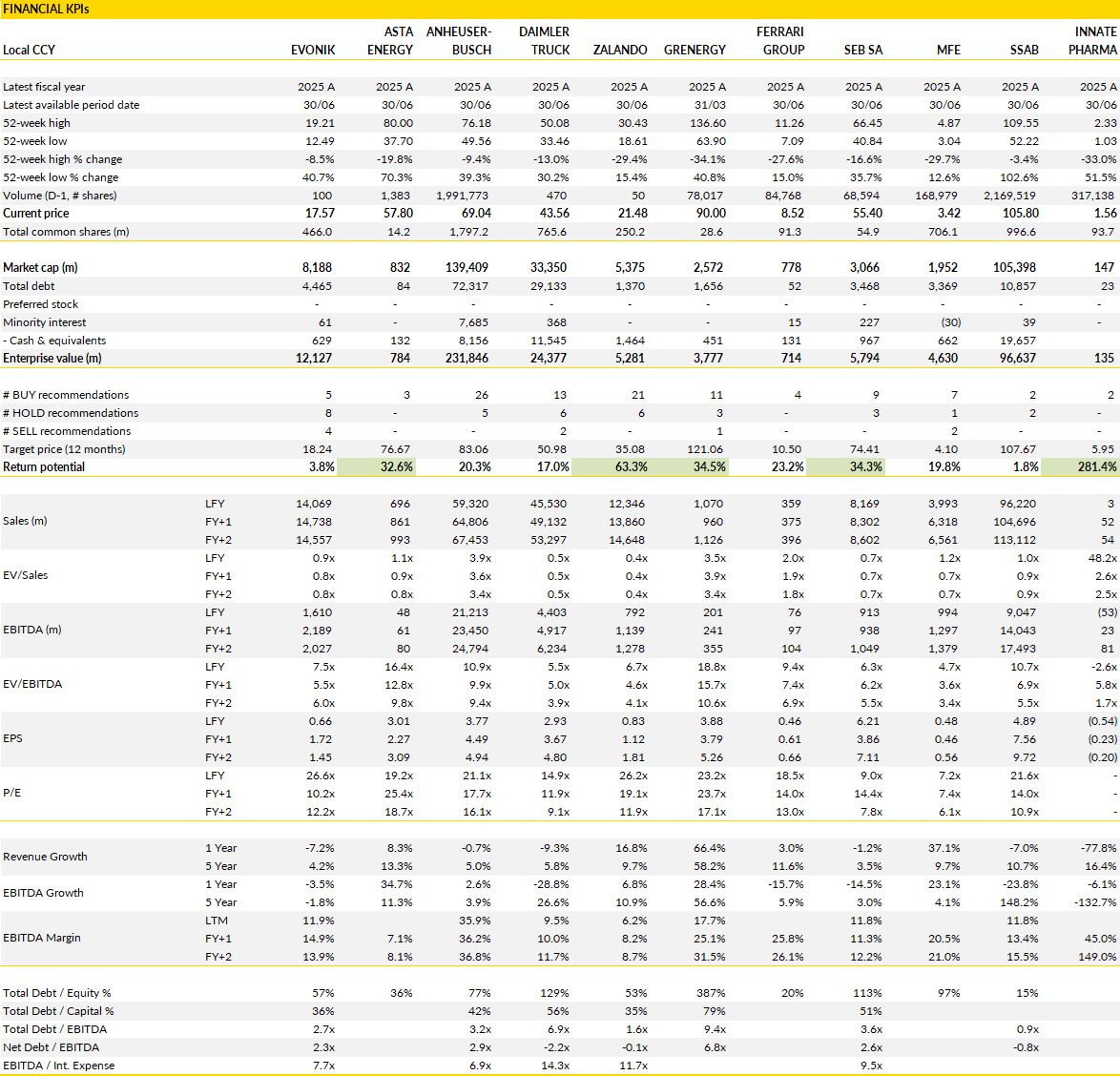
Financial KPIs
Companies covered in this edition: Evonik, ASTA Energy Solutions, Anheuser-Busch InBev, Daimler Truck, Zalando, Grenergy Renovables, Ferrari Group, Groupe SEB, MFE, SSAB, Innate Pharma
Evonik Industries (EVK Germany): Cost reductions become central to closing the returns gap
Evonik expects Q3 trading to remain broadly consistent with the trends seen in Q2, with animal nutrition providing the clearest improvement.
Higher methionine spot prices from the previous quarter are now feeding into realised pricing, making Q3 potentially the strongest quarter of 2026 for the product. Exposure to short-term price movements is limited by the structure of Evonik's contracts: around ~75% of methionine volumes are agreed quarterly, leaving only ~25% exposed to spot conditions. This provides some protection against the recent decline in Chinese spot prices, although customer destocking is expected to produce a more subdued Q4. Beyond methionine, Evonik continues to see growth opportunities in products such as PA12 and alkoxides.
Management's full-year adjusted EBITDA guidance remains €2.0-2.2bn. Energy represents another variable heading into 2027. Evonik hedges requirements over a rolling three-year period and has already covered 30-40% of next year's consumption, following approximately 70% hedging for 2026. Natural gas accounts for around 70% of European energy requirements, making sustained high gas prices a potential cost burden despite the hedging program.
The larger operational challenge is improving returns from a relatively low starting point. Evonik generated barely a 6% ROCE in 2025 and has established an 11% medium-term target, which is also incorporated into management incentives. Closing that gap requires a substantial improvement in underlying profitability and has increased the importance of structural cost reductions. Management has initiated a more stringent program of net savings, with the benefits needed to supplement growth from higher-return specialty businesses as earnings from animal nutrition normalise. Portfolio actions can also improve the capital base against which returns are measured, including the planned separation of C4 activities, while tighter capital expenditure should limit further expansion of invested capital.
The task is therefore broader than offsetting the next downturn in methionine. Evonik needs to reduce its recurring cost base, concentrate investment on businesses capable of earning attractive returns and continue removing assets that dilute the group's overall capital efficiency.
This creates a different earnings mix over the next several years. Animal nutrition can still generate substantial cash, but the exceptional pricing conditions that periodically lift methionine profitability cannot provide a dependable route towards the ROCE objective. Greater weight will have to come from self-help and businesses where Evonik has stronger technological differentiation and pricing power. Energy inflation could complicate that progression in 2027, particularly if European gas prices remain elevated, although existing hedges delay part of the impact and customer pricing could recover some of the additional expense.
The current restructuring effort consequently carries considerable strategic significance: achieving the 11% ROCE ambition requires a material increase in earnings efficiency even after allowing for portfolio disposals and disciplined capital spending. Q3 should benefit from favourable methionine conditions, but the subsequent normalisation will provide a clearer test of how much progress Evonik is making through permanent cost savings and growth elsewhere in the portfolio. Execution on those measures will determine whether the company can raise returns structurally without relying on another favourable cycle in animal nutrition.
ASTA Energy Solutions (1AST Austria): Grid renewal supporting further capacity expansion
ASTA continues to expand capacity against a demand environment that is shaped primarily by replacement and reinforcement of electricity grids in Europe and the US.
Management sees the renewal requirement for ageing grid infrastructure as a much larger source of demand than AI data centres, where some transformer configurations may not use continuously transposed conductors at all. This reduces ASTA's dependence on data-centre investment and ties growth more closely to long-duration utility spending. Customer demand remains strong, including from major transformer manufacturers such as GE Vernova and Siemens Energy, and existing long-term agreements support the current production ramp. The economics of those contracts should also improve as newer agreements carry better margin profiles. We understand that management is seeing little evidence that planned industry capacity additions will create structural oversupply, given the scale of grid investment required. HVDC infrastructure provides another attractive application because demanding technical specifications favour suppliers capable of consistently meeting stringent quality standards.
Product development is central to ASTA's strategy of concentrating on the premium end of the CTC market. The company is improving insulation technology through thinner layers and proprietary enamel materials, allowing customers to reduce transformer dimensions and improve performance. Management intends to preserve this technological and quality differentiation instead of pursuing market share through aggressive volume expansion. Competitors including Essex and Sam Dong operate in the same market, but ASTA believes its manufacturing standards remain particularly strong in Europe. This approach also explains why capacity additions are being aligned closely with customer commitments.
Further long-term agreements are under discussion and could cover individual customer facilities as well as broader purchasing requirements, allowing ASTA to add production with a high degree of contracted demand. For 2026, the company continues to target adjusted EBITDA of €60-64m, with execution of the existing capacity program and the progression of new customer agreements determining how quickly the earnings base can expand beyond this level.
North America represents the next major strategic decision. ASTA currently supplies the US from its European and Brazilian operations and is assessing whether a local manufacturing investment would improve its competitive position. Management expects to decide during H2, potentially towards the end of the year, and appears prepared to proceed only once the economics and customer commitments justify additional capacity. Brazil already provides a viable export base, reducing the need to establish US production simply to gain access to the market. A brownfield project could offer a lower-risk route if ASTA can secure sufficient customer volumes before committing capital. Such an approach would be consistent with the broader expansion strategy, where production growth follows contracted demand and quality standards take precedence over speed.
The combination of grid replacement, HVDC investment and long-term customer agreements provides several sources of growth without requiring a large contribution from AI infrastructure. Additional contracts and a carefully structured North American expansion could extend that growth while preserving the margin discipline that has characterised ASTA's capacity ramp so far.
Anheuser-Busch InBev (ABI Belgium): Stronger cash generation is shifting attention to capital returns
Anheuser-Busch InBev enters its Capital Markets Day on 22-23 September with the operating framework established in 2021 largely intact. The company continues to target medium-term organic EBITDA growth of 4-8%, and recent performance remains consistent with that range.
H1 2026 organic revenue increased 5.7%, EBIT rose 7.6% and EBITDA advanced 5.6%, with the Q2 EBITDA margin reaching 35.6%. Volume development has been slower to improve. Group volumes contracted from Q2 2023 through the end of 2025 before returning to growth during H1, leaving further volume recovery as an important source of potential earnings expansion. China and the US account for a substantial share of the remaining weakness, together representing roughly 23-24% of group volumes. US trends have started to improve and the portfolio has shown greater resilience, whereas the Chinese recovery remains uneven and dependent on a broader improvement in consumer demand. Sustained progress in these two markets would allow revenue growth to rely on a healthier combination of volume, pricing and mix.
The Capital Markets Day should also provide a good indication of how ABI intends to convert its digital infrastructure into incremental earnings. BEES has already achieved significant scale as the group's business-to-business platform, connecting retailers with ABI and an expanding range of third-party suppliers. Marketplace monetisation is now becoming more relevant as transaction activity grows and the platform extends beyond the distribution of ABI's own products. The next stage is demonstrating the contribution these activities can make to profit and cash generation across the group. The US portfolio will receive particular attention in St. Louis, given the location of the event and the importance of rebuilding sustained growth in one of ABI's largest markets. Management is unlikely to alter the broader strategy materially. The more useful development would be additional financial parameters around the returns generated by digital investments, the economics of Marketplace and the contribution expected from improving US execution. These would provide a clearer bridge between the operating initiatives presented at previous Capital Markets Days and the group's medium-term EBITDA framework.
Deleveraging has meanwhile created substantially more flexibility in capital allocation. Net debt/EBITDA declined from 3.38x at the end of 2023 to 2.86x, reducing the need to direct such a large proportion of free cash flow towards balance-sheet repair. ABI already has a $6bn share repurchase program running until October 2027, making another immediate programme unlikely, but the allocation of cash beyond that point is becoming increasingly relevant.
Management has several competing uses for future free cash flow, including further debt reduction, dividends, repurchases and selective acquisitions. Greater clarity on the balance between these alternatives could become one of the more consequential outputs from St. Louis. ABI has spent several years restoring financial flexibility following the heavy leverage associated with its earlier acquisition strategy, and maintaining discipline as that constraint recedes will be important.
Daimler Truck (DTG Germany): US order trends improve
Daimler Truck is heading into the important US fleet-order season with encouraging early signals for its new EPA27-compliant truck.
The model will carry an additional compliance surcharge of around $6,000, on top of the normal model-year and tariff-related increases, yet management believes it remains competitive with older-generation trucks that rivals intend to keep selling. Daimler Truck will move entirely to the new generation and says the pricing has been achieved without sacrificing profitability. Customer acceptance still needs to be demonstrated and the final regulatory framework has yet to be settled, but recent orders suggest the company's position remains strong. Daimler Truck North America captured 48% of August orders, up from 45% in July and above its roughly 40% share of market volumes. September has also started reasonably well as fleets begin placing orders for the following year, although management has not seen customers rushing to secure capacity. Order activity is expected to build through the final months of 2026, particularly after the ATA trade fair.
The wider US truck cycle remains difficult to read after very weak volumes in 2025 and only a partial recovery this year. Freight activity improved in August and purchasing indicators remain healthy, but profitability across the logistics industry is still under pressure. Replacement demand provides some support after the prolonged downturn, and Daimler Truck has particularly high exposure to any improvement, with North America generating around half of group EBIT.
Management expects the US market to expand further in 2027 and believes the regional business can maintain solid double-digit profitability. The new truck's commercial performance will therefore be important over the next several months. A competitive EPA27 offering would allow Daimler Truck to defend its leading position as customers replace ageing fleets, without needing to rely on aggressive discounting to offset the cost of new emissions technology. The recently agreed tariff treatment provides some additional protection to the economics of the North American business.
Mercedes-Benz Trucks faces a different set of pressures in Europe, where cost inflation and the economics of electrification are receiving greater attention. Management plans to protect profitability through pricing, a richer sales mix and the Cost Down Europe program. Around €250m of savings have already been delivered against the more than €1bn planned by 2030, with further benefits due to build during 2027. Sales incentives are also being directed towards more profitable truck configurations, complementing the price increase implemented in April. At the same time, Daimler Truck continues to push policymakers for changes to Europe's 2030 emissions framework, arguing that penalties under the current rules could absorb Mercedes-Benz Trucks' profitability if electric-truck adoption develops too slowly.
Elsewhere, autonomous trucking remains on schedule for the first driver-out tests by the end of 2026. Capital returns are also continuing after the Archion transaction generated final proceeds of €1.7bn, with the next €1.1bn tranche of the share buyback due to start shortly. Near-term attention now shifts to US orders, where the next few months should provide a much clearer indication of fleet demand and the reception of Daimler Truck's new generation of vehicles.
Zalando (ZAL Germany): Logistics efficiencies and B2B growth to lift margins
Zalando is pursuing market share growth despite weak consumer spending across Europe, with online fashion still developing faster than physical retail.
The company holds around 10% of the European online fashion market and generated roughly 5% GMV growth in H1 2026, broadly matching category growth. Expansion opportunities remain significant in markets where Zalando entered later and penetration is still comparatively low, including Greece, parts of Eastern Europe and Portugal. Future growth is expected to come from both more active customers and higher spending per customer. Competitive pressure from Chinese platforms has also become somewhat less intense as their performance-marketing activity has moderated. Recent category trends have been uneven, however. Q2 GMV increased 4.4%, with weaker sneaker demand contributing to the slowdown from Q1. Sneakers represent more than 10% of GMV, and excess inventory across the market following soft summer demand has led Zalando to increase promotional activity in Q3. This should help clear products and support volumes, although the additional discounting will weigh on gross margin during the quarter.
B2B is becoming a larger part of Zalando and is growing faster than the consumer-facing business. It now generates around 10% of revenue, with logistics accounting for more than 80% of the segment and software platforms Scayle and Tradebyte providing most of the balance. Scayle recently secured Levi's as its first US customer, extending the platform beyond its European base. B2B currently earns an adjusted EBIT margin above 10%, although management sees 8-9% as a more representative level for 2026.
Its growing contribution should improve the group's earnings mix over time, particularly if Zalando can add external volumes to infrastructure originally built for its own marketplace. This creates a second source of growth alongside the core B2C platform and allows the company to monetise logistics and technology capabilities across third-party retailers and brands. The opportunity extends beyond adding revenue, since greater utilisation of the fulfilment network are also improving the economics of the underlying infrastructure.
Fulfilment efficiency is one of the main building blocks behind Zalando's objective of reaching a 6-8% group adjusted EBIT margin by 2028. Fulfilment costs currently represent approximately 23-24% of revenue, leaving substantial scope for productivity improvements as the network is streamlined. H1 costs were temporarily inflated by inefficiencies surrounding the planned closure of the Erfurt warehouse. Inbound deliveries to the site stopped in September, allowing the first savings to emerge towards the end of 2026 and a larger contribution thereafter. Higher energy prices will create a low double-digit million euro cost burden, but network efficiencies should help absorb part of that pressure.
Near-term consumer demand remains subdued and sneaker discounting adds another constraint in Q3, so margin improvement will depend heavily on internal execution. Over the medium term, a leaner fulfilment footprint, continued B2B expansion and higher penetration in less mature European markets give Zalando several avenues to grow without requiring a sharp recovery in consumer spending.
Grenergy Renovables (GRE Spain): Asset rotations fund an increasingly storage-led expansion
Grenergy's earnings accelerated sharply in Q2 as the development business returned to a more active transaction schedule following a quiet first quarter. EBITDA reached €121.7m, up just over 400% year-on-year, with Development & Construction contributing €119.4m. The principal transaction was the recognition of the Gabriela asset rotation in Chile, comprising 272MW of solar capacity and 1.1GWh of battery storage within the fourth phase of Oasis de Atacama. The operating Energy division provided a smaller but stable contribution, with EBITDA increasing 8% to €11.7m. For H1 as a whole, group EBITDA reached €126.5m, 47% above the prior-year period, while net income more than doubled to €74.2m. Net debt stood at €1.1bn at the end of June, equivalent to total leverage of 4.6x, although corporate leverage was considerably lower at 1.7x. The quarterly earnings profile will remain influenced by the timing of asset rotations, but these transactions are also an integral funding component of Grenergy's development model as it deploys capital into a much larger portfolio of battery and hybrid renewable projects.
The company is now executing a €3.7bn investment program covering 2026-28, with storage taking an increasingly prominent role. Grenergy has 2.3GW of generation capacity and 8.5GWh of batteries either operating or under construction, backed by a BESS pipeline of 63GWh. Commercial activity during H1 expanded across several markets and contract structures. In Spain, the company secured 1.3GWh of tolling agreements, while projects in Poland and the UK obtained a combined 2.9GWh through auctions. Chile added more than 2TWh per year of PPAs covering projects including Algarrobal Hybrid and Elena BESS, and the US contributed a 400GWh-per-year hybrid PPA. GreenBox provides another route into storage, with 10GWh of projects already under construction or at an advanced development stage. This geographic and contractual spread gives Grenergy several ways to monetise batteries, from hybrid solar-storage facilities to standalone systems and tolling arrangements, reducing reliance on a single electricity market or revenue model.
Financing is progressing alongside the project pipeline. Grenergy raised €170m through a Green Bond, arranged $623m of project financing for the Oasis Central portfolio and secured another €100m for the Oviedo Standalone project. These sources of capital, combined with proceeds from asset rotations, are supporting the investment programme while allowing the company to retain selected projects with attractive recurring cash flows. Management has also announced a share repurchase programme of up to €50m, indicating confidence that the current financing structure can accommodate shareholder distributions alongside development spending.
Chile remains a major contributor through Oasis de Atacama, but Spain and the GreenBox portfolio are broadening the storage platform, with further opportunities emerging in other European markets and the US. GR Data adds another potential avenue beyond the projects included in the current plan. Grenergy's development model is consequently evolving around a cycle of originating projects, securing long-term contracts and financing, rotating selected assets and recycling the proceeds into a growing storage portfolio.
Maintaining that pace without allowing corporate leverage to rise materially will be central as the €3.7bn program moves through its most capital-intensive phase.
Ferrari Group (FERGR Netherlands): Special dividend under consideration
Ferrari Group delivered 6.2% constant-currency revenue growth in H1 2026, taking sales to €187.3m, with growth across most regions offsetting continued weakness in parts of Asia. Europe remained the largest business with €109.4m of revenue, followed by North America and Brazil at €28.6m. Rest of World generated €23.2m, while Asia contributed €26.1m and continued to feel the effect of softer conditions in Singapore and China. Adjusted EBITDA reached €47.8m and the margin declined by 110bp to 25.5%, reflecting continued investment in the network and cost base. Operating profit was €34.3m and net profit €25.7m.
Management has narrowed its 2026 constant-currency revenue growth guidance from 3-6% to 4-6%, while retaining its expectation for a broadly stable adjusted EBITDA margin and ordinary capital expenditure around the prior-year level. The narrower range follows a first half in which revenue growth remained above the new full-year floor despite the difficult Asian markets.
Cash generation was relatively weaker during the period, largely because of working capital and the timing of shareholder distributions. Operating cash flow was €32m, with working capital absorbing €10.5m. Net investments amounted to €6.2m, while €30.6m was paid in dividends. Ferrari so ended June with €78m of net cash.
The balance sheet still leaves ample flexibility to finance the group's expansion and return additional capital to shareholders. Management indicated that a special dividend could be considered during H2 if suitable acquisition opportunities do not emerge, on top of the €30m ordinary dividend already paid for FY 2025. This creates a clear capital allocation choice between external growth and returning excess cash. Recent spending has concentrated on expanding Ferrari's international network and capabilities, and H2 should begin to show whether these investments can generate better operating leverage as volumes increase.
Ferrari's specialised logistics model for jewellery and other high-value goods requires investment ahead of revenue in new locations, which can temporarily dilute profitability during periods of network expansion. The benefits become more attractive once additional volume is handled through the enlarged infrastructure. Europe remains a solid base, and North America, Brazil and other international markets are adding growth, leaving China and Singapore as the weaker parts of the geographic mix. Management's decision to retain its margin guidance suggests that the H1 decline is expected to be absorbed over the full year through better operating leverage and continued trading growth.
With net cash still substantial after the ordinary dividend, Ferrari can pursue smaller strategic investments without restricting shareholder distributions. If no compelling M&A opportunities are available, an additional dividend in H2 would provide a straightforward use for part of the excess balance sheet capacity.
Groupe SEB (SK France): New leadership takes over
Groupe SEB will install Loïc Moutault as CEO from 1 October, bringing in an external executive as the company works through its Rebound program. Moutault spent more than three decades at Mars, most recently leading Mars Petcare after previously serving as President of Royal Canin. Stanislas de Gramont will leave the CEO role at the end of September, while Thierry de La Tour d'Artaise remains chairman, preserving the separation between executive management and board leadership.
The succession process began several months ago, indicating that the appointment is part of a planned governance transition rather than a response to a recent deterioration in trading. Moutault also inherits an established strategic programme instead of being asked to devise a new direction immediately. His background running large international consumer businesses should be relevant to SEB's priorities around brand management, organisational efficiency and international execution, particularly as the company seeks to restore stronger organic growth after a period of uneven demand.
Rebound remains the framework for improving the group's operating performance, with approximately €200m of recurring savings targeted by 2027. The program spans industrial productivity, lower indirect procurement expenditure and a leaner overhead structure, alongside greater emphasis on digitalisation, marketing and product innovation. SEB had already generated €20m of benefits during H1 and expects €40-60m for 2026 as a whole, leaving a considerably larger contribution to emerge as the program matures. Management's medium-term ambitions call for a return to 5% annual organic sales growth and an operating margin of 10%, followed eventually by 11%. Achieving those levels will require savings to translate into lasting margin improvement while the commercial side of the business returns to healthier growth. Volumes are currently contributing positively and currency conditions have become more favourable compared with 2025, although disruption in the Middle East is expected to reduce earnings by around €30m this year. The new CEO therefore arrives with several operational measures already underway and a clear set of financial objectives against which progress can be assessed.
The leadership change could become more consequential once the initial Rebound measures have been implemented. SEB has a broad collection of consumer and professional brands, manufacturing operations and geographic businesses, creating scope to simplify decision-making and redirect resources towards categories with stronger growth and returns. Moutault's experience at Royal Canin and Mars Petcare also comes from businesses where premiumisation, innovation and disciplined brand investment played significant roles in long-term development.
At SEB, the immediate priority will be ensuring that organisational restructuring and cost reduction do not weaken product development or commercial execution. The company ultimately needs both elements to reach its longer-term objectives: a structurally lower cost base and enough innovation and marketing effectiveness to restore 5% organic growth. Continuity in the Rebound program reduces transition risk, while external leadership introduces the possibility of further changes once Moutault has reviewed the portfolio and organisation.
MFE (MFEB Italy): Cost savings offset weak advertising
MFE's first-half performance saw continued weakness in television advertising and rapid cost reductions following the integration of ProSiebenSat.1.
Germany remains the most difficult advertising market, with Italy also under pressure and Spain proving more resilient. Italian Q2 advertising revenue fell 6.5%, while Spain was flat. June and July were particularly soft as the FIFA World Cup drew audiences and advertising spending towards public broadcasters, with geopolitical uncertainty in the Middle East adding further pressure earlier in Q2. Conditions improved during August and September, and management currently expects Q3 advertising revenue to decline by a low single-digit percentage. There is still little clarity on Q4, particularly in Germany. The advertising recovery is thus developing gradually, leaving MFE dependent on internal efficiency measures to protect profitability until revenue trends improve more decisively.
Cost reductions are already having a substantial effect. Adjusted EBIT reached €145.7m in H1, compared with a pro forma adjusted loss of €7.3m a year earlier. Entertainment costs declined by €216.9m, equivalent to 9%, and management reported more than €200m of efficiency measures and optimisation during the first half. The existing target for €120-160m of savings in 2026 remains unchanged, although implementation is progressing faster than initially planned. Some of the H1 figures are affected by accounting alignment and the phasing of measures following the ProSiebenSat.1 consolidation, making the underlying run rate difficult to assess precisely. Adjusted EBIT also excludes €26.6m of purchase price allocation amortisation and €54.8m of exceptional costs connected with the Pasapalabra dispute. Cash generation remains uneven across the enlarged group. Italy and Spain produced €198.4m of free cash flow, whereas the DACH operations consumed €151.2m, leaving group free cash flow at €47.2m. Covenant net debt excluding IFRS 16 and ProSiebenSat.1 debt fell by €102.1m during H1 to €857.1m.
The next stage of the ProSiebenSat.1 integration will be more and more commercial as MFE tries to use its combined reach across Germany, Spain and Italy to create a more attractive proposition for large advertisers. ALL21 Europe launches on 23 September and will offer coordinated linear television and digital campaigns across the three markets. One format will allow advertisers to run the same campaign simultaneously during prime time, reaching a potential audience of almost 14m viewers within a minute. Building a genuinely cross-border advertising product could differentiate MFE from national broadcasters and improve its relevance to multinational advertisers, although the financial contribution will depend on adoption and pricing.
Near term, earnings are still being supported primarily by restructuring and cost control, with the German advertising market providing the largest operational challenge. Faster integration savings provide some protection if advertising remains subdued, but stronger cash generation from the DACH business and a sustained recovery in advertising demand are needed to broaden the improvement beyond costs.
SSAB (SSABB Sweden): US steel prices remain strong
SSAB continues to benefit from having the largest US exposure among the European steel producers, with conditions there considerably stronger than in Europe.
Infrastructure investment is supporting demand, alongside spending on transmission networks and onshore wind linked indirectly to the expansion of data centres. Supply remains tight, with both SSAB and Nucor operating at full capacity and each holding around 30% of the market. US spot steel prices have consequently increased by almost 50% since the beginning of 2026. These levels are beginning to improve the economics of imports, which could restrict further increases, but current pricing should still feed into SSAB's earnings over the coming quarters. Q3 itself will be seasonally weaker, with maintenance reducing production and volumes expected to decline by more than 10% sequentially in both Special Steels and the European operations. Recent trading indicates that the Americas business is developing somewhat better than management initially expected on both volumes and realised prices.
Europe remains softer because of SSAB's exposure to construction and automotive customers, although the market structure has improved following the introduction of tighter import protection on 1 July. Import quotas have been cut in half and tariffs on volumes above those quotas have increased from 25% to 50%. European hot-rolled coil prices have started rising again since late August and are now around €735 per tonne. The effect should become more apparent from Q4 as higher spot prices gradually flow into realised pricing. Germany could provide another source of demand from 2027 as infrastructure spending begins to reach steel-consuming projects. Together with the stronger US environment, this gives SSAB a better pricing backdrop after the maintenance-heavy third quarter. Special Steels adds a differentiated part of the portfolio, with higher-value products reducing some of the group's exposure to commodity steel pricing and supporting a stronger product mix than a conventional European flat-steel producer.
SSAB is also moving forward with the restructuring of its Nordic production footprint towards lower-emission steelmaking. Oxelösund is approaching the final stage of its transformation, with commissioning planned for Q2 followed by approximately six months of ramp-up. Progress at Luleå has resumed after work was interrupted by illness cases during the spring, and one infrastructure uncertainty has been reduced after Vattenfall received the necessary permit for the transmission line. The European Commission's July review also left the broad direction of the EU Emissions Trading System intact, maintaining the economic pressure on carbon-intensive steel production. SSAB's investment program should therefore leave it with a materially different European asset base as carbon costs rise.
Q3 carries the expected seasonal and maintenance effects, but the subsequent quarters should benefit from stronger realised pricing, particularly in the US, with tighter European import rules providing an additional source of support closer to home.
Innate Pharma (IPH France): Clinical catalysts approach
Innate Pharma is in the final months of 2026 with a strengthened balance sheet and several (very) important clinical readouts approaching.
The recently completed partnership with Sobi for lacutamab provides a $75m upfront payment, with another $40m of potential milestone payments over the coming quarters and double-digit royalties on future sales. Combined with the €30m capital increase, which involved the issuance of 17m new shares, this extends the company's cash runway through the end of Q1 2028. At the end of June, before incorporating these subsequent proceeds, cash and financial assets stood at €21.4m versus €44.8m at the end of 2025. Spending declined considerably during the first half, with net operating expenses down 18.5% to €24.7m. R&D expenditure fell 17.8% to €16.9m and selling and general expenses were reduced to €7.8m. Together with an increase in revenue to €5.7m, this narrowed the operating loss from €25.4m to €19.0m. The financing position should now allow Innate to progress its main programs through several upcoming development milestones without an immediate requirement for additional capital.
Three clinical programs will determine much of the near-term development agenda. Monalizumab, partnered with AstraZeneca, is approaching results from the Phase III PACIFIC-9 trial before year-end. IPH4502 should also produce Phase I data over the same period, providing the first meaningful clinical evidence for another internally developed asset. Lacutamab is further advanced and has gained a clearer development path following the Sobi agreement. Innate is working towards an accelerated approval submission while proceeding with the confirmatory TELLOMAK 3 study. Commercial timing for lacutamab in Sézary syndrome has moved to 2028, and the start of TELLOMAK 3 will require R&D spending to increase again after the reduction recorded in H1. Sobi's participation changes the financial profile of the program by transferring part of the development and commercial burden to a larger partner while preserving milestone income and royalties for Innate. It also provides external funding at a useful point in the development cycle, ahead of the confirmatory study and potential regulatory process.
The concentration of several events around year-end creates an unusually active period for Innate's pipeline. PACIFIC-9 is particularly significant because monalizumab has already advanced into Phase III through AstraZeneca, whereas the IPH4502 readout will provide an early indication of whether another asset can develop into a meaningful component of the pipeline. Lacutamab offers a separate route through a rare hematological cancer indication, with the Sobi partnership giving the asset both financial backing and a defined commercial framework.
These programs are at very different stages, which spreads development risk across early clinical data, a late-stage trial and a potential accelerated regulatory submission. The stronger cash position gives Innate more time to absorb setbacks or additional trial spending, although biotechnology development remains inherently dependent on clinical outcomes.
After several years in which financing and development costs constrained strategic flexibility, the company now has funding into early 2028 and a sequence of clinical and regulatory events capable of materially reshaping its portfolio over the next several quarters.