
Payments, commodities and eagles
Adyen, Vincorion, Montana Aerospace, TKMS, Bilfinger, Evotec, Vestas, Antofagasta, Demant, Brenntag, Aquila, Zurich Insurance

At Lux Opes, we break down companies into quick takes that get straight to the point - what is happening, why it matters, and what to watch next. We publish 2-3 times per week, depending on the news flow.
For the best reading experience, we recommend reading at Lux Opes
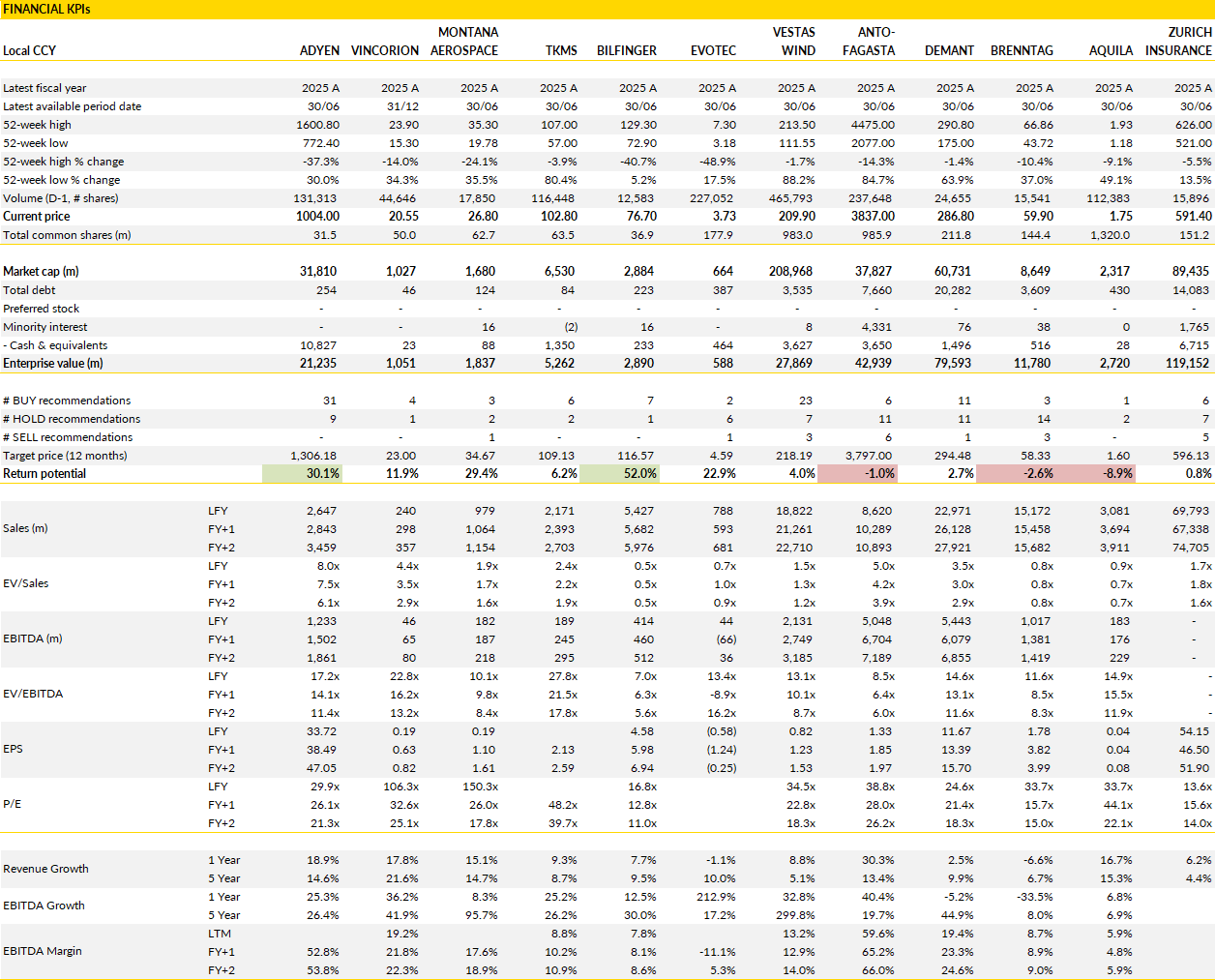
Financial KPIs
Companies covered in this edition: Adyen, Vincorion, Montana Aerospace, TKMS, Bilfinger, Evotec, Vestas, Antofagasta, Demant, Brenntag, Aquila, Zurich Insurance
Adyen (ADYEN Netherlands): Growth holds above 20%. The platform continues to scale
Adyen delivered a solid half, with constant-currency growth remaining above 20% and even accelerating slightly during Q2. H1 net revenue increased 20% to €1.30bn, or 21% at constant currencies, while Q2 growth reached 22% compared with 20% in Q1. Processed volume rose to €804bn, although the take rate edged down to 16.2bp. Growth remains broad across the platform. Digital accelerated to 15% in Q2, Unified Commerce grew 27% and Platforms continued to expand at 40%. The latter two businesses remain particularly important as Adyen moves beyond its original large-enterprise online payments base and captures more omnichannel and embedded-payment volumes. EBITDA reached €642m, corresponding to a 49.2% margin, while H1 net profit increased to €544m.
Management maintained its 2026 outlook, calling for constant-currency net revenue growth of 21-23%, including the contribution from recently completed acquisitions. This effectively leaves the underlying guidance unchanged, as the acquisitions were previously expected to add around 1 percentage point to growth. The H1 performance therefore leaves Adyen comfortably within its targeted range, with management expecting broadly similar growth across the two halves. Quarterly comparisons will be somewhat uneven, with a tougher base in Q3 followed by an easier Q4. Profitability guidance is also unchanged: including the acquisitions, the 2026 EBITDA margin should finish around 1 percentage point below the 52.7% achieved in 2025. Adyen is therefore continuing to absorb investment while maintaining an EBITDA margin above 50% on a full-year basis.
That said, Adyen now expects capex to reach around 7% of net revenue in 2026, potentially remaining at that level in 2027, before returning towards 5%. This reflects the unusually tight global market for data-centre capacity and Adyen's decision to operate its own infrastructure. It temporarily reduces cash conversion, but does not change the underlying growth trajectory.
The more relevant operating signal remains Adyen's ability to sustain at least 20% constant-currency net revenue growth while expanding Unified Commerce and Platforms at much faster rates. H1 provides another clean data point that the franchise continues to grow at that pace, with no meaningful deterioration in profitability despite continued investment. The combination of 22% Q2 growth, a near-50% H1 EBITDA margin and unchanged full-year guidance leaves the fundamental trajectory intact heading into H2.
Vincorion (V1NC Germany): Defence ramp-up pushes revenue towards the top of guidance
Vincorion maintained its rapid growth in H1, supported by armoured vehicles and air-defence programmes.
Revenue increased 42% to €150.2m, including 45% growth in Q2. Vehicle Systems was the strongest contributor, with sales up 72% to €72.6m as demand for stabilisation products continued to expand. Power Systems grew 41% to €46.2m, helped by increasing production for PATRIOT and IRIS-T programs, while Aviation was broadly stable at €33.2m as currency effects offset underlying progress. The new electronic hoist should provide an additional contribution from Q4 following certification. Adjusted EBIT increased to €28.4m, with the margin declining 140bp to 18.9% as Vincorion continues to invest in additional production capacity and R&D. Free cash flow remained negative at €6m due to inventories and working capital required for the ramp-up, although Q2 itself returned to slightly positive cash generation.
Orders provide a strong foundation for further expansion. H1 order intake reached €330m, more than four times the prior-year level, including over €100m secured during June alone. Recent awards included a €54m contract for armoured-vehicle stabilisation systems and €20m for generators used in ground-based air-defence systems. Backlog consequently reached €1.2bn at the end of June, roughly four times the midpoint of 2026 revenue guidance. More than 90% of expected 2026 sales are already covered by firm orders, reducing the dependence on new bookings for the remainder of the year. The backlog also extends the growth runway beyond 2026 as European defence spending feeds into vehicle, air-defence and power-system procurement programmes.
Management kept its 2026 targets of €280-320m of revenue and an adjusted EBIT margin of 18-19%, but now expects sales towards the upper end of the range following the strong first half. That would represent growth of more than 30% at the top end while maintaining margins despite substantial capacity investment. Working capital should also begin to normalise during H2 as inventories accumulated for higher production are converted into deliveries, providing scope for better cash generation towards year-end.
The combination of strong order intake, €1.2bn of backlog and production ramps across PATRIOT, IRIS-T and armoured-vehicle programs gives Vincorion a solid base for continued growth.
Montana Aerospace (AERO Switzerland): Cash generation catches up with aerospace growth
Montana Aerospace continued to grow strongly in H1, with sales increasing 11.7% to €518.4m and EBITDA rising 12.2% to €87.1m. Aerostructures remains the main engine, with sales up 12.9% and adjusted EBITDA increasing 16.1%, lifting the segment margin to 18.3%. EBIT improved to €40.1m from €32.8m, while continuing operations generated a €29.7m profit compared with a €2.4m loss a year earlier, helped by stronger operating performance and lower financial expenses.
On the balance sheet: H1 free cash flow reached €67.3m, while proceeds from the Energy disposal helped reduce net debt to just €64.7m, equivalent to 0.4x LTM EBITDA. This marks a considerable change from the period when rapid capacity expansion consumed much of the cash generated by the business.
Management confirmed its 2026 targets of more than €1bn of sales and over €185m of adjusted EBITDA, alongside cash conversion of around 50%. Combined with the Energy disposal proceeds, this should leave Montana Aerospace in a net cash position by year-end. The 2027 targets also remain intact, with sales above €1.1bn, adjusted EBITDA above €210m and free cash flow in the low triple-digit millions. The company is still investing for growth, with €60-80m of additional capex planned across 2026 and 2027 to expand key manufacturing sites serving commercial aerospace, defence and space customers. The combination of vertical integration and additional capacity should allow Montana to capture more content as aircraft manufacturers work through historically large backlogs.
Capital allocation is therefore becoming a more relevant part of the discussion. With leverage already down to 0.4x and net cash expected by year-end, the Board is evaluating additional measures including a potential share buyback. The unresolved issue is governance: operating activities continue as planned following the leadership changes, but the Board has not yet announced the future management structure and expects to provide an update during Q3.
Operationally, however, H1 shows continued market-share gains, improving profitability and much stronger cash conversion. If the company delivers its 2026 targets, the transition from a capital-intensive expansion phase towards sustained free cash flow should become increasingly clear, leaving Montana with room to continue investing in aerospace growth while potentially returning excess capital to shareholders.
TKMS (TKMS Germany): Faster submarine execution and a growing pipeline of naval contracts
TKMS raised its 2025/26 outlook as execution improves across submarines and Atlas Electronics.
Revenue is now expected to grow 10-12% (up from 2-5% previously), while the adjusted EBIT margin target has increased to 6.5% from above 6%. The submarine business delivered three legacy contracts during the first nine months, including vessels for Turkey, Southeast Asia and the Mediterranean region, with execution generally progressing faster. Some work involving Turkish shipyards remains slower, but the broader improvement is helping TKMS work through older, lower-margin contracts while newer German and Norwegian programmes begin ramping up. Surface vessels should become another source of growth from 2027 as the roughly €5bn German MEKO program starts contributing to revenue.
Cash flow remains distorted by contract timing. Free cash flow was negative €204m over the first nine months, but management expects advance payments, particularly from the MEKO programme, to bring full-year cash generation back into positive territory. Beyond the current year, the order pipeline is becoming increasingly significant. Canada remains one of the largest opportunities, with management still aiming to secure the submarine contract by the end of 2026. Progress is also being made in India, while the F127 frigate programme being developed with Rheinmetall represents another potentially substantial German award. A decision is expected during H1 2027, and the program is closely linked to Germany's NATO commitments. Belgium could additionally join the German MEKO 200 program, although this would require an agreement between the Belgian and German governments.
The combination of better execution and several large procurement decisions could materially expand TKMS's order book over the next 12-18 months. Near-term earnings are already benefiting from faster submarine deliveries, while the transition towards newer contracts should gradually improve the quality of the backlog as older, less profitable programmes are completed. Canada is the most immediate major catalyst, followed by India and Germany's F127 decision, with MEKO providing an additional growth leg from 2027.
The main constraint is that much of this potential is already reflected in the shares after their strong performance. Operationally, however, the direction remains favourable: guidance has been raised, legacy execution is improving and TKMS enters the coming procurement decisions with several credible opportunities to convert Europe's expanding naval budgets into long-duration contracts.
Bilfinger (GBF Germany): Delayed work sets up a stronger second half
Bilfinger remains confident that customer spending postponed during H1 will return during the second half, allowing the group to maintain its 2026 guidance despite a difficult start to the year.
Revenue remains on track, although management now expects the EBITA margin towards the lower end of the 5.8-6.2% target range. Regional conditions remain uneven. Western Europe is dealing with tough order comparisons, although profitability is improving as recent acquisitions are integrated. Central Europe has been weaker, particularly in DACH, where customers delayed spending, while international margins have remained stable despite tensions in the Middle East. The business mix is also changing, with Energy increasing to 28% of sales and offsetting continued weakness in European chemicals, while Oil & Gas remains supported by LNG and Middle Eastern activity.
There are encouraging signs that the hesitation among customers is beginning to ease. Bilfinger recorded €1.5bn of orders during Q2, making it the third-strongest quarter for order intake in more than a decade, while the project pipeline improved noticeably in June as Energy activity picked up. Management says maintenance work has generally been postponed by months instead of quarters, creating scope for a meaningful catch-up during H2. Around 90% of expected full-year revenue had already been completed or was covered by the backlog at the end of June, up from 88% a year earlier. Reaching the lower end of full-year margin guidance would require an H2 EBITA margin of roughly 6.7%, compared with 6.0% last year. Part of that improvement was already planned, while the delayed H1 workload should provide additional operating leverage without requiring significant new recruitment.
The recently acquired Teknokon business adds another growth avenue. It contributed €115m to the order book at the beginning of April, with roughly two-thirds of its activity coming from maintenance, broadly matching Bilfinger's existing business mix. More strategically, Teknokon provides an entry point into Azerbaijan, Kazakhstan and Uzbekistan and expands Bilfinger's exposure to mining. Together with the increasing contribution from Energy, LNG and Middle Eastern projects, this reduces some of the dependence on Europe's struggling chemicals industry.
H2 execution is now the key test: Bilfinger needs to convert delayed work into revenue and deliver the expected margin recovery. The strong Q2 order intake, 90% revenue coverage and absence of a need for substantial additional staffing make that catch-up achievable, while continued growth in Energy and the expansion of Teknokon provide additional support beyond 2026.
Evotec (EVT Germany): Yet another reset
Evotec's final H1 numbers confirmed the scale of the deterioration already disclosed in July.
Revenue declined 4% to €300.1m, while adjusted EBITDA fell to a loss of €42.7m. The weakness became more pronounced during Q2, when revenue dropped 10% to €143.5m and adjusted EBITDA remained deeply negative at €20.8m. Both operating divisions are struggling. Discovery & Preclinical Development revenue declined 16% during H1 to €227.9m, while Just-Evotec Biologics fell 29% to €72.3m. Evotec consequently maintained its heavily reduced 2026 guidance, with revenue now expected at €570-610m compared with €700-780m previously and adjusted EBITDA between negative €70m and negative €105m, down from the previous expectation of €0-40m.
The guidance reduction illustrates Evotec's continued dependence on the timing of partnerships and milestones. Around 40% of the expected revenue shortfall comes from milestones that have been delayed into 2027, another 45% relates to delays in signing or progressing strategic partnerships and the remaining 15% reflects weaker revenue conversion. Management considers much of the deterioration timing-related, but repeated delays make forecasting the pace of recovery difficult. The underlying business is currently not growing fast enough to compensate when partnership contributions slip, leaving earnings highly sensitive to individual agreements and milestones. The company continues to describe the commercial pipeline as healthy, but the H1 performance provides limited evidence yet that this is translating into stronger reported revenue.
Cost reductions provide some offset, although not enough to compensate for the revenue shortfall. The Horizon program remains on schedule, with Evotec targeting €75m of cost-base improvements and expecting 20-30% of those savings to be realised during 2026. That should provide a meaningful benefit as the programme progresses, particularly if delayed partnership income eventually arrives in 2027.
For now, however, a credible recovery requires both better performance from the underlying business and tangible conversion of partnership discussions into contracts, milestones and cash. Until that happens, the timing of the earnings recovery remains difficult to assess.
Vestas (VWS Denmark): Turbine profitability finally breaks higher
Vestas delivered a very strong Q2, with the improvement concentrated in its Power Solutions business. Revenue increased 26% to €4.72bn, driven by 37% growth in Power Solutions, while adjusted EBIT jumped from €57m to €446m and the group margin expanded from 1.5% to 9.4%. Power Solutions generated a 10.4% adjusted EBIT margin as higher turbine deliveries and a favourable project mix translated into much better profitability. This is a significant improvement for a business that has spent several years dealing with inflation, supply-chain disruption and poorly priced legacy orders. Services was softer on revenue, declining 5%, but retained a healthy 16.6% margin. EPS increased to €0.28 from €0.03, while new turbine orders rose 67% to 3,349 MW.
The stronger profitability has allowed management to raise its 2026 adjusted EBIT margin guidance to 7-9%, up from 6-8%, while maintaining the €20-22bn revenue target. The Q2 performance suggests that the economics of the turbine business are normalising as higher-priced orders move through production and legacy contracts become a smaller part of deliveries. Orders are also developing well, providing support beyond the immediate margin recovery. New capacity ordered during Q2 increased sharply year-on-year, while the overall backlog remains very large. Services continues to provide a high-margin recurring earnings base alongside the more cyclical turbine operation, although the 5% revenue decline in Q2 is one area to monitor. Planned investment remains around €1.2bn for the year.
Vestas is also returning more cash to shareholders, announcing a new share buyback of around €400m beginning on 13 August. The combination of the guidance increase, sharply higher Power Solutions margins and strong order intake suggests that the operational recovery has progressed considerably during 2026.
An important question now is how much of the 10.4% Q2 Power Solutions margin can persist once the favourable project mix normalises. Even a lower sustainable level would represent a major improvement compared with recent years. With the group now targeting a 7-9% margin for 2026, Vestas has moved beyond simply recovering volumes and is beginning to demonstrate that stronger pricing and better contract economics can translate into substantially higher earnings and cash generation.
Antofagasta (ANTO UK): Higher metals prices lift earnings but Los Pelambres cuts the production outlook
Antofagasta delivered a strong first half financially, although the reduction in 2026 copper production guidance takes some shine off the results.
Revenue increased 18% to $4.48bn and EBITDA rose 27% to $2.84bn despite lower copper production and higher operating costs. Commodity prices did most of the work, with realised copper prices up 36%, gold up 46% and molybdenum up 55%. Los Pelambres generated EBITDA of $1.40bn, up 30%, while Centinela contributed $1.03bn, up 9%. Net earnings increased 62% to $847m, helped by lower depreciation and finance costs. Cash generation also improved, with operating cash flow rising 38% to $1.59bn, although the group's heavy investment programme absorbed most of this as capex reached $1.67bn.
The main negative is Los Pelambres, where extreme weather during June and July disrupted operations and prompted management to cut group copper production guidance to 625-655kt (was 650-700kt). The timing is awkward because Antofagasta had reiterated its previous guidance as recently as 22 July, after operations at the mine had resumed. Weather may therefore not explain the entire reduction. Los Pelambres is also passing through a weaker mining sequence, with lower grades potentially contributing to the downgrade. The problems appear concentrated at this operation, as production guidance for Centinela, Antucoya and Zaldivar remains unchanged. Cost guidance has also been maintained, with gross cash costs expected at $2.40-2.60/lb and net cash costs at $1.15-1.35/lb. This is encouraging given the 51% increase in diesel costs during Q2, although long-term contracts have limited the impact from higher sulphuric acid prices.
Beyond the near-term production setback, Antofagasta continues to invest heavily in expanding its Chilean copper base. Los Pelambres and Centinela remain central to the group's medium-term production growth, and the current capex programme is being undertaken against a very supportive copper price environment. Net debt increased to almost $4.0bn during H1, partly reflecting the accounting treatment of Centinela's new water system, so the balance sheet will naturally become more important as these projects progress.
The strong increase in EBITDA and earnings demonstrates the group's considerable exposure to higher copper prices, but H1 also shows the operational sensitivity of a concentrated asset base.
Demant (DEMANT Denmark): Solid
Demant delivered a strong Q2, with organic growth reaching 9% and performance running well across all three divisions. Hearing Aids was particularly strong, with external revenue of DKK 2.62bn and organic growth of 10%, helped by the Oticon Zeal launch and a combination of higher volumes and better average selling prices. Hearing Care grew organically by 8%, alongside a large contribution from acquisitions including Kind, while Diagnostics posted 9% organic growth on market-share gains and healthy demand across instruments, services and consumables. The stronger sales mix fed through into profitability, with H1 EBIT reaching DKK 2.13bn, up 15%, for a margin of 16.5%.
The stronger first half has prompted management to raise its FY 2026 outlook. Organic growth is now expected at 6-7%, compared with 3-6% previously, while EBIT guidance has increased to DKK 4.4-4.8bn from DKK 4.1-4.5bn. Currency pressure has also eased, with the expected FX drag reduced to around 1%. There is another product catalyst arriving almost immediately: the new Oticon Reveal hearing-aid platform will begin its global rollout during Q3. Following the strong reception for Zeal, Reveal gives Demant another opportunity to sustain above-market growth in Hearing Aids and potentially maintain the favourable combination of unit growth and pricing seen during Q2.
The broader development is encouraging because growth is not dependent on a single product or geography. Hearing Aids has regained momentum, Hearing Care is combining organic expansion with the Kind acquisition, and Diagnostics continues to gain share. Acquisitions are also materially increasing the group's scale, although integrating Kind and maintaining margins as the retail business expands will be important over the coming quarters.
The raised guidance now implies another strong second half, with Reveal providing an additional commercial driver. In short, Demant enters H2 with stronger underlying growth and a higher earnings base than expected at the beginning of the year, although the substantial share-price recovery has already captured part of that improvement.
Brenntag (BNR Germany): Essentials rebounds sharply as cost savings gather pace
Brenntag’s final Q2 numbers came in slightly ahead of the already strong preliminary release, with operating EBITDA reaching €463m. That represents a sharp improvement from €306m in Q1, helped by stronger demand, better pricing and improved margins. Essentials drove most of the acceleration, with operating EBITDA of €362m, up 47% year-on-year on an FX-adjusted basis. Operating gross profit increased 23%, supported by positive pricing and volumes across regions, particularly North America and EMEA. Specialties also performed well, with operating EBITDA rising 18% on an FX-adjusted basis to €130m as both Life Science and Material Science maintained strong gross margins.
The strength has already prompted Brenntag to raise its FY 2026 outlook twice. Management now expects operating EBITDA of €1.35-1.45bn, compared with €1.25-1.40bn previously. H1 delivered €756m, while management said the stronger trading environment continued into the beginning of Q3. Cost reductions should provide another contribution during the second half. Brenntag generated €41m of savings during Q2 and continues to target an annualised run-rate of €150m by year-end. At the same time, management remains cautious about demand as the year progresses. The guidance therefore incorporates some deterioration from the unusually strong Q2 environment, with its midpoint implying around €644m of operating EBITDA in H2.
The quarter demonstrates how much earnings leverage Brenntag retains when pricing, volumes and cost control move in the same direction. Essentials has recovered particularly strongly, while Specialties is providing a steadier contribution through healthy margins and growth across Life Science and Material Science.
Looking out to the rest of the year, let's see how much of the Q2 improvement persists as supply conditions normalise and macroeconomic uncertainty continues. Brenntag does not need Q2 conditions to continue indefinitely to deliver its raised guidance, especially as additional cost savings come through. A good start to Q3 provides some cushion, while further execution on the €150m savings program could help absorb softer demand later in the year.
Aquila (AQ Romania): Market-share push comes at a heavy cost to margins
Aquila’s Q2 showed the downside of its current push for market share, with revenue broadly flat at RON 830m but profitability deteriorating sharply.
Growth in traditional retail and HoReCa was offset by weaker modern retail as Romanian consumer spending remained subdued. More damaging was the change in sales mix towards higher-volume, lower-margin products, combined with heavier commercial discounts. Gross margin consequently fell from 21.8% to 17.4%, while higher fuel costs added further pressure. EBITDA dropped 43% to RON 25m and the margin contracted from 5.4% to just 3.0%. Below the operating line, FX losses and higher interest expenses contributed to a RON 24m net loss, compared with a RON 10m profit a year earlier.
Cash flow provided one area of improvement. H1 operating cash flow turned positive at RON 7m, compared with negative RON 38m last year, helped by lower inventories and better receivables collection. The balance sheet nevertheless moved in the opposite direction, with net debt increasing from RON 391m at year-end to RON 474m, largely because of higher short-term borrowing and lease liabilities. The key question is whether Aquila can retain the market share gained through aggressive pricing while subsequently restoring margins. Management expects profitability to improve gradually during H2, but its previous expectation for roughly 1 percentage point of gross-margin improvement from Q1 has yet to materialise. H1 gross margin remained at 18%.
That leaves Aquila facing a demanding second half. H1 revenue reached RON 1.67bn, with EBITDA of RON 61m and a net loss of RON 21m, while the existing FY targets call for RON 3.69bn of revenue, RON 183m of EBITDA and RON 44m of net profit. Delivering those numbers would require a substantial acceleration in both sales and profitability during H2.
The strategic decision to sacrifice margin for volume could eventually pay off if market-share gains prove durable and discounts can be reduced, but Q2 provides little evidence of that transition yet. Working-capital discipline is helping cash generation, although restoring gross margin while navigating weak Romanian consumption and elevated financing costs is now the more pressing challenge.
Zurich Insurance (ZURN Switzerland): Specialty and Life extend growth
Zurich Insurance delivered another solid first half, with growth across its main insurance businesses and earnings slightly ahead of expectations. Group business operating profit increased 13% to $4.77bn, while attributable net profit rose 14% to $3.49bn. P/C and Life provided most of the improvement, offsetting a somewhat weaker contribution from Farmers. The P/C business generated $2.81bn of operating profit, up 16%, on insurance revenue of almost $25bn. The combined ratio remained healthy at 92.7%. Pricing conditions are becoming more differentiated, with retail rates still rising 4% but commercial rates declining 1%. Zurich is therefore relying increasingly on portfolio selection and growth in areas where demand remains stronger instead of broad market-wide pricing increases.
Commercial insurance remains a useful source of growth despite the softer pricing backdrop. Operating profit increased 12% to $2.0bn, helped by Global Specialty and Middle Market. Global Specialty is benefiting from insurance demand linked to the construction of AI and digital infrastructure, giving Zurich exposure to the large investment programmes underway in data centres and related infrastructure. Retail operating profit increased 14% to $825m, with portfolio optimisation and pricing helping the underlying accident-year combined ratio improve to 94.6%. Life was even stronger, with revenue increasing 18% to $6.79bn and operating profit rising 23% to $1.27bn. Growth in higher-margin protection and unit-linked products improved the new business margin from 5.3% to 6.6%. Management consequently raised its 2026 Life operating profit growth guidance from at least mid-single digits to at least 10%.
Farmers remains the weaker part of the group, although the underlying franchise is still performing reasonably well. Its operating profit contribution increased only 2% to $1.18bn as competition intensified, even as policy growth continued to accelerate. The Farmers Exchanges produced an 82.4% combined ratio, indicating that underwriting profitability remains strong despite the tougher commercial environment.
To conclude, P/C profitability remains healthy, Life is benefiting from a better product mix, and Specialty is adding new growth opportunities from infrastructure investment. Commercial pricing is likely to become a greater constraint from here and Farmers faces tougher competition, but the 13% increase in group operating profit shows that Zurich is currently absorbing those pressures without sacrificing earnings growth.