
Ads, AI and transformative acquisitions
Strabag, Siemens Energy, JCDecaux, ASML, Naturgy, PUIG, United Internet, Thales, Assa Abloy, Sword Group, Wavestone

At Lux Opes, we break down companies into quick takes that get straight to the point - what is happening, why it matters, and what to watch next. We publish 2-3 times per week, depending on the news flow.
For the best reading experience, we recommend reading at Lux Opes
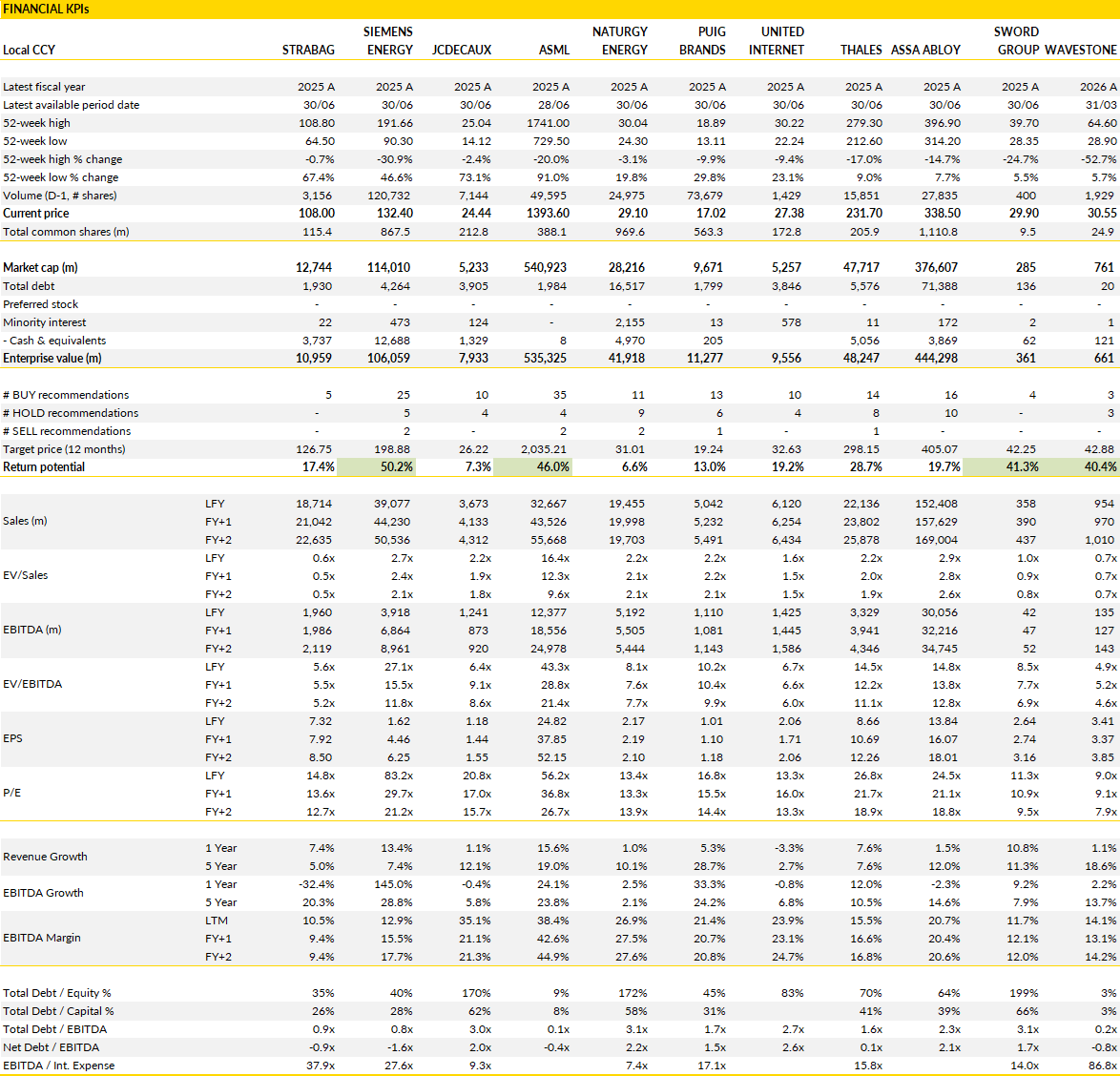
Financial KPIs
Companies covered in this edition: Strabag, Siemens Energy, JCDecaux, ASML, Naturgy, PUIG, United Internet, Thales, Assa Abloy, Sword Group, Wavestone
Strabag (STR Austria): Boosting growth
Strabag recently raised its 2030 output ambition to approximately €30bn from €28bn, implying average annual growth of around 8% from 2025.
In what was a very iteresting CMD, perhaps the more significant change is on profitability, with the previous 6% EBIT margin objective now defined as a sustainable minimum. This follows margins above earlier expectations in 2024 and 2025 and another increase in guidance for 2026, where management expects output of around €23bn and an EBIT margin of 5.5-6.0%.
The higher targets are backed by a record order book and broad infrastructure demand across the group's core markets. Germany's €500bn infrastructure fund adds another source of future work, but Strabag's opportunities extend much beyond this program. Transport networks, energy and water infrastructure, high-tech facilities and other complex construction projects are all receiving higher investment, giving the group several end markets capable of supporting growth through the remainder of the decade.
Geographic expansion will account for part of the additional output. Australia has become an important development market following the acquisition of Georgiou, whose backlog has already doubled, and Strabag wants to move from roughly the country's 15th-largest contractor into the top five. The UK provides another opportunity to build a larger position around infrastructure projects, complementing the group's established leadership in Germany, Austria and Central Europe. Acquisitions can contribute as much as half of the growth required to reach the 2030 objective, with management planning at least €1bn of annual investment across M&A, PPP projects and real estate.
Internally, Strabag is expanding vertical integration, using prefabrication and modular construction more extensively and introducing digital and AI tools across bidding and project execution. These initiatives should improve utilisation of the group's existing capabilities and help preserve bidding discipline as volumes rise. Maintaining that discipline will be particularly important as public infrastructure spending accelerates and competition for labour and subcontracting capacity increases.
The capital structure could also become simpler if the long-running Rasperia issue is resolved. Raiffeisen Bank International has initiated enforcement proceedings against Rasperia's Austrian assets, which include 28.5m Strabag shares and frozen dividends, and has indicated that it considers a successful outcome highly likely. A resolution could eventually increase Strabag's free float and remove the uncertainty created by the sanctioned shareholder, although the ultimate treatment of the stake remains unresolved.
It may also influence future distributions. Strabag currently operates with a 30-50% payout framework, and stronger cash generation could allow distributions towards the upper end once the ownership situation is settled and investment requirements are covered. The combination of a €30bn output objective, a 6% minimum EBIT margin and a broader geographic and sector footprint gives Strabag a substantially larger base to work towards by 2030.
Siemens Energy (ENR Germany): Turbine demand and grid investment push the order horizon well into the next decade
Siemens Energy is seeing another increase in prospective demand for gas turbines, with management now estimating that the global market could reach 110-120 GW annually by 2030, compared with 100-110 GW previously. Data centres and AI-related electricity demand could add another 10-20 GW in a particularly strong scenario, taking annual requirements as high as 120-140 GW.
Siemens Energy intends to maintain its global market share at approximately 20-25%, prioritising contracts where supply-chain capacity can be secured before committing to delivery. Production slots are already largely allocated through 2030, and some recent orders extend into 2030-31. The €10bn of Gas Services orders booked in Q3 was unusually high and should not be extrapolated quarter by quarter, but the underlying pipeline remains strong into 2027, including across markets outside the US. With turbine capacity increasingly scarce across the industry, the commercial environment remains favourable for pricing and contract selection.
The growing turbine fleet also expands the future service opportunity. Long-term service agreements now have an average duration of 17 years, compared with 11-13 years historically, increasing the amount of recurring revenue attached to each equipment sale. Management has previously indicated that every gigawatt of new turbine capacity can generate roughly €400m of cumulative service revenue over 20 years. The current equipment cycle therefore creates an earnings stream that extends far beyond the initial delivery period, with the service contribution from today's turbine orders becoming increasingly significant during the mid-2030s. Contract economics have already improved substantially. Between 2022 and 2025, backlog margins increased by 12 percentage points for gas turbines, 3 points in Gas Services and 9 points in Grid Technologies. Pricing remains supportive and execution has strengthened, allowing higher-quality orders to replace contracts booked during weaker industry conditions.
Grid Technologies has an even longer demand horizon, with management seeing customer requirements extending to 2035 and potentially 2040. Utilities are replacing ageing equipment while simultaneously investing in higher electricity consumption, data-centre connections, network stability, digitalisation and HVDC links. Siemens Energy is already expanding Grid capacity by approximately 50% through 2030, yet supply could remain insufficient in parts of the market even after these investments. Large transformers are particularly constrained, creating scope for further capacity additions if customer demand remains at current levels.
The November 11 Capital Markets Day will establish the group's financial framework through 2030 and provide a clearer indication of how much of the stronger backlog economics can ultimately reach reported margins. Siemens Energy is entering that update with scarce turbine capacity, a rapidly expanding installed base and years of grid demand already identified.
JCDecaux (DEC France): Digital expansion and major tenders create plenty of momentum
JCDecaux is expecting organic revenue growth of around 5% in Q3, with the geographic mix improving despite continued weakness in China and the Middle East.
The US and Latin America remain strong even after the FIFA World Cup, while Southern Europe and Africa are also contributing healthy growth. European trading held up well through the summer, particularly in France, with Germany somewhat softer. Conditions in the Middle East are gradually normalising after a difficult Q2, although revenue in the region is still declining. China, which represents around 10% of group sales, has yet to show a broader recovery, but the operations remain profitable and digital advertising is expanding strongly. This leaves JCDecaux with several regional growth engines as it moves through H2, supported by continued demand for outdoor advertising and the increasing proportion of inventory that can be sold digitally.
Profit conversion will be somewhat weaker during H2 as several recently awarded contracts enter their initial operating phase; e.g. Stockholm, Barcelone, Denver require upfront sales, marketing and other launch expenditure before reaching normal profitability, temporarily reducing operating leverage. Capital expenditure should nevertheless remain close to the group's long-term average of around 8% of sales. The digitalisation of the estate remains central to the economics of the business, allowing JCDecaux to increase inventory flexibility, shorten campaign lead times and offer advertisers more targeted purchasing options. Programmatic advertising provides an additional distribution channel, and the group is developing a platform aimed specifically at expanding its reach among SMEs. This could broaden the advertiser base beyond the larger agencies and brands that traditionally dominate outdoor media. Selective acquisitions remain part of the strategy as well, with opportunities in existing geographic markets and in technology that can strengthen the digital advertising infrastructure.
A substantial tender pipeline could add another source of expansion from 2027. JCDecaux is competing for airport contracts in San Francisco, Phoenix, Amsterdam and Chicago, alongside the Paris MUPI street-furniture concession, where the existing agreement expires in March 2027. These are opportunities to add contracts that are not currently part of the group's revenue base, giving successful bids an immediate contribution to future growth. Hong Kong airport, which JCDecaux already operates, is also being retendered.
The competitive environment has become more favourable as the scale, capital requirements and technology needed to operate large outdoor advertising networks create significant barriers to entry. JCDecaux can combine its global footprint with digital capabilities and relationships with major transport authorities and municipalities when bidding for these assets. The current growth rate does not depend on winning the upcoming tenders, but securing even part of the pipeline would add to the contribution from existing contract ramp-ups.
With organic growth holding around mid-single digits and digital penetration increasing, the tender calendar provides a strong route to extending the current expansion into 2027.
ASML (ASML Netherlands): High-NA is moving towards industrial adoption
ASML's production roadmap remains geared towards a major increase in semiconductor equipment demand through 2028, despite the renewed discussion around AI regulation.
The company plans to lift EUV output from around 65 systems in 2026 to 85 in 2027 and 110 in 2028, with the transition towards more productive E and F platforms allowing wafer-processing capacity to grow faster than unit shipments. Immersion DUV is expanding alongside EUV, with planned system capacity rising from roughly 130 units this year to 170 next year and 220 in 2028. Customer demand is coming from several areas simultaneously, including HBM and advanced DRAM, the migration towards 1.4 nm and 2 nm logic, greater lithography intensity and continued investment in AI accelerators. Upgrade activity across the installed base adds another source of demand. Customers are securing equipment earlier because their own commitments to chip designers and hyperscalers extend several years forward. In some cases, cleanroom availability at semiconductor fabs has become a more immediate bottleneck than ASML's ability to manufacture machines, potentially shifting delivery timing without changing the underlying equipment requirement.
High-NA EUV is also progressing from technological development towards broader industrial deployment. Samsung has committed to using the technology for DRAM from 2028, with TSMC planning adoption for advanced logic from 2030. At the same time, work on moving photomasks to a 12-inch format could double the exposed field and improve system productivity by as much as 40%. These developments strengthen the economics of High-NA for customers and increase the value generated by each machine, creating additional scope for ASML to capture part of the productivity benefit through pricing.
The company's existing 2030 financial framework of €44-60bn of revenue is thus becoming dated, and management is due to provide a new strategic framework at the June 2027 Capital Markets Day. Profitability is benefiting from the same industrial scaling. Higher volumes improve fixed-cost absorption, Installed Base Management is expanding and product mix is becoming more favourable. ASML now sees gross margin at 54-56% in 2026, compared with its previous 51-53% range, with price increases announced in July contributing more fully once they flow into later backlog.
China and potential changes in AI investment remain the main external uncertainties, but neither currently alters ASML's capacity plans. Chinese equipment manufacturers are making progress in parts of DUV, although ASML believes a credible domestic EUV alternative could still be more than a decade away. Closing the gap requires competitive productivity, availability and yields across successive process generations in addition to developing the lithography hardware itself. Export restrictions could reduce ASML's direct Chinese sales, although semiconductor production displaced from China would likely require additional equipment elsewhere.
The more recent regulatory debate around advanced AI introduces a separate question around hyperscaler spending, but semiconductor capacity remains constrained in several areas and the current supply-demand gap is estimated at 30-40%. Memory pricing also indicates that physical capacity has yet to catch up with demand. ASML therefore continues preparing for substantially higher output across multiple lithography platforms through 2028.
Naturgy (NTGY Spain): Balance sheet capacity unlocks a new phase of growth
Naturgy has emerged from several years of shareholder and governance changes with a much simpler ownership structure and considerable financial capacity for its next strategic move. The proposed Gemini separation has been abandoned, BlackRock/GIP and CVC have exited their longstanding positions, and free float has increased from below 10% to almost 47%.
These changes remove several constraints that previously complicated strategic decisions and capital allocation. Naturgy enters this new phase with its BBB credit rating intact. The current 2025-27 plan contains only €6.4bn of investment, leaving a sizeable gap between committed spending and the €10-12bn of additional investment capacity that management believes can be deployed without compromising the rating. Organic projects are unlikely to absorb that amount within a reasonable timeframe, increasing the likelihood that acquisitions become an important part of the next stage of growth.
Renewables and regulated electricity networks appear the most natural areas for expansion. Acquiring an independent renewable power producer would add scale in a segment where Naturgy can use its existing power-market capabilities and customer base, although the relatively high prices paid for renewable platforms require discipline around entry multiples and future development pipelines. Regulated networks offer different economics, with lower transaction multiples and returns supported by regulated asset bases. They would also complement Naturgy's existing network activities and increase the proportion of earnings generated from predictable infrastructure assets. Depending on the size and type of transaction, management sees scope to add between roughly €400m and more than €1bn of EBITDA. Naturgy has enough balance-sheet flexibility to contemplate a meaningful acquisition without abandoning its existing organic investment program, giving it access to assets that could materially change the group's earnings mix.
So the next strategic decision will be aimed on how quickly and where Naturgy deploys its surplus financial capacity. The enlarged free float makes the company easier to access for institutional shareholders, while the stabilised governance structure should make large capital-allocation decisions more straightforward than during the previous ownership configuration. A regulated-network acquisition would deepen Naturgy's exposure to stable infrastructure earnings, whereas a renewable platform could provide a larger growth pipeline and accelerate the expansion of generation capacity. Both routes require careful acquisition discipline, particularly given the scale of the available capital and the risk of paying away future returns in competitive processes.
Naturgy is under little financial pressure to transact quickly, which gives management scope to wait for assets offering acceptable returns. After years dominated by ownership changes and the abandoned separation proposal, the next phase will be shaped by deployment of the balance sheet.
Puig (PUIG Spain): Full control of ISDIN creates a broader beauty platform
Puig is taking full ownership of ISDIN after agreeing to acquire the Esteve family's 50% interest for €1.2bn, turning a longstanding joint venture into a fully consolidated dermatology and skincare business.
The transaction has unusually low integration risk for an acquisition of this size because the Puig and Esteve families established ISDIN together in 1975 and Puig has owned half of the company ever since. Payment is split between €900m in cash following the expected Q1 2027 closing and a fixed €300m payment in Q1 2029, with Puig expecting net debt/EBITDA to remain below 2x.
ISDIN gives the group a leading pharmacy-based dermatology and sun-protection franchise, particularly in Spain, where it holds the number-one position in both categories. The acquisition also changes Puig's category exposure considerably. Skincare should rise from 11% to approximately 21% of group revenue, with sales in the category approaching €1.2bn, while fragrances decline from 72% to around 64% and makeup represents approximately 15%. This gives skincare sufficient scale to become a major business within Puig alongside its established fragrance portfolio.
The geographic opportunity extends well beyond ISDIN's Spanish base. Its sun-care products already have strong positions in Argentina, Mexico and Peru, where the brand ranks among the top three, providing Puig with an established dermatological platform across several Latin American markets. That footprint can be combined with Puig's strength in prestige fragrances and used to support other brands, including a broader rollout of Charlotte Tilbury. Mexico already provides an initial presence for Charlotte Tilbury, although penetration remains limited. Brazil offers another potential expansion market as Puig builds greater scale across skincare and beauty. Europe provides a separate avenue for ISDIN itself. The brand has gained recognition among European consumers through exposure to Spain and tourism, but its commercial penetration outside its domestic market remains comparatively underdeveloped. Puig's distribution network and relationships with beauty retailers can therefore support a wider European rollout, while the US offers a larger long-term opportunity if the company can establish ISDIN within the premium dermatological skincare category.
Strategically, ISDIN reduces Puig's dependence on prestige fragrances and increases its exposure to dermatology, one of the stronger areas within skincare. Sun protection remains central to the brand, but expanding everyday dermatological products can also reduce the seasonality associated with that category and increase purchasing frequency. Full ownership gives Puig greater freedom to coordinate distribution, marketing and international expansion across the portfolio and removes the constraints inherent in a 50/50 ownership structure.
The purchase price is substantial relative to ISDIN's current earnings, so future returns will depend on Puig accelerating growth outside Spain and extracting commercial benefits from its broader distribution platform. The transaction nevertheless adds an asset that Puig already knows intimately and gives the group meaningful positions across three major prestige beauty categories. Successful expansion of ISDIN across the US and Europe, combined with greater use of the group's Latin American infrastructure across skincare, makeup and fragrances, could make the acquisition considerably more valuable than the existing standalone business.
United Internet (UTDI Germany): Cost reductions begin across IONOS and 1&1
United Internet is starting a broader cost program across IONOS and 1&1, with the two subsidiaries expected to generate €55m of annual savings once the measures are fully implemented. The group will absorb approximately €95m of restructuring charges in Q4 2026, but its adjusted EBITDA guidance of €1.45bn for the year remains unchanged.
The initiatives indicate a stronger focus on cash generation and operating efficiency across Ralph Dommermuth's portfolio after years in which investment and expansion took priority. The programs are substantial enough to change the cost base without altering the strategic direction of either subsidiary. IONOS remains focused on cloud, hosting and AI-related products, and 1&1 is still building out its mobile network, but both businesses are being asked to operate with leaner organisational structures. The different timing of the savings reflects their respective situations, with IONOS expected to realise the benefits from 2027 and the Versatel measures at 1&1 reaching their full annual contribution from 2028.
IONOS plans to reduce its workforce by approximately 300 positions, or 8%, taking headcount from around 3,800 to 3,500. The program carries an estimated €35m restructuring charge and should lower annual costs by €30m from 2027. This is the company's first significant restructuring programme and comes during a period of healthy expansion, with IONOS guiding to 8% revenue growth and 9% adjusted EBITDA growth in 2026 while maintaining its full-year adjusted EBITDA objective of €530m.
The objective appears to be to create room for faster investment in growth areas without allowing the overall expense base to rise at the same pace. Greater use of AI internally can automate parts of the organisation, while agent-based AI and cloud services are becoming increasingly relevant commercially. The appointment of a new CFO with previous experience improving margins at NFON also fits with a greater emphasis on operating efficiency. IONOS therefore has an opportunity to combine a structurally lower cost base with continued customer growth and expansion of its cloud and AI offering.
At 1&1, the restructuring is concentrated on Versatel, the fibre-network business recently acquired from United Internet. Headcount there is planned to fall from roughly 1,350 to around 1,000, equivalent to 26% of Versatel employees and approximately 8% of the total 1&1 workforce. Annual savings are expected to reach €25m from 2028. Versatel generates an EBITDA margin of around 29%, but heavy network investment means the business currently consumes cash, making cost reduction particularly relevant as 1&1 simultaneously funds its mobile infrastructure. The company continues to guide to €800m of adjusted EBITDA for 2026, or €740m after the €60m restructuring charge.
Taken together, both programs at IONOS and 1&1 suggest that United Internet is becoming more demanding on subsidiary-level returns and cash conversion. This could eventually give the group greater flexibility for debt reduction, shareholder distributions or further strategic changes in German telecommunications. IONOS currently offers the cleaner route to earnings growth, given its lower capital intensity and the prospect of capturing cost savings already from 2027, whereas 1&1 must still balance restructuring benefits against substantial network investment.
Thales (HO France): Cyber joins defence
Thales is seeing strong demand across defence, with management increasingly likely to revisit its medium-term targets early next year as the market expands beyond the assumptions underlying the existing plan.
European military spending provides a long-duration source of demand, complemented in the near term by urgent procurement requirements from several Middle Eastern countries. Management expects elevated defence activity to persist for at least another decade and has already invested in additional industrial capacity to accelerate deliveries from the backlog. The principal constraint remains the supply chain, where shortages have shifted towards selected IT equipment and continue to limit the speed at which orders can be converted into revenue. Space is also improving after a prolonged period of weaker commercial activity. Thales has secured three GEO satellite contracts since the start of 2026, compared with two during all of 2025, adding a commercial recovery to already healthy military and institutional demand. European public spending could provide a substantial additional source of activity, with the proposed European Commission framework for 2028-34 envisaging a space budget approaching €65bn compared with roughly €14.9bn under the current programme.
Cybersecurity is developing into another meaningful growth contributor. Trading has remained strong into H2, and new products should extend the momentum into 2027. Thales plans to introduce its next generation of hardware security modules by the end of Q3, creating both new sales opportunities and a replacement cycle for older equipment already installed at customer sites. This installed base gives the company an existing channel through which new cybersecurity technology can be deployed without relying entirely on new customer wins. The overlap with defence, aerospace and critical infrastructure also gives Thales access to customers for whom security requirements are becoming progressively more complex. Elsewhere in the portfolio, the planned Bromo space combination is progressing through antitrust discussions according to the original timetable. The addition of Exail will further increase Thales's exposure to defence technologies and autonomous systems, broadening the range of products through which it can capture higher military spending.
Management continues to regard the digital division, representing around 10% of group revenue, as a core activity despite the growing weight of defence and aerospace. Digital identity has technological links with security and defence applications, while the division also generates substantial cash that can fund investment elsewhere in the group. Payments is a more mature activity, however, and the strategic logic of retaining every part of the digital portfolio could be tested as Thales allocates more capital and management resources towards defence, space and cyber.
For now, the operating portfolio is benefiting from an unusually broad improvement in end markets. Defence capacity is being expanded into a decade-long demand cycle, commercial space orders are recovering alongside institutional spending, and cybersecurity has both new products and an installed-base replacement opportunity ahead. Supply-chain execution remains the main operational obstacle. If component availability improves, Thales has already made much of the capacity investment required to convert its large order book more rapidly, giving the group scope to sustain higher growth across several businesses simultaneously.
Assa Abloy (ASSAB Sweden): Pricing and acquisitions offset a delayed US housing recovery
Assa Abloy's demand environment remains broadly unchanged from Q2, with resilient non-residential activity compensating for a residential market that is still uneven across regions.
The US remains the weakest area, particularly in housing, where elevated borrowing costs have pushed out the timing of a recovery. Conditions are healthier in the Nordic countries and Central Europe, and commercial construction continues to provide a firmer source of demand across the group. Pricing remains supportive at slightly above 2%, while volumes are modestly positive overall. Currency pressure is also becoming less pronounced after weighing on reported growth during recent quarters. The resulting operating environment is sufficient for Assa Abloy to generate continued organic growth without requiring a rebound in US residential construction, although a future normalisation in that market would add another source of volume growth.
Profitability has remained resilient through the softer residential cycle because Assa Abloy's cost structure can adjust to changes in demand and pricing has consistently compensated for inflation. Acquisitions are currently dilutive to group margins as newly acquired businesses are integrated, with the initial profitability of targets often below Assa Abloy's established operations. This is a recurring feature of the acquisition model and creates an internal source of margin improvement as procurement, manufacturing and commercial processes are brought onto the group's platform. Assa Abloy typically adds around 4-5% of annual sales through acquisitions, giving it a route to expand even when underlying construction markets are subdued. The breadth of the portfolio across mechanical and electronic locks, access control, entrance systems and related security products also limits reliance on any single construction segment. Increasing electronic content provides an additional long-term growth avenue as buildings move towards connected access and more sophisticated security systems.
A recovery in US housing would strengthen this model, but current conditions suggest that contribution is unlikely to arrive during H2 2026. US 30-year mortgage rates have risen to around 6.7%, and housing starts fell 13.2% year-on-year in August, leaving residential construction under pressure. Assa Abloy can still grow through pricing, non-residential demand and its acquisition programme while waiting for housing activity to improve. Its strong free cash flow generation also allows acquisitions to remain an integral part of capital deployment without placing excessive strain on the balance sheet.
The eventual residential recovery could become more relevant during 2027, particularly if financing conditions ease and construction volumes begin to normalise. Until then, earnings progression depends primarily on preserving pricing, extracting efficiencies from acquired businesses and maintaining discipline over the cost base. That combination has allowed Assa Abloy to navigate the current mixed construction environment with relatively stable profitability and should leave the group well placed to capture additional operating leverage once residential volumes begin to recover.
Sword Group (SWP France): Double-digit growth continues with the portfolio shifting to AI and managed services
Sword Group entered H2 with broad-based commercial momentum after generating 12.6% organic growth and a 12% EBITDA margin in the first half. Management continues to target 12% organic growth and a 12% EBITDA margin for 2026, consistent with the objectives embedded in its plan through 2028.
The UK could provide additional acceleration during H2 as utilities generate new project opportunities and the group's oil and gas activities remain resilient. Benelux has strengthened following several EU contract awards, complemented by a healthy pipeline of prospective work, while the Middle East is maintaining its growth despite regional uncertainty. Switzerland remains the main area requiring operational work, with a reorganisation underway that should gradually improve performance over the coming quarters. Sword's backlog exceeds €750m under the company's definition, equivalent to 23.2 months of revenue, providing a substantial base of contracted activity from which to pursue its double-digit growth ambitions.
The revenue mix is becoming more in focus as AI changes the economics of traditional IT services. Sword plans to allocate more resources towards infrastructure, managed services, cloud, cybersecurity and AI-related platforms, areas where customer demand is expanding and the scope for longer-duration relationships is greater. Its exposure to large organisations and public-sector institutions provides opportunities to extend existing contracts into these newer services without relying exclusively on new customer acquisition.
The management incentive structure also supports the current operating model, with key executives participating through the profit-sharing arrangement linked to the 2029 share deal. Acquisitions are likely to remain small and targeted, filling capability or geographic gaps without changing the group's financial profile. Sword's ability to sustain a 12% EBITDA margin alongside double-digit organic expansion indicates that the current growth is being achieved without sacrificing profitability, while the gradual change in service mix should help protect the business as AI automates parts of conventional technology consulting.
Capital allocation could become more active from 2027 if the share price remains weak. CEO Jacques Mottard indicated that concrete measures may be considered, creating several possible routes for deploying Sword's financial resources. A share repurchase is one option, while Eximium's approximately 20% holding creates the possibility of Sword acquiring some or all of that stake should the shareholder seek an exit. Portfolio disposals could also enter the discussion where individual operations attract valuations that management considers compelling. Businesses in the UK or Belux have developed meaningful scale and could draw strategic interest, although no disposal programme has been announced. Such transactions could also simplify the group ahead of a possible change in Jacques Mottard's involvement around the end of the current 2028/29 planning period.
For now, operational delivery remains strong enough so that Sword does not need major corporate action to sustain growth. The combination of more than €750m of backlog, improving regional performance and increasing exposure to AI, cloud and managed services provides a solid base for the existing plan, with potential capital measures adding another strategic option from 2027.
Wavestone (WAVE France): Sand Cherry adds scale to the US expansion
Wavestone is accelerating its North American development with the acquisition of Sand Cherry, a Denver-based management consultancy serving large US corporates.
Sand Cherry employs 130 people and is targeting $31.5m of revenue with an adjusted EBITDA margin of 15%, following average annual growth of 15% over the past three years. Its historical strength in telecom, media and technology has broadened into energy and utilities, adding sector capabilities that complement Wavestone's existing US exposure to financial services and life sciences. The transaction lifts Wavestone's US operations to approximately $120m of pro forma revenue and 370 employees. Although Sand Cherry represents only around 3% of group revenue, it increases the US business by roughly 30%, giving the acquisition much greater significance at the regional level. Existing Sand Cherry management will remain involved alongside Wavestone's North American team, which should help preserve client relationships and reduce disruption during integration.
The acquisition advances Wavestone's Lead the Shift plan, which targets €350m of combined US and UK revenue by 2030. North America currently represents only around 8% of group revenue, leaving considerable room to build a more balanced geographic footprint. Sand Cherry provides an established US client base and local management platform from which Wavestone can cross-sell a broader range of transformation services. The purchase price is $35m, with up to another $12m payable through earn-outs, against Sand Cherry's targeted $31.5m of annual revenue.
The initial consideration so remains manageable for Wavestone and leaves capacity for further transactions. Management continues to examine several US opportunities of comparable size, suggesting that the regional build-out could proceed through a sequence of bolt-on acquisitions. This approach allows Wavestone to add local client relationships and experienced consultants incrementally, avoiding the integration complexity associated with a much larger transformational transaction.
The deal comes during a difficult operating period for Wavestone following weaker Q1 trading and a subsequent reduction in its financial outlook. Consulting demand remains subdued across several traditional transformation categories, and management has acknowledged execution issues that it expects to resolve progressively. AI-related work is developing more favourably and could become increasingly relevant as clients move from experimentation towards larger implementation programmes. Geographic diversification also reduces Wavestone's historical sensitivity to France, even though perceptions of French political risk still affect the company.
Sand Cherry does little to change group earnings in the near term, but it advances two strategic priorities at once: expanding the US platform and adding exposure to sectors where transformation spending remains active. Further acquisitions would make North America a progressively larger contributor before 2030. The immediate task is to stabilise the existing business after the weak start to the year, integrate Sand Cherry without losing consultants or clients and demonstrate that AI-related demand can translate into sustained revenue growth.