
Defense, telcos and a lot of results
Rheinmetall, Siemens Energy, Wolters Kluwer, Kontron, Scout24, Vonovia, Fresenius, Merck, Infineon Technologies, Swisscom, R&S Group, Deutsche Telekom, IONOS

At Lux Opes, we break down companies into quick takes that get straight to the point - what is happening, why it matters, and what to watch next. We publish 2-3 times per week, depending on the news flow.
For the best reading experience, we recommend reading at Lux Opes
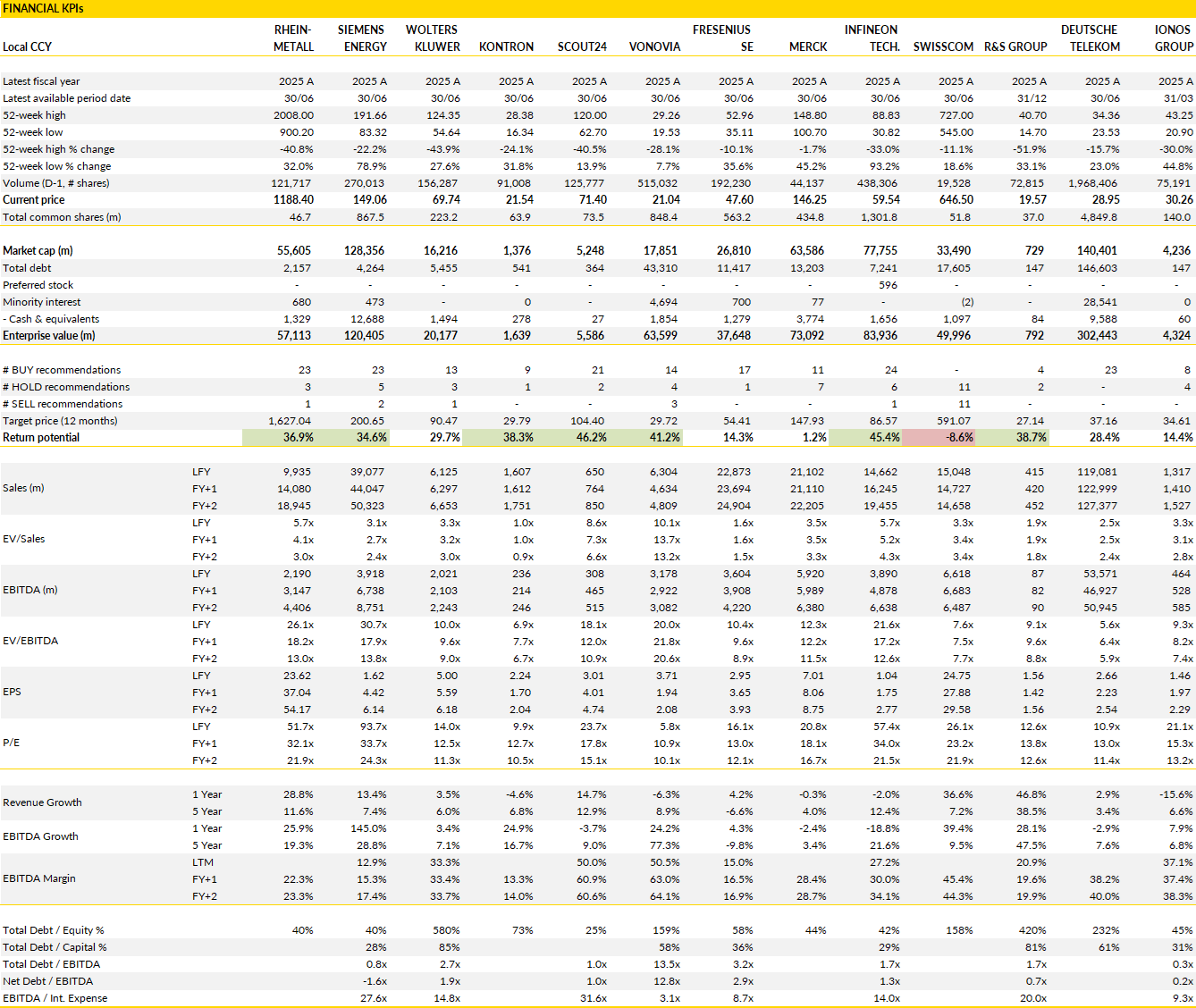
Financial KPIs
Companies covered in this edition: Rheinmetall, Siemens Energy, Wolters Kluwer, Kontron, Scout24, Vonovia, Fresenius, Merck, Infineon Technologies, Swisscom, R&S Group, Deutsche Telekom, IONOS
Rheinmetall (RHM Germany): Strong execution continues as record backlog supports years of growth
Rheinmetall confirmed an exceptionally strong second quarter, with revenue rising 69% year-on-year to €3.29 billion while operating profit significantly exceeded market expectations at €562 million. Every division contributed to the outperformance as higher production volumes and improved operating leverage translated into a margin of 17.1%. Naval Systems was consolidated for the first time and contributed broadly as expected, providing an additional source of long-term growth. Vehicle Systems benefited from deliveries of Puma infantry fighting vehicles, Lynx vehicles for Romania and logistics platforms for Germany, while Weapon & Ammunition continued to capitalise on sustained demand for artillery ammunition and medium-calibre systems across Europe. Air Defence also delivered another strong performance as Skynex and Skyranger programs gathered pace, while Digital Systems benefited from growing demand for digital battlefield solutions and short-range air defence technologies.
The strongest signal from the quarter came from order intake. New orders reached €11.4 billion, pushing the backlog above €80 billion and providing exceptional visibility well beyond the current planning period. Management therefore continues to expect organic revenue growth of 28% to 31% this year, although reported revenue guidance has been narrowed to €13.7-14.2 billion following the removal of the F1 2026 naval programme, creating an expected headwind of around €300 million.
Importantly, profitability expectations remain unchanged, with management still targeting an operating margin of around 19%, indicating that the contract adjustment has little impact on the underlying earnings profile. The only notable weakness in the quarter came from free cash flow, which turned sharply negative as working capital expanded to support higher production, customer advances were delayed and receivables increased during the ongoing industrial ramp-up.
Rheinmetall remains one of the strongest execution stories within the European defence sector. Demand across ammunition, armoured vehicles, air defence and military electronics continues to expand as European governments accelerate rearmament programmes, while the record backlog provides unusually long visibility on future revenue. The modest reduction in reported sales guidance reflects a specific program adjustment instead of weaker underlying demand and should have only a limited impact on market expectations.
Attention will now shift towards the pace of additional contract awards, particularly in air defence and military mobility, and whether these programs continue to extend the company's already substantial order book. With execution remaining strong and structural defence spending still increasing across Europe, Rheinmetall enters the second half of the year with considerable operational momentum.
Siemens Energy (ENR Germany): Reinforcing momentum
Siemens Energy delivered another exceptionally strong quarter, comfortably beating market expectations across orders, revenue and profitability while reinforcing confidence in its full-year outlook.
Order intake climbed almost 19% on a like-for-like basis, driven by another wave of demand across Gas Services, Grid Technologies and Transformation of Industry, lifting the order backlog to €162bn. That backlog now covers the vast majority of expected 2027 revenue and provides unusually strong earnings visibility for the coming years. Revenue growth remained equally robust, with all major divisions contributing double-digit organic growth. Siemens Gamesa was the only exception on orders, although that largely reflected project timing instead of deteriorating demand. More importantly, the wind business delivered its first positive operating result since 2022, marking another milestone in its operational recovery.
Profitability was the standout of the quarter. The group generated an adjusted EBIT margin of 14.2%, comfortably exceeding both market expectations and the upper end of its full-year guidance range. Gas Services continued to benefit from exceptionally favourable market conditions and high utilisation rates, while Grid Technologies maintained outstanding profitability as utilities worldwide continue investing heavily in transmission infrastructure. Transformation of Industry also delivered another strong quarter, reflecting healthy demand across industrial electrification and energy efficiency projects. Combined with the improving performance at Gamesa, these results suggest that earnings growth is becoming increasingly broad-based instead of relying on one or two divisions. Free cash flow also remained exceptionally strong, further strengthening an already solid balance sheet and providing additional flexibility as the company expands manufacturing capacity to meet growing demand.
Management left its formal guidance unchanged but now expects operating margins to finish at the top end of the previously announced range, a subtle upgrade that clearly reflects confidence in current trading conditions.
Investors are now likely to shift their attention towards the capital markets update scheduled alongside the annual results in November, where new medium-term targets extending towards 2030 are expected. One of the key questions will be how quickly Siemens Energy can expand production capacity, particularly in gas turbines, where demand continues to outstrip supply. Greater detail on the composition of recent gas turbine orders, including exposure to data centre projects, could also help investors assess how durable current demand proves to be.
The latest results reiterate the company's operational momentum, although much of that progress is already reflected in the valuation following the stock's exceptional performance over the past year.
Wolters Kluwer (WKL Netherlands): Recurring revenue model delivers another dependable half
Wolters Kluwer reported another resilient set of interim results, with profitability comfortably ahead of market expectations despite revenue growth remaining broadly in line with forecasts.
Organic revenue increased 5%, supported by continued expansion in recurring revenues, while adjusted operating profit exceeded consensus by around 2% as the operating margin improved by a full percentage point to 29.4%. Earnings per share also outpaced expectations, reflecting the group's ability to convert steady top-line growth into faster profit expansion. Management left its full-year guidance unchanged, continuing to target around 5% organic growth, an operating margin of roughly 28%, free cash flow of €1.3bn-€1.35bn, a return on invested capital of 18%-19% and high single-digit adjusted EPS growth. Given the strong first-half execution, the company appears comfortably positioned to achieve those objectives.
Performance remained broadly balanced across the portfolio, although some businesses continued to stand out. Tax & Accounting delivered one of the strongest performances, helped by 18% cloud software growth in North America as AI-enabled products continued gaining traction. Corporate Performance & ESG also reported solid growth, although management now expects the division to grow broadly in line with last year's pace instead of accelerating further because of a more uncertain geopolitical backdrop. Health, Legal & Regulatory and Financial & Corporate Compliance all continued to generate stable mid-single-digit growth, highlighting the defensive characteristics of the group's diversified information and software portfolio.
Recurring revenue expanded 7%, offsetting weaker non-recurring activity and reinforcing the long-term shift towards subscription-based revenues that continues to support earnings quality. Management also indicated that product development spending will be weighted more heavily towards the second half, suggesting some moderation in margin progression later this year.
Despite all undertainty, the investment case remains unchanged. Wolters Kluwer continues to combine predictable organic growth, expanding margins and robust cash generation, although its revenue growth still trails faster-growing information services peers. That differential partly explains why the shares continue to trade below longer-term historical valuation multiples despite the consistency of execution.
With guidance reaffirmed and first-half profitability ahead of expectations, meaningful consensus revisions appear unlikely following these results. Instead, investor attention will remain focused on whether continued investment in AI-powered software and cloud-based products can gradually narrow the growth gap with competitors while preserving the company's long record of disciplined margin expansion and strong returns on capital.
Kontron (KTN Germany): Continued strong orders
Kontron delivered a stronger-than-expected second quarter, with revenue reaching €373.4 million, around 5% ahead of market expectations, while EBITDA and earnings comfortably exceeded forecasts.
The earnings beat was not driven by stronger underlying gross profitability, however, as the gross margin declined to 42.5%. Instead, lower-than-expected other operating expenses provided the main boost, allowing EBITDA to reach €46.9 million and almost doubling earnings per share versus expectations. The restructuring program also continued to progress, with headcount reduced by 424 employees by the end of June as the company works towards annual cost savings of approximately €30 million. Cash generation was weakish though, with operating cash flow remaining negative during the first half of the year, reflecting continued working capital pressure.
The most encouraging development came from demand. Kontron reported a book-to-bill ratio of 1.55x during the second quarter, well above expectations, lifting the order backlog to €2.75 billion. While some of the increase may reflect longer-duration contract extensions, the figures nevertheless provide greater visibility for future revenue. Management therefore maintained its full-year outlook, expecting revenue of around €1.61 billion, broadly matching last year's level, alongside adjusted EBITDA of €225 million and reported EBITDA of €200 million. At the same time, the company disclosed that delayed customer deliveries linked to the semiconductor shortage have increased further, with the delinquent backlog rising above €50 million during the quarter.
Overall, the results strengthen confidence that Kontron can achieve its full-year targets, although questions remain over the quality of the earnings improvement. The stronger profitability was supported primarily by lower operating expenses instead of underlying margin expansion, making it important to assess whether those benefits are sustainable over the coming quarters.
Meanwhile, the sharp increase in order intake suggests demand remains healthy and provides a solid foundation for future growth once supply constraints ease. Investors are therefore likely to focus on whether stronger orders can begin translating into improved cash generation and more durable operating margin expansion during the second half of the year.
Scout24 (G24 Germany): AI monetisation and subscription growth drive strong execution
Scout24 delivered a strong quarter, with revenue increasing 20% year-on-year to €192.7 million, supported by both organic growth and the first full-quarter contribution from its Spanish acquisition. Organic revenue still expanded by an impressive 10.4%, highlighting continued strength in the underlying business. The professional segment remained the main engine of growth as subscription revenue, customer additions and a 10.4% increase in average revenue per user all contributed to higher sales. Customers continue to migrate towards higher-value memberships, while pricing initiatives and growing adoption of AI-powered products through ImmoPunkte are providing additional monetisation opportunities. The private customer business also performed well, benefiting from expanding subscription services, continued growth of WohnenPlus and double-digit gains in pay-per-ad revenues.
Profitability remained healthy despite the temporary impact of integrating the lower-margin Spanish operations. Adjusted EBITDA increased more than 14% during the quarter, although the reported margin declined to 60.2% because of the acquisition. Excluding Spain, the core business continued to expand margins, with the organic EBITDA margin improving to 63.0% during the first half, demonstrating that operating leverage remains firmly intact. Earnings per share also continued to grow at a double-digit pace, while operating cash flow declined modestly because of payments related to long-term incentive programmes instead of any deterioration in the underlying business.
Artificial intelligence is becoming an increasingly important part of Scout24's long-term strategy. AI-supported search interactions have expanded rapidly, while around 60% of professional customers already use ImmoPunkte to access AI-enabled products, creating another avenue for pricing and revenue growth. Management therefore maintained its full-year guidance, targeting revenue growth of 16% to 18%, including the contribution from Spain, alongside continued high operating margins. The combination of recurring subscription revenue, expanding AI monetisation, pricing power and improving underlying profitability suggests the company continues to execute well despite temporary integration effects from the Spanish acquisition.
Vonovia (VNA Germany): Resilient rental ops
Vonovia's first-half results largely confirmed the operational trends already visible after the first quarter, with the rental business continuing to provide stable earnings despite a higher financing burden.
Adjusted EBITDA increased modestly, driven primarily by residential leasing, while adjusted earnings before tax and adjusted shareholder earnings declined because of higher interest expenses and a larger contribution from minority interests. Organic rental growth remained healthy at 3.6%, only slightly below the pace seen earlier in the year following a more measured implementation of the updated Berlin rent index. Occupancy remained exceptionally strong with vacancies stable at 2.3%, rent collection continued at almost 100% and average in-place rents increased steadily, underlining the resilience of the underlying residential portfolio despite a more challenging macroeconomic backdrop.
Outside the core rental activities, the picture was more mixed. Value-add businesses, including technical services and energy operations, continued to expand rapidly and provided an increasingly meaningful contribution to earnings. Recurring property sales also remained stable despite subdued transaction markets across Germany. Residential development, however, continued to face difficult conditions, with profitability falling sharply against a demanding comparison that included one-off land sales last year. On the balance sheet, portfolio values continued to recover gradually, supporting a reduction in leverage over the past twelve months. Vonovia also remained active in refinancing, extending debt maturities while maintaining manageable financing costs through several transactions completed since the beginning of the year. Asset disposals also progressed as planned, contributing further to the company's broader deleveraging strategy.
Management therefore left its medium-term framework largely intact. All major financial targets for both 2026 and 2028 were reaffirmed, including EBITDA, adjusted earnings and shareholder returns, although the company modestly reduced its organic rental growth expectation for this year to reflect a more conservative approach to Berlin rent increases.
The residential portfolio continues to generate predictable cash flows, financing risks are steadily declining and property valuations have begun recovering, although the weak investment market is likely to remain a headwind for non-rental activities over the near term.
Fresenius (FRE Germany): Kabi and Helios deliver
Fresenius reported another solid quarter, with earnings comfortably ahead of market expectations despite revenue landing almost exactly in line with forecasts. Organic sales increased 6%, while adjusted EBIT grew more than 11%, reflecting another step-up in profitability across the group's core businesses. Core EPS also exceeded market expectations and prompted management to raise its full-year earnings guidance.
The main feature of the quarter was not simply stronger profitability, but the improving composition of earnings. Higher-growth businesses within Fresenius Kabi continued expanding at a much faster pace than the traditional pharmaceuticals portfolio, while Helios Germany returned to healthy operating growth after a prolonged period of pressure. Together, these trends suggest the group's ongoing portfolio transformation is beginning to translate into a structurally stronger earnings profile.
Kabi produced another impressive performance, driven by its Growth Vectors business. Biopharma remained the standout contributor with exceptionally strong expansion, supported by continued momentum in Nutrition and Medical Technology. Those higher-value activities generated substantial profit growth and helped lift divisional margins despite ongoing pricing pressure in the traditional IV drugs and fluids business. While the Pharma division remained profitable, weaker pricing in the US continued to weigh on earnings, largely offsetting healthy volume growth and stronger international demand. Helios also contributed positively. Germany returned to attractive organic growth as pricing and inpatient admissions both improved, while the Spanish business maintained stable underlying activity despite lower reported revenue. Together, Kabi and Helios delivered another quarter in which operational execution remained consistently strong across most of the portfolio.
Management maintained its revenue and operating margin outlook but upgraded its core EPS guidance to 10%-15% growth, reflecting confidence that the stronger earnings trajectory can be sustained through the remainder of the year. Kabi is now expected to finish at the upper end of its margin target range, reinforcing expectations that the mix shift towards faster-growing and higher-margin businesses will continue.
Fresenius continues to benefit from disciplined execution, expanding margins and stronger contributions from businesses with structurally higher returns, while the recovery in Helios Germany provides an additional source of operational improvement.
Merck (MRK Germany): Broad-based strength drives guidance upgrade
Merck second quarter results beat market expectations across revenue, earnings and profitability while raising full-year guidance for all three business divisions.
Organic revenue growth reached 4.1%, supported by healthy demand across Life Science, Electronics and Healthcare, while EBITDA and earnings per share both came in comfortably ahead of market forecasts. Management responded by lifting its outlook for revenue, EBITDA and EPS, signalling that momentum has improved since the start of the year. The result also demonstrates that Merck's diversified portfolio is providing multiple sources of growth instead of relying on a single business. With demand strengthening across several end markets, the company enters the second half with improving earnings momentum and greater confidence in its outlook.
Within Life Science, Process Solutions delivering another quarter of double-digit organic growth as demand for downstream manufacturing technologies and single-use products continued to recover. Advanced Solutions and Discovery Solutions also returned to growth, supporting higher group guidance for the division. Electronics also surprised positively despite softer reported revenue, driven by strong semiconductor materials demand as customers increased production for advanced chips and AI-related applications. The Healthcare division completed the broad-based picture, benefiting from continued strength in Rare Diseases while the decline in Mavenclad proved less severe than anticipated.
This combination allowed management to raise guidance despite assuming no additional US Mavenclad sales from August onwards and no contribution from Pergoveris in the United States.
Merck thus continues to enjoy a favourable phase across its core businesses. Semiconductor materials continue to benefit from structural investment in advanced computing infrastructure, while Process Solutions appears to be moving beyond the inventory correction that weighed on the sector over the past two years. Healthcare also looks more resilient than expected, limiting the impact of patent-related headwinds. Following the recently announced Bio-Techne acquisition, Merck is also strengthening its exposure to higher-growth consumables and cell therapy tools, broadening the Life Science platform even further.
With guidance now moving higher across every division and several long-term growth drivers improving simultaneously, the company's earnings trajectory appears stronger than it did only a few months ago, while valuation remains reasonable compared with global life science peers.
Infineon Technologies (IFX Germany): AI momentum offsets weakness elsewhere, but not enough
Infineon's third-quarter results broadly met market expectations, with revenue slightly ahead of forecasts while profitability came in marginally below consensus.
Revenue reached €4.17 billion, up 13% year-on-year and 9% sequentially, supported by continued strength in AI-related demand. Adjusted gross margin remained stable at 42.8%, while the segment result margin came in at 19.1%, comfortably within management's guidance despite falling short of market expectations. The quarter again highlighted the growing divergence across the portfolio. The automotive business remained resilient, with stable margins supported by microcontrollers, smart power products and software-defined vehicle content. The standout performer was Power & Sensor Systems, where revenue climbed 34% year-on-year and margins expanded to almost 25%, reflecting accelerating demand for AI infrastructure. The only notable disappointment came from Green Industrial Power, where margins weakened because of temporary operational and inventory-related issues that had not previously been flagged.
Management's outlook introduced few surprises and largely confirmed the existing trajectory for the business. Fourth-quarter revenue is expected to reach around €4.7 billion, modestly ahead of market expectations, while operating margins should improve to roughly 23% as all divisions deliver sequential growth. For the full year, Infineon now guides for approximately 11% revenue growth, broadly matching consensus estimates, while maintaining expectations for an operating margin of around 20% and gross margins in the low-to-mid 40% range. Within the portfolio, Automotive should continue to grow below the group average, while Power & Sensor Systems remains the clear engine of expansion. Management also disclosed multi-year AI capacity reservation agreements worth a cumulative high single-digit billion euro amount, providing greater visibility on future demand and reinforcing confidence that investment by AI customers extends beyond the current cycle.
In short, AI-related products continue to deliver exceptional growth and expanding profitability, while more traditional industrial markets remain mixed. The reduction in Green Industrial Power expectations is a reminder that not all end markets have recovered, although management continues to view the current issues as temporary. Cash generation also remains healthy, with operating free cash flow guidance raised, although reported free cash flow was reduced because of the acquisition of the ams OSRAM sensor portfolio.
Overall, the results provide further evidence that AI has become an increasingly important (as expected), but the combination of uneven performance across the portfolio and a valuation that already sits well above historical averages leaves limited room for further multiple expansion in the near term.
Swisscom (SCMN Switzerland): Underlying commercial trends remain soft
Swisscom a relatively strong quarter, with earnings benefiting from merger synergies and ongoing cost savings despite continued pressure on revenue growth. Group revenue declined 2% year-on-year, broadly reflecting weaker performance in Italy, while the Swiss business remained stable. The main highlight was profitability, as EBITDA expanded 6%, comfortably ahead of market expectations. The improvement was largely driven by integration synergies from the Vodafone Italy combination, where cost savings continue to build, alongside further efficiency gains in Switzerland. Management reaffirmed its full-year outlook, expecting a modest revenue decline, slight EBITDA growth, improving operating cash flow and a dividend of around CHF 27 per share.
Beneath the stronger earnings performance, commercial momentum remains mixed. Italy continues to face a highly competitive environment, with further losses in both mobile and broadband subscribers weighing on revenue despite modest improvement in wireless average revenue per user. Switzerland also saw continued customer declines across both mobile contracts and broadband connections, although the pace of losses remained manageable and postpaid ARPU stabilised after earlier pressure. Swisscom also retained its leading network quality rankings, supporting its premium market positioning, but that has yet to translate into stronger subscriber growth. Cash flow improved significantly during the first half, helped by synergy realisation and favourable timing effects.
The investment case continues to be heavily centered around execution of the Vodafone Italy integration. Management remains on track to deliver around €300 million of annual synergies, although much of the financial benefit will only become fully visible after integration costs are absorbed over the next two years. While cost savings are progressing well, the underlying commercial performance in both Switzerland and Italy still lacks momentum, limiting near-term earnings acceleration beyond synergy delivery.
With the shares trading at historically elevated valuation multiples despite these operational challenges, the balance between upside and downside remains unfavourable, particularly while subscriber trends and organic revenue growth continue to disappoint.
R&S Group (RSGN Switzerland): A weak first half
R&S Group's preliminary first-half results fell short of market expectations, with both revenue and order intake coming in meaningfully below market forecasts as deliveries into parts of the utility distribution transformer market slowed temporarily.
Revenue reached CHF179m, around 10% below consensus, while order intake also disappointed despite remaining comfortably above revenue and supporting a book-to-bill ratio of 1.2x. The weaker sales performance would normally have translated into a much softer earnings profile, yet profitability proved considerably more resilient than expected. EBITDA margin reached 19.0%, exceeding forecasts despite the lower revenue base, while free cash flow generation also remained broadly intact. That suggests the company continues to benefit from favourable product mix, pricing and operational discipline even during periods of softer delivery activity.
The most important aspect of the update was management's outlook for the second half. The order backlog continued to expand, reaching almost CHF358m and providing good visibility well into 2027 and even 2028 for larger power transformer projects. Management also confirmed that investments aimed at expanding manufacturing capacity and commercial capabilities remain on schedule, supporting future growth.
For the first time, the company introduced formal full-year revenue guidance of CHF410m-420m. Although that sits modestly below previous analyst expectations for the full year, it implies second-half revenue of roughly CHF230m-240m, noticeably stronger than the first six months and above prior forecasts for the remainder of the year. Stable margins are also expected despite the anticipated acceleration in deliveries, while the company reaffirmed its medium-term objectives for revenue growth, EBITDA margins and dividends.
The market reaction clearly focused on the revenue shortfall, particularly after both sales and orders missed market expectations by a meaningful margin. However, margin performance remained robust despite weaker volumes, backlog continues to expand and management's guidance implies confidence that delayed deliveries will largely be recovered during the second half. Longer term, the investment case continues to rest on favourable long-term demand for power transformers, capacity expansion and sustained profitability instead of short-term fluctuations in quarterly deliveries.
Deutsche Telekom (DTE Germany): Higher cash flow outlook supports growing shareholder returns
Deutsche Telekom delivered a solid quarter, supported by continued strength across its core businesses and an improving cash generation profile. Revenue increased 4.4% year-on-year, while organic EBITDA growth exceeded expectations as the company continued to benefit from resilient performance in both Europe and the United States. Management responded by raising full-year guidance, now expecting higher EBITDA and free cash flow while maintaining double-digit earnings growth. At the same time, Deutsche Telekom significantly increased its shareholder return ambitions by expanding its 2026 share buyback program from €2 billion to €5 billion, reflecting growing confidence in the balance sheet and cash generation.
Germany continued to post steady growth in both mobile and fixed-line operations, with improving service revenue and stable EBITDA expansion. The broader European business also maintained positive momentum, supported by disciplined pricing and cost control. T-Mobile US remained the largest growth engine, following another quarter of solid postpaid customer additions, rising service revenue and stronger cash flow guidance. Higher average revenue per account and continued customer growth demonstrate that the US operation continues to execute well despite a more competitive wireless market. Together, these businesses continue to provide diversified earnings growth across the group instead of relying on a single geography.
The main weakness remains fibre broadband in Germany, where customer additions turned negative following recent price increases, illustrating that pricing power still has limits in parts of the fixed-line market. Outside of broadband, commercial trends remain encouraging, with healthy mobile customer additions and continued expansion of the television business.
Deutsche Telekom appears well positioned to continue delivering predictable earnings growth, sustained by stable European operations and the strong contribution from T-Mobile US. Even after recent share price gains, the valuation remains modest relative to the broader European telecom sector, leaving room for further upside if operational momentum and cash generation continue at the current pace.
IONOS (IOS Germany): (Temporary) margin pressure
IONOS delivered another quarter of solid growth, with revenue increasing 8% year-on-year and exceeding market expectations as both core hosting and cloud services accelerated. Web hosting maintained healthy momentum, while cloud solutions expanded particularly rapidly, reflecting continued demand from businesses migrating workloads online. EBITDA came in below expectations as the company continued investing in growth, though management left its full-year outlook unchanged, signalling some confidence that profitability will strengthen over the remainder of the year. The most encouraging operational indicator was customer acquisition, with another 100,000 net new clients added during the quarter. That performance also challenges concerns that generative AI could reduce demand for traditional web hosting providers, suggesting the market continues to expand despite changing technology trends.
The results present a different picture at 1&1. Revenue and EBITDA both improved, with profitability recovering as migration-related costs linked to the Vodafone network rollout faded. Management also reaffirmed full-year guidance, expecting strong EBITDA growth alongside sharply lower capital expenditure as network investments mature. Operationally, however, the quarter was weaker than expected. The company unexpectedly lost 150,000 mobile customers following price increases, partly offset by modest broadband additions. The contrast between improving earnings and weaker customer trends suggests that profitability is recovering faster than commercial momentum, leaving questions over the sustainability of future subscriber growth.
For United Internet, the combined results illustrate a business with improving financial performance but uneven operational execution across its portfolio. Strong customer growth at IONOS and the recovery in 1&1 profitability supported group earnings, allowing management to reaffirm full-year guidance for both revenue and EBITDA growth.
Even so, softer margins at IONOS and the unexpected subscriber losses at 1&1 temper the overall picture. IONOS' attractive growth profile in hosting and cloud services remains interesting, while 1&1 still needs to demonstrate that commercial momentum can recover following recent pricing changes. Until subscriber trends stabilise more convincingly, United Internet's diversified structure provides resilience but offers fewer obvious catalysts for a significant revaluation.