
Chems, rumors and desperate cases
Bayer, Beiersdorf, Fresenius Medical Care, Evonik Industries, Deutsche Telekom, Stabilus, Comet, Forvia, AT&S, Amadeus IT Group, ArcelorMittal, AstraZeneca, Aston Martin Lagonda, Smith & Nephew, LEG Immobilien

At Lux Opes, we break down companies into quick takes that get straight to the point - what is happening, why it matters, and what to watch next. We publish 2-3 times per week, depending on the news flow.
For the best reading experience, we recommend reading at Lux Opes
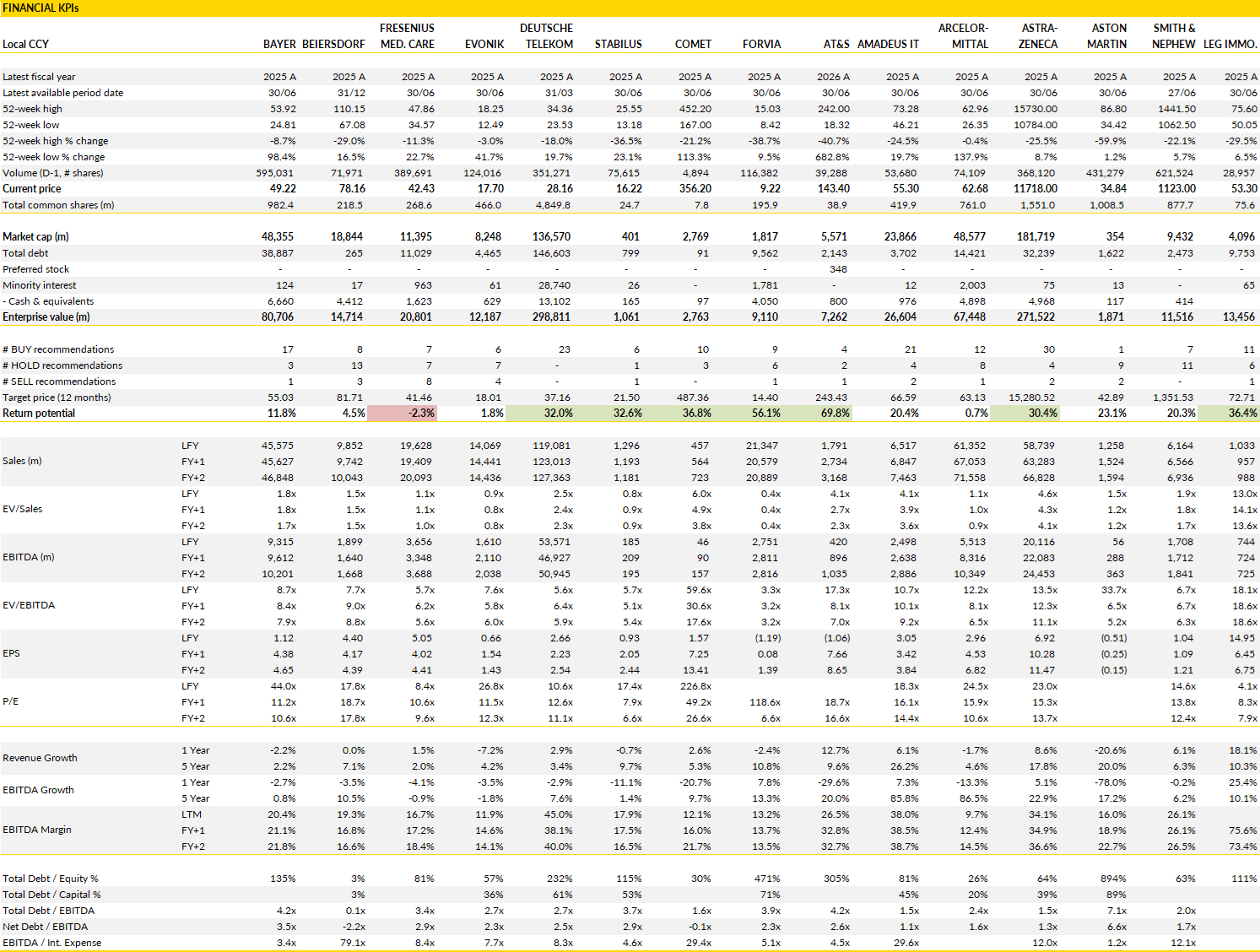
Financial KPIs
Companies covered in this edition: Bayer, Beiersdorf, Fresenius Medical Care, Evonik Industries, Deutsche Telekom, Stabilus, Comet, Forvia, AT&S, Amadeus IT Group, ArcelorMittal, AstraZeneca, Aston Martin Lagonda, Smith & Nephew, LEG Immobilien
Bayer (BAYN Germany): Crop Science recovery and resilient Pharma drive a stronger quarter
Bayer delivered a stronger-than-expected second quarter, with operating performance comfortably ahead of market expectations despite ongoing pressure in parts of the pharmaceutical portfolio.
Group sales increased 1.2% to €10.87bn, while adjusted EBITDA rose 1.9% to €2.14bn and adjusted EPS reached €0.95. The biggest surprise came from Crop Science, where profitability improved sharply after a difficult period for the agricultural market. Sales rose 2.5% to €4.91bn, but perhaps the more interesting development was the jump in adjusted EBITDA to €902m from €693m a year earlier, lifting the EBITDA margin from 14.5% to 18.4%. This indicates that the division's operational improvement program and more disciplined cost base are beginning to trickle down into (materially) higher earnings, providing an encouraging indication that the multi-year recovery plan is gaining traction.
Pharmaceuticals also produced a solid performance despite continuing patent headwinds. Sales slipped just 0.3% to €4.46bn as the sharp 42% decline in Xarelto continued to weigh on the business, but newer products are increasingly offsetting that pressure. Nubeqa recorded another quarter of exceptional growth with sales up 61%, while Kerendia expanded 80%, supporting adjusted EBITDA of €1.06bn despite the erosion of mature products. Consumer Health remained stable, with revenue increasing 1.3% to €1.45bn, although profitability softened modestly as adjusted EBITDA declined 3.6% to €319m. Overall, the combination of improving agricultural profitability and a pharmaceutical portfolio that is successfully replacing part of the Xarelto decline resulted in a considerably stronger earnings profile than what the market had anticipated.
Management left its operational guidance for 2026 unchanged but upgraded its balance sheet outlook, now expecting net financial debt of €29-30bn instead of the previous €32-33bn following the announced transaction with Apollo-managed funds. Thus reduction strengthens Bayer's financial flexibility; a good thing given the company continues to address both operational and legal challenges. Management also reiterated progress on the Five-Year Framework aimed at improving Crop Science profitability while highlighting continued advances across the pharmaceutical pipeline.
Today's results show that Bayer is executing well across its two largest divisions, with Crop Science recovering faster than expected and Pharmaceuticals demonstrating that its newer growth products are becoming increasingly capable of offsetting the decline of legacy medicines. Together with the gradual improvement in the legal position, these developments point to a business whose fundamentals continue to strengthen.
Beiersdorf (BEI Germany): NIVEA reset weighs on 2026
Beiersdorf surprised the market with a profit warning ahead of its scheduled half-year results, lowering its full-year Consumer guidance and announcing a major recovery plan for NIVEA.
The company now expects low single-digit organic sales declines at group level instead of flat to slightly positive growth, while the operating margin is set to fall to at least 11.8% from the previous expectation of just below 14%. The Consumer division, which accounts for roughly 80% of revenue, will bear the full impact as management plans to increase marketing spending by around €100m during the second half to revive NIVEA's momentum. Tesa's outlook remains unchanged, although management acknowledged that the electronics business could become more challenging later in the year. The revised outlook is likely to trigger another round of earnings downgrades after analysts had already moved expectations lower in recent months.
The weaker guidance follows a disappointing second quarter in which group organic sales declined 2.3%, well below market expectations. Consumer sales fell 3.3%, reflecting continued weakness at NIVEA, where sales dropped 6.7%, while Tesa delivered a modest 2.5% increase. First-half revenue reached €4.95bn, down 4.5% on a reported basis and 3.5% organically. Underlying operating profit amounted to €768m, producing a 15.5% operating margin compared with 16.1% a year earlier. Performance across the portfolio remained uneven. Eucerin and Aquaphor continued to deliver healthy 7.4% growth, reinforcing the strength of the dermatology franchise, while La Prairie returned to positive territory with 2.2% growth ahead of several product launches planned for September. Geographically, Europe and North America remained the weakest regions, offsetting more resilient trends elsewhere.
The key issue remains NIVEA, where management has clearly concluded that rebuilding brand momentum now takes priority over protecting near-term profitability.
The recovery plan represents a shift towards investing for longer-term growth instead of defending margins. Increasing marketing expenditure will weigh on earnings throughout the second half, but management appears willing to accept that trade-off if it restores NIVEA's competitive position. Investors will now look for greater detail during the earnings call on how the additional spending will be allocated, how quickly management expects sales trends to improve, and whether the current weakness reflects temporary execution issues or broader structural challenges in consumer demand. Tesa continues to provide a degree of stability, while the dermatology portfolio remains an important source of growth, but the investment case is likely to depend on whether the NIVEA recovery plan begins to produce tangible results over the coming quarters.
Fresenius Medical Care (FME Germany): Margin expansion continues despite softer patient growth
Fresenius Medical Care delivered another strong quarter, with profitability improving significantly despite slower patient growth in its core dialysis business.
Revenue increased 1.4% to €4.86bn, or 3.6% at constant currencies, while adjusted EBIT climbed 18.5% to €569m, lifting the margin to 11.7%. Currency movements reduced reported growth by more than two percentage points, but operational execution remained strong across most of the business. The main driver was Care Delivery, where revenue rose 2.9% to €3.48bn and adjusted EBIT jumped 39% to €527m, increasing the operating margin to 15.2%. Higher reimbursement through TDAPA, favourable pricing dynamics and lower implicit price concessions all contributed to the improvement, demonstrating that profitability initiatives continue to gain traction even in a relatively muted volume environment.
The main weakness in the quarter was patient growth. Same-market treatment volumes declined 0.4%, with the US down 0.9%, reflecting the ongoing optimisation of the clinic network. The closure program reduced the US clinic base by around 3% over the past year and patient numbers fell roughly 1% as a result. While those measures weighed on volumes, they also supported profitability by concentrating activity in higher-performing centres. Outside the core dialysis operations, Value-Based Care continued to perform well. Revenue increased 5.9% to €536m, supported by higher membership and favourable premium rates, while profitability exceeded expectations. Care Enablement also produced a solid performance despite continued weakness in China, where softer market conditions remained a drag on growth. Excluding China, pricing and volumes developed positively, allowing the division to offset much of the regional weakness.
Fresenius left its full-year guidance unchanged, continuing to expect broadly stable revenue at constant currencies together with operating income ranging from a modest decline to modest growth. The second quarter supports that outlook, although investors are likely to focus on whether patient volumes can stabilise over the coming quarters once the clinic rationalisation program is largely complete.
Operationally, the business continues to move in the right direction. Margin expansion remains visible, Value-Based Care is becoming a larger contributor to earnings and the restructuring program continues to improve the quality of the clinic network. Patient growth will remain an important metric to monitor, but the latest results show that Fresenius Medical Care is successfully balancing operational efficiency with continued investment in the long-term quality of its dialysis franchise.
Evonik Industries (EVK Germany): Strong execution keeps earnings momentum intact
Evonik delivered another strong quarter, comfortably building on the preliminary figures released in June.
Revenue increased 11% to €3.9bn, driven by a combination of 7% volume growth and 7% pricing, highlighting that demand remained healthy across most of the portfolio despite an increasingly uncertain macro backdrop. Adjusted EBITDA reached €630m, up 24% year-on-year and slightly ahead of market expectations, placing the result in the upper half of the company's previously guided €600-650m range. Operational free cash flow also improved sharply to €49m from an outflow of €211m a year earlier, largely reflecting lower bonus payments and continued discipline on cash generation. Following a first half that produced roughly €1.1bn of EBITDA, management reiterated the higher full-year guidance introduced in June, calling for €2.0-2.2bn of EBITDA while maintaining its expectation that the second half will remain well above historical levels.
The strength was broad-based across the operating divisions. Advanced Technologies produced EBITDA of €333m, up 25% from last year, supported by continued demand for high-performance polymers, crosslinkers and animal nutrition products. Custom Solutions also delivered a solid quarter, with EBITDA rising 7% to €271m as additives, healthcare and care solutions benefited from favourable pricing and resilient customer demand. The only weaker area was Infrastructure & Other, where EBITDA fell to €26m after higher bonus provisions weighed on profitability. Importantly, management indicated that momentum in animal nutrition remains positive heading into the third quarter, helping offset concerns surrounding weaker market conditions following recent Middle East disruptions. The group's cost optimisation program also continues to support margins, giving management confidence that earnings should remain resilient even if external conditions become somewhat less supportive during the remainder of the year.
Cash generation remains another encouraging feature of the investment case. Evonik reaffirmed its target of converting around 40% of EBITDA into operating free cash flow, implying €800-880m this year, comfortably above last year's €695m and ahead of market expectations. This provides additional financial flexibility while reinforcing the benefits of the ongoing efficiency program.
Overall, the latest results strengthen confidence that the company is executing well across both growth and cost initiatives. If demand in animal nutrition remains firm and volumes continue to recover across the broader portfolio, the upper end of the €2.0-2.2bn EBITDA guidance range appears achievable. Combined with improving cash generation and a business mix that is benefiting from stronger pricing and operational discipline, Evonik continues to look well placed.
Deutsche Telekom (DTE Germany): Merger speculation clouds the outlook
Reports that Deutsche Telekom has been exploring a potential merger with its US subsidiary T-Mobile have introduced an unexpected source of uncertainty, although neither company has confirmed that such a proposal is actively being pursued.
According to the reports, the idea would involve creating a holding company above Deutsche Telekom and T-Mobile, with shareholders of both businesses exchanging their shares for stock in the new entity. Based on the proposed structure, current T-Mobile shareholders would own roughly 66% of the holding company, while Deutsche Telekom shareholders would hold around 44%, including an estimated 12% stake for the German government. The strategic rationale appears straightforward: Deutsche Telekom currently owns 52% of T-Mobile but does not fully benefit from the US operator's substantial cash generation. A merger could give the group access to 100% of T-Mobile's free cash flow without requiring the debt-funded acquisition of the minority stake, something that would currently be difficult given leverage of around 2.6x.
Despite the industrial logic, the execution hurdles are considerable. T-Mobile's management has reportedly expressed reservations, while CEO Mike Sievert previously indicated that any transaction would require approval from minority shareholders, with Deutsche Telekom excluded from voting because of its controlling stake. Investor support also looks uncertain. Many US shareholders own T-Mobile specifically for exposure to the US wireless market and may have limited appetite for a combined company with substantial European operations. Political considerations could further complicate matters, with both German and US authorities potentially taking an interest given the strategic importance of the assets involved. Even if the transaction were structured successfully, there would be trade-offs. Deutsche Telekom could potentially adopt a more generous dividend policy by gaining greater access to T-Mobile's cash generation, but its valuation would become even more closely tied to the market's assessment of the US business.
For now, the speculation does little to alter the investment case. Longer term, however, the episode highlights management's continued interest in increasing its economic exposure to T-Mobile, suggesting alternative structures could eventually emerge.
Meanwhile, Deutsche Telekom continues to trade at a meaningful valuation discount to the broader telecom sector despite owning one of the industry's strongest assets through its majority stake in T-Mobile. That discount, combined with the quality of the underlying business and the continued strength of the US operation, leaves the broader equity story intact even if the current merger proposal never progresses beyond the rumour stage.
Stabilus (STM Germany): Industrial resilience offsets automotive weakness as deleveraging gathers pace
Stabilus' full third-quarter results largely confirmed the preliminary figures released in July, i.c. the view that the business is stabilising despite continued pressure in automotive markets.
Revenue declined 5% year-on-year to €300m as weaker vehicle production continued to weigh on demand, but adjusted EBIT slipped only 3% to €32.2m, allowing the adjusted EBIT margin to improve to 10.8% from 10.5% a year earlier. Reported EBIT increased sharply to €66.1m following the completion of the disposals of Fabreeka and Tech Products, which generated a gain of roughly €44m. Cash generation remained solid, with adjusted free cash flow reaching €29m, comfortably ahead of market expectations, while net debt continued to fall. Leverage declined from 3.2x EBITDA at the end of the second quarter to 2.8x after the asset sales and ongoing cash generation, marking another step towards management's objective of reducing leverage below 2x over the next two years.
Performance remained highly differentiated across the portfolio. The diversified industrial activities continued to outperform, delivering 8% organic growth and once again demonstrating the benefits of the group's broader end-market exposure. Automotive remained considerably weaker, with organic sales falling 15% as production volumes stayed under pressure across several regions. Geographically, Europe held up well with broadly stable organic revenue, while the Americas recorded a modest 4% decline. Asia-Pacific remained the weakest region, with sales down 18%, reflecting ongoing softness in automotive demand. Despite these headwinds, profitability was resilient as operating discipline and the increasing contribution from higher-margin industrial businesses helped offset much of the volume pressure in automotive.
Management also reaffirmed the updated full-year outlook introduced alongside the preliminary release. Revenue is expected to reach around €1.15bn, with an adjusted EBIT margin of approximately 10% and adjusted free cash flow of roughly €90m. While these targets sit towards the lower end of the original guidance ranges, they indicate that earnings remain resilient despite challenging market conditions.
More importantly, balance sheet repair continues to gather momentum, reducing one of the principal concerns surrounding the shares following recent acquisitions. As leverage declines and the industrial businesses continue to increase their contribution to earnings, Stabilus is becoming less dependent on the automotive cycle.
With the shares still trading on relatively modest valuation multiples despite improving cash generation and a steadily strengthening balance sheet, the current valuation continues to look undemanding if management executes on its deleveraging and margin objectives.
Comet (COTN Switzerland): Semiconductor upcycle accelerates as orders point to a much larger business in 2027
Comet's latest results were overshadowed by concerns over first-half revenue, free cash flow and guidance, but those figures missed what was arguably the most important development in the release.
Second-quarter order intake surged 45% sequentially to CHF210m, equivalent to an annualised run rate of roughly CHF840m, already approaching what the market had previously expected the company to generate in revenue during 2028. Management also indicated that order momentum should strengthen further during the second half, with incoming orders expected to exceed those recorded in the first six months despite some inventory-related purchases having already benefited H1.
This outlook prompted a substantial increase in earnings expectations and reflects a broader semiconductor capital spending recovery that is only beginning to emerge. DRAM and logic remain the primary drivers today, while the recovery in NAND spending has yet to make a meaningful contribution. At the same time, demand for the CA20 platform in advanced packaging continues to build and Synertia is gaining traction with major equipment manufacturers, creating additional avenues for growth beyond the current cycle.
Those stronger order trends have materially improved the medium-term revenue outlook. Revenue could now grow around +25% in 2026, before accelerating to 30-40% growth in 2027. The combination of expanding semiconductor investment, new product adoption and potential market share gains supports the view that Comet could emerge from this cycle as a substantially larger business than previously anticipated.
Importantly, management believes the current order book still does not fully capture several of these growth drivers, particularly the improving NAND market and the commercial rollout of newer technologies. That leaves scope for further upside if industry investment continues to broaden across memory and advanced packaging applications.
The earnings outlook becomes even more compelling as volumes increase. First-half EBITDA margin reached 13.1%, comfortably ahead of expectations despite one-off costs related to restructuring and the transfer of production capacity. As those temporary costs disappear, higher utilisation, pricing improvements and operational efficiency initiatives are expected to drive significant margin expansion.
We could now see the EBITDA margin reaching high-teens in 2026 before climbing towards 25% in 2027 as revenue growth combines with operating leverage and cost savings. This implies EBITDA could almost double over the next two years, leading to substantial upgrades to earnings forecasts. Despite those improvements, the shares continue to trade well below their historical valuation multiples, suggesting the market has yet to fully reflect the scale of the expected earnings expansion as semiconductor capital spending accelerates.
Forvia (FRVIA France): Strong execution keeps deleveraging on track, but the market wants more than steady progress
Forvia delivered another solid set of results, increasing the hope that management is executing well on the turnaround plan (even if the share price failed to respond positively).
The strongest feature of the first half was cash generation, which comfortably exceeded market expectations and prompted upward revisions to profitability and free cash flow forecasts. Management now appears well on track to achieve an operating margin around the middle of its 6.0-6.5% target range this year, while free cash flow is expected to exceed the company's minimum objective of 3% of sales. Despite these improvements, the broader investment case remains largely unchanged. Investors continue to focus on the automotive sector's weak sentiment and the group's elevated leverage, leaving debt reduction as the primary priority before capital can be returned to shareholders. As a result, the latest results improve confidence in execution.
The conference call also reinforced this. Management expressed confidence that recent improvements are sustainable, particularly in North America where the 7.1% operating margin achieved during the first half was described as representative of the underlying business instead of being driven by one-off items. China also appeared more encouraging than recent market concerns suggested. Weak sales continue to reflect an unfavourable product mix, particularly related to BYD, but management indicated that this business is stabilising while order intake from Chinese manufacturers remains exceptionally strong, with a book-to-bill ratio approaching 3x. Elsewhere, the Lighting division appears to have reached its low point during the first half and should gradually improve through the second half, supporting margins in Europe over the coming years. The broader IGNITE restructuring programme also continues to progress, with the EU Forward and Simplify initiatives expected to generate around €110m of savings this year.
Cash generation remains central to the investment case. Management acknowledged that the exceptionally strong first-half free cash flow partly reflected lower capital expenditure, with investment expected to normalise during the second half. Even so, guidance already incorporates around €150m of headwinds, including the purchase of a Mexican facility and the settlement of a long-running tax dispute, while management still expects second-half operating margins to at least match those achieved in the first six months despite a more difficult production environment.
The long-term capital allocation framework also remains unchanged. Management continues to target leverage of around 1.5x by the end of 2026 before reducing it further towards 1.2x by 2028, with dividends and share buybacks remaining secondary priorities until that objective has been achieved. Continued operational execution is steadily reducing financial risk, but a broader re-rating is likely to require clearer evidence that balance sheet repair is nearing completion.
AT&S (ATS Austria): AI-driven growth remains intact, with the strongest earnings expansion still to come
AT&S delivered another strong quarter, although the results broadly matched the market's elevated expectations after management had already upgraded guidance in June.
First-quarter revenue increased 38% year-on-year to €549m, driven by higher shipment volumes and stronger pricing as demand for AI-related substrates remained exceptionally robust. EBITDA more than doubled to €165m, producing a margin of 30.1% and modestly exceeding consensus expectations, while EBIT reached €73m. Operating cash flow and free cash flow appeared weaker than anticipated, but those figures exclude customer payments linked to the Chongqing and Kulim expansion projects. Cash increased significantly to €1.18bn following the successful issuance of a €400m hybrid convertible bond, helping reduce net leverage from 3.2x to 1.9x EBITDA and substantially strengthening the balance sheet ahead of the group's ongoing capacity expansion.
Management reiterated the upgraded guidance introduced in June, calling for revenue growth of 45-55% this year, an EBITDA margin of 32-37%, capital expenditure of €1.0-1.2bn and positive free cash flow. Although some investors may have hoped for another increase after the strong first quarter, management continues to highlight robust demand, with capacity expansions progressing according to schedule and supported by long-term customer agreements.
The underlying industry backdrop also remains favourable. Demand for advanced ABF substrates and high-end printed circuit boards continues to benefit from accelerating AI infrastructure investment, the shift towards inference workloads and increasingly complex semiconductor packaging. At the same time, customer prepayments and reservation agreements are helping finance the group's expansion program, reducing execution risk while supporting future cash generation as new production capacity comes online.
Higher pricing, additional long-term agreements and the gradual ramp-up of new manufacturing capacity are expected to contribute more meaningfully over the coming quarters, suggesting that the strongest profitability improvements still lie ahead. Financing concerns have also eased considerably following the recent capital raising and customer funding arrangements.
Even so, the shares already discount much of that favourable outlook. The business remains exposed to the cyclical nature of the semiconductor industry, where today's capacity shortages could eventually give way to oversupply, while technological shifts always present an additional source of uncertainty. Operational momentum remains strong, but after the significant re-rating seen over the past year, valuation appears to reflect much of the expected improvement.
Amadeus IT Group (AMS Spain): Resilient execution offsets softer travel volumes, but it's not enough
Amadeus delivered a solid second quarter despite continued weakness in global travel demand, with results broadly matching market expectations and demonstrating the resilience of its business model.
Revenue increased 2.2% at constant currency to €1.65bn, while adjusted EBIT grew slightly faster and the operating margin improved to 31.0%. The main headwind remained Air Distribution, where bookings declined 7.6% as softer air traffic and elevated cancellation rates continued to weigh on volumes. That pressure was partly offset by a 5.6% increase in revenue per booking, limiting the impact on profitability. Elsewhere, Air IT again proved resilient, growing 5.6% despite broadly flat passenger boardings as higher-value software solutions continued to expand across the customer base. Hospitality also maintained strong momentum with 8.5% growth, supported by new customer deployments and continued expansion of its payments offering.
Management described trading as gradually improving since June following disruptions linked to the Middle East, although it acknowledged that visibility remains limited given ongoing geopolitical uncertainty. The company reduced its full-year growth outlook solely because of weaker Air Distribution, while leaving expectations for Air IT and Hospitality unchanged, albeit now towards the lower end of their respective target ranges. Several structural growth drivers remain firmly in place. Around one-quarter of passenger boarding volumes are now linked to airlines migrating onto the Nevio platform, while the company also secured another Altea Passenger Service System customer serving more than 40 million passengers annually. Large implementations for Marriott and Accor continue to progress, reinforcing the long-term expansion of the Hospitality business.
Despite lowering revenue growth guidance to 5-8% at constant currency, management maintained both its operating margin target of around 29% and free cash flow guidance of €1.35-1.45bn.
The results show the quality of the franchise but do little to change the short-term investment case. The software portfolio continues to diversify, reducing dependence on traditional airline booking volumes through products such as Nevio, Airport IT, Loyalty, Payments and Professional Services. Those businesses should continue gaining weight over time and support more stable growth. However, Air Distribution remains closely linked to global travel activity, leaving earnings sensitive to geopolitical developments and airline booking trends.
With the shares already trading broadly in line with their historical valuation discount relative to other software companies, the current multiple appears to reflect both the quality of the business and the uncertainty surrounding the travel cycle. The longer-term outlook remains attractive, but a meaningful re-rating is likely to require clearer evidence that booking volumes are recovering sustainably.
ArcelorMittal (MT Netherlands): European recovery gathers pace as stronger pricing lifts the earnings outlook
ArcelorMittal delivered yet another solid quarter, with second-quarter EBITDA reaching $2.06bn, broadly in line with market expectations and confirming that the earnings recovery is progressing well. Europe was once again the standout performer, contributing roughly one-third of group EBITDA as firmer steel prices combined with continued cost discipline to drive a meaningful improvement in profitability. North America also remained a significant earnings contributor, accounting for around one-quarter of EBITDA, while Brazil and India continued to perform well. Mining was the only notable weak spot, reflecting lower iron ore prices, higher freight costs and operational disruption caused by adverse weather in Liberia.
Management's outlook for Europe became more constructive during the conference call. Steel pricing continues to strengthen following the implementation of the new European trade framework on 1 July, with benchmark prices already increasing by around €20 per tonne and further gains expected once seasonal demand returns after the summer. At the same time, improving manufacturing activity and tighter import restrictions are providing additional support for regional demand.
Operationally, ArcelorMittal also has significant room to increase production through the restart of idled blast furnaces at Dabrowa and Fos, representing close to 10% of its European capacity. Conditions also remain favourable elsewhere. Trade protection measures are gradually strengthening in markets including the United States, Mexico, Brazil and India, supporting pricing and margins across several regions. As a result, management expects earnings to improve further during the second half, with EBITDA projected to rise to around $5bn compared with $3.7bn generated during the first six months.
The stronger European backdrop has also improved the medium-term outlook. Expansion projects in India, alongside additional investments in North America and Brazil, are expected to provide another leg of growth beyond the current pricing cycle, supporting a further increase in earnings during 2027. Market forecasts have consequently been revised modestly higher, primarily reflecting stronger expectations for Europe and the Sustainable Solutions business.
Even after the recent share price recovery, valuation remains relatively undemanding compared with the improving earnings profile. The combination of strengthening steel prices, continued cost discipline, expanding production capacity and long-term growth investments provides several drivers for further earnings growth, while current valuation multiples remain broadly in line with European peers despite what appears to be a more favourable operating outlook.
AstraZeneca (AZN UK): Merger rumours risk overshadowing one of the sector's strongest organic growth stories
Reports suggesting that AstraZeneca has explored a possible merger with Bristol Myers Squibb triggered a sharp sell-off in the shares, reflecting concerns that such a deal would be 'too much'.
Bristol Myers would add roughly $50bn of annual revenue and substantially increase AstraZeneca's exposure to the US market, lifting the combined proportion of US sales to around 50%. At the same time, however, the acquisition would also bring significantly greater patent expiry risk. Bristol Myers remains heavily reliant on Eliquis and Opdivo, products facing generic competition before the end of the decade and together accounting for around half of its revenue. That would increase the combined group's near-term patent exposure from roughly 17% of sales for AstraZeneca today to around one-third, materially altering the balance between growth opportunities and revenue risk.
The industrial logic is mixed. The two companies operate across similar therapeutic areas, including oncology, cardiovascular disease and immunology, creating opportunities for cost savings and a broader commercial platform. A transaction of this scale would probably require a combination of cash and shares and would likely include a sizeable acquisition premium, making execution both financially and operationally demanding. Annual research and development spending would exceed $23bn, creating one of the largest pharmaceutical innovation budgets globally, yet scale alone does not necessarily translate into stronger innovation. Integrating two organisations of this size while extracting meaningful synergies would be a multi-year exercise, with cost savings potentially needing to reach $3bn-$5bn before the economics become compelling.
More importantly, investors could begin viewing the combined company as a mature pharmaceutical group instead of one of the sector's faster-growing innovators, particularly given Bristol Myers' slower underlying growth profile and elevated exposure to products nearing patent expiry.
This contrast explains why the market reacted negatively to the reports. AstraZeneca has built its premium valuation on consistent pipeline execution, diversified therapeutic franchises and earnings growth that remains comfortably above the industry average. Multiple late-stage programs across oncology, cardiovascular disease and rare diseases continue to provide opportunities for organic expansion, while the company's patent profile remains considerably healthier than many large-cap peers. The recent share price weakness has also left AstraZeneca trading on a valuation that is no longer demanding relative to other global pharmaceutical companies.
Unless management can demonstrate that a transaction would accelerate growth, investors are likely to continue favouring AstraZeneca's existing strategy of expanding through internal innovation instead of pursuing a 'transformational' acquisition.
Aston Martin Lagonda (AML UK): Recovery remains possible, but the balance sheet continues to dominate
Aston Martin's latest results did little to change the story. Trading remains broadly in line with market expectations and management continues to target a gradual improvement during the second half of the year, but the financial recovery is proving slower than previously anticipated.
Higher operating costs and the impact of the recent £550m refinancing have led to a more cautious earnings outlook, with losses now expected to remain materially higher through both 2026 and 2027. That also pushes back the expected improvement in free cash flow, leaving the business in a cash-consuming position for longer than previously assumed. Operational progress is visible, but not yet sufficient to offset the weight of financing costs and a still challenging earnings profile.
The balance sheet remains the central issue. Net debt stands at around £1.5bn, equivalent to leverage of roughly 5.5x EBITDA, leaving limited financial flexibility despite the recent refinancing. While the new funding has removed immediate liquidity concerns and reduced the likelihood of another near-term capital raise, the company is still expected to generate negative free cash flow over the next two years. With a large portion of outstanding debt maturing in 2029, Aston Martin will eventually need to strengthen its financial position further, either through a sustained improvement in profitability or additional external funding. Lawrence Stroll and Yew Tree have repeatedly supported the company, although recent backing has increasingly taken the form of debt financing and asset transactions instead of fresh equity injections. This shift, together with the complete separation between Aston Martin's automotive business and the Formula One team, leaves investors questioning what future support could look like if operating performance fails to improve as planned.
The valuation has become increasingly depressed, which naturally fuels periodic takeover speculation, but identifying a credible strategic buyer remains difficult. Existing shareholders have little obvious incentive to pursue a full acquisition, while other potential industry buyers are already focused on their own restructuring priorities.
As a result, the investment case still rests primarily on management delivering a gradual operational turnaround while preserving liquidity. The recent refinancing has bought additional time, but it has not fundamentally changed the long-term challenges facing the business. Until profitability improves sufficiently to reduce leverage and restore sustainable cash generation, Aston Martin is likely to remain a highly speculative turnaround story despite its discounted valuation.
Smith & Nephew (SN/ UK): Not good enough
Smith & Nephew's second-quarter results were weaker than expected at the revenue level, prompting management to lower its full-year sales outlook.
Revenue growth slowed to 1.6% on an underlying basis, missing expectations as Orthopaedics and Advanced Wound Management both underperformed. Sports Medicine & ENT remained the clear bright spot, delivering strong growth supported by continued momentum in products such as Regeneten and the Q-Fix platform, although the ENT business continued to be affected by the rollout of volume-based procurement in China. Orthopaedics remained mixed, with weakness in Knees ahead of the Landmark implant launch outweighing modest growth in Hips, Trauma and Extremities. Advanced Wound Management also disappointed, largely because reimbursement changes in the US skin substitute market continued to weigh heavily on the Bioactives portfolio.
Despite the softer top line, profitability remained comparatively resilient. First-half trading profit increased more than 8%, with margins holding up well despite tariff effects, inventory revaluation, reimbursement changes and continued disruption in China. Management maintained its expectation for roughly 8% trading profit growth this year, signalling confidence that earnings will remain heavily weighted towards the second half as new product launches gather pace and operational initiatives continue to support margins.
The contrast between weaker revenue growth and stable profit guidance suggests the company still sees meaningful scope to protect earnings through cost control, product mix improvements and operating discipline even if market conditions remain uneven.
The main change following the results is the reduction in full-year organic growth guidance from around 6% previously to roughly 4%, reflecting the slower first-half performance and a more cautious outlook for several end markets. Even so, management continues to expect an acceleration during the second half, supported by new orthopaedic product launches and a more favourable earnings mix.
That leaves the investment case relatively balanced. The company continues to execute well operationally and earnings remain resilient, but slower revenue growth limits the scope for multiple expansion in the near term.
LEG Immobilien (LEG Germany): First-half results keep the company firmly on track to meet full-year targets
LEG Immobilien delivered a steady first half, with operating performance closely matching the trajectory required to achieve its 2026 objectives.
Like-for-like rental growth accelerated to 3.7%, moving closer to management's full-year target of 3.8%-4.0%, while occupancy remained exceptionally high with the vacancy rate holding at just 2.3%. Adjusted EBITDA increased modestly and the margin recovered sequentially to almost 78%, broadly in line with the company's year-end objective. Although both FFO I and AFFO declined versus last year, management attributed the weakness almost entirely to the deliberate front-loading of investment spending during the first half instead of any deterioration in the underlying portfolio. Property valuations also continued to improve, with the residential portfolio recording a modest uplift and EPRA NTA increasing further during the period.
Capital allocation remains focused on strengthening the portfolio while preserving balance sheet flexibility. Investment spending increased nearly 10% during the first six months as the company accelerated refurbishment and modernisation projects that should support future rental growth. Management expects spending patterns to normalise during the second half, helped by higher subsidy income and a more balanced investment schedule. At the same time, disposals continue to progress as planned, with more than 500 apartments sold during the first half as part of the broader program to monetise 5,000 units. These disposals, together with the modest increase in property values, reduced the loan-to-value ratio to 45.5%. Financing also remains a competitive advantage, with an average debt cost of just 1.82% and no significant refinancing pressure before the end of the first quarter of 2027.
Management had little reason to alter its outlook. All major guidance items were reaffirmed, including rental growth, EBITDA margin, FFO I, AFFO, investment spending and a year-end loan-to-value ratio of around 45%. The company also continues to target a full payout of 2026 earnings, supplemented by part of the proceeds generated through asset sales.
LEG's operational execution remains consistent despite a still challenging property market. Rental growth continues to benefit from favourable housing fundamentals, portfolio values are gradually recovering and the balance sheet is improving, but the first-half figures contained few surprises and are unlikely to materially change investor expectations in the near term.