Chems, medtech and luxury issues
LVMH, Interparfums, Genfit, Inditex, Wacker Chemie, TINC, Air Liquide, Corbion, AstraZeneca, Santander, Sandoz, HighCo

At Lux Opes, we break down companies into quick takes that get straight to the point - what is happening, why it matters, and what to watch next. We publish 2-3 times per week, depending on the news flow.
For the best reading experience, we recommend reading at Lux Opes
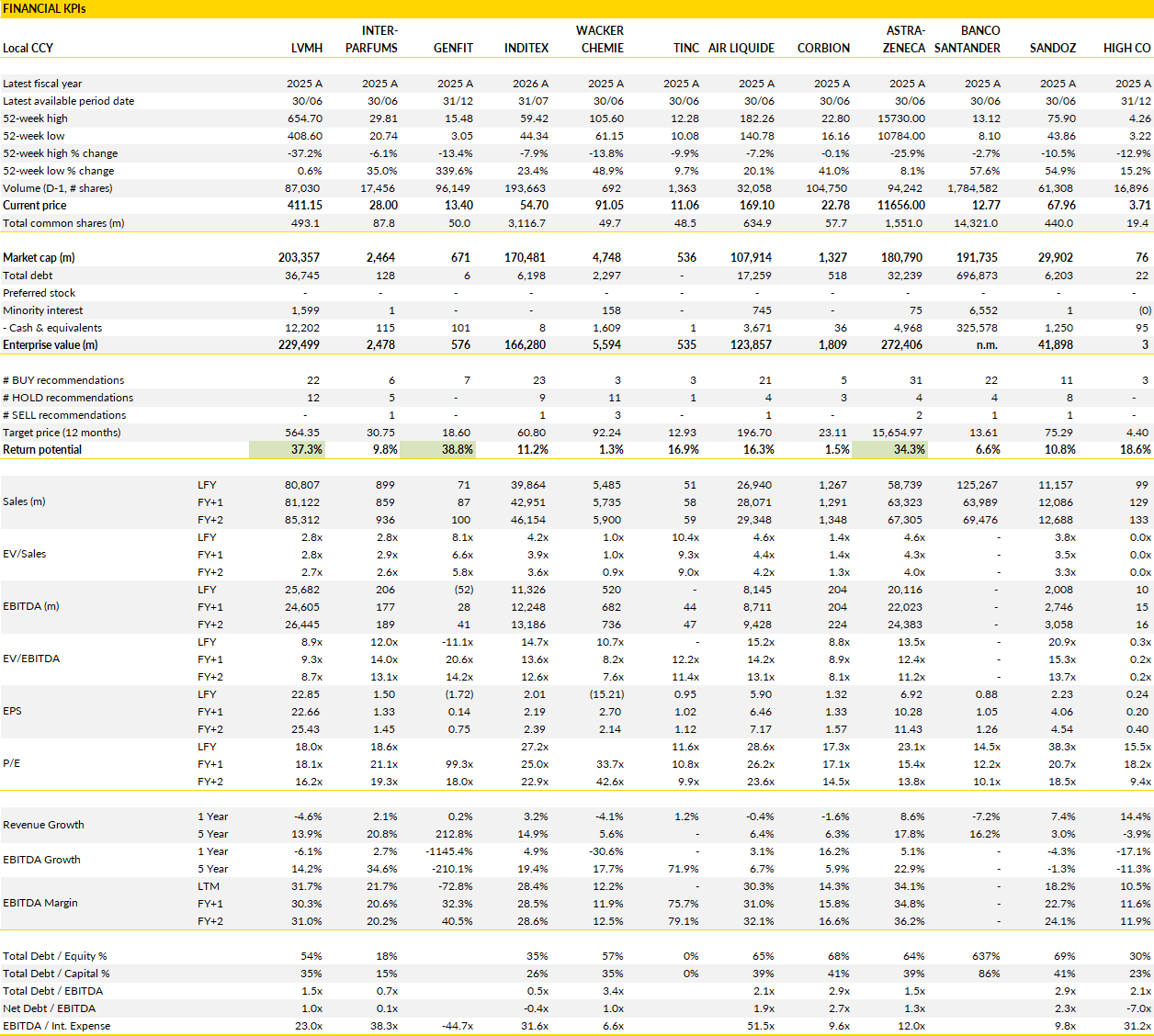
Financial KPIs
Companies covered in this edition: LVMH, Interparfums, Genfit, Inditex, Wacker Chemie, TINC, Air Liquide, Corbion, AstraZeneca, Santander, Sandoz, HighCo
LVMH (MC France): Fashion weakness delays the earnings recovery
LVMH faces an even more difficult second half as weaker discretionary spending threatens the tentative recovery seen earlier this year in Fashion & Leather Goods.
Organic sales in the division improved from a 2% decline in Q1 to 1% growth in Q2, but the progression remains fragile given softer US consumption, pressure on middle-income customers and a more difficult environment in China. The exposure of Louis Vuitton is particularly relevant because the brand generates more than half of divisional sales and close to half of group EBIT, with canvas products accounting for over one-third of its revenue. Dior is entering a more promising creative phase under Jonathan Anderson, whose initial collections and new handbag introductions are starting to refresh the offer, although the commercial impact will take time to build. Fashion & Leather Goods generates around 70% of LVMH's EBIT, so subdued demand in the division has a disproportionate effect on group earnings and is likely to limit margin recovery during H2.
Conditions elsewhere in the portfolio are gradually improving. Sephora remains a strong source of expansion in selective retailing, supported by store growth and continued demand for beauty products. Jewellery is also developing more favourably, providing LVMH with another avenue for growth beyond its largest fashion houses. Wines & Spirits appears to have moved beyond the weakest part of its cycle after a prolonged period of inventory adjustment and softer demand, although a full recovery will depend on a sustained improvement in cognac and champagne consumption. These businesses cannot fully compensate for stagnation in Fashion & Leather Goods given the division's contribution to profit, but they make the group's earnings base more balanced during the current downturn. LVMH also retains considerable scope to protect profitability through product mix, cost discipline and selective investment, without compromising the brand expenditure required to maintain desirability when demand eventually strengthens.
A stronger earnings trajectory is so becoming more dependent on 2027 and 2028. Fashion & Leather Goods still has several internal levers available, including Dior's creative reset, continued product development at Louis Vuitton and the gradual maturation of smaller houses across the portfolio. The current weakness also follows several years of exceptional expansion, leaving LVMH with a much larger revenue and profit base than before the previous luxury cycle. Near-term margin pressure is likely if Fashion & Leather Goods remains around flat in H2, since the group must keep investing in stores, marketing, craftsmanship and product development despite softer sales. A return to healthier industry growth would provide significant operating leverage because of the division's scale and profitability.
The timing has become less favourable after the deterioration in consumer conditions over the summer, but the underlying brand portfolio and improving contribution from beauty, jewellery and Wines & Spirits leave LVMH with multiple sources of recovery once luxury demand strengthens.
Interparfums (ITP France): Margin resilience and stronger launch calendar
Interparfums delivered a better first-half profit performance than the decline in sales would suggest, helped by gross-margin improvement and tight control of operating expenses.
H1 sales were €414m, down from €447m a year earlier, while EBIT declined 16% to €87.3m and net income reached €65.5m. The operating margin came to 21.1%, comfortably above the 19-20% range indicated by management in July. Gross margin increased to 67.3% from 65.5%, helped by reimbursement of US tariffs paid last year, favourable product management and improvements in cost of goods. Even excluding the approximately €12m tariff benefit, underlying gross margin improved year-on-year. Interparfums achieved this despite maintaining substantial commercial investment ahead of its next product cycle, with marketing spending increasing to 20% of sales from 18.3%. Administrative expenses remained controlled, allowing a larger proportion of the gross-margin improvement to reach operating profit.
Management continues to expect 2026 revenue of €850-870m and has now specified an operating margin objective of around 18%, compared with 19.5% in 2025. The first-half result provides a solid base for reaching that level despite the heavier launch and marketing program. H2 should also benefit from easier comparisons and a gradual improvement in the product calendar after a weak period for several important franchises.
The larger change comes in 2027 and 2028, when Interparfums has a much fuller schedule of launches across both existing and recently added brands. New fragrance franchises including Montblanc, Lacoste and Coach are due to contribute from 2027, with Jimmy Choo following in 2028, alongside the development of Longchamp and the group's owned brands. The November Capital Markets Day should provide more detail on the commercial sequencing of these launches and the associated investment requirements. The current level of marketing spending indicates that preparation is already underway.
Cash generation adds considerable flexibility ahead of this expansion phase. H1 cash flow reached approximately €100m, helped by lower inventories of components and finished goods, while net debt declined to around €70m. The balance sheet is consequently close to debt-free on an underlying basis and leaves Interparfums with capacity to add further licences or acquire brands if suitable opportunities emerge. This is particularly useful in a fragrance industry where access to attractive licences can reshape the medium-term growth profile without requiring heavy fixed investment.
Interparfums has already broadened its portfolio considerably, reducing dependence on individual brands and creating a larger pipeline of launches across the next two years. The H1 figures show that profitability can remain above 20% during a period of weaker sales and elevated marketing expenditure. With inventory normalising, financial leverage minimal and several major launches approaching, the operational backdrop entering 2027 is considerably stronger than the recent (revenue) performance suggests.
Genfit (GNFT France): NIS2+ adds a recurring diagnostics opportunity alongside MASH treatment growth
Genfit is beginning to establish NIS2+ as a potentially valuable diagnostics franchise in MASH, where the expansion of drug treatment creates a growing need to identify suitable patients and monitor them over time.
The company estimates that the US market could exceed $1.5bn by 2033, corresponding to more than 7m tests annually. The addressable population is substantial: almost 90m Americans with steatohepatitis or liver abnormalities associated with metabolic risk factors could potentially undergo screening, while 5-7m patients are already considered eligible for MASH therapies. Current treatment penetration remains below 1%, leaving considerable scope for diagnostic volumes to increase as additional medicines become available. NIS2+ is designed specifically to identify patients with both active disease and significant F2/F3 fibrosis, the population targeted by approved and developing therapies. Its development draws on more than a decade of biopsy-linked patient cohorts, longitudinal biological information and external validation, with the test also gaining recognition through initiatives including NIMBLE and LITMUS.
Commercial infrastructure is starting to develop around the technology. NASHnext, which incorporates NIS2+, is already available through Labcorp, and Medicare coverage for eligible patients began in August 2026. Broader reimbursement will be critical to adoption, particularly as diagnosis moves beyond specialist hepatology centres and involves more endocrinologists and primary-care physicians. Genfit is also preparing an in-vitro diagnostic version of the test for launch by 2028, with potential partnerships under consideration. An IVD format would broaden distribution beyond the current centralised laboratory approach and could make NIS2+ available through a much larger network of laboratories.
The arrival of additional MASH treatments should expand the commercial opportunity further. GLP-1s, FGF21 therapies and potential combination regimens would increase the number of patients requiring assessment for treatment eligibility and create demand for tools capable of following disease progression and therapeutic response.
Monitoring could ultimately become the largest part of the franchise. The scenarios presented by Genfit indicate that close to three-quarters of testing volumes at maturity could come from patients already receiving treatment, creating a recurring revenue stream linked to the installed population of MASH therapies. That gives NIS2+ different economics from a diagnostic used primarily for initial screening, since each successfully treated patient could generate repeated testing over several years. Several steps are still required before the market reaches that scale. Reimbursement must expand beyond the initial Medicare coverage, physicians need to incorporate the test into routine treatment pathways, the IVD program must progress successfully and the emerging MASH drug market itself needs to achieve broad adoption.
NIS2+ nevertheless gives Genfit an asset whose commercial potential grows alongside the entire therapeutic category. As MASH shifts from a largely undiagnosed disease towards active pharmacological treatment, patient selection and longitudinal monitoring could develop into a sizeable market in their own right.
Inditex (ITX Spain): Sales momentum remains strong
Inditex maintained an unusually strong pace of growth in Q2, with sales increasing 9% to €11.0bn and 9.5% at constant currencies (despite the market not appreciating it).
The underlying performance remained broad enough to sustain the momentum seen earlier in the year. The 9.5% constant-currency increase followed 11.5% growth in May, when calendar effects provided some additional benefit. Gross profit rose 10% to €6.24bn and gross margin improved 23bp to 56.7%, showing that the sales expansion was achieved without sacrificing merchandise economics. Current trading has remained similarly strong after the quarter ended. Store and online sales at constant currencies increased 9% between August 1 and September 7, extending the high-single-digit growth rate into Q3 despite a difficult consumer environment across much of the apparel industry.
Higher operating expenses absorbed part of the gross-profit improvement. Q2 EBITDA increased 8% to €2.95bn, with the margin declining 22bp to 26.8%, while EBIT also rose 8% to €2.09bn and the EBIT margin eased to 19.0% from 19.1%. The modest margin contraction reflects faster cost growth and comes despite the improvement in gross margin. Inditex is continuing to invest heavily in its physical and digital infrastructure, with gross selling space expected to increase around 5% this year. Ordinary capital expenditure is planned at €2.3bn, supplemented by another €200m for improvements to corporate facilities. Management also expects currencies to reduce full-year reported sales by approximately 1% and continues to guide for the gross margin to remain within 50bp of the prior-year level.
The latest results demonstrate the strength of Inditex's integrated store and online model at a point when many apparel competitors are struggling to generate meaningful volume growth. Its ability to refresh merchandise quickly, allocate inventory across markets and maintain high store productivity allows the group to respond rapidly to changing demand without relying heavily on discounting. The 23bp increase in Q2 gross margin provides evidence that the current growth rate is being achieved with healthy pricing and inventory discipline.
Let's now see how quickly the cost base catches up with the higher level of investment. August trading provides a strong start to the second half, with 9% constant-currency growth broadly matching Q2. If that pace persists, Inditex should enter 2027 with a substantially stronger base, additional selling space and continued scope to absorb the investments currently weighing on operating leverage.
Wacker Chemie (WCH Germany): Cost reductions can support chemicals as polysilicon remains unresolved
Wacker Chemie's upcoming Capital Markets Day is likely to reset the ambitions established in 2024 after two years in which several of the assumptions behind the previous plan have deteriorated.
The existing 2030 framework calls for sales above €10bn, an EBITDA margin exceeding 20% and EBITDA of more than €2bn. These objectives now sit far above the group's current earnings base, with 2026 guidance calling for sales of approximately €5.8bn and EBITDA of €625-750m. Management has already started adapting the cost structure through PACE, launched in October 2025 with a target of €300m in global savings by the end of 2027. The program should provide a meaningful contribution to future profitability, although restoring earnings also requires better utilisation, product mix and demand across the operating businesses. A revised medium-term plan should consequently give a clearer indication of the profitability Wacker believes it can achieve under more conservative volume assumptions.
Polysilicon remains the largest strategic complication. Wacker has achieved its objective of raising semiconductor-grade material to around 50% of polysilicon output, but this partly reflects weak utilisation in solar-grade production instead of a major increase in semiconductor volumes. Overall polysilicon capacity utilisation remains around 50% as the global solar market works through severe excess supply. Conditions in the US offer limited near-term relief. Regulatory changes under Section 232 have yet to create a clear recovery path, while substantial inventories of imported, assembled and domestically manufactured solar modules could satisfy US installations through 2026 and 2027. Semiconductor-grade polysilicon provides a structurally more attractive market with higher technological barriers, but the underutilised solar assets continue to weigh on the segment's economics. A more fundamental decision on the future configuration of solar-grade production would therefore address one of the largest uncertainties surrounding Wacker, although such an announcement does not appear imminent.
The chemicals businesses offer a more straightforward route to earnings improvement, particularly if PACE lowers the fixed-cost base and raw-material conditions become more favourable. Wacker's previous ambition for chemicals to exceed a 20% EBITDA margin by 2030 looks demanding given that the businesses averaged 17.2% between 2016 and 2025 and exceeded 20% only twice during that period. Lower vinyl acetate monomer prices should provide some cost relief for Polymers in Q3, although demand conditions remain subdued. Biosolutions is also considerably removed from the scale envisioned at the previous CMD, when management targeted more than €1bn of sales and over €250m of EBITDA by 2030.
The September 17 presentation needs to establish a credible earnings framework across businesses operating from very different starting points. PACE, better chemical mix and eventual semiconductor growth can rebuild profitability, but solar-grade polysilicon remains a structural issue that cost savings alone cannot solve.
TINC (TINC Belgium): Portfolio expansion accelerates across social and energy infrastructure
TINC delivered another period of substantial portfolio growth in H1 2026, taking the fair value of its investments to approximately €765m and moving the group closer to its longer-term €1bn portfolio milestone.
Portfolio income increased to €31.4m from €24.5m a year earlier, while EBIT rose to €27.6m from €20.1m and net income reached €25.9m compared with €18.4m. Earnings per share increased to €0.53 from €0.50. NAV per share reached €13.09, while portfolio fair value amounted to €15.80 per share. The expansion has required additional financing, with net debt rising to €130.8m from €76.0m at the end of FY 2025 as TINC funded new investments and shareholder distributions. Available liquidity remains substantial, however, with around €168m of undrawn credit facilities against outstanding investment commitments of €81.1m. This leaves the company with sufficient resources to complete its existing pipeline and pursue further opportunities without materially constraining near-term capital deployment.
Growth was spread across all four infrastructure categories, with Social Infrastructure becoming the largest segment after the investments completed during H2 2025. Its fair value increased 44.2% year-on-year to €215.3m and the portfolio generated an 11.8% segment return, the highest within the group. Public Infrastructure grew 18.7% to approximately €164m, including a €31.3m investment in Higher Education Buildings, despite higher discount rates creating some negative valuation effects. Digital Infrastructure reached approximately €194m, up 4.8%, as TINC continued to build value across data centres and fibre networks. Energy Infrastructure increased 8.6% to roughly €192m, supported by renewable generation and a growing exposure to battery storage. The portfolio has consequently become more evenly spread across infrastructure categories, combining assets designed to produce recurring distributions with investments offering greater potential for capital appreciation.
Energy storage is becoming a more significant part of TINC's deployment strategy. The company recently committed €23m to two Belgian battery projects developed by Storm Group and another €11m to two large-scale Belgian battery energy storage systems developed by BSTOR. These investments broaden an Energy Infrastructure portfolio that already includes renewable generation and give TINC exposure to the increasing need for grid flexibility as intermittent renewable capacity expands. Improved electricity pricing also provides a more supportive environment for the segment entering H2. Social Infrastructure should remain another major source of portfolio income following its rapid expansion over the past year, while digital assets provide exposure to structurally increasing data and connectivity requirements.
With portfolio fair value already at €765m (9.26% disocunt rate), TINC is making tangible progress towards a €1bn asset base. The balance sheet has absorbed the recent acceleration in investment without exhausting available liquidity, leaving further portfolio growth dependent primarily on maintaining investment discipline and finding projects capable of generating attractive infrastructure returns.
Air Liquide (AI France): Accelerating growth
Air Liquide is increasing its exposure to semiconductor manufacturing through the acquisition of DIG Airgas, adding a business with approximately €510m of revenue and an EBITDA margin above 30%. The transaction gives Air Liquide a larger presence in South Korea, the world's fourth-largest industrial gases market and one of the main centres of global semiconductor production. Electronics already represents an attractive part of the group's portfolio because gases are critical inputs in semiconductor fabrication, with customer relationships supported by demanding purity requirements, qualification processes and integrated on-site infrastructure. DIG Airgas strengthens this position at a time when semiconductor manufacturers are investing heavily in additional capacity for artificial intelligence, data centres and broader computing demand. The acquisition therefore adds exposure to a faster-growing end market within a business model still anchored by long-term contracts and essential customer processes.
The change in business mix should also contribute to Air Liquide's margin development. Electronics carries stronger profitability than several traditional industrial gas activities, and DIG Airgas enters the group with an EBITDA margin above 30%. This comes alongside the existing Advance efficiency programme, which has repeatedly been expanded since its introduction in 2022. Management now targets another 200bp of operating-margin improvement during 2026-27, taking the cumulative increase since 2022 to 560bp. The program spans pricing, productivity, portfolio management and operational efficiencies across the broader organisation.
A growing contribution from electronics can complement those internal measures because incremental semiconductor-related revenue carries attractive economics. Air Liquide can also use its existing technology, engineering capabilities and customer relationships to support DIG Airgas's development after integration, particularly as semiconductor investment expands across Asia and other strategic manufacturing regions.
Air Liquide has generated average EPS growth of close to 7% over the past two decades through a combination of recurring industrial gas demand, disciplined investment and gradual productivity improvements. Semiconductor gases add another structural source of expansion alongside healthcare, energy transition projects and traditional industrial applications. They also deepen Air Liquide's role in customer infrastructure, since reliable access to highly specialised gases is essential for semiconductor fabrication and represents only a small part of the value of the finished product.
In short, the strategic benefit of DIG Airgas extends beyond its immediate revenue contribution. It increases Air Liquide's participation in one of the industry's fastest-growing applications and adds a highly profitable business while the Advance programme is already lifting group margins. Successful integration and continued semiconductor investment could allow electronics to account for a progressively larger share of group earnings through the remainder of the decade.
Corbion (CRBN Netherlands): Health & Nutrition strengthens, pricing catches up with higher input costs
Corbion went into H2 with stronger momentum in Health & Nutrition, particularly within Nutrition, where volume growth and improving pricing should lift divisional profitability.
July and August trading has been strong, while higher fish-oil prices are already feeding through to non-contracted business. Corbion has also supplied incremental demand from an existing contracted customer at attractive prices. Contract renewals from January 2027 provide another opportunity to adjust pricing across the portfolio. Raw-material costs should become more supportive as well, with favourable sugar hedges beginning to contribute from Q3. Existing Nutrition capacity is sufficient to accommodate growth through 2028, giving Corbion time to benefit from higher utilisation before committing significant additional capital. Management will nevertheless need to decide on the next expansion phase before the end of 2026 if it wants to maintain the current growth trajectory beyond that point.
Functional Ingredients & Solutions is progressing more slowly because higher sulfuric-acid costs have yet to be fully recovered. Corbion estimates the annualised 2026 increase at approximately €26m and has so far passed around €15m through to customers. Further price increases are therefore required to restore profitability, although strong demand for lactic acid provides a favourable backdrop for those negotiations. Internal cost measures will have to contribute as well. Functional systems, representing approximately €300m of sales, has experienced margin erosion and offers scope for tighter cost management and portfolio improvement. Corbion's ambition for FI&S remains an EBITDA margin of 15%, with the path dependent on recovering the remaining raw-material inflation and improving the economics of weaker activities. Progress in Health & Nutrition can lift group profitability sooner, but a sustained improvement towards Corbion's broader margin ambitions requires FI&S to contribute more meaningfully.
The PLA joint venture has meanwhile become a potentially useful source of portfolio simplification. Revenue growth is improving, initial price increases are beginning to support profitability and a larger margin recovery is expected as the business moves into 2027, although EBITDA margin remains below 10%. Corbion is discussing a possible disposal with an estimated two or three parties and has stated that it will not sell its 50% interest below the €71.9m book value reported at H1 2026. A sale would release capital and remove exposure to a business that has struggled to generate adequate returns, while Corbion would retain an economic relationship through lactic-acid supply agreements running until 2035. Across the remaining businesses, the combination of Health & Nutrition growth, better contract pricing, favourable sugar hedges and further FI&S price recovery creates scope for a more pronounced improvement in profitability from 2027.
The next operational milestones are the Q3 update, the Nutrition capacity decision and progress towards a PLA transaction on terms that preserve the value of Corbion's existing investment.
AstraZeneca (AZN UK): Tozorakimab opens a large COPD opportunity across a broad patient population
AstraZeneca's tozorakimab delivered convincing Phase III results in COPD, strengthening the prospects for a new respiratory franchise with company-estimated peak sales above $5bn.
The OBERON and TITANIA trials enrolled former smokers and showed a 29-34% reduction in moderate or severe exacerbations compared with placebo, with efficacy also demonstrated across the overall study population. The results were consistent across different blood eosinophil levels, giving tozorakimab a potentially broader commercial profile than existing biologics. AstraZeneca is particularly interested in patients with eosinophil counts below 300 cells/µL, who represented around 65% of trial participants and account for roughly 70% of the approximately 6m COPD patients considered eligible for biologic treatment. Treatment options remain limited in this group, especially below 150 cells/µL. At higher eosinophil levels, where Dupixent and Nucala are already established, tozorakimab still reduced exacerbations by 43%, allowing AstraZeneca to pursue patients across the full eosinophil spectrum.
The regulatory process is already advanced. Tozorakimab has received Priority Review in the US, with an FDA decision expected in Q1 2027, while applications are also under review in Europe and China. The programme has additional strategic significance because competing IL-33 programmes from Sanofi/Regeneron and Roche previously failed, potentially leaving AstraZeneca with the first approved therapy targeting this pathway. Safety in OBERON and TITANIA was broadly comparable with placebo, with serious adverse events occurring at similar rates and injection-site reactions representing the main differentiating feature.
One issue requires further follow-up: major cardiovascular events were unexpectedly low in the placebo arm, creating an imbalance that management expects to become less pronounced as additional data accumulate through the PROSPERO extension study. There is currently no clear evidence that this represents a drug-related safety problem, but the longer follow-up will be relevant ahead of commercial adoption in a COPD population with substantial underlying cardiovascular risk.
Tozorakimab adds another potentially large product to an already diversified development portfolio. AstraZeneca recently secured approval for camizestrant in breast cancer and has multiple Phase III programs approaching readouts across oncology, cardiovascular disease and rare diseases during 2027. The breadth of the pipeline helps absorb individual clinical failures and is central to replacing products that eventually encounter generic competition beyond the end of the decade.
Management is also retaining financial flexibility for external development, although recent transactions indicate a preference for medium-sized acquisitions and licensing deals over transformational M&A. Tozorakimab could become particularly valuable because it builds on AstraZeneca's longstanding respiratory commercial infrastructure and addresses a large group of COPD patients for whom existing biologics provide limited options. The Phase III program has now demonstrated reductions in exacerbations across both low- and high-eosinophil populations, leaving regulatory approval, extended safety follow-up and eventual physician adoption as the next stages in establishing the scale of the franchise.
Santander (SAN Spain): Sacrificing near-term revenue to rebuild credit quality
Santander Brasil remains well below the profitability level targeted by the group after another difficult quarter, with Q2 net profit falling 20% sequentially and 18% year-on-year.
Revenue declined 3% from Q1 and return on allocated capital dropped by more than three percentage points to below 13%, leaving considerable distance to the medium-term ambition of around 20%. Credit quality is the largest obstacle. The NPL ratio reached 3.3%, an increase of 70bp year-on-year, while loan-loss provisions rose around 20% sequentially and 12% from the prior year. Management attributes part of the increase to specific items, although the broader deterioration has persisted for several quarters and is unlikely to reverse materially during H2. Cost discipline has held up better, with the cost-to-income ratio remaining below 40% despite weaker revenues. Management now expects the difficult phase to extend into 2027, having previously anticipated improvement by the end of 2026.
The current pressure partly reflects a deliberate restructuring of Santander Brasil's loan book. The bank is reducing exposure to more vulnerable borrowers and shifting new lending towards customers and products carrying lower credit risk. This initially depresses revenue because unsecured consumer lending earns substantially higher spreads than the safer assets replacing it, whereas the benefit from lower defaults arrives with a delay. The result is an uncomfortable transition in which revenue loses some of the contribution from high-yielding loans before provisions begin to reflect the improved quality of new origination. Commercial activity underneath this portfolio adjustment remained healthy during H1, providing a base from which revenue can recover once the repricing and loan-mix effects moderate.
The success of the strategy will ultimately be measured through NPL formation and provisioning. A sustained decline in both would allow the safer balance-sheet mix to translate into higher earnings even without returning to the previous level of credit risk.
Brazil moves into H2 as Santander's main operational repair project, with 2026 increasingly looking like a transition year. A new CEO took over during the middle of the year, and the strategic direction is centred on more selective lending, better risk-adjusted revenue and a gradual restoration of profitability. Domestic competition from Itaú, Bradesco and other large banks remains intense, so achieving a 20% medium-term return will require improvement in credit costs alongside stronger revenue generation.
The Brazilian interest-rate cycle and the economic environment following the October presidential election will also influence the pace of recovery. The restructuring is already changing the composition of the loan book, but the financial benefits have yet to become evident in reported results. H2 is likely to retain many of the characteristics seen during the first six months, with the more meaningful test arriving in 2027 as lower-risk lending seasons and legacy problem loans become a smaller part of the portfolio.
Sandoz (SDZ Switzerland): Biosimilars move to the centre of the long-term growth plan
Sandoz has extended its strategic framework beyond 2028, setting out a much larger role for biosimilars over the coming decade.
For 2025-30, management is targeting mid-to-high single-digit annual sales growth at constant currencies and an adjusted EBITDA margin of 25-27%. The longer-term ambitions are considerably more substantial: revenue is expected to more than double from the 2025 level by 2035, with adjusted EBITDA margin exceeding 30%. Much of the additional growth is expected to come from a progressive shift in the portfolio towards biosimilars, which currently account for around 30% of sales but could represent more than 55% over time. These products are more complex to develop and manufacture than conventional generics and typically carry better economics, so the changing mix should contribute to both revenue growth and margin expansion. The existing 2028 objectives remain unchanged, making the new framework primarily an extension of the strategy into the next decade.
The centrepiece is Bio100, under which Sandoz intends to build a portfolio of more than 100 biosimilars by 2040 compared with 13 today. The company also plans to broaden its coverage of relevant biologic medicines to around 80% from approximately 50%. Management estimates that originator products corresponding to its potential development universe could represent close to $550bn of additional sales by 2040 before biosimilar discounts. Patent expirations across biologic medicines create a large pipeline of addressable opportunities, while changes in regulation could reduce the cost and complexity of biosimilar development. Sandoz intends to complement this with selective investment in vertical integration and manufacturing capacity, using control over production as a competitive advantage in markets where dependable supply and consistent quality are critical.
The company is also preparing for opportunities in GLP-1 medicines, although it does not currently see a need to build dedicated internal manufacturing capacity given the availability of external production.
The scale of Bio100 creates an attractive long-term opportunity, although a simpler development pathway could also encourage additional competitors to enter biosimilars. Sandoz's established manufacturing network, regulatory experience and commercial relationships provide meaningful advantages in that environment, particularly in Europe. Biosimilar competition depends on more than price because hospitals, pharmacies and healthcare systems require reliable availability in the required volumes and specifications, making manufacturing execution and supply continuity important barriers for smaller entrants.
The 2030 financial objectives themselves imply a steady progression from the current business rather than a sharp change in trajectory. The more consequential transformation comes thereafter as a much broader biosimilar portfolio reaches the market and becomes the majority of group revenue. If Sandoz can execute Bio100 while maintaining manufacturing discipline, the resulting mix shift offers a credible route towards the company's ambition of more than doubling revenue by 2035 and taking adjusted EBITDA margin above 30%.
HighCo (HCO France): Digital activities support higher margins
HighCo delivered a strong first half despite carrying out a significant restructuring of Sogec.
Gross profit increased 26.7% to €39.2m, including organic growth of 2.8%, while recurring operating profit rose 25% to €6.3m. The corresponding adjusted operating margin was 16.1%, only 20bp below the prior year despite the changes underway across the business. France generated 92% of H1 gross profit and benefited from continued expansion in Retail Activation, increasing adoption of HighCo Nifty and HighCo Merely, and the first contributions from recent acquisitions. International operations remain considerably smaller and are still affected by weak conditions in Belgium, partly balanced by a more resilient Spanish business. Adjusted attributable net income increased 29.5% to €5m. Reported operating profit was negative at €0.8m because the first half absorbed €5.5m of restructuring expenses related to Sogec.
The Sogec reorganisation is central to the next stage of margin improvement. HighCo is implementing a job protection plan covering 64 employees, moving activities from Villebon-sur-Yvette to Aix-en-Provence and centralising selected functions in Morocco. These measures create substantial exceptional costs in 2026 but should lower the recurring expense base from H2 onwards. Management has raised its full-year adjusted operating margin objective to around 13%, from more than 12% previously, and now expects the margin to exceed 15% from 2027. The gross-profit outlook has been trimmed slightly to more than €77m from above €78m because Retail Media is developing somewhat later than planned, although this would still represent approximately 15% growth for the year. The combination of Sogec and BudgetBox also broadens HighCo's position across promotional technology, retail activation and data, providing opportunities to consolidate overlapping functions and distribute digital products across a larger customer base.
HighCo's balance sheet provides additional flexibility while the restructuring is completed. Reported net cash increased to €84m at the end of June from €77m at the end of 2025, although €78m relates to working capital associated with the Data activity, leaving approximately €6m of underlying net cash after adjusting for this item. The operational development is increasingly tied to digital promotion, dematerialised vouchers and technology-based retail activation, which should gradually reduce the dependence on more traditional activities.
The first-half margin performance indicates that the underlying business can already generate profitability above the level targeted for 2027, although H2 seasonality, integration work and the timing of Retail Media growth mean the 16.1% H1 margin should not be extrapolated directly. Completion of the Sogec restructuring should remove a significant source of exceptional expense and simplify the operating structure.
If the planned savings are realised alongside continued digital growth, HighCo will go into 2027 with a materially leaner cost base and a clearer route towards sustaining an adjusted operating margin above 15%.