
Streaming, DIY and cheap razors
Universal Music Group, OC Oerlikon, Raiffeisen Bank, Hornbach, Burkhalter Group, Dormakaba, Ferrari Group, Novartis, BIC, SPIE

At Lux Opes, we break down companies into quick takes that get straight to the point - what is happening, why it matters, and what to watch next. We publish 2-3 times per week, depending on the news flow.
For the best reading experience, we recommend reading at Lux Opes
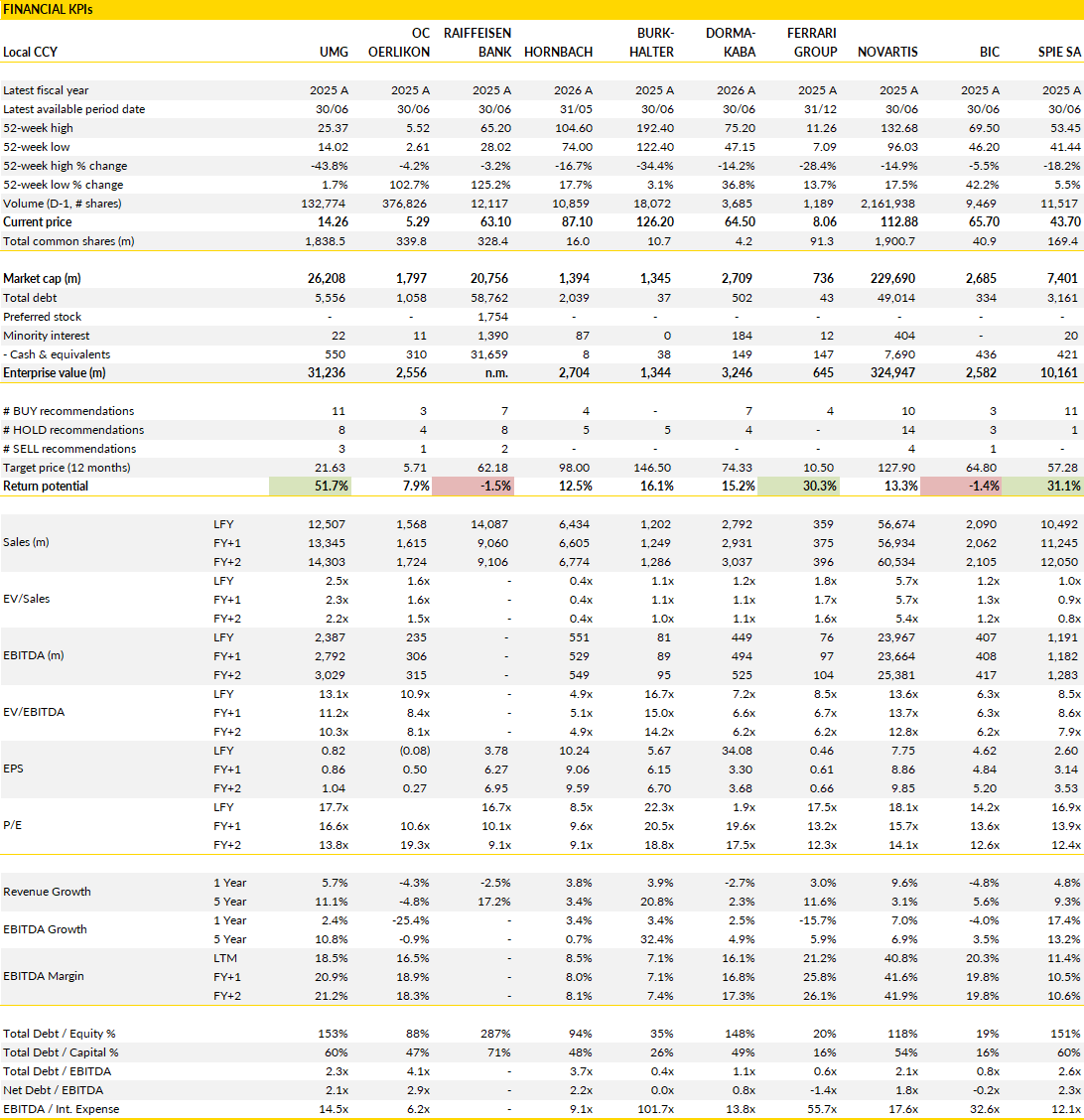
Financial KPIs
Companies covered in this edition: Universal Music Group, OC Oerlikon, Raiffeisen Bank, Hornbach, Burkhalter Group, Dormakaba, Ferrari Group, Novartis, BIC, SPIE
Universal Music Group (UMG Netherlands): Streaming growth needs to recover. The release schedule strengthens
Paid streaming remains of course the clearest indicator of whether the weakness seen during the first half at UMG was temporary or not.
Organic paid streaming growth slowed from 7.9% in Q1 to 6.7% in Q2, despite continued subscriber growth across the major streaming platforms and ongoing price increases. Several factors held back Q2. UMG lost market share after starting the year with a relatively light release schedule, and the accounting methodology used for the final month of each quarter meant that successful late-Q2 releases were not fully reflected in reported revenue. The quarter also absorbed roughly one percentage point of pressure from guaranteed minimums, audits and catch-up payments, which can fluctuate significantly between periods.
Underlying industry demand has remained healthy, with streaming volumes still expanding and Spotify's recent performance showing no obvious deterioration in paid music consumption. Price increases from Spotify, Apple and YouTube provide another source of revenue growth, leaving UMG's own release performance and resulting market share as the main swing factor for Q3.
The release calendar has improved considerably since June. Olivia Rodrigo, Drake and Noah Kahan provide carry-over into Q3, supplemented by releases from a.o. Gracie Abrams in July and Ariana Grande, KATSEYE and Karol G during August. Ariana Grande and KATSEYE have started particularly well, giving UMG a broader collection of commercially successful releases than it had during much of H1. The comparison is still demanding because Q3 2025 included several major sellers, but UMG should regain some of the ground lost earlier this year against Warner Music and Sony. Warner benefited from stronger new releases and an Atlantic Records recovery during Q2, while Sony also had a healthier catalogue and release slate. UMG's Q3 schedule is more evenly distributed across the quarter, and some releases associated with competitors can also generate economics for UMG through distribution arrangements.
In short, a return towards high-single-digit or around 10% organic paid streaming growth would indicate that the first-half slowdown reflected release timing and quarterly items instead of a deterioration in the broader streaming model.
Management is also responding to concerns around reporting and capital allocation. UMG has completed approximately €1bn of share repurchases, including shares acquired directly from Pershing Square, and intends to provide more detailed and frequent disclosure around the components of revenue and profitability. Better separation of pricing, volume, market-share, scope and mix effects should make quarterly streaming performance easier to interpret, particularly given the noise created by minimum guarantees and catch-up payments. The planned sale of half of UMG's Spotify stake provides another potential source of capital.
Longer term, the economics of the business still depend on growth in paid subscribers, regular platform price increases and UMG maintaining its share of global listening through both new releases and its catalogue. Q3 offers an early test after two weaker quarters. Stronger releases are already in place and the one-off pressure seen previously should ease, leaving market-share development as the most useful measure of whether paid streaming can return to a healthier growth rate.
OC Oerlikon (OERL Switzerland): Mission 2030 targets build on a sharp recovery in order intake
Oerlikon has set out its Mission 2030 financial framework as it completes its transition towards a focused materials science and surface engineering group.
The company is targeting around CHF2bn of sales by 2030, based on average organic growth of approximately 6%, together with an operational EBITDA margin above 20% and ROCE above 10%. These objectives build on a clear improvement in demand, with organic orders increasing 6.5% in 2025 and accelerating to 17.6% in H1 2026. The margin target also represents further progress from the 19.1% level currently expected for 2026, suggesting that much of the profitability improvement required for Mission 2030 is already underway. Returns on capital require a larger step, having reached only 4.7% in 2025. Higher utilisation, revenue growth and a more focused portfolio should allow Oerlikon to move ROCE above its cost of capital as the strategy progresses.
The growth plan is spread across several end markets where Oerlikon's coatings and materials technologies represent a relatively small component of customer costs but perform critical functions. Aerospace benefits from rising engine production and an MRO market expected to expand by around 6% annually through 2030, creating demand for coatings that improve component durability and performance. Power generation is gaining another source of demand from the rapid increase in electricity requirements associated with AI data centres, supporting investment in industrial gas turbines. Semiconductor exposure comes through leading equipment manufacturers and refurbishment activity, while defence customers are adding capacity and adopting more advanced manufacturing processes. Electrification creates additional applications for materials that improve efficiency, durability and thermal performance. This diversification reduces dependence on any single industrial cycle and gives Oerlikon several routes towards the 6% average organic growth embedded in its 2030 plan.
Technology and the installed service network remain central to maintaining the economics of these businesses. Oerlikon operates 110 coating service sites globally and has more than 550 connected coating systems and over 2,500 thermal spray systems installed at customers, creating recurring aftermarket activity alongside equipment and materials sales. Barriers to entry come from materials science expertise, proprietary coating processes, long qualification cycles and established relationships with major OEMs. The company intends to maintain R&D spending at around 4-5% of sales, with investment spanning computational materials design, advanced coatings, thermal spray and new manufacturing technologies. Additive manufacturing is one area where execution still needs to improve after previous initiatives produced disappointing results, making capital discipline particularly important as management revisits the opportunity.
To conclude: Mission 2030 does not require an unusually aggressive financial outcome. CHF2bn of sales, margins above 20% and ROCE above 10% can largely be achieved through sustained organic growth and incremental operating improvement. The recent acceleration in orders provides a strong starting point for delivering those objectives.
Raiffeisen Bank International (RBI Austria): Core profitability recovers, with Russia a smaller constraint
Raiffeisen Bank International's underlying business outside Russia is developing more strongly, supported by resilient revenues, disciplined costs and very limited credit losses.
Q2 net profit increased 22%, while management raised its 2026 expectations for core revenues from net interest income and commissions and maintained its cost-of-risk guidance. Reported expenses will be higher than previously planned, although much of the additional spending relates to Austrian legal proceedings connected with the Rasperia dispute instead of deterioration in the operating cost base. Capital remains comfortable despite RBI simultaneously reducing its Russian exposure and pursuing acquisitions elsewhere in Central and Eastern Europe. The fully loaded CET1 ratio stood at 15.5% at the end of June on a pro forma basis that assigns zero value to the equity of the Russian subsidiary. Management continues to target a ratio above 14% over the medium term, including the expected capital consumption from the acquisitions of Garanti BBVA Romania and Addiko Bank.
Russia remains the largest unresolved issue, but its economic relevance to the wider group has declined substantially. Since February 2022, loans in the Russian subsidiary have been reduced by 82% and customer deposits by 63%, leaving a much smaller operation than before the invasion of Ukraine. A complete exit remains difficult and part of the subsidiary's capital is effectively trapped, but the ongoing run-off reduces the amount of future group earnings and capital exposed to developments in Russia. The Rasperia litigation is a separate source of uncertainty and has generated additional legal costs, although prospects for a favourable resolution have improved. RBI's strong capital position provides a useful buffer against these legacy issues and allows management to develop the rest of the franchise without depending on the release of Russian capital. Further progress on either the litigation or the Russian run-off would simplify the group considerably, but the core business can already support improving profitability without such an outcome.
Capital deployment is increasingly shifting towards expansion in RBI's established CEE markets. The Garanti BBVA Romania transaction is expected to reduce CET1 by around 60bp, while the planned Addiko Bank transaction following the proposed carve-out should consume another approximately 15bp. Both are manageable within the current capital position, particularly given ongoing organic capital generation and optimisation of risk-weighted assets. These transactions can also generate better returns than simply retaining surplus capital as the core group's profitability recovers. RBI still expects medium-term CET1 above 14% after incorporating both acquisitions, leaving capacity for further strategic action.
The forthcoming Capital Markets Day should provide more detail on profitability targets, capital allocation and the shape of the group after these transactions. RBI is gradually moving from a situation dominated by Russian exposure towards one where operating performance and capital deployment across Central and Eastern Europe have a larger influence on earnings. Continued core revenue growth, successful integration of the new businesses and further reduction of the remaining Russia-related risks would complete that shift.
Hornbach (HBH Germany): Strong first half provides a cushion ahead of a less predictable winter
Hornbach maintained healthy sales momentum through the summer, with Q2 revenue increasing 7.3% to €1.81bn after 5% growth in Q1. This brought H1 sales to €3.82bn, up 6% year-on-year. Demand remained robust during June to August and was helped by approximately 1.3 additional trading days. Profit growth broadly tracked revenue, with H1 underlying operating profit increasing 5% to €286m and the margin holding at 7.5%. Gross profit increased 12.8% to €125m in Q2 despite ongoing cost pressure. The figures show that Hornbach is sustaining growth despite a difficult home-improvement market in Germany, where consumer spending and residential activity remain subdued. Its performance also reflects continued market-share gains and the benefits of a broader European footprint, which reduces reliance on the German DIY market.
Management has kept its FY 2026/27 guidance unchanged despite the strong first half. Sales are expected to be around the prior year's €6.43bn level or slightly higher, while underlying operating profit is targeted around the €265m achieved in FY 2025/26.
The cautious outlook leaves room for a materially softer second half following the strong spring and summer trading period. Seasonality already makes H2 less important to annual profitability, and geopolitical uncertainty could affect consumer confidence as well as sourcing, transportation and other operating costs. Hornbach is also continuing to invest in its store network, including expansion in Serbia, which adds start-up expenses before the new locations reach normal profitability. In short, the unchanged guidance reflects both a weaker seasonal period and continued spending on expansion, even though the first six months have provided a healthy earnings buffer.
The wider strategic development remains favourable. Hornbach has consistently gained share in Germany and continues to expand across European markets, giving the group opportunities to grow even when the overall DIY market is stagnant. Its large-format stores, professional customer exposure and established online offering have helped it perform better than the underlying market during a prolonged period of weak housing activity. Expansion adds another source of revenue growth but requires disciplined execution because new stores initially dilute group margins through pre-opening and ramp-up costs. H1 demonstrates that Hornbach can absorb these investments while maintaining profitability, with the operating margin unchanged despite continued cost inflation. The September 29 detailed results should provide more information on regional trading, gross-margin development and the cost base.
For now, 6% H1 sales growth and €286m of underlying operating profit leave the company comfortably placed against its unchanged annual objectives, with H2 demand and the cost of network expansion determining how much of the first-half momentum carries through to the full year.
Burkhalter Group (BRKN Switzerland): Not good enough (for the market)
Burkhalter delivered a steady first half that reinforced the resilience of its business model despite intense competition across the Swiss electrical and HVAC installation market.
Revenue was essentially unchanged year-on-year, but profitability improved, with the EBIT margin increasing 30 basis points to 5.3% and earnings per share rising 8%. The results were broadly in line with expectations, but the quality of earnings was encouraging given the lack of top-line growth. Management maintained its expectation for a moderate increase in full-year earnings per share compared with 2025, implying slower growth in the second half after the strong H1 performance. The completed rollout of the Abacus ERP platform should begin contributing to efficiency gains from H2 onward, while implementation costs that weighed on the first half are largely finished. This creates an opportunity for operational improvement without requiring stronger market conditions.
Acquisitions remain a central component of Burkhalter’s strategy. Management views four to five transactions annually as a normal pace, with six acquisitions already completed this year. The rationale extends beyond growth. Workforce availability is becoming increasingly important as retirements reduce industry capacity, making acquisitions an effective way to secure skilled employees in a fragmented market. Burkhalter estimates its market share at roughly 8-10%, ahead of BKW, Equans, Etavis and Hälg, giving it a leadership position in a market still populated by thousands of smaller competitors. Large projects continue to progress according to plan, including contracts such as Aarau Hospital and the Bern Police Center, although these projects account for only around 10% of group revenue.
That said, valuation clearly remains in focus. Investors had increasingly priced in the possibility that Switzerland’s upcoming renovation cycle, supported by changes to the tax treatment of renovation spending before 2029, would generate stronger volumes and better pricing across the sector. Management’s commentary suggests a more restrained outcome. Construction activity may increase by around 8-9%, but labour constraints limit the industry's ability to translate this into significant volume growth, while competitive pressure remains too intense to support meaningful pricing improvement. The stagnant H1 revenue performance supports that view.
Even so, Burkhalter continues to generate solid earnings growth through operational discipline, acquisitions and efficiency improvements. With a payout ratio targeted at 90-100% of earnings, the company also offers a dividend yield above 4%, providing an important component of total return. The combination of stable operations, strong cash distribution and market leadership remains attractive, although expectations for a substantial earnings acceleration driven by a renovation boom now appear less realistic than the market previously assumed.
Dormakaba (DOKA Switzerland): Restructuring gives way to a broader push for organic growth
Dormakaba is approaching the end of its current restructuring phase with a cleaner cost base and scope to put greater emphasis on organic growth.
As mentioned last week, for FY 2026/27, management is targeting organic sales growth above 3%, including around 2-2.5% from pricing, despite a backlog currently growing at a high-single-digit rate. The conservative stance reflects uncertainty around interest rates, tariffs and geopolitical conditions, as well as some internal constraints. Portfolio rationalisation is still underway and gaps remain in parts of the product range, particularly access control in the US. Profitability should nevertheless make another step forward. The company expects its reported EBIT margin to exceed 11%, representing an improvement of around 100bp. Roughly half should come from better underlying operations and half from lower exceptional costs. This follows several years in which restructuring expenses obscured part of the progress in the underlying business.
The November 18 Capital Markets Day should shift attention towards the next phase of development. Dormakaba sees further potential from simplifying its organisation and reducing SKU complexity, alongside a substantial decline in non-recurring expenses. These costs absorbed around 280bp of profitability in FY 2025/26 and are expected to settle at approximately 100bp over time. North America is likely to receive particular attention. Dormakaba is currently the number three player in the region with market share below 10%, leaving significant room to expand through better products, stronger commercial execution and selected acquisitions. Heather Torrey, who joined from Honeywell in April to lead the Americas business, will present the regional strategy at the CMD. Hotels, airports and data centres are among the verticals where management sees further opportunities. Bolt-on M&A remains part of the plan, supported by leverage of only 0.8x, although management has shown restraint when acquisition prices become excessive, as demonstrated by its approach to Gunnebo.
The simplification of Dormakaba's ownership structure adds another source of financial improvement. Around 36m new shares will be issued in exchange for eliminating the Mankel family's 47.5% minority interest in the operating company, compared with approximately 42m shares currently outstanding. The transaction is designed to be economically neutral in terms of dilution and is scheduled to close in January 2027. Following completion, the Mankel family will own 52.09% of the listed group, while the Kaba family will hold 9.05%. Removing the dual holding structure also allows intellectual property rights to be centralised in Switzerland, which management expects to reduce the effective tax rate by roughly three percentage points over time, from 26% to around 23%.
Dormakaba will consequently enter this next strategic period with fewer structural complications, lower exceptional expenses, modest leverage and a simpler tax structure. The CMD now has the opportunity to establish how much of those benefits can be converted into stronger organic growth and further margin expansion, particularly through a larger North American business.
Ferrari Group (FERGR Netherlands): Network expansion and cash generation will lead to higher shareholder returns
Ferrari Group enters the second half of 2026 with its growth plan progressing broadly as intended, supported by additional logistics hubs, geographic expansion and deeper relationships with existing customers.
Management is targeting organic sales growth of 3-6% for the year after a strong start in Q1, with Europe, North America and Brazil providing much of the momentum. The company's concentration on high-value goods gives it particular exposure to jewellery and other hard-luxury categories, which have recently performed better than fashion and leather goods. The US remains an attractive corridor for these products, while higher gold prices increase the declared value of shipments in Brazil and can support revenue generated from value-related logistics services. Asia is weaker, primarily because of subdued luxury demand in China, although Japan has remained comparatively resilient. New locations opened during 2025 are also moving through their ramp-up phase and should contribute more fully this year as local volumes build.
Profitability has remained robust alongside the network investment. Ferrari generated a 26.0% adjusted EBITDA margin in FY 2025 and expects a broadly similar level in 2026, with limited seasonal variation between the two halves. Europe should remain the strongest regional contributor, whereas weaker volumes in Asia create some pressure on operating leverage. Digitalisation provides an offset by improving shipment processing and administrative efficiency as the network expands. The comparison with H1 2025 will also be cleaner below EBITDA. Last year's first half included a €15.8m customs-related provision that reduced reported net profit to €14.1m, compared with €27.7m on a normalised basis, as well as IPO-related expenses that were subsequently reimbursed through other income. With those items absent, reported earnings should better reflect the underlying economics of the logistics business. The asset-light model also limits capital requirements, with ordinary capex expected to remain around the 2025 level.
Cash accumulation is now really becoming a thing. Ferrari's specialist logistics model combines high margins with relatively modest capital intensity, allowing a significant proportion of operating earnings to convert into cash. Management's existing 2026 framework already incorporates investment in new hubs, further network expansion and technology, leaving the balance sheet with scope beyond the requirements of the operating plan. This could eventually translate into additional distributions to shareholders if suitable acquisition or organic investment opportunities do not absorb the growing cash balance.
Operationally, the next stage depends on extracting more business from the expanded footprint and increasing wallet share with luxury customers that already use Ferrari across parts of their logistics chain. Management's medium-term objectives call for organic growth of 6-8% and an adjusted EBITDA margin of 27-29%, requiring another improvement from the current run rate. The immediate outlook is more measured, with the existing 3-6% growth objective and broadly stable margins providing a solid base as the newer hubs mature and Ferrari extends its presence across the main global luxury corridors.
Novartis (NOVN Switzerland): Pelacarsen failure shifts attention to the broader cardiovascular pipeline
Novartis has suffered a clinical setback in cardiovascular disease after pelacarsen failed to improve patient outcomes in a large Phase III trial. The study enrolled around 8,000 patients with elevated lipoprotein(a), or Lp(a), a cardiovascular risk factor found in roughly one-fifth of the population. Pelacarsen, licensed from Ionis Pharmaceuticals and administered through monthly injections, had previously demonstrated reductions of more than 80% in circulating Lp(a). That biological effect did not translate into fewer cardiovascular deaths, heart attacks, strokes or coronary revascularisations compared with placebo.
The commercial impact on Novartis itself should be relatively contained because expectations for pelacarsen were modest and management had already anticipated a gradual launch. The scientific implications are broader. Several competing programmes from Amgen, Eli Lilly and Silence Therapeutics also target Lp(a), in some cases achieving reductions above 90%. Pelacarsen's failure raises the possibility that lowering the biomarker alone may be insufficient, although treatment duration and the magnitude of Lp(a) reduction remain possible explanations for the lack of clinical benefit.
The result does not materially alter the breadth of Novartis's cardiovascular franchise, where the next important readouts arrive in 2027. Leqvio is already approved for lowering LDL cholesterol and offers a differentiated dosing profile of two injections per year. The next Phase III outcome study will assess whether its cholesterol-lowering effect translates into lower cardiovascular morbidity and mortality among patients with established cardiovascular disease. Positive data could broaden use among higher-risk patients and strengthen Leqvio's role as Novartis rebuilds cardiovascular growth following the loss of exclusivity for Entresto. Abelacimab provides a second major clinical program. The factor XI inhibitor is being studied in atrial fibrillation patients who cannot use conventional anticoagulants such as Eliquis or Xarelto. Its initial addressable population is narrower, at approximately 15-20% of atrial fibrillation patients, and monthly subcutaneous administration could limit convenience. Its mechanism could nevertheless offer an alternative for patients whose bleeding risk or other characteristics make existing anticoagulation unsuitable. Novartis also has QCZ485 in development for severe hypertension, adding another potential cardiovascular programme behind the two more advanced assets.
The pelacarsen disappointment comes shortly after positive multiple-sclerosis data for remibrutinib and illustrates the diversification Novartis has built across its late-stage pipeline. Several additional clinical events are due over the coming quarters, including remibrutinib in dermatology and del-desiran in neuromuscular disease. Cardiovascular development now depends more heavily on Leqvio and abelacimab, with the 2027 morbidity and mortality studies particularly important because they test whether favourable biological mechanisms deliver measurable benefits for patients.
Pelacarsen also provides a useful reminder of that distinction: an 80%+ reduction in a well-established cardiovascular risk biomarker ultimately produced no improvement in the clinical endpoints that determine the value of the therapy. Novartis can absorb the loss of this individual program, but the result removes one potential product from the pipeline and increases the importance of successful outcome data from the remaining cardiovascular assets.
BIC (BB France): New 2030 plan targets steady growth and another step up in margins
BIC has introduced its new “BIC to the Future” strategy with a 2030 horizon, targeting average annual organic sales growth of around 3% between 2026 and 2030.
The plan relies on a relatively broad set of initiatives, including a simpler product portfolio, higher brand investment, more innovation, deeper retail penetration and selective geographic expansion. The priorities differ across the portfolio. Stationery will focus on increasing product penetration and removing complexity from the range, which should also improve category economics. Lighters remain a highly profitable business where BIC can use its global leadership to expand further, particularly in emerging markets. In shavers, management intends to protect and develop its established non-refillable franchise and selectively broaden its presence in refillable products. Tangle Teezer has a different growth profile and will receive investment in new products, premiumisation and international distribution as BIC seeks to develop the brand into a much larger global hairbrush franchise.
The financial plan combines moderate top-line growth with a meaningful productivity programme. BIC is aiming for an adjusted operating margin above 15.5% by 2030, supported by higher sales, manufacturing efficiencies and improvements across the supply chain. Reaching that level will require upfront spending. Management expects approximately €100m of transformation costs between 2027 and 2030, concentrated mainly in the first two years, with the programme generating around €80m of recurring annual savings by the end of the period. Capital expenditure should remain close to 4% of sales, suggesting that the strategy does not require a major increase in capital intensity. Portfolio simplification could be particularly useful here, reducing manufacturing and supply-chain complexity alongside the direct savings program. The margin objective is also broadly consistent with the profitability ambitions established under the previous Horizon plan, so the new framework extends the existing direction instead of requiring a fundamental change in the economics of the business.
Cash generation remains an important component of the strategy. BIC expects net free cash flow to exceed €250m in 2030 and is targeting cumulative generation of €900-950m between 2027 and 2030. This would provide ample funding for the transformation program and continued investment in the brands while preserving substantial capacity for shareholder distributions. The current dividend policy calls for a payout of 40-50% of adjusted earnings per share, leaving additional cash available for other forms of capital allocation. Execution will depend on whether BIC can establish a consistent 3% organic growth rate across a portfolio containing several mature categories. Tangle Teezer and emerging-market lighters provide clearer expansion opportunities, while stationery and shavers require stronger innovation, distribution and portfolio management to generate sustainable growth.
The combination of modest sales expansion, €80m of recurring savings and stable capital expenditure creates a credible path towards the 2030 profitability and cash targets, with the detailed category plans determining how evenly that progress is distributed over the next four years.
SPIE (SPIE France): Margin expansion and cash generation accompany another year of bolt-on growth
SPIE is combining steady organic growth with further margin improvement as demand remains strong across most of its European markets. Organic sales growth accelerated to 3.1% in Q2 after a softer start to the year, led by Germany at 7.3%, North-Western Europe at 4.7% and Central Europe at 7.3%. France remains the exception, with Q2 revenue down 1.9% and H1 down 0.7%, although management expects the full-year decline to remain modest and sees no further deterioration during H2.
The group is benefiting from sustained investment in electrification, energy infrastructure and technical building services, areas where customer spending has remained relatively resilient. Acquisitions provide an additional growth engine. Transactions already completed in 2026 represent around €670m of acquired annual revenue, and management continues to see an active pipeline in a highly fragmented market. This combination allows SPIE to expand both geographically and across specialist technical services without relying on a material acceleration in underlying European construction activity.
Profitability is progressing alongside the larger revenue base. H1 operating margin increased 20bp to 6.2%, reflecting tighter contract selection, continued optimisation of existing work and disciplined cost management. Further benefits should come through during H2 as ROFA and SGS enter the consolidated figures after making no contribution to the first half. SPIE's operating model provides room for gradual margin expansion through procurement, contract mix and greater density within local markets, particularly as bolt-on acquisitions are integrated into the existing network. Management has not provided a separate H2 margin target but expects the positive development seen during H1 to persist. The ability to maintain pricing discipline is especially relevant given the group's labour-intensive activities and the continued scarcity of qualified technical workers. Selectivity around new work limits the risk of filling the order book with contracts that generate revenue without adequate returns, and the first-half margin progression suggests this discipline is feeding through to earnings.
Cash conversion has also strengthened. SPIE generated positive free cash flow of €25.7m in H1, an unusual outcome given that the first half is traditionally cash negative. Working capital remained favourable at negative 28 days of production, slightly better than negative 27 days a year earlier. Management continues to target cash conversion of around 100% for the full year, which should leave the group with substantial capacity to fund acquisitions while reducing leverage.
The M&A model remains central to SPIE's development: a fragmented competitive landscape provides a regular supply of smaller businesses that can be acquired and integrated into the group's regional operations, adding technical capabilities, customer relationships and local scale. Strong cash generation allows this process to continue without placing excessive pressure on the balance sheet. With organic growth recovering, margins still moving higher and recently acquired businesses adding another layer of expansion, SPIE retains several independent sources of earnings growth even in a relatively subdued European economic environment.