
Trading, electrification and a lot of results
Jungheinrich, Interparfums, FlatexDEGIRO, ABB, ID Logistics, Basic-Fit, EssilorLuxottica, SAP, Telekom Austria, Iberdrola, OPmobility, La Française de l'Énergie, Moncler, BE Semiconductor Industries

At Lux Opes, we break down companies into quick takes that get straight to the point - what is happening, why it matters, and what to watch next. We publish 2-3 times per week, depending on the news flow.
For the best reading experience, we recommend reading at Lux Opes
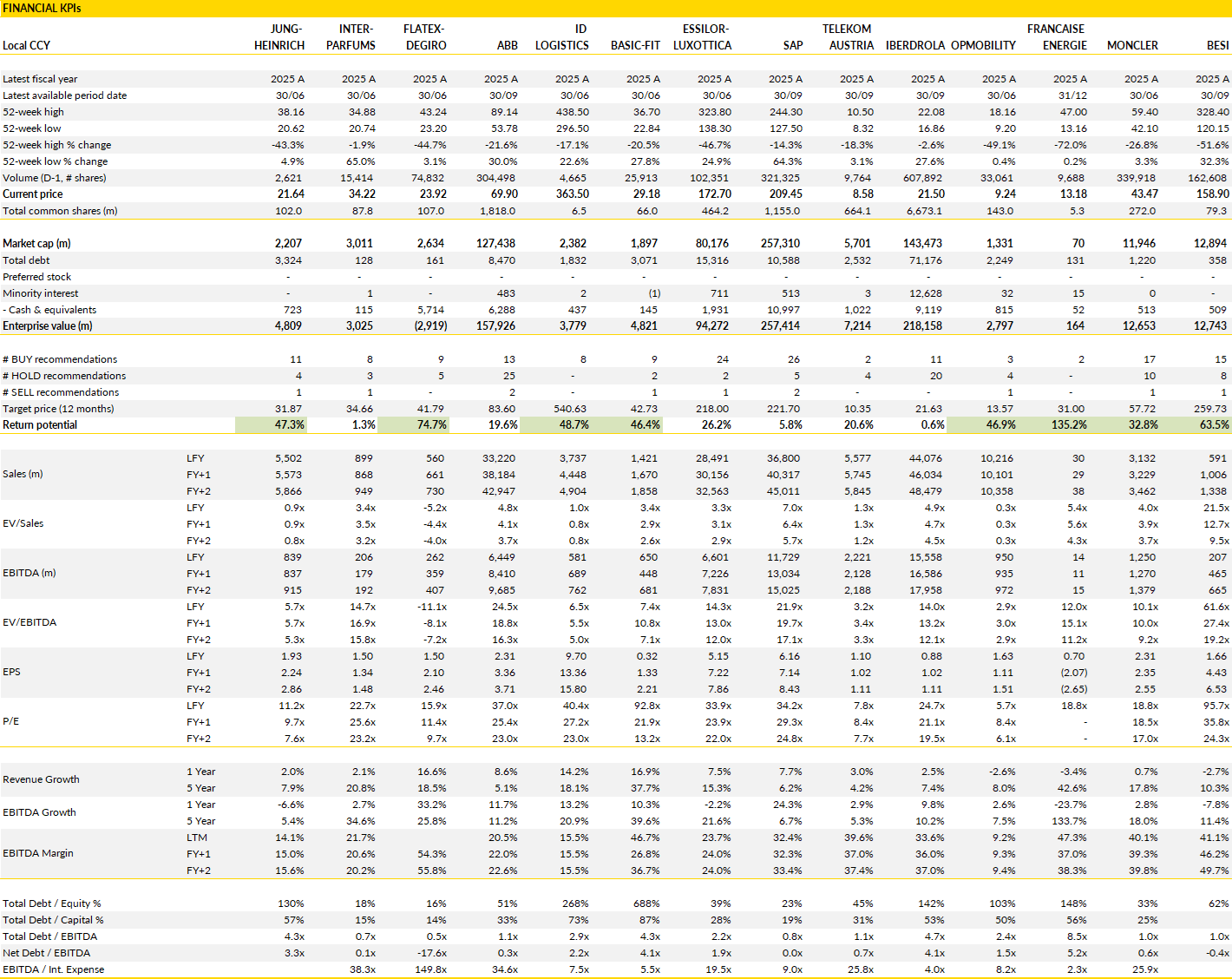
Financial KPIs
Companies covered in this edition: Jungheinrich, Interparfums, FlatexDEGIRO, ABB, ID Logistics, Basic-Fit, EssilorLuxottica, SAP, Telekom Austria, Iberdrola, OPmobility, La Française de l'Énergie, Moncler, BE Semiconductor Industries
Jungheinrich (JUN3 Germany): Weak industrial demand keeps margins under pressure
Jungheinrich is heading into its third-quarter results with little indication that demand for industrial trucks is recovering. Recent comments from competitor KION suggest that customers remain cautious about investing in new warehouse equipment, with pricing pressure, an unfavourable product mix and underutilised factories affecting profitability. Jungheinrich faces many of the same challenges in its Industrial Trucks & Services (ITS) division, where sales are expected to remain broadly unchanged from both the previous quarter and last year. Higher labour and energy costs are adding to the pressure, making it difficult to improve margins without stronger volumes. The loss of the previously profitable Russian business also continues to weigh on the division's earnings. Despite improving German economic indicators and expectations of government stimulus, industrial customers have yet to show a meaningful increase in equipment spending.
Growth is coming mainly from Automated Warehouse Equipment (AWE), where demand for warehouse automation and integrated logistics systems remains healthier. The division is expected to deliver approximately 20% revenue growth in Q3, helping offset stagnation in traditional industrial trucks. However, AWE still contributes a relatively small share of group earnings, limiting its ability to compensate for weaker profitability elsewhere. Group revenue could increase modestly to around €1.4bn, but operating profit is unlikely to improve much from Q2 and could remain well below last year's level. Jungheinrich has been cutting costs to protect profitability, but these savings are being absorbed by inflation and competitive pricing. This leaves the company dependent on a recovery in customer investment to achieve a more substantial improvement in earnings.
Management's existing 2026 guidance calls for reported EBIT of €340-400m, with current trading conditions suggesting that the lower end may be more achievable. The outlook for 2027 also remains challenging because higher financing costs and uncertain industrial activity are delaying investment decisions. Jungheinrich's automation business offers longer-term growth opportunities as companies seek to improve warehouse efficiency and reduce their dependence on labour, but traditional forklift operations remain central to overall profitability.
The company's strong balance sheet provides financial flexibility during the downturn and allows it to keep investing in automation technology. A broader recovery in European manufacturing and logistics spending would help factory utilisation and pricing, but recent industry developments suggest that improvement could take longer than expected. For now, cost reductions are helping Jungheinrich defend its earnings, with limited signs of a sustained recovery in its core market.
Interparfums (ITP France): Brand recovery momentum ahead of new launches
Interparfums returned to growth in the third quarter, with revenue increasing 4.8% to €265.5m (+4.6% at constant exchange rates). This marks a clear improvement from the first half, when organic sales declined 3.7%. Revenue for the first nine months reached €679.8m, down 2.9% on a reported basis and just 0.7% at constant currencies. Currency pressure has also eased considerably, with almost no impact in Q3 compared with a 3.5% negative effect during the first half.
The recovery was broad-based, with all major fragrance brands recording growth. Coach performed particularly well, increasing sales by 25% following the success of two product extensions. Montblanc also recovered strongly, growing 13% after a slight decline in H1, suggesting that demand is improving across several important parts of the portfolio. Lacoste returned to growth with a 5% increase, following a difficult first half when sales fell 21%. Jimmy Choo delivered a smaller improvement of 0.4%, supported by the introduction of I Want Choo Midnight.
The return to growth at Montblanc and Lacoste is encouraging because both brands had weighed on performance earlier in the year. Interparfums has maintained its full-year revenue guidance of approximately €870m and an operating margin target of 18%. The company therefore expects to preserve profitability despite weaker sales over the first nine months. Its relatively limited exposure to France, estimated at around 6-7% of revenue, also reduces its dependence on domestic consumer spending. The broader international footprint gives Interparfums access to markets with different demand patterns, although currency movements remain an important factor in reported growth.
The product pipeline should provide further support in 2027 and 2028. Interparfums is preparing new fragrance franchises for Coach, Montblanc and Lacoste, alongside its regular extensions of established product lines. These launches should help refresh the portfolio, attract new customers and support sales through existing distribution networks. Management has reported encouraging feedback from agents and distributors following presentations of its upcoming campaigns, suggesting a positive initial reception.
The timing is favourable after a period of weaker demand and uneven performance across brands. However, successful launches will still depend on consumer response and retailer orders once the products reach the market. The latest quarterly figures show that Interparfums is recovering before the next major launch cycle begins, creating an opportunity for stronger growth over the following two years.
FlatexDEGIRO (FTK Germany): A bit slower trading activity
FlatexDEGIRO delivered another quarter of double-digit earnings growth, although weaker trading activity and slower customer acquisition had their impact on revenue.
Third-quarter sales increased 13.9% to €150.3m, supported by a 32.8% rise in interest income to €55.9m. Higher interest rates and continued demand for margin lending helped offset more subdued commission revenue, which grew just 5.8% to €89.4m. Trading activity has normalised following stronger periods earlier in the year, and the slower addition of new customers also limited transaction growth. Nevertheless, profitability improved considerably. EBIT increased 23.6% to €70.8m, with the operating margin expanding by 370 basis points to 47.1%. Net income rose 29.3% to €50.3m, showing the benefits of FlatexDEGIRO's largely fixed-cost technology platform as revenue increases.
Earnings showed resilience, showing that the company can maintain strong profitability even when trading volumes moderate. Interest income has become an increasingly important contributor, supported by customer balances and margin loans, although this also makes earnings more sensitive to changes in interest rates. Commission income remains closely linked to market activity, investor sentiment and the pace of customer acquisition. A recovery in retail trading could so provide additional revenue without requiring a proportionate increase in operating expenses. However, personnel and other operating costs were higher than anticipated during the quarter, partly limiting the improvement in profitability.
Management has maintained its full-year net income guidance of €200-230m, having generated €166.3m during the first nine months. Achieving the lower end of this range requires approximately €34m in fourth-quarter earnings, below the level achieved in Q3.
Governance developments have become an additional consideration for FlatexDEGIRO. The introduction of a co-CEO structure and the departure of the Supervisory Board Chairman have created uncertainty around leadership and oversight at a time when the business is performing well operationally. The company benefits from a scalable platform, a substantial European customer base and opportunities to expand its financial services offering beyond securities trading. Its ability to generate high operating margins also provides flexibility to invest in customer acquisition and product development.
That said, restoring confidence in the management structure will be important, particularly if slower customer growth persists. The underlying business remains profitable and capable of delivering further earnings growth, but future performance will depend on renewed trading activity, the sustainability of interest income and a more stable governance environment.
ABB (ABBN Switzerland): Strong orders come with growing data centre exposure
ABB delivered another strong third quarter, with orders rising 40% organically to $12bn and revenue increasing 14% to $9.7bn.
Electrification led the performance, recording 70% order growth as demand for data centre infrastructure more than doubled again. Motion also performed well, with orders up 12%, while Automation remained broadly stable because of project timing. Short-cycle businesses continued growing at double-digit rates, suggesting that demand remains healthy beyond large infrastructure contracts. The book-to-bill ratio reached 1.24x, adding to the backlog and supporting future sales. Operating EBITA margin improved by 160 basis points to 20.8%, helped by higher volumes, efficiency measures and price increases of just over 2%. However, net profit declined to $1.18bn, affected by losses on currency and commodity derivatives, alongside integration and disposal costs. Free cash flow increased slightly to $1.58bn.
Management sees no signs of demand weakening, particularly among utilities investing in electricity grids and data centre operators expanding computing capacity. Most of ABB's data centre business comes from established hyperscalers and colocation providers, although the company also supplies newer cloud operators. Customers have not indicated that they are delaying projects, despite growing concerns about the financing of AI infrastructure. Some ABB factories are already operating close to full capacity, but management expects annual capital expenditure to remain around the €1bn level planned for 2026. The company has raised its full-year guidance again, now targeting organic revenue growth in the low teens and an operating margin improvement of at least 270 basis points compared with 2025. Orders are also expected to remain above revenue.
Acquisitions remain another important part of ABB's growth strategy. Following the planned disposal of Robotics and the transactions involving Rotork and Mitsubishi Electric, management estimates that it could deploy approximately $13-14bn on further acquisitions while keeping leverage around 2x EBITDA. This gives ABB considerable scope to expand its technology portfolio and strengthen its presence in attractive industrial markets.
However, the rapid growth of Electrification has also increased its dependence on data centre investment. Current orders remain exceptionally strong, but a slowdown in AI infrastructure spending could eventually affect growth, particularly if financing conditions become more restrictive. ABB's operating performance remains impressive, with improving margins and healthy demand across several businesses.
The combination of greater exposure to data centre spending, weaker reported net profit and a substantial valuation premium to industrial peers leaves (way) less room for disappointment if growth begins to moderate.
ID Logistics (IDL France): International expansion for the win
ID Logistics delivered an exceptionally strong third quarter, with revenue increasing 25.6% to €1.18bn and organic growth accelerating to 25%, compared with 20% during the first half. Sales for the first nine months reached €3.26bn, up 20.9%, including organic growth of 21.7%.
North America remains the fastest-growing region, with quarterly revenue increasing 48% to €266m. New contracts in the US and Canada are contributing significantly, including an automated textile warehouse for Amazon. Growth across Europe excluding France was also impressive, reaching 23.4% to €544m, supported by continued expansion in Germany, Poland and the UK. France delivered a more modest 8.3% increase to €272m as recently launched contracts gradually reached higher activity levels. Revenue from other markets rose 36% to €96m, helped by strong demand in Brazil and the start of operations in Australia.
The company's growth reflects continued demand for outsourced logistics services, particularly among large retailers and e-commerce businesses seeking more efficient distribution networks. ID Logistics has been winning new contracts and expanding its international footprint, with 27 new sites opened during the first nine months and more than 30 expected for the full year. Commercial activity remains healthy, with approximately 25 additional projects scheduled to begin in 2027. This pipeline should support further revenue growth as newly opened facilities reach full operating capacity.
The rapid pace of expansion also creates costs, as warehouses require investment in equipment, recruitment and operational preparation before generating their full earnings contribution. Managing these start-up expenses will be important for profitability, particularly as the company enters new markets and takes on increasingly complex logistics contracts.
ID Logistics is also considering acquisitions, with Germany and the US identified as priority markets. Both offer opportunities to strengthen its customer base and increase operating scale, complementing the company's existing organic expansion. The business has developed a strong record of winning contracts with large international customers, benefiting from the growing complexity of supply chains and the increasing use of automated warehouses. Revenue growth remains substantially ahead of the broader logistics market, although operating margins are relatively modest because of the labour-intensive nature of the business and ongoing start-up costs. As recently opened sites mature, profitability should improve, provided new contract launches remain well controlled.
In short, ID Logistics is maintaining its strong commercial momentum across several regions, with a substantial project pipeline supporting continued expansion into 2027.
Basic-Fit (BFIT Netherlands): Membership growth and stronger cash generation
Basic-Fit delivered another solid quarter, with revenue increasing 18% year-on-year to €417m and continued growth in memberships and its club network.
The company ended September with 1,809 owned gyms, compared with 1,653 a year earlier, including eight Kraftwerk locations acquired during the quarter. Germany remains an important expansion market, with the network reaching 127 clubs, while Spain grew to 246 locations. France remains Basic-Fit's largest market with 901 clubs, although the number declined slightly from the first half. Total memberships across owned clubs increased to 5.42m from 4.73m a year earlier, while average memberships per club reached 3,035. This suggests that Basic-Fit is attracting more customers to its existing locations alongside opening new gyms, helping improve club economics as fixed operating costs are spread across a larger membership base.
Average monthly revenue per member reached €25.64, unchanged from the first half but above the €24.60 recorded in Q3 2025. Management expects further improvement in this figure, which would support revenue growth without requiring additional club openings. The company is also developing its franchise business, which now covers 437 clubs and generated €6.4m in quarterly revenue. Franchising offers an opportunity to expand the brand with lower capital requirements than operating every location directly. Basic-Fit has already achieved its target of approximately 50 net owned-club openings for 2026, allowing management to concentrate on improving the performance of its existing network. The expansion in Germany, including the Kraftwerk acquisition, also shows that acquisitions can complement organic openings in markets where Basic-Fit is still building scale.
Management has reiterated its full-year revenue guidance of €1.64-1.69bn and underlying EBITDA guidance of €430-460m, following two upgrades to the original profitability target earlier this year. The company expects a significant improvement in free cash flow as spending on new clubs declines and existing locations become more profitable. Financial leverage is also expected to fall to just above 2.0x, strengthening the balance sheet after several years of rapid expansion.
The shift towards stronger cash generation is an important development for Basic-Fit, which has historically invested heavily in growing its European network. Membership growth remains healthy, club density is improving and management has greater flexibility over expansion spending. Further increases in revenue per member and continued improvements in mature-club profitability should support earnings growth, even if the pace of new openings remains relatively modest.
EssilorLuxottica (EL France): Smart glasses add to solid growth in eyewear
EssilorLuxottica delivered another strong quarter, with revenue increasing 7.2% at constant exchange rates to €7.49bn. Its traditional eyewear and optical businesses grew approximately 6.5%, showing that demand remains healthy despite a difficult consumer environment in several markets.
Growth was broad-based, with Europe, Asia and North America all contributing. Direct-to-consumer sales increased 10.6%, helped by the group's extensive retail network, while Professional Solutions grew 3.4%, reflecting stronger demand from independent optical retailers and wholesale customers. Product mix also remains favourable, with little indication that consumers are switching to cheaper eyewear. This is encouraging for profitability, particularly as the company continues expanding its premium lens and branded eyewear offerings. Currency movements added nearly two percentage points to reported growth, providing an additional benefit during the quarter.
Wearables are becoming a more meaningful part of EssilorLuxottica's business. Revenue from AI-enabled glasses and Nuance Audio products increased approximately 20% at constant exchange rates, supported by demand for more advanced models and higher-value configurations. The company has started reporting this category separately, making it easier to track its development alongside traditional eyewear.
The fourth quarter will face a difficult comparison because wholesale partners placed substantial orders for smart glasses during the final months of 2025. However, the latest models introduced at Meta Connect should support demand during the holiday season. Higher adoption of Transitions photochromic lenses is also helping the product mix, with penetration approaching 60% within the group's own retail network. These lenses add functionality and increase the value of each pair sold.
EssilorLuxottica has several opportunities to expand its wearables business beyond the current generation of AI glasses. A second-generation Nuance Audio product, offering improved performance, could broaden demand for glasses with integrated hearing assistance. Continued development of AI features should also encourage upgrades and attract consumers who have not previously considered smart eyewear. The company's manufacturing capabilities, optical expertise and global distribution network give it an advantage in bringing these products to a wider audience. Meanwhile, the established eyewear business continues growing at a healthy pace, providing a stable foundation as new technologies develop.
Wearables remain exposed to product launch cycles and potentially uneven wholesale ordering, but stronger product adoption and a favourable mix could support revenue growth over several years. There's now more condifence that EssilorLuxottica can expand into connected eyewear while maintaining solid performance across its traditional operations.
SAP (SAP Germany): Cloud growth accelerating on strong demand for AI
SAP delivered yet another strong quarter, with revenue increasing 12.2% at constant currencies to €10.27bn, supported by continued migration of existing customers to cloud-based software.
Cloud subscription and support revenue grew 25%, maintaining the momentum seen earlier this year, while total cloud and software revenue increased 14.5% to €9.25bn. Demand for Business Data Cloud is also contributing to growth, as customers look to integrate their business information and prepare their systems for AI applications. Current cloud backlog increased 26% at constant currencies, providing a substantial base of contracted revenue for the coming quarters. Traditional software licence revenue declined just 9.3%, a much smaller reduction than the 32.5% recorded in Q2. This helped overall revenue growth accelerate despite the ongoing transition away from upfront licence sales.
Profitability improved as revenue growth outpaced operating expenses. Non-IFRS operating profit increased 18% to €3.03bn, with the margin reaching 29.5%, an improvement of 150 basis points at constant currencies. Operating expense growth slowed to 8%, compared with 15% in the previous quarter, reflecting better cost control and the scalability of SAP's cloud platform. Gross margin nevertheless declined slightly to 74.4%, affected by investments in sovereign cloud infrastructure, third-party software resale and initial AI-related costs. Free cash flow increased 36% to €1.72bn, although customer payments were somewhat slower, with higher receivables affecting cash conversion. Adjusted earnings per share reached €1.79, also benefiting from a lower effective tax rate of 25%. These results show that SAP is improving operating efficiency while continuing to invest in its cloud and AI offerings.
Management now expects full-year cloud revenue growth at the upper end of its 23-25% constant-currency guidance, with cloud and software revenue also approaching the top of its 12-13% target range. The company maintained its operating profit guidance of €11.8-12.2bn and free cash flow target of approximately €10bn.
Management also remains cautious about the economic environment, particularly because the fourth quarter typically accounts for around half of annual bookings. Customer decisions on large software contracts could therefore have a significant impact on year-end backlog growth. SAP's transition to recurring cloud revenue is progressing well, supported by demand for AI functionality and integrated business data.
The expanding backlog and improving operating margins provide a solid foundation for further growth, although sustained investment in cloud infrastructure and slower enterprise spending will affect the pace of margin improvement.
Telekom Austria (TKA Austria): International growth offsets weakness at home
Telekom Austria delivered a solid third quarter, with revenue increasing 4.6% to €1.47bn, supported by continued expansion across its international markets. The company raised its full-year revenue growth guidance from 2-3% to approximately 4%, broadly reflecting the momentum already established during the first half. EBITDA before restructuring increased 1.9% to €595m, while net profit rose by the same percentage to €195m. Profitability developed more slowly than revenue, with the EBITDA margin declining by approximately one percentage point to 41%.
The main concern was a sharp increase in investment spending. Capital expenditure excluding spectrum reached €222m during the quarter, prompting management to raise its full-year spending guidance by €100m to €850m. The additional expenditure comes relatively late in the financial year and will put pressure on cash generation despite the healthy revenue performance.
The international operations remain Telekom Austria's main growth engine. Revenue increased 8% to €800m, with service revenue growing 8.3% and EBITDA improving 5.6%. Demand for connectivity and digital services across Central and Eastern Europe continues to support expansion, helping compensate for difficult conditions in the domestic market. Austria generated revenue of €687m, up just 0.8%, while EBITDA declined 2% to €283m. Service revenue fell another 0.7%, despite inflation-linked adjustments and selective price increases earlier this year. Competition remains particularly intense in traditional mobile and fixed-line services, limiting the company's ability to increase prices or improve customer economics. Growth in Austria is coming mainly from business connectivity and solutions, which has not yet been sufficient to offset weakness in the core consumer operations.
Management attributes the higher investment budget to fibre deployment in Austria, broadband network expansion across Central and Eastern Europe and selected IT projects. These investments should strengthen network quality and support future service growth, but the unexpected increase raises questions about the company's capital requirements over the coming years. Further clarification on the timing and recurring nature of this spending will be important, particularly given the limited improvement in domestic profitability.
Telekom Austria benefits from a geographically diversified business, with international markets delivering healthy revenue and earnings growth. However, the Austrian business remains under competitive pressure, and higher capital expenditure could absorb some of the additional cash generated elsewhere. The stronger revenue outlook is encouraging, but sustainable earnings growth and better investment efficiency will determine the stock's potential.
Iberdrola (IBE Spain): Network investments lead another guidance upgrade
Iberdrola delivered a solid performance during the first nine months of 2026, with recurring net profit increasing 8.8% to €5.14bn. Reported net profit reached €5.82bn, up 9.6%, including gains and other non-recurring items. Recurring EBITDA rose 7.5% to €11.89bn, while EBIT increased 11.3% to €7.65bn.
The results prompted management to raise its full-year net profit growth guidance from more than 8% to more than 10%, reflecting stronger contributions from regulated electricity networks and continued investment in new generation capacity. The upgrade also suggests that Iberdrola is progressing ahead of the earnings trajectory outlined in its 2026-2028 strategic plan. The growing contribution from regulated activities provides a relatively predictable earnings base, although higher operating costs and weaker electricity pricing have affected profitability in parts of the generation business.
Networks remain Iberdrola's strongest business, with adjusted EBITDA increasing 15% to €6.43bn. Growth was supported by higher regulated returns in Spain, favourable regulatory decisions in the US and stronger electricity distribution and transmission activities in Brazil. The UK also contributed significantly, helped by the consolidation of Electricity North West following its acquisition earlier this year. In the US, new transmission infrastructure and previously approved tariff increases supported earnings.
These developments reflect Iberdrola's strategy of directing substantial capital towards regulated electricity infrastructure, where investment requirements are increasing as grids accommodate renewable generation and rising electricity demand. The electricity generation and customer business performed less strongly, with EBITDA declining 2% to €5.36bn. Iberian operations faced higher gas procurement costs, increased ancillary service expenses and less favourable electricity prices. Disposals of renewable assets in Hungary and France also reduced contributions from other markets.
Management expects the stronger network performance to continue through the remainder of 2026, supported by ongoing investment, additional generation capacity and available hydroelectric reserves. The higher profit guidance demonstrates the resilience of Iberdrola's diversified business, particularly as regulated earnings offset weaker conditions in electricity generation. However, the investment program requires substantial financing. Adjusted net debt increased to €54.6bn from €50.2bn at the end of 2025, despite proceeds from the disposal of Mexican assets. Maintaining financial discipline will therefore remain important as the company expands its network portfolio.
Iberdrola benefits from attractive long-term electricity infrastructure investment opportunities across several markets, with regulatory frameworks supporting returns on new capital. These investments are translating into higher earnings, although debt levels and the performance of its generation activities remain important considerations.
OPmobility (OPM France): Sales hold up despite a tougher automotive market
OPmobility's third-quarter trading update offered some reassurance following the significant profit warning issued earlier in October. Consolidated revenue increased 3.2% to €2.44bn, including organic growth of 2.8%, despite global light vehicle production declining 1.9%. This represents an outperformance of nearly five percentage points, suggesting that new contracts and production ramp-ups are helping the company gain business in a weak automotive market.
Growth was positive across all three divisions, led by Exterior & Lighting, where revenue increased 4.1% organically to €1.08bn. New lighting programs in Eastern Europe and North America contributed to the improvement. Modules delivered 3.2% organic growth to €721m, while Powertrain increased sales by 0.5% to €635m, supported by fuel tank demand outside China and expanding battery production. However, the contribution from joint ventures remained weak, particularly in China, where deteriorating market conditions and lower tooling revenue weighed on Exterior & Lighting's economic sales.
The operating environment remains difficult, especially in Europe, where weak vehicle production and rising costs have put pressure on margins. These challenges prompted management to lower its annual earnings expectations earlier this month, and the latest revenue figures do little to change the underlying profitability concerns. OPmobility has responded with restructuring measures aimed at reducing its cost base and improving competitiveness, particularly across its European operations.
Management has also reaffirmed its revised 2026 guidance, targeting operating profit of €430-450m and free cash flow above €220m. The company expects to deliver a significant attributable net profit and reduce net debt compared with the end of 2025. Maintaining cash generation and controlling capital expenditure remain priorities as automotive manufacturers continue adjusting production schedules and investment plans.
Besides the current industry weakness, OPmobility has several opportunities to strengthen its business. The proposed acquisition of Hyundai Mobis's lighting operations, expected to close in the second half of 2027, would more than double the size of its Lighting division and substantially increase its presence in Asia. This could improve geographic diversification and create additional opportunities with international vehicle manufacturers. European initiatives encouraging local automotive production could also benefit suppliers with established manufacturing operations in the region. However, the acquisition will require careful integration, and the timing of any broader recovery in vehicle production remains uncertain.
OPmobility's shares have fallen over 25% since the profit warning, reflecting concerns about earnings and industry conditions. The third-quarter results show that the company can still outperform global vehicle production, but sustained margin recovery and successful restructuring are needed to rebuild confidence.
La Française de l'Énergie (FDE France): New assets deliver growth but hedging losses weigh on finances
La Française de l'Énergie has started its 2026-27 financial year strongly, with first-quarter revenue increasing 35% to €8.9m. The improvement reflects contributions from recently commissioned assets and more favourable energy prices. Electricity revenue reached €3.9m, supported by a 24% increase in volumes, while gas sales grew 16% to €2.1m. The newly consolidated Romerike business in Norway contributed €1.8m and was already profitable in its first quarter. However, Norwegian engineering and construction revenue declined to €1m following a contract postponement.
Management continues to target at least 25% revenue growth for the full year. This follows a relatively resilient 2025-26, when revenue declined 3% to €29.5m and EBITDA fell to €10.6m from €11.4m. Operating profit remained stable at €6.3m despite a 28% increase in administrative expenses, while operating cash flow improved 42% to €13.7m.
The main concern remains the company's excessive gas hedging exposure, which has created substantial financial losses unrelated to the performance of its operating assets. FDE recorded a €9.9m attributable net loss in 2025-26, including €3.8m of realised hedging losses, €6.7m of unrealised losses and €7.1m in debt costs. The unrealised loss associated with the gas over-hedge has since increased to approximately €33m. Management expects to finalise an agreement with its counterparty shortly, establishing a maximum financial exposure and a settlement schedule. The final amount could be below the current mark-to-market loss, but uncertainty remains until the terms are agreed. Resolving this issue is particularly important because the company has already committed substantial capital to its expansion.
Investment spending reached €67.2m last year, increasing net debt to €115.9m and leaving €17.5m in cash. Management is now prioritising cash generation, with capital expenditure expected to fall to €30-50m in 2026-27. Newly commissioned combined heat and power plants and Romerike should contribute more than €8m in additional annual revenue, while the company expects over €15m in grants, approximately €2m in cost savings and €3-7m from asset disposals.
Management currently anticipates no covenant breaches or need for additional equity. The underlying mine gas and biogas operations continue to expand, but the high debt burden makes delivery on these cash flow measures essential. Finalising the hedging settlement and presenting the new strategic roadmap on 10 December should help clarify FDE's financial position and future investment priorities.
Moncler (MONC Italy): Weak store traffic, but encouraging product trends
Moncler's third-quarter revenue was broadly stable (at constant currencies), reaching €606m despite weak store traffic during the summer.
The Moncler brand recorded a 2% decline in direct-to-consumer sales, reflecting softer demand in Europe and unusually mild weather that discouraged purchases of winter clothing. Wholesale sales performed better, increasing 2%, although the company still expects this channel to remain broadly flat for the full year. Regional performance varied considerably. Asia grew 5%, supported by particularly healthy demand in Japan and South Korea, while China remained positive but developed more slowly. Sales in the Americas increased 2%, whereas Europe, the Middle East and Africa declined 8%, matching the weakness seen in the previous quarter. Stone Island performed somewhat better, growing 5% at constant currencies, helped by favourable wholesale deliveries and modest retail growth despite reduced discounting.
Trading improved somewhat in September, but customer traffic remained subdued into October, particularly as mild temperatures continued to delay purchases of autumn and winter collections. China's Golden Week holiday generated strong sales, with Moncler outperforming the broader luxury market among Chinese consumers, although activity slowed again afterwards. In the US, the newly opened New York flagship has started ahead of management's expectations.
The final months of the year remain particularly important for Moncler because winter clothing accounts for a substantial share of annual sales. However, management is encouraged by the performance of its spring and summer collections, which reportedly achieved strong growth earlier this year. This suggests that the brand can attract customers beyond its traditional down jacket business, an increasingly important consideration as weather patterns and consumer purchasing habits change.
Moncler plans to increase the proportion of lightweight clothing in its collections, reducing its dependence on cold weather and extending the brand's relevance throughout the year. Expansion opportunities in the US and the development of the Grenoble performance collection provide additional growth opportunities. Stone Island also has room to improve its international distribution and retail productivity, although recent performance remains relatively modest. The group's profitability remains strong, supported by premium pricing and disciplined distribution, while its substantial net cash position provides financial flexibility.
The shares currently trade at a discount of more than 20% to luxury peers on forward earnings and operating profit multiples, despite the brand's established profitability and expansion opportunities. Near-term trading remains sensitive to weather and consumer confidence, but the success of lighter collections indicates that Moncler has opportunities to broaden its business without weakening its premium positioning.
BE Semiconductor Industries (BESI Netherlands): Hybrid bonding orders accelerate with AI demand
BESI delivered a good third quarter, with orders increasing 96% year-on-year and 17% sequentially to €343m. Demand was particularly strong for hybrid bonding equipment, with orders for the technology more than doubling during the first nine months compared with the whole of 2025. AI infrastructure investment is supporting demand across several applications, including advanced logic chips, high-bandwidth memory and co-packaged optics.
Revenue reached €283m, up 114% year-on-year, while gross margin improved to 65.2%, exceeding the company's guidance range of 63-65%. Operating profit reached €130m, representing an EBIT margin of 45.8%. This demonstrates the profitability of BESI's equipment portfolio as volumes recover, with its relatively flexible cost structure allowing a substantial portion of additional revenue to translate into earnings.
Hybrid bonding adoption continues to broaden, with the number of customers increasing to 23 from 21 in the previous quarter and cumulative demand exceeding 215 systems. The technology enables more efficient connections between semiconductor components, an increasingly important requirement as chipmakers seek higher performance and lower power consumption. However, adoption in high-bandwidth memory has been complicated by supply shortages, which have encouraged manufacturers to extend production using existing, lower stack heights. This could delay some hybrid bonding investment, although BESI expects the technology to enter a wider range of memory configurations over the next two years, including designs combining advanced logic and memory. A leading memory manufacturer has recently ordered both hybrid bonding and next-generation thermocompression systems.
BESI also addressed concerns about potential competition from ASML, explaining that the companies are working together on placement accuracy and that ASML's interests currently concern a different area of three-dimensional chip integration.
Management expects fourth-quarter revenue to remain broadly stable, within a range of 5% above or below Q3, as some customers have requested deliveries in early 2027 to match their production schedules. Gross margin guidance remains healthy at 63-65%, although operating expenses are expected to increase 5-10% sequentially because of additional strategic consulting costs.
Order momentum should remain strong, supported by data centre investment, photonics applications and market share gains in conventional semiconductor assembly equipment. The timing of hybrid bonding adoption in memory remains uncertain, but growing demand from logic and optical applications reduces dependence on any single market. Advanced packaging investment is gathering pace, with further opportunities as semiconductor manufacturers move towards more complex chip architectures.