
Semis, pools and scary dividend cuts
Comet, Fluidra, Aixtron, tonies, Technip Energies, Pernod Ricard, Cicor Technologies, IONOS, BAWAG, Nordex, Cosmo Pharmaceuticals, ABB, Solvay

At Lux Opes, we break down companies into quick takes that get straight to the point - what is happening, why it matters, and what to watch next. We publish 2-3 times per week, depending on the news flow.
For the best reading experience, we recommend reading at Lux Opes
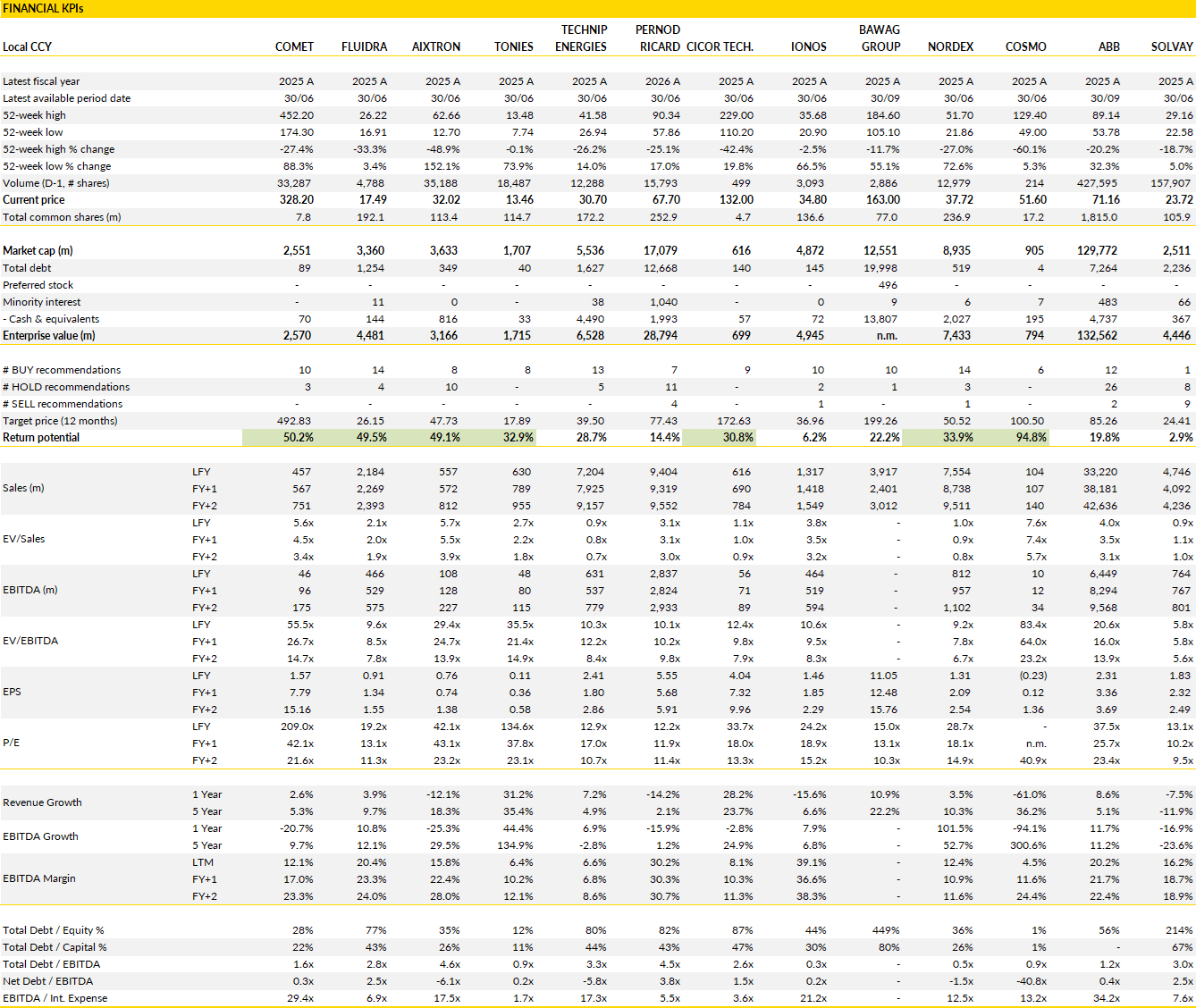
Financial KPIs
Companies covered in this edition: Comet, Fluidra, Aixtron, tonies, Technip Energies, Pernod Ricard, Cicor Technologies, IONOS, BAWAG, Nordex, Cosmo Pharmaceuticals, ABB, Solvay
Comet (COTN Switzerland): Another semi with booming demand
Comet's third-quarter results show a substantial acceleration in semiconductor equipment demand, with orders reaching CHF 276m, up 170% year-on-year and 31% from Q2. The book-to-bill ratio climbed to 1.77x, meaning new orders considerably exceeded shipments and added to the backlog. Revenue increased 52% to CHF 156m, helped by strong demand for plasma control technology used in semiconductor manufacturing.
Growth is spreading beyond DRAM and logic chips into NAND memory, reflecting broader investment in AI infrastructure and data centres. Comet's Synertia platform is also gaining traction with customers, supporting market share gains in its Plasma Control Technologies (PCT) division. The strength of recent orders means that a substantial portion of production is already scheduled for delivery in 2027.
The recovery is also benefiting Comet's other businesses. Industrial X-Ray Modules (IXM) recorded strong sales growth, supported by demand from defence and aerospace customers, alongside opportunities in battery production and semiconductors. Industrial X-Ray Systems (IXS) remained weaker, with sales slightly below last year's level, but the rollout of its CA20 platform for advanced semiconductor packaging is progressing.
Following the strong quarter, management raised its 2026 revenue guidance to CHF 570-590m from CHF 540-570m previously. The expected EBITDA margin has also increased to 17-19%, compared with 14-17% before. These targets still include approximately three percentage points of costs associated with the Penang facility and the company's efficiency program. As these expenses fade and production volumes rise, profitability could improve considerably because of Comet's relatively high fixed-cost base.
The order acceleration suggests that the semiconductor recovery could extend well into 2027, particularly if memory manufacturers continue expanding capacity to meet AI-related demand. Equipment manufacturers may also be building additional component inventories because of concerns about supply availability, potentially bringing some orders forward. This makes the pace of future bookings important to keep an eye on.
Beyond the industry recovery, Comet has opportunities to expand its market share through Synertia and establish a stronger presence in advanced packaging through CA20. Higher production volumes, improved pricing and the completion of restructuring activities should support margins. Comet is benefiting from both stronger semiconductor investment and improvements in its own product portfolio, with a growing backlog supporting further revenue growth.
Fluidra (FDR Spain): Aftermarket demand holding up but new pool construction continues to struggle
Fluidra's third-quarter results are likely to show slower growth after a particularly strong first half and a recovery in several markets during 2025.
Demand has benefited from favourable weather and a longer swimming pool season, but comparisons have become more demanding, especially in France and the US. The French market, which accounted for 14% of sales last year, began recovering in Q3 2025, creating a higher base for this year's results. The US market is also losing some momentum, with distributors moderating purchases despite relatively healthy end-customer demand. Channel inventories appear well controlled, suggesting that lower orders reflect normal purchasing patterns instead of a broader inventory correction. Fluidra's aftermarket business, representing approximately 66% of revenue, remains resilient as existing pool owners continue spending on maintenance, replacement equipment and water treatment. New pool construction, accounting for the remaining 34%, is still struggling with high borrowing costs, inflation and weak consumer confidence. Southern Europe has shown some improvement, but a meaningful recovery in new installations remains unlikely before 2027.
Profitability should remain relatively stable despite rising input costs. Fluidra has implemented price increases of approximately 5% during the year, including transportation surcharges and adjustments to inflation. These measures should support revenue growth, but higher costs for metals, plastics, energy and other materials are absorbing much of the benefit. The sales mix is also becoming slightly less favourable, with a larger contribution from lower-margin water treatment products and slower growth in the profitable US market. Fluidra's efficiency program remains an important source of longer-term improvement, targeting €120m in savings between 2026 and 2030, including €15m already achieved during the first half. However, further contributions during Q3 are expected to be limited.
In short, the company's established aftermarket business provides stability while management waits for new pool construction to recover. Although consumer spending remains under pressure, construction activity is already at historically low levels, which could limit further declines. Fluidra also benefits from its broad distribution network, product portfolio and opportunities to improve operating efficiency. Net debt is expected to increase from €1.1bn at the end of June following a €60m dividend payment and completion of a €40m share buyback.
The broader pool equipment industry remains under pressure, with financial difficulties and weaker profitability among several competitors reflecting the prolonged construction downturn. Fluidra's ability to maintain aftermarket demand and protect margins leaves it relatively well placed, but a stronger recovery in volumes will depend on improving consumer confidence and financing conditions.
Aixtron (AIXA Germany): Order book flying on AI photonics demand
Aixtron delivered a strong preliminary third quarter, with orders more than doubling year-on-year to approximately €275m, up 28% from Q2. Demand remains particularly strong for equipment used to manufacture lasers for optical communications in AI data centres, where faster data transmission is becoming essential as computing infrastructure expands.
Revenue reached approximately €184m, while profitability improved considerably thanks to a favourable product mix. Gross margin climbed to around 48%, and EBIT reached €57m, representing a margin of approximately 31%. The strong margins show how quickly profitability can improve when higher-value equipment accounts for a larger share of sales. More importantly, the acceleration in orders suggests that customers are committing to additional manufacturing capacity as demand for optical components grows. Aixtron will publish its final quarterly results on 29 October.
Management has maintained its 2026 guidance, targeting revenue of €530-590m, a gross margin of approximately 42% and an operating margin of 17-20%. The strong order intake has improved the outlook for 2027, although some component and metal supply constraints could limit how quickly equipment can be delivered. Aixtron is benefiting from the growing use of optical connections in AI infrastructure, where conventional electrical interconnects face greater challenges as data transmission speeds and power requirements increase. The move towards co-packaged optics could create another wave of investment, particularly as semiconductor companies develop new generations of AI processors. Demand could accelerate during the second half of 2027 as suppliers prepare for future computing platforms. These opportunities would expand Aixtron's role in the semiconductor equipment industry beyond its existing laser applications.
There are also signs of improvement in other parts of the business. Silicon carbide manufacturers have begun reporting higher capacity utilisation, which could eventually support renewed equipment spending after a difficult investment cycle. Gallium nitride technology offers another opportunity as data centres look for more efficient power conversion systems, with initial equipment orders potentially emerging in 2027. Both markets remain at an earlier stage of recovery than photonics, but they could provide additional growth as customers resume investment.
Aixtron's immediate priority is converting its strong order intake into revenue while maintaining the improved profitability seen in Q3. The current mix of high-value photonics equipment is particularly favourable, but margins will still depend on future product deliveries and manufacturing efficiency. With several semiconductor technologies moving towards broader commercial adoption, Aixtron has more growth opportunities than it did during the recent industry downturn.
tonies (TNIE Germany): Strong demand ahead of the holiday season
Tonies is heading into the very important holiday shopping period with strong sales momentum, supported by the expansion of its international business and the growing popularity of Toniebox 2.
The company will report its third-quarter results on 12 November, with expectations pointing to another quarter of growth across all major regions. North America should remain the fastest-growing market, helped by wider distribution and increasing brand recognition. Germany, Austria and Switzerland are also expected to perform well, alongside continued expansion in other international markets. Comparisons with last year should be relatively favourable because Toniebox 2 was introduced in the DACH region only in mid-September 2025, followed by other markets in October. This could support strong hardware sales as retailers prepare for Christmas.
The introduction of Toniebox 2 also creates opportunities to increase sales of the company's collectible audio figurines. Each additional device expands the installed base of customers who can purchase new content, giving Tonies a recurring revenue stream beyond the initial hardware sale. New licensed characters and entertainment franchises should support figurine demand, while the growing catalogue helps keep existing customers engaged. Figurines already account for the majority of revenue and are central to the company's business model. Accessories and digital products remain relatively small but provide additional ways to increase customer spending. The expansion of the product range, together with new international markets, gives Tonies several opportunities to grow without relying entirely on new device purchases.
North America remains particularly important for the company's longer-term growth. A larger presence in the US would increase the potential customer base considerably, while successful new character launches could strengthen the brand's appeal. The upcoming results should give a clearer picture of consumer demand for Toniebox 2 and the performance of the figurine portfolio ahead of the peak selling season.
Another consideration is the potential dilution from outstanding warrants. Tonies has approximately 10m public warrants and 6.4m sponsor warrants, but cashless exercise would result in fewer new shares than a conventional one-for-one conversion. At a share price around €13, full cashless exercise would imply approximately 1.9m additional shares, or 1.6% dilution. This limits the potential impact on existing shareholders. The more significant factor remains Tonies' ability to expand its installed base and turn growing hardware adoption into sustained figurine sales.
Technip Energies (TE France): Strong cash position adds to earnings potential
Technip Energies is benefiting from a strong order environment and a balance sheet that could generate more financial income if interest rates remain elevated. The company ended the first half of 2026 with €3.4bn in net cash, including approximately €900m after excluding customer advances and cash tied to ongoing projects.
Engineering and construction companies typically receive substantial upfront payments, allowing them to finance project execution without committing large amounts of their own capital. This creates a cash-rich business model, particularly when new contract awards are strong. Technip Energies secured €12.7bn in orders during H1, bringing its backlog to approximately €25bn, equivalent to 3.5 years of activity. The large order book should support further customer advances as projects move forward. Higher interest rates also make these cash balances more valuable. A 100-basis-point increase in the return earned on €3.4bn would generate approximately €34m in additional annual financial income before tax, assuming the full balance benefits from the increase.
The operating outlook is also improving after a difficult period for project profitability. The Project Delivery division recorded an EBITDA margin of just 1.7% in Q2, reflecting logistical challenges that have weighed on execution costs. These problems have not been linked to operational failures on individual contracts, and much of the additional expenditure should be recoverable. A recovery in margins would therefore provide another source of earnings improvement alongside higher financial income. Demand for LNG infrastructure remains strong as countries seek to diversify energy supplies and strengthen energy security. Technip Energies is one of the leading engineering contractors in LNG liquefaction, giving it access to major projects as producers expand export capacity. Its substantial backlog also provides a solid foundation for revenue over the coming years.
Technip Energies is also expanding into newer energy technologies, including sustainable aviation fuel and plastics recycling through Reju. These activities remain smaller than its established engineering business but could become more meaningful as customers invest in lower-carbon industrial processes. The company's strong financial position allows it to pursue these opportunities without placing significant pressure on its balance sheet. However, the €3.4bn cash balance includes funds linked to customer projects, so the benefit from higher rates will depend on how much cash remains available and the returns achieved on its investments.
The more immediate opportunity is improving project margins while converting the record backlog into profitable revenue. With strong demand, substantial customer advances and limited financial leverage, Technip Energies has several ways to continue to grow earnings.
Pernod Ricard (RI France): Recovery remains elusive (in key markets)
Pernod Ricard's first-quarter results show that demand remains weak across several of its largest markets, with India providing most of the group's growth.
Organic sales declined 0.9%, but the underlying performance was weaker once adjusted for temporary inventory movements. China remains particularly difficult, with sales falling 25% as distributors continue reducing stocks and consumer spending stays subdued. There are some encouraging signs, including better sales of Martell through retail channels and growing demand for brands such as Jameson, The Glenlivet and Olmeca. However, much of the recent improvement appears linked to the Mid-Autumn Festival and easier comparisons. In the US, the spirits market continues to contract, with little evidence of a meaningful recovery in consumer demand. Pernod Ricard is gradually resolving disruptions caused by changes to its distribution network, which should improve commercial execution, but sales remain under pressure.
India continues to perform better, reporting organic growth of 19% during the quarter. However, part of this reflects distributors building inventories following changes to the local corporate structure. Excluding this effect, management indicated growth closer to 12%. Over two years, cumulative growth of approximately 7-8% suggests that Pernod Ricard is performing broadly in line with the Indian market. Elsewhere, demand remains sluggish, with organic growth outside India close to zero. The group's 6% volume increase was also offset by a negative price and product mix effect of approximately 7%, largely reflecting the growing contribution from lower-priced emerging markets. This could put pressure on gross margins even if volumes continue recovering. Management is preparing a potential listing of its Indian business, subject to final board approval, which could create additional financial flexibility and highlight the value of its operations in the country.
Management maintained its target of stable organic sales for FY2026/27, but achieving this will require continued growth in India and some stabilisation elsewhere. Inventory reductions in China and the US should become less severe, although underlying consumer demand remains uncertain.
Pernod Ricard also faces financial constraints, with substantial debt and an established dividend policy limiting its flexibility. The company has yet to announce a broader strategic review that could address its portfolio and capital allocation priorities. Its global brand portfolio remains valuable, but the current geographic mix is unfavourable, with growth concentrated in markets generating lower revenue per unit.
A sustained recovery will depend on improving consumption in the US and China, alongside stronger demand across the rest of the business. For now, the operating environment remains difficult despite a few early signs of stabilisation.
Cicor Technologies (CICN Switzerland): Strong orders hit persistent supply shortages
Cicor's recent third-quarter results show that customer demand remains healthy, but component shortages are preventing the company from converting orders into revenue as quickly as expected.
Sales increased 6.7% to CHF 170.8m, including organic growth of 4.6%, with shortages of printed circuit boards (PCBs) affecting production. The problem is particularly acute in aerospace and defence, where component lead times have increased from around eight to 20 weeks. Orders performed considerably better, rising approximately 11% to CHF 193.2m, giving Cicor a book-to-bill ratio of 1.13x. This indicates that new business is growing faster than deliveries, adding to the order backlog. The strength of demand is encouraging, especially given the structural increase in European defence spending, but the growing gap between orders and sales highlights the operational challenges facing the company.
Management has maintained its 2026 guidance, targeting revenue of CHF 700-750m and EBITDA of CHF 70-80m, equivalent to a margin of approximately 10-10.7%. Achieving these targets will require a substantial acceleration during the final quarter. Cicor expects second-half sales growth of 10-25%, implying Q4 revenue of approximately CHF 195-245m. The midpoint would represent growth of around 25%, a considerable improvement from Q3. Much will depend on whether PCB deliveries improve sufficiently to allow production to catch up with demand. The wide guidance range reflects this uncertainty, as even relatively small delays in critical components can prevent completed systems from being delivered. The company has limited control over these supply constraints, making the timing of the expected recovery difficult to predict.
Cicor's longer-term prospects remain supported by its exposure to defence, aerospace and other demanding electronics markets, where customers require specialised manufacturing capabilities and reliable suppliers. Growing military procurement budgets should support orders over several years, while the company's existing backlog provides a foundation for future revenue. However, the immediate challenge is execution. Strong order intake offers limited financial benefit until Cicor can secure the necessary components, complete production and deliver finished products. Persistent shortages could also create additional costs and put pressure on margins if production schedules need to be adjusted repeatedly.
The company has maintained its profitability objectives despite these difficulties, suggesting that management expects the disruption to ease. A stronger fourth quarter would demonstrate that the supply chain is beginning to recover, but further delays could push revenue into 2027. Cicor has the demand needed to grow; converting that demand into sales is now the priority.
IONOS (IOS Germany): AI services open up new growth opportunities
IONOS is preparing for stronger growth in the second half of 2026, supported by new customer acquisitions, improving cloud demand and lower marketing costs. Its established hosting business provides a recurring revenue base, but the company is also expanding into AI-powered services aimed at small businesses and self-employed professionals. The opportunity is attractive because IONOS already serves millions of customers who rely on its infrastructure to run their websites and online operations. Selling additional services to these customers requires relatively little extra distribution spending and could improve revenue per customer and profitability. The planned expansion of its agency offering should provide another source of growth in 2027, while faster cloud adoption could help diversify the business beyond traditional web hosting.
The AI Phone Receptionist is currently IONOS's most promising new product. By June, it had attracted approximately 15,000 customers, generating average monthly revenue of €50-70 per user. The service allows small businesses to handle incoming calls automatically, reducing missed enquiries without requiring additional staff. It is particularly relevant for sole traders and very small companies that cannot justify employing a dedicated receptionist.
IONOS also benefits from competitive pricing, especially for customers receiving relatively few calls. Management expects to develop AI products relevant to almost its entire customer base, creating opportunities to sell more services to existing subscribers. Future additions could include customer relationship management, sales assistance and business analytics. Competitors such as Wix already offer a broader selection of AI tools, so IONOS will need to accelerate product development to remain competitive.
Another opportunity is the emergence of AI-powered commerce, where customers can discover and purchase products directly through conversational assistants. Shopify has already begun developing this model, and similar capabilities could become valuable for IONOS customers operating online stores. Helping small businesses sell through platforms such as ChatGPT or other AI assistants would extend IONOS's role beyond website hosting into customer acquisition and transactions. However, the commercial potential of these services remains uncertain, and broader adoption will depend on how consumers use AI shopping tools.
For the moment, the Phone Receptionist shows that customers are willing to pay for practical AI applications. IONOS has a strong distribution advantage through its existing customer relationships, and successful expansion into additional services could support faster growth and higher margins without requiring a major increase in customer acquisition spending.
BAWAG Group (BG Austria): Cost savings are supporting earnings amidst shifting lending mix
BAWAG delivered a solid third quarter, with net profit increasing 13% year-on-year to €247m despite higher credit costs. Net interest income rose 8% to €497m, supported by a further improvement in the net interest margin to 3.48%. Loan growth remained subdued, with retail lending increasing 1% sequentially while corporate lending declined by the same amount, partly because of higher repayments in commercial real estate. Deposits also fell 1%, reflecting lower balances in German online banking and Austrian public-sector accounts. The bank is gradually shifting its lending mix towards unsecured consumer loans, which offer higher margins but also carry greater credit risk. Loan loss provisions increased to €79m, with the annualised cost of risk reaching 56 basis points compared with 54 basis points in Q2. The non-performing loan ratio also edged up to 1.0%, although asset quality remains relatively stable overall.
Cost discipline remains one of BAWAG's strongest features. Operating expenses fell 11% year-on-year to €181m, comfortably exceeding management's target of a reduction of more than 5% for 2026. This helped offset the increase in credit provisions and supported operating profitability despite limited balance sheet growth.
Management has maintained its full-year guidance, including net interest income and core revenue growth above 6%, credit costs of approximately 50 basis points and net profit exceeding €960m. Capital remains strong, with a pro forma CET1 ratio of 17.1% after accounting for the full quarterly dividend accrual. The bank's ability to generate capital internally is particularly important ahead of its planned acquisition of Ireland's Permanent TSB.
The Permanent TSB transaction remains the main strategic development for BAWAG. Completion is expected around late 2026 or early 2027, subject to the remaining legal process, and management expects the acquisition to consume approximately 450 basis points of CET1 capital, funded entirely through internal resources. The deal will significantly expand BAWAG's Irish operations and create opportunities to improve efficiency through its established cost management approach. Management plans to update its longer-term financial targets at the end of 2026 to reflect the enlarged business.
In the meantime, deposit competition and the move towards higher-risk consumer lending deserve attention, particularly if credit losses continue rising. However, strong profitability, disciplined expenses and substantial capital generation give BAWAG flexibility to absorb these pressures while preparing for the integration of Permanent TSB.
Nordex (NDX1 Germany): Strong execution lifts profitability to new highs
Nordex delivered an exceptionally strong third quarter, with preliminary results showing a substantial improvement in profitability and cash generation. Revenue increased 28% year-on-year to €2.19bn, while EBITDA more than doubled to €278m. The EBITDA margin reached 12.7%, up from 8.0% a year earlier, reflecting better project execution and stronger profitability in the Service division. The company also benefited from fewer unexpected costs in its Projects business, where previously anticipated risks did not materialise. Free cash flow increased sharply to €379m from €149m, helped by the stronger operating performance and favourable working capital dynamics. These results suggest that Nordex is making considerable progress in improving the profitability of its wind turbine operations after years of pressure from inflation, supply chain disruptions and difficult project economics.
The stronger performance prompted management to raise its full-year EBITDA margin guidance from 8.0-11.0% to 11.5-12.5%, while maintaining its revenue target of €8.2-9.0bn. The improvement is particularly encouraging because it comes alongside healthy demand for new turbines. Third-quarter orders increased 29% to 2,810 MW, bringing bookings for the first nine months to 7,733 MW, up 16% year-on-year. This keeps Nordex on track to reach approximately 10 GW of orders for 2026. The growing installed base should also support its Service business, which provides maintenance and other recurring activities over the operating lives of its turbines. Management continues to target capital expenditure of approximately €200m and a working capital ratio below -9%, with positive free cash flow also expected in the final quarter.
Nordex's recent results show how much profitability can improve when projects are delivered efficiently and earlier cost risks prove less severe than anticipated. Strong orders and higher service margins provide a foundation for further growth, while improved cash generation strengthens the balance sheet. However, sustaining the current level of profitability will require continued execution discipline, particularly as the company expands production and delivers a growing order book. Changes to renewable energy regulations and support mechanisms could also affect future demand, even if current orders remain healthy. The wind industry's longer-term growth prospects remain attractive as electricity demand rises and countries expand renewable generation capacity.
Nordex is now demonstrating that it can translate this demand into significantly better financial results. The full third-quarter release on 5 November should provide further detail on the sustainability of the margin improvement and the outlook for 2027.
Cosmo Pharmaceuticals (CMHC Austria): Positive trial results broaden the pipeline
Cosmo Pharmaceuticals has reported encouraging Phase II results for its topical rifamycin treatment in patients with distal ulcerative colitis and mild to moderate ulcerative proctitis. The six-week, placebo-controlled study enrolled 76 patients and achieved its primary endpoint, with 46.2% of patients receiving rifamycin reaching clinical remission compared with 14.3% in the placebo group. The difference was statistically significant, with a p-value of 0.019, and no unexpected safety concerns were identified. Remission was measured using both symptom improvement and endoscopic healing, consistent with the FDA's regulatory approach. Cosmo now plans to discuss the design of a Phase III trial with US and European regulators. The results provide an encouraging first clinical demonstration of the treatment's effectiveness, but a larger study will be needed to establish its benefits and safety more conclusively.
The treatment uses Cosmo's proprietary delivery technology to administer rifamycin directly to inflamed intestinal tissue. Its liquid formulation turns into a gel when it comes into contact with the intestinal mucosa, helping concentrate the drug where it is needed while limiting exposure elsewhere in the body. This could offer advantages over treatments that affect the immune system more broadly. Current options for patients with localised ulcerative colitis include topical corticosteroids and 5-ASA therapies, but some patients experience inadequate symptom control or tolerability problems.
Cosmo's formulation could eventually provide another option before patients move to more intensive treatments such as biologics. The potential patient population across Europe and the US is estimated at approximately 2.4 million, although the commercial opportunity will depend on which patients ultimately qualify for treatment and how the product compares with established therapies.
The positive results also demonstrate Cosmo's ability to develop new applications for existing molecules through specialised drug delivery technologies. This approach can offer a different development path from discovering entirely new compounds, although regulatory approval still requires convincing clinical evidence.
Rifamycin adds another potential source of future revenue, but the company's more immediate commercial prospects remain closely linked to Breezula, its treatment for androgenetic alopecia. Progress towards FDA approval and securing a commercial partner will be central to determining Breezula's financial contribution. Rifamycin remains at an earlier development stage, with Phase III trial design, recruitment and results still ahead. Nevertheless, the latest data strengthen Cosmo's development pipeline and suggest that its formulation technology could support additional products beyond its existing portfolio.
ABB (ABBN Switzerland): Data centre demand drives another strong quarter
Despite the intial market reaction. ABB delivered another strong quarter, with orders increasing 40% on a comparable basis to $12.1bn and revenue growing 14% to $9.7bn.
Demand was particularly strong in the US, where orders rose 82%, while China recorded 25% growth and Europe increased 10%. Data centres remain a major source of demand, with orders more than doubling as operators invest in electrical infrastructure to support AI computing capacity. Short-cycle businesses also grew at double-digit rates, suggesting that industrial spending is improving beyond the largest infrastructure projects. The book-to-bill ratio reached 1.24x, adding to ABB's order backlog. Operating EBITA increased 24% to $2.0bn, lifting the margin by 160 basis points to 20.8%. Net profit fell 2% to $1.18bn, mainly because of valuation adjustments on financial instruments and investments, alongside separation and integration expenses.
Profitability improved across most of the business. Electrification delivered a particularly strong performance, with its margin rising 110 basis points to 25.6%, helped by demand for power distribution equipment and favourable operating leverage. Automation also improved, reaching a 14.8% margin. Motion was weaker, with profitability falling to 19.1% because of inflation and the integration of the acquired Gamesa operations. Free cash flow increased slightly to $1.58bn.
Management raised its 2026 outlook again, now expecting revenue growth in the low teens and an operating margin improvement of at least 270 basis points compared with 2025. The company also expects orders to exceed revenue for the full year. A $240m property gain will be recognised in Q4, providing an additional benefit to reported profitability.
ABB also announced a joint venture with Mitsubishi Electric that will expand its low-voltage electrical equipment business in Japan and the wider Asia-Pacific region. ABB will invest $495m for a 51% stake, combining selected Mitsubishi Electric operations in a business that generated approximately $640m in revenue in 2025. The transaction gives ABB a stronger presence in Japan, where establishing a meaningful position can be difficult for foreign suppliers. Management expects the venture to contribute positively to earnings in its second year and reach an EBITA margin of at least 20% within five years. The deal is relatively small compared with ABB's existing operations, but it fits the company's strategy of expanding its electrification business.
Strong demand, improving margins and continued investment in power infrastructure are supporting ABB's growth, with data centres becoming an increasingly significant contributor.
Solvay (SOLB Belgium): Middle East disruptions leading to the (dreaded) dividend but
Solvay lowered its 2026 outlook after another difficult quarter, with disruptions in the Middle East putting further pressure on profitability.
Preliminary Q3 revenue came in at €1.03bn, slightly below the €1.04bn recorded a year earlier, but underlying EBITDA fell sharply to €173m from €269m. The EBITDA margin declined to 16.8%, compared with 18.1% in Q2. The regional disruption reduced quarterly EBITDA by approximately €25m, including nearly €15m from the continued shutdown of the peroxide plant at the Sadara complex in Jubail, Saudi Arabia. Combined with the €20m impact in Q2, the disruption has cost Solvay approximately €45m in EBITDA over six months. The weak profitability despite relatively stable revenue also shows how exposed the business remains to operational interruptions and lower production volumes.
Management has reduced its full-year underlying EBITDA guidance to €720-740m, a substantial cut from the previous €770-850m range. With €579m already generated during the first nine months, the revised outlook implies Q4 EBITDA of just €141-161m, suggesting another sequential decline. The company has also lowered its free cash flow target to €120-150m, including approximately €90m of cash costs related to its transformation program. Q3 free cash flow was €54m, showing some resilience despite the weaker operating performance, but the reduced annual target raises questions about the company's capacity to fund dividends and reduce debt. The company has not yet provided detailed divisional figures for the quarter, making it difficult to assess whether other parts of the business are also deteriorating.
One potential source of financial recovery is compensation under the contractual arrangements governing the Sadara joint venture. Solvay has excluded any such payments from its revised guidance, so a successful claim could provide additional cash and earnings. However, neither the amount nor the timing is clear, and the continuing shutdown creates uncertainty around future production.
The challenge today remains restoring operations while managing costs and protecting cash generation. Solvay's restructuring efforts should eventually improve efficiency, but the current disruption is delaying the benefits and putting greater pressure on its financial position. The company needs a recovery in plant operations and stronger cash flow before any confidence in its outlook can improve.