
LNG, stock exchanges and exaggerated reactions
GTT, Deutsche Telekom, Deutsche Börse, BE Semiconductor Industries, Safran, London Stock Exchange Group, Nexans, Hermès International, Krones, Thales, Centiel, Galderma, Publicis, SIG Group

At Lux Opes, we break down companies into quick takes that get straight to the point - what is happening, why it matters, and what to watch next. We publish 2-3 times per week, depending on the news flow.
For the best reading experience, we recommend reading at Lux Opes
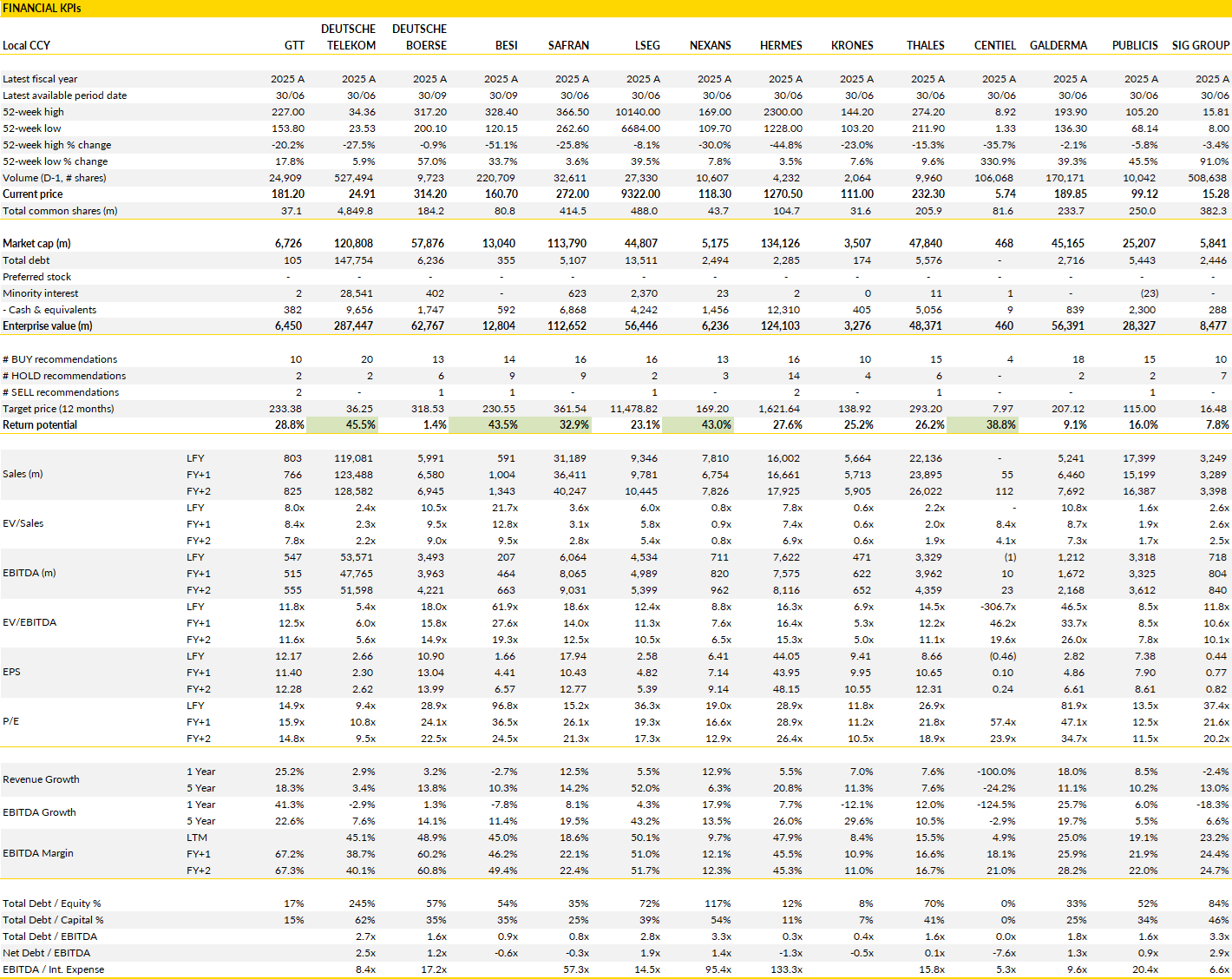
Financial KPIs
Companies covered in this edition: GTT, Deutsche Telekom, Deutsche Börse, BE Semiconductor Industries, Safran, London Stock Exchange Group, Nexans, Hermès International, Krones, Thales, Centiel, Galderma, Publicis, SIG Group
GTT (GTT France): LNG demand remains strong - that's where the focus should be
GTT's recent share price decline seems excessive given the continued strength of the global LNG investment cycle.
Q3 revenue was weaker than expected, reflecting fewer orders in 2025 and a normalisation of delivery schedules following earlier project acceleration. Disruptions linked to tensions in the Middle East also affected activity, although the impact was limited to less than €10m, or 2% of 9M revenue. Management maintained its 2026 guidance instead of raising it following a strong first half, disappointing investors who had expected an upgrade. The departure of former chairman Philippe Berterottière added uncertainty, although his decision to leave appears unrelated to the company's operating performance. GTT continues to expect EBITDA of €490-530m in 2026, with management expressing confidence in the outlook despite geopolitical risks.
But longer-term demand for GTT's LNG containment technology remains healthy. Industry expectations now point to approximately 550 LNG carriers being ordered over the next decade, compared with earlier estimates of 450. Investment decisions on new liquefaction projects provide an indication of future vessel demand, with 84m tonnes per annum of capacity approved in 2025 and another 51m tonnes already announced in 2026. Additional projects representing approximately 15m tonnes could follow. These investments could eventually require more than 250 LNG carriers, yet only 21 associated vessel orders have been identified so far. So GTT has considerable potential business ahead, although shipyard ordering schedules remain difficult to predict. Its €1.8bn secured revenue base also provides much support, with €603m scheduled for recognition in 2028, more than twice the corresponding 2025 amount. Management expects a slowdown in 2027 before growth accelerates again from 2028.
GTT's competitive position remains strong because its membrane containment systems are widely used in LNG carriers, and its royalty-based business model generates high margins without requiring substantial manufacturing investment. The recent weakness in quarterly revenue does little to change the longer-term demand outlook, particularly as new LNG export capacity will require additional shipping infrastructure. The main uncertainty concerns when shipowners convert expected demand into firm orders.
Following the sell-off, GTT trades at less than 11.5x expected 2027 EBITDA, compared with a historical benchmark of approximately 13x. That discount looks attractive for a highly profitable business with a substantial contracted revenue base and a strong position in a growing market. Near-term earnings could remain uneven, but the recent share price decline offers an attractive entry point ahead of the expected recovery in 2028.
Deutsche Telekom (DTE Germany): Starlink concerns look exaggerated
Deutsche Telekom has come under pressure alongside other telecom operators over concerns that Starlink could disrupt the US mobile market. This seems in contrast with SpaceX's reported interest in leasing approximately 80,000 mobile towers, suggesting that conventional infrastructure will remain essential to its plans.
Satellite connectivity can extend coverage into remote areas, but it cannot currently match the capacity and reliability of dense 5G networks in populated locations. Building a competitive nationwide network would require substantial investment in infrastructure and spectrum. Verizon's management estimates that SpaceX would need to spend $300-500bn over six to eight years to compete with established operators. Even then, Starlink would face considerable challenges in pricing, marketing and customer acquisition. A network-sharing agreement could accelerate its entry, but without cooperation from existing operators, becoming a credible competitor would likely take many years.
T-Mobile US, Deutsche Telekom's largest business, has partnered with Starlink since 2022 to improve mobile coverage in areas beyond the reach of traditional networks. Existing 4G and 5G infrastructure already covers approximately 99% of the US population, although geographical coverage is considerably lower. Satellite services therefore offer a useful addition to conventional mobile networks, particularly in rural areas, without necessarily threatening their core business. Greater disclosure of actual Starlink usage among T-Mobile customers could help establish the commercial importance of these services. Meanwhile, Deutsche Telekom's underlying performance remains healthy, with continued growth expected in the US and EBITDA after leases in Germany expected to increase by more than 2% in Q3.
In short, the recent sell-off appears difficult to justify based on the immediate competitive threat. Starlink has considerable technological and financial resources, but building a nationwide mobile business would be very expensive and time-consuming. Deutsche Telekom benefits from T-Mobile's established US network, large customer base and strong competitive position, alongside relatively stable earnings in Germany.
Its shares now trade at a historically wide discount to the European telecom sector, despite a stronger growth profile than many peers. The valuation looks attractive given limited near-term risk from satellite competition.
Deutsche Börse (DB1 Germany): Strong trading activity and fund services
Deutsche Börse recently delivered another strong quarter (revenue +13.4% yoy to €1.63bn and EBITDA growing 16.2% to €978m). The performance was helped by higher trading volumes in fixed income derivatives, as rising interest rates encouraged investors to hedge their exposures. Financial derivatives revenue increased 30% to €357m, with Eurex benefiting from its strong position in European interest rate products. Short-term interest rate derivatives also performed well, with activity increasing 43% sequentially and the exchange reaching a 25% share of open interest in this market. OTC clearing continued to expand, with 2,600 clients now connected to the platform, although only around 20% are actively using it. Management has decided to moderate investment in this area because adoption has been slower than initially expected.
Following the strong quarter, Deutsche Börse raised its full-year EBITDA guidance from more than €3.8bn to approximately €3.9bn, despite costs associated with the planned Allfunds acquisition.
Fund Services is becoming another important source of growth. Third-quarter revenue increased 16.8% to €160m, supported by higher asset values, transaction activity and continued outsourcing by investment managers. Assets under custody reached a record €5.2tr, up 24%, while settlement volumes increased 25%. Fund processing revenue grew 19% to €92m, with distribution revenue increasing at a similar rate as assets on the platform expanded. The proposed acquisition of Allfunds will strengthen Deutsche Börse's position in European fund distribution and administration, particularly as governments encourage greater participation in capital markets through private pension schemes.
Cost control also remains solid. Total quarterly expenses increased 6.7% to €777m, but underlying operating costs grew only around 3% after excluding share-based compensation and acquisition-related expenses. Further automation, AI adoption and a more efficient allocation of staff across international locations should help contain costs as the business expands.
Deutsche Börse benefits from several sources of recurring revenue, including custody, fund administration and clearing, alongside trading businesses that can perform particularly well during periods of market uncertainty. Net interest income has also returned to growth, adding to earnings. European pension reforms and efforts to deepen capital markets could support activity over the coming years, although some of the recent boost from interest rate volatility may be difficult to repeat. The planned Allfunds transaction offers additional growth opportunities but also brings integration costs and execution risks.
In short, good progress overall. But that all said, with the shares having risen roughly 40% over the past year, the valuation now reflects much of the improvement in profitability. Deutsche Börse remains a strong business with several opportunities for expansion, but maintaining its recent earnings growth will require continued progress in fund services and clearing as the benefit from unusually strong trading activity becomes harder to repeat.
BE Semiconductor Industries (BESI Netherlands): Strong orders should ease concerns
Lots of news out on BESI. Starting with the latest, Applied Materials intends to increase its stake in BESI from around 9% to 20%, strengthening an existing partnership focused on advanced chip-packaging technologies used in AI and high-performance computing. This move is a strong endorsement of BESI’s position in hybrid bonding, a key technology for next-generation semiconductors. It has also revived speculation that Applied Materials could eventually pursue a full takeover (which we deem as quite likely). With BESI’s shares having fallen sharply and trading well below historical valuation levels, the announcement could help improve sentiment.
Also, BESI's latest results suggest that demand for advanced packaging equipment remains strong despite concerns about delays in hybrid bonding adoption. As mentioned last week, third-quarter orders increased 96% yoy and 17% sequentially to €343m, with hybrid bonding orders during the first nine months already more than double those received throughout 2025. Revenue rose 13% sequentially to €283m, while EBIT reached €130m, a margin of 45.8%. The gross margin was also strong at 65.2%.
Management expects order momentum to remain healthy into the fourth quarter, supported by demand for AI infrastructure, photonics, power management and co-packaged optics. Automotive and industrial markets are also beginning to recover. Fourth-quarter revenue is expected to remain broadly stable, within 5% of Q3, as some customers have scheduled deliveries for early 2027 to match their production plans. Management confirmed that these timing adjustments do not reflect order postponements.
Hybrid bonding remains the company's largest longer-term growth opportunity, with demand spreading across logic, memory and advanced chip packaging. TSMC is expected to expand capacity at its AP7 facility, followed by AP9, while Intel could return with new orders in 2027 as demand for its processors recovers. NVIDIA's next-generation Feynman architecture also offers opportunities, with qualification work taking place in 2026, potential equipment orders in 2027 and volume production planned for 2028. Adoption in high-bandwidth memory is progressing more slowly because manufacturers are extending production of existing 8- and 12-layer designs amid severe memory shortages. However, BESI still expects Samsung, SK Hynix and Micron to introduce hybrid bonding gradually over the next two years, supported by orders already received from memory customers. Concerns about ASML entering the market have also eased, with BESI explaining that the two companies are cooperating on placement accuracy and working on different applications.
Thermocompression bonding could provide another source of growth as chipmakers evaluate different packaging technologies. BESI now has seven customers for its next-generation systems, including recent orders from memory manufacturers, and this business could become more significant in 2027 and 2028. The company therefore has several opportunities beyond the initial adoption of hybrid bonding in memory.
Its shares have fallen approximately 50% from their highs, compared with around 30% for semiconductor equipment peers, despite relatively limited changes to the underlying earnings outlook. At roughly 18x expected 2027 EBITDA, compared with a three-year average of over 30x, the valuation has become considerably less demanding. The timing of new technology adoption remains uncertain, but strong orders, a broader customer base and growing demand for advanced packaging indtcate that BESI's growth prospects remain largely intact.
Safran (SAF France): Higher investment needs complicate a strong growth outlook
Safran expects to increase capital expenditure substantially over the coming years as demand grows across its aerospace and defence businesses - something the market didn't appreciate.
Investment is now expected to exceed 6% of revenue, compared with an average of 4.5% over the past two years (excluding capitalised R&D). The additional spending will support higher production volumes for commercial aircraft engines and equipment, alongside rapid expansion in defence electronics, where management expects annual growth of around 20%. Safran has maintained its target of generating more than €21bn in cumulative free cash flow between 2024 and 2028, although the higher investment requirements make achieving this more challenging. Advance payments from new military contracts could offset some of the spending. Meanwhile, operating performance remains healthy. Following a third quarter broadly in line with expectations, management continues to target €6.4-6.5bn in operating profit for 2026, supported by strong aftermarket demand and growing LEAP engine activity.
The civil engine aftermarket remains Safran's main earnings driver, benefiting from high aircraft utilisation, limited maintenance capacity and strong demand for spare parts. Management expects CFM56 workshop volumes to remain stable in 2027, with maintenance work remaining extensive and further price increases supporting revenue. The newer LEAP engine should also contribute more through spare parts and services as the installed fleet expands. Engine retirements remain unusually low, at less than 2% in 2026, helping sustain demand for maintenance on older aircraft. However, higher fuel prices could eventually encourage airlines to reduce capacity and retire less efficient aircraft more quickly. CFM56 flight hours declined approximately 8% in September, although combined CFM56 and LEAP flight hours still increased 1%. A sustained reduction in airline activity will weaken aftermarket volumes and pricing from 2028 onwards. Aircraft interiors face separate challenges, with certification delays slowing the recovery in that business.
Safran's longer-term prospects remain supported by rising aircraft production, a growing installed base of LEAP engines and increased European defence spending. Converting this growth into free cash flow will require careful management of capital expenditure and working capital. The company also faces a higher French tax burden, which will reduce the share of operating profit reaching shareholders.
Recent weakness in the share price has made the valuation more reasonable, with the forward earnings multiple now below its ten-year historical average. Even so, the business remains exposed to changes in airline capacity plans, particularly as carriers prepare their summer 2027 schedules. Safran has several years of potential earnings growth ahead, but the combination of higher investment spending and uncertainty around airline demand reduces cash generation visibility.
London Stock Exchange Group (LSEG UK): Strong growth at a discounted valuation
LSEG delivered a strong third quarter, supported by higher trading activity and accelerating subscription revenue growth, which reached 6.6%. Management raised its 2026 guidance, now expecting organic revenue growth above 8%, EBITDA margin expansion of 100-120 basis points and free cash flow exceeding £2.8bn.
The company is also making progress in distributing its financial data through AI platforms, with more than 300 customers connected to or onboarding onto its Model Context Protocol server. Monetisation though remains at an early stage, particularly among larger customers negotiating additional fees within existing data agreements. AI should contribute gradually to growth from 2027 onwards, with considerable potential as financial institutions integrate these tools into their workflows.
The planned acquisition of Octus looks more attractive following additional financial disclosures. The specialist credit intelligence provider owns proprietary datasets sourced through court proceedings, confidential agreements and secure data rooms, making its information difficult to replicate. Octus is expected to deliver low-to-mid-teens revenue growth, with annual EBITDA margin improvements of approximately three percentage points from a starting level near 40%, before synergies. LSEG will finance the acquisition entirely through debt, with management expecting it to be earnings-neutral in 2028 and accretive from 2029. Integration costs should total approximately £100m over 2027-2028, while leverage is expected to approach the upper end of the company's 1.5-2.5x target range. The transaction strengthens LSEG's position in specialist financial data, although successful integration will be important to justify the acquisition price.
LSEG benefits from recurring subscription revenue, strong cash generation and a growing portfolio of proprietary financial information. Management also has potential capacity for £1-1.5bn of share buybacks in 2027, providing additional support for shareholder returns.
Risks include weaker trading activity, slower AI monetisation and higher integration costs at Octus. But the shares trade at approximately 17.5 x expected 2027 earnings, representing a discount of more than 20% to exchange and financial services peers. The recent weakness offers an attractive opportunity, particularly if the company can demonstrate that AI distribution is generating additional revenue.
Nexans (NEX France): Grid investments and data centres are pushing up the growth rate
Nexans reported a clear acceleration in third-quarter activity, with organic revenue growth reaching 9%, compared with just 1.5% during the first half. Its Electrification business, which now accounts for 88% of revenue, grew 7.1%, up from 4.5% in the previous six months. Grid delivered the strongest improvement, with growth accelerating to 14.8% from 4.9%, helped by additional production capacity and strong demand from European utilities. Long-term supply agreements are supporting activity, alongside growing demand for grid accessories and data centre infrastructure. Connect also performed well, with revenue increasing 10.5%, supported by hyperscale data centre investment in North America and improving demand in European markets, including Finland and Norway. Management expects both businesses to maintain their positive momentum, although seasonal factors should make fourth-quarter growth more moderate.
Several investments should support further expansion over the coming years. Nexans is spending €62m to increase production capacity for grid accessories by almost 40% by 2028 across Europe and the US. This business already generates approximately €300m in annual revenue, representing around 20% of Grid sales, and has delivered double-digit growth for three consecutive years. The acquisition of Republic Wire will also strengthen Nexans' North American operations, increasing capacity in Connect by approximately 30%, with the full financial contribution expected in 2027. Meanwhile, Transmission is preparing to return to more normal growth as major projects move into production. Its €7.8bn order backlog provides a substantial base of future activity, including the recently started TenneT offshore grid connection project in Germany and a new interconnection between Mallorca and Menorca. Additional mass-impregnated cable contracts are expected to keep production capacity fully occupied until at least mid-2028.
Management has maintained its 2026 EBITDA guidance of €770-840m and expects to finish above the midpoint of that range. The longer-term target of €1.15bn in EBITDA by 2028 also remains unchanged. Growth should benefit from the increasing contribution of higher-value projects, better capacity utilisation and the expansion of Nexans' North American operations.
The company's shift towards electrification has strengthened its exposure to structural investment in electricity networks, renewable energy connections and data centres. However, project execution, production ramp-ups and the timing of large transmission contracts remain important to take into account.
Despite the improving operating performance, the shares have declined around 11% this year and trade at approximately 6x EV/EBITDA, with a substantial discount to peers.
Hermès International (RMS France): Leather goods hold up (but that's about it)
Hermès reported a slowdown in third-quarter sales growth to 4.3% at constant currencies, down from 6.7% in Q2, with revenue reaching €4.1bn. Leather goods remained the strongest business, growing 10.8%, but sales across the other divisions declined by 0.7%. Ready-to-wear and accessories fell 2%, while other activities, including jewellery, declined 1%.
Much of this weakness came from China, where softer consumer spending affected footwear, accessories and jewellery in particular. Sales in Asia excluding Japan were flat, masking a decline in Greater China, while Japan continued to perform well with growth of 9.6%. The Americas grew 8.8%, supported by resilient local demand, and Europe excluding France increased 9.5%, helped by Southern Europe and the opening of a new London flagship. France grew just 3.6%, reflecting weaker tourist spending and less favourable summer trading conditions.
The start of the fourth quarter has brought little improvement in China, although trading in the US and Paris recovered somewhat during September and October. Hermès expects activity in the US to benefit from several store openings and events, while an expanded boutique in Geneva will open shortly. Leather production remains on track to increase 6% in 2026, supporting further growth in the company's most profitable and supply-constrained category. However, maintaining the current pace of one new workshop annually will gradually deliver smaller percentage increases in capacity as the production base expands. Management also expects price increases in 2027 to be slightly below the 5-6% implemented this year. Pricing should therefore remain an important source of revenue growth, particularly if volumes in other product categories remain weak. The company's ability to increase prices without significantly affecting demand remains a competitive advantage, although recent results show that its broader product range is more sensitive to economic conditions.
Hermès is taking several steps to strengthen these businesses. Grace Wales Bonner's first menswear collection is scheduled for January 2027, alongside the brand's first women's haute couture show. The company is also expanding its jewellery production capabilities and retail space, developing more exclusive fragrances for its boutiques and preparing a skincare range for 2028. Footwear will receive greater attention through new urban styles and women's boots.
These initiatives should help broaden demand beyond leather goods, although their contribution will take time to develop. Hermès continues to benefit from exceptional brand strength, controlled distribution and operating margins of around 40%, but the slowdown in non-leather categories makes a return to stronger overall growth more difficult.
Following the recent share price decline, its valuation premium to the luxury sector has narrowed to approximately 30%. The business remains highly profitable, but a recovery in Chinese spending and stronger demand across its wider product range will be needed to restore momentum.
Krones (KRN Germany): Lower growth targets reflect cautious customer spending
Krones has reduced its growth expectations as customers remain cautious about committing to new packaging equipment investments. The company now expects currency-adjusted revenue growth of just 1-2% this year, compared with its previous guidance of 3-5%.
Revenue reached €4.1bn during the first nine months, including €1.39bn in Q3, with the performance affected by currency movements and tariff-related adjustments. Nine-month EBITDA reached €453m, while Q3 EBITDA was €160.4m, although the latter benefited from approximately €10m in tariff-related effects. Underlying profitability was therefore somewhat weaker than the reported figures indictate. Despite the slower sales outlook, management maintained its full-year EBITDA margin target of 10.7-11.1% and return on capital employed guidance of 19-20%. This reflects continued pricing discipline, with Krones unwilling to accept lower-margin contracts simply to support order volumes.
The company also revised its medium-term ambitions, reducing its 2028 revenue target from approximately €7bn to €6.0-6.2bn and narrowing its EBITDA margin target to 11-12%, compared with the previous 11-13%. Its goal of achieving a return on capital employed above 20% remains unchanged. These adjustments reflect a slower recovery in customer investment and acknowledge that the previous growth targets are (now) too ambitious.
Krones remains the leading supplier of high-speed bottling and filling equipment, serving beverage producers whose underlying demand is generally more stable than in many other industrial markets. However, customers can postpone major equipment purchases when economic conditions are uncertain, particularly when financing costs remain elevated. Management indicated that pricing remains stable, but a stronger order recovery will likely require greater confidence among customers. Order intake figures for Q3 have not yet been released, leaving some uncertainty around the near-term revenue outlook.
Krones benefits from a strong balance sheet, an established global customer base and a business that combines equipment sales with recurring service and aftermarket revenue. These strengths should help protect profitability during periods of slower investment, although limited volume growth will make further margin improvement more difficult. The revised targets also reduce uncertainty around the company's medium-term plans, allowing management to work towards more achievable objectives. However, there are few immediate signs of a significant recovery in customer spending, and growth in 2027 could remain subdued.
Following the recent share price weakness, Krones trades at approximately 7.3x expected 2027 EV/EBIT, compared with around 11x before the pandemic. The discount appears substantial for a market leader with a solid financial position, but a sustained recovery in orders will probably be needed before investors become more confident about its growth prospects.
Thales (HO France): Defence growth accelerates and other businesses prepare for recovery
Thales continues to benefit from strong defence spending, with third-quarter organic growth reaching 12.8% despite a demanding comparison with the previous year.
The performance was particularly encouraging given the cancellation of the F126 naval program, which is expected to reduce second-half growth by approximately two percentage points. Higher production capacity and shorter manufacturing cycles are helping the company deliver equipment from its substantial order backlog more quickly. Defence revenue growth could reach around 12% for 2026, supported by continued demand for air defence systems, military electronics and other equipment. The Middle East and Europe should remain important markets in 2027, with deliveries from existing contracts supporting another year of strong growth. The Defence business is also benefiting from improving operating efficiency as production volumes increase, although the timing of major contract deliveries can still cause quarterly fluctuations.
Performance elsewhere is more uneven. Aerospace is benefiting from a recovery in space activities, which should contribute more strongly towards the end of the year, but its avionics aftermarket business faces slower growth as airline traffic weakens. The comparison with a particularly strong fourth quarter in 2025 will also be difficult. Cybersecurity is showing more encouraging signs after several quarters of modest growth. Organic revenue increased 4.3% in Q3, and management says the recruitment difficulties that previously limited expansion have now been resolved. The launch of the Luna 8 hardware security module and a stronger partnership with Google, including solutions designed to secure autonomous AI systems, should support growth in 2027. Digital remains weaker, with third-quarter revenue declining 3% organically, although management still expects slightly positive growth for the full year. A recovery in the final quarter will therefore be needed to meet that objective.
Thales benefits from a broad technology portfolio spanning defence, aerospace and cybersecurity, giving it several opportunities beyond the current increase in military spending. Defence is expected to account for a larger share of earnings as production expands, while a recovery in cybersecurity and space could provide additional growth in 2027. The company also has potential acquisitions ahead, including the planned consolidation of Exail in early 2028, which would strengthen its position in advanced defence technologies. However, keep in mind that a higher French tax burden is likely to pressure earnings, even if operating performance remains strong.
Thales trades at approximately 18.7 times expected 2027 earnings, slightly below European defence peers, despite its strong cash generation and growing defence backlog. The continued expansion of defence production should support earnings over the coming years, with further opportunities if its other businesses return to stronger growth.
Centiel (CENT Switzerland): US orders drive expansion but increase execution risks
Centiel is preparing for a substantial increase in production after securing its first major contracts in the US data centre market.
The company recently confirmed a $51.4m order through its distribution partner Neo Critical Power, bringing its total US order backlog to $60.1m. The partnership gives Centiel access to hyperscale and colocation customers without having to build its own extensive sales and service organisation in the country. This is an important development for a relatively small Swiss supplier of uninterruptible power supply systems, particularly as demand for reliable power infrastructure grows alongside investment in AI and data centres. Centiel's technology has now received the necessary US certification, and its initial contracts provide a basis for expansion into a much larger market. However, the company still needs to prove that it can manufacture and deliver these systems at the required scale.
Production capacity is already increasing, with a 28% expansion planned for 2026 and further investment in a new facility in Muzzano, near the company's headquarters in Lugano. The facility and equipment will require approximately CHF 15m and should significantly increase capacity by the end of 2027. Centiel is also expanding its workforce, with headcount expected to rise another 20% during the second half of 2026 after already increasing 46% year-on-year at midyear.
These investments are necessary to fulfil the US backlog, which is scheduled for delivery in 2027 and could result in revenue roughly doubling compared with 2026. However, the initial $8.7m US order has been delayed into next year following additional independent testing of the systems in their final delivery configuration. As a result, management reduced its 2026 revenue guidance from approximately CHF 65m to CHF 55m, with no US contribution now expected this year. The adjusted EBIT margin is also expected to fall into the high teens, compared with the previous target of more than 20%, reflecting higher costs associated with expanding production ahead of deliveries.
Centiel's established business outside the US continues to perform well, with management expecting approximately 20% organic growth in its core markets during 2026. The US contracts could substantially increase the company's scale, but the rapid expansion creates operational and financial challenges. Higher staffing costs, depreciation and production expenses will affect profitability before the new capacity is fully utilised. Successful delivery of the existing backlog will therefore be particularly important in 2027, alongside maintaining margins and continued growth in established markets. The distribution partnership reduces the need for a large US commercial organisation, although Centiel remains dependent on its manufacturing operations and external production partners to meet customer requirements. The opportunity is substantial, but the recent delivery delay shows that converting strong demand into revenue still requires careful execution.
Galderma (GALD Switzerland): Nemluvio drives growth as skincare expansion gathers pace
Galderma recently raised its full-year organic revenue growth guidance to 22.5-23.5%, up from 19-21%, following another strong quarter across its dermatology businesses.
Nemluvio remains the main growth driver, accounting for approximately 55% of organic growth in Q3. The treatment has gained considerable traction in prurigo nodularis, capturing more than 45% of new patients according to prescription data, although these figures do not cover every revenue channel. Growth is also broadening across the company's established dermatological treatments. In injectable aesthetics, Galderma continues to gain market share despite weaker demand for fillers, while Sculptra has performed particularly well in China and Southeast Asia. Relfydess is now approved in 37 countries, compared with 23 at the beginning of the year, as Galderma accelerates its international launch following delays in obtaining US approval. Management plans to submit a new application to the FDA in the first quarter of 2027.
The planned acquisition of ZO Skin Health should further strengthen Galderma's position in premium dermatological skincare. The transaction is expected to close between late 2026 and early 2027, adding a well-established brand with strong relationships among dermatologists, medical spas and specialised skincare retailers. Galderma sees opportunities to combine ZO's daily skincare products with Alastin's pre- and post-procedure treatments and its existing injectable aesthetics portfolio. The acquisition should also expand distribution and support cross-selling across these businesses. Management expects 2027 to be a transition year, with a modest negative impact on the core EBITDA margin but no material effect on earnings per share. From 2028, ZO should contribute more meaningfully to growth without weakening the group's overall margin. The deal also fits with growing consumer demand for science-based skincare, which is already benefiting brands such as Cetaphil and Alastin.
Despite the stronger revenue outlook, Galderma has maintained its 2026 core EBITDA margin target of approximately 26%. Management intends to reinvest part of the additional earnings into marketing, product launches and commercial expansion, supporting further market share gains. This approach should help sustain growth across its three divisions, particularly as Nemluvio expands and new products reach more countries.
The company's medium-term ambition remains annual organic growth of 15-17% between 2023 and 2027, with recent performance suggesting that it could reach the upper end of that range. The US launch delay for Relfydess remains a setback, and weaker conditions in the fillers market could continue to affect injectable aesthetics. However, Nemluvio's rapid adoption, the international expansion of Relfydess and the addition of ZO Skin Health give Galderma several opportunities to maintain strong growth beyond 2027.
The shares trade at a premium valuation, for good reasons, reflecting the company's strong earnings growth and expanding dermatology portfolio.
Publicis (PUB France): Client wins and data capabilities should bring further growth
Publicis remains confident about its growth prospects following a strong year of new business wins and continued demand from major advertisers. Management reiterated its fourth-quarter organic growth guidance of 4.5-5%, with the US, which accounts for approximately 60% of revenue, remaining particularly strong.
The company has benefited from advertisers consolidating more of their marketing spending with fewer agencies, allowing Publicis to expand its relationships with existing customers. Average annual revenue from its 200 largest clients has increased from €35m to €50m over the past five years, with these customers now representing approximately 75% of group revenue. Recent contract wins, including business from Kering, PepsiCo, Gilead and LVMH, are expected to contribute approximately two percentage points to growth in 2027. Tender activity remains healthy following a particularly active first nine months, suggesting that Publicis could continue gaining market share from competitors such as WPP and Dentsu.
Publicis Sapient is also beginning to recover after a period of weaker demand for digital transformation services. Management expects modest growth in the fourth quarter, followed by further improvement in early 2027, supported by several recent contract wins involving AI. A priority is to integrate Sapient more closely with the group's media and data operations, allowing Publicis to offer clients broader services instead of managing the businesses separately.
The planned acquisition of LiveRamp should strengthen this approach by helping advertisers use their own customer data more effectively. Publicis wants to combine LiveRamp's data connectivity with Epsilon and its existing marketing platforms, allowing AI agents to identify audiences, manage campaigns and measure performance. Only a small proportion of Publicis clients currently use LiveRamp, leaving considerable room for expansion once the acquisition is completed. The company expects the transaction to contribute to growth among its largest customers from 2028.
Profitability should also benefit from continued revenue growth and disciplined cost management. Publicis expects group headcount to remain broadly stable in 2026 despite higher client spending, with productivity improvements allowing it to invest more in technology and employee training. Further operating margin expansion appears achievable in 2027 as the business grows without a corresponding increase in staffing costs.
The company remains relatively insulated from political and economic uncertainty in France, which represents only around 5% of revenue. Its strong position in data-driven advertising, combined with continued contract wins and a recovering Sapient business, provides several opportunities for growth. Competition remains intense, and advertisers could become more cautious if economic conditions weaken, but Publicis has maintained a clear lead over many traditional agency groups. Its shares also trade at relatively modest earnings multiples, despite strong cash generation and a record of gaining market share.
SIG Group (SIGN Switzerland): Margins go boom
SIG delivered another strong quarter, with organic revenue growth accelerating to 7.2% in Q3 from just 0.8% in the first half. Revenue reached €843m, supported by particularly strong growth in India, the Middle East and Africa (+18.2%) and the Americas (+9.3%). Aseptic cartons remained the strongest product category, growing 9.6%, although bag-in-box and spouted pouches declined 4.6%, while chilled cartons fell 1.3%. Profitability improved considerably, with the adjusted EBIT margin increasing 260 basis points to 17.4%, helped by higher volumes, a better product mix and pricing measures to offset input costs. Management raised its 2026 margin guidance to 16.0-16.5%, from 15.7-16.2%, while maintaining its organic revenue growth target of 0-2%. Net leverage also improved from 3.0 to 2.6 times, showing progress in strengthening the balance sheet.
At its Capital Markets Day, SIG raised its medium-term adjusted EBIT margin target from above 16.5% to more than 18%, including a margin above 20% for aseptic cartons. The company maintained its ambition of 3-5% annual revenue growth, supported by market expansion, share gains and additional service revenue. Capital expenditure should remain at 6-8% of sales, with net leverage expected to fall below 2.5 times by 2027.
SIG also announced a €250m non-cash goodwill impairment related to its bag-in-box, spouted pouch and chilled carton businesses. The charge reflects weaker expectations for these activities, although management still expects their underlying markets to grow by approximately 3% and 5% for bag-in-box and spouted pouches, respectively. SIG remains a leading global supplier in both categories, but their recent performance shows that the recovery is uneven.
SIG has now delivered four consecutive quarters of results above expectations, showing strong consistency. The higher margin targets are particularly encouraging because they indicate further potential from cost control, production efficiency and a stronger sales mix. The goodwill impairment is disappointing, but it does not affect cash flow and may allow management to establish more realistic expectations for the weaker businesses.
With leverage declining and profitability improving, SIG appears to be making meaningful progress after a difficult period. The shares offer an interesting recovery opportunity, although sustained growth outside aseptic cartons and delivery of the new margin targets will be needed to justify a lasting valuation recovery.