
Chems, energy and potential frauds
Geberit, Pluxee, MTU Aero Engines, Fresenius Medical Care, Evonik, Bucher Industries, Capgemini, Technip Energies, Befesa, 2CRSI, Alstom, Forvia, Richemont, Galderma, TeamViewer, Clariant

At Lux Opes, we break down companies into quick takes that get straight to the point - what is happening, why it matters, and what to watch next. We publish 2-3 times per week, depending on the news flow.
For the best reading experience, we recommend reading at Lux Opes
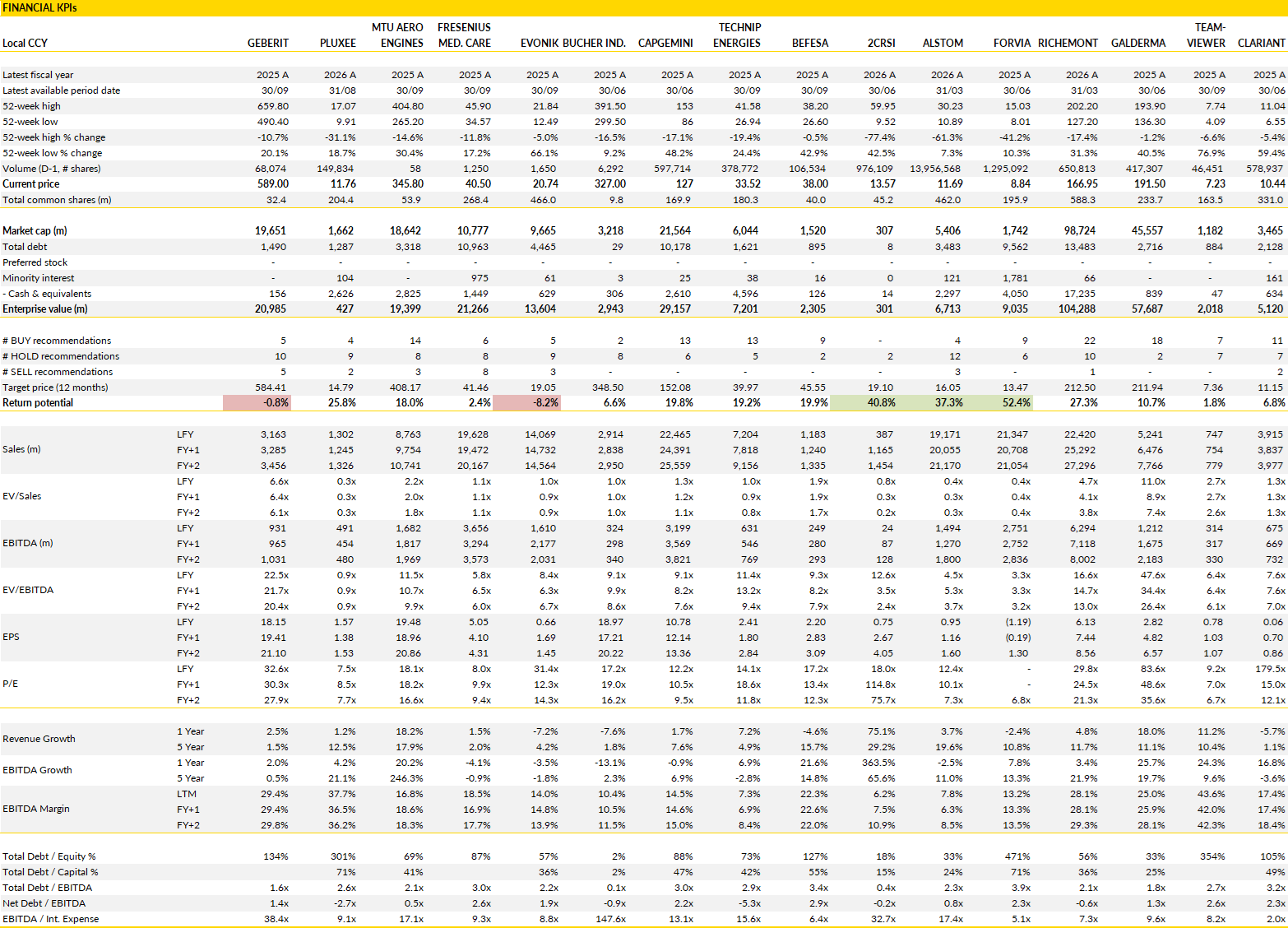
Financial KPIs
Companies covered in this edition: Geberit, Pluxee, MTU Aero Engines, Fresenius Medical Care, Evonik, Bucher Industries, Capgemini, Technip Energies, Befesa, 2CRSI, Alstom, Forvia, Richemont, Galderma, TeamViewer, Clariant
Geberit (GEBN Switzerland): Germany's recovery continues (stronger)
Geberit is benefiting from improving conditions in European construction, with Germany providing the best indication that demand is recovering.
Organic revenue increased 5.2% in Q3, bringing growth for the first nine months to 5.7%. Germany, which accounts for approximately 30% of group sales, accelerated to 7.5% growth from 3.6% in H1, a particularly encouraging development given the prolonged weakness in residential construction. Switzerland also performed well, growing 8.3%, while markets outside Europe delivered double-digit increases. Conditions remain less favourable in Austria, Italy and Eastern Europe, where sales declined. The broader improvement is encouraging, particularly as German residential building permits increased 13% during the first eight months of 2026, potentially supporting further demand from 2027.
Pricing contributed approximately 3% to third-quarter growth, with volumes adding another 2%. This is a moderation in underlying volume momentum compared with H1, although Geberit continues to outperform its end markets. Profitability remains resilient, with Q3 EBITDA reaching CHF249m and the margin holding at 30.2%, down just 40bp despite higher freight, energy and labour costs. Spending on digitalisation, IT and marketing also weighed on profitability, but operating cash flow still increased 8% to CHF303m.
Management has maintained its 2026 guidance for organic revenue growth of 5-6% and an EBITDA margin around the previous year's 29.4%. The figures indicate that Geberit can sustain healthy profitability even before a broader recovery in construction activity takes hold.
The longer-term outlook is becoming more interesting as European residential construction begins to stabilise. Geberit's strong market position, established distribution network and exposure to renovation provide a solid foundation, while a recovery in new housing activity could add another source of volume growth. Germany is particularly important given its size and the improvement already evident in building permits.
The main risk is that construction activity recovers more slowly than expected, especially if financing costs remain elevated. Nevertheless, Geberit's ability to deliver mid-single-digit organic growth and margins around 30% in a still challenging market shows the strength of the business.
Pluxee (PLX France): Strong operations, but Brazil remains a problem
Pluxee delivered a solid FY 2026, but the outlook for Brazil has become much more challenging.
Employee benefit volumes grew 7.7% over the year, accelerating to 11.2% in Q4, helped by €1.5bn of new client wins and an impressive 99.4% net retention rate. Organic revenue growth was just 0.7%, reflecting the initial effects of Brazil's regulatory reforms, which pushed Q4 revenue down 4.9%. Profitability held up much better, with recurring EBITDA rising 3.8% organically to €488m and the margin improving by 101 basis points to 37.5%. Efficiency measures, acquisition synergies and operating leverage contributed most of the improvement, reducing dependence on float income. Cash generation was also healthy at €341m, allowing management to increase the dividend payout ratio to 40%.
Brazil will be a much bigger drag in FY 2027. Management expects the annual revenue impact of regulatory changes to reach approximately €140m, compared with €30m in FY 2026, as merchant fees are aligned at 3.6% across regulated meal and food allowance programs and acquirers are progressively integrated into Pluxee's systems. Recurring EBITDA is consequently expected to reach at least €440m on a like-for-like basis, implying a meaningful decline despite continued growth in transaction volumes.
The first half should be particularly difficult, with some recovery expected later in the year as cost savings begin to contribute. Pluxee has already delivered approximately €50m in efficiency gains during FY 2026, providing some confidence in its ability to absorb part of the regulatory pressure. Nevertheless, the potential for further changes in Brazil makes the eventual earnings impact difficult to assess.
At slighly above 8x forward earnings, Pluxee trades at a roughly 20% discount to Edenred, which seems reasonable given its greater exposure to Brazilian regulatory uncertainty. The underlying business remains attractive, with strong customer retention, growing volumes and considerable scope for further efficiency gains. That said, the gap between volume growth and revenue growth shows how quickly regulatory intervention can undermine the economics of the business. European macroeconomic conditions offer little additional support.
Pluxee could become interesting once the impact of Brazil's reforms is better understood, but for now the discount seems justified despite the strong operational execution.
MTU Aero Engines (MTX Germany): As mentioned, the supply chain is holding it back
MTU's underlying performance remains healthy, but supply chain problems are increasingly delaying revenue recognition across both engine manufacturing and maintenance.
The company has reduced its 2026 organic growth ambition for original equipment sales from mid-to-high teens to mid-to-high single digits, reflecting slower production increases across several engine programs, including the GE9X, GEnx and Pratt & Whitney GTF. The direct impact on profitability is manageable, but the delays raise questions about how quickly production can accelerate in 2027. Importantly, Airbus deliveries for 2026 remain secure, suggesting that the problems are primarily affecting the timing of MTU's own revenue.
The aftermarket business is facing similar constraints, despite continued strong demand for engine maintenance. Parts shortages are extending workshop turnaround times and pushing some revenue into 2027. This is frustrating because maintenance demand remains structurally attractive, supported by ageing aircraft fleets and the substantial work required during engine shop visits. Even the V2500 program, where engine utilisation has declined, continues to benefit from more extensive maintenance requirements.
Third-quarter profitability also looks better after adjusting for exceptional items. A non-cash charge linked to an airline bankruptcy, partly offset by US tariff refunds, depressed reported adjusted EBIT. Excluding these effects, underlying EBIT growth would have been approximately 7-8%, suggesting that operational profitability is holding up reasonably well despite the production bottlenecks.
MTU's valuation has become more interesting, now lower vs its ten-year average of 20x (refer to table) and substantial premiums for Safran and Rolls-Royce. The discount seems somewhat excessive given the strength of maintenance demand and improving conditions surrounding the GTF fleet's return to service. Nevertheless, the company still needs to demonstrate that its suppliers can support higher production and maintenance volumes. Military customer prepayments are helping cash generation, but they do not resolve the underlying execution challenges.
The Capital Markets Day on 30 November should provide a better indication of the 2027 production outlook. MTU remains an attractive aerospace business, although a sustained recovery in delivery growth would make the valuation considerably more compelling.
Fresenius Medical Care (FME Germany): Better profitability
Fresenius Medical Care delivered a better-than-expected third-quarter operating profit, although the underlying revenue trends remain subdued.
Adjusted EBIT reached €545m, representing an 11% margin, despite declining 5.7% year-on-year. Revenue increased just 0.1% organically to €4.94bn, reflecting continued pressure on dialysis treatment volumes and reimbursement dynamics. The Care Delivery division performed relatively well on profitability, with adjusted EBIT increasing 4.1% to €513m and its margin reaching 14.7%. Improved reimbursement rates helped offset weaker treatment volumes, particularly in the US, where same-market treatments declined 1.1%. However, the transition of temporary reimbursement support under TDAPA into a negative year-on-year comparison is beginning to weigh on performance.
The equipment business is showing healthier demand, although profitability has yet to follow. Care Enablement generated 5.1% organic revenue growth, supported by the introduction of the 5008X dialysis system and improving sales outside China. Segment revenue reached €1.45bn, but adjusted EBIT increased only 2.9% to €106m, leaving the margin at 7.3%. This suggests that stronger volumes are not yet translating into meaningful operating leverage. Meanwhile, Value-Based Care remains a relatively small contributor to earnings, generating just €1m in EBIT on revenue of €537m. The division's revenue declined 6.8%, illustrating the challenges of expanding alternative care models profitably.
Management maintained its expectation of broadly flat constant-currency revenue for 2026, while narrowing adjusted operating income guidance towards the lower half of its previous range, implying flat to mid-single-digit declines from the €2.21bn base in 2025. The stronger Q3 profit performance is encouraging, but the outlook suggests that the earnings recovery remains gradual. Fresenius Medical Care has opportunities to improve margins through operational efficiency, better reimbursement and product innovation, although declining US treatment volumes remain a concern.
The business offers meaningful recovery potential if Care Enablement profitability improves and Care Delivery maintains its recent margin progress. For the moment, the results provide some reassurance on execution, but sustained earnings growth will require a more convincing improvement in the underlying operating trends.
Evonik (EVK Germany): Strong cash flow adds weight to the BASF discussions
Evonik's operating performance is improving, giving management a stronger position as it considers BASF's takeover interest.
Third-quarter revenue increased 13% to €3.83bn, with pricing contributing 10% and volumes adding 2%. Adjusted EBITDA rose 40% to €629m, supported by particularly strong performance in Advanced Technologies. The division delivered €377m in EBITDA, an 87% increase, benefiting from healthy demand for high-performance polymers, favourable pricing in crosslinkers and continued strength in animal nutrition. Custom Solutions was less impressive, with EBITDA increasing 7% to €231m. Additives performed well, but demand for care products remained broadly unchanged. Overall, the results show that Evonik is benefiting from stronger pricing and improving demand, although growth remains concentrated in certain businesses.
Cash generation was particularly encouraging. Operating free cash flow reached €601m during the first nine months, more than double the €284m recorded a year earlier. Management has maintained its 40% cash conversion target, implying approximately €850m for 2026, compared with €695m in 2025. Following nine-month EBITDA of €1.73bn, the company now expects to finish in the upper half of its €2.0-2.2bn full-year guidance range. Healthy order books should support the final quarter, although methionine prices are expected to moderate from unusually strong Q3 levels. The improvement in cash flow is particularly valuable because it gives Evonik greater financial flexibility and strengthens its ability to pursue its existing strategy independently.
There was little new information regarding BASF's approach. Evonik reiterated that it does not consider the proposal sufficient to justify formal takeover negotiations, but remains prepared to hold confidential discussions to understand BASF's strategic rationale. This leaves the possibility of a transaction open without committing management to a sale. The stronger operating performance and cash generation could also make it harder for BASF to secure agreement without improving its terms. Evonik's results are encouraging on their own merits, although the substantial contribution from pricing deserves monitoring as market conditions normalise.
With the business recovering and BASF still expressing interest, Evonik has two potential sources of value creation, even if a takeover remains uncertain.
Bucher Industries (BUCN Switzerland): Agricultural demand is recovering slowly
Bucher Industries is seeing tentative signs of improving demand, but the recovery remains uneven and profitability remains under pressure.
Third-quarter orders increased 2.4% organically, supported primarily by Kuhn, where advance purchasing programs in the US helped offset continued weakness in European agricultural equipment markets. Organic sales declined 0.8%, reflecting subdued customer spending and the gradual conversion of new orders into revenue. Conditions in Europe remain particularly difficult, with farmers facing higher input costs and unfavourable weather. Competitor AGCO recently reported an 18% sales decline in the region, illustrating the pressure across the industry. Order intake at Bucher Specials and Emhart Glass remained weak, partly reflecting the irregular timing of larger projects.
Management has maintained its cautious 2026 outlook, expecting a modest organic revenue decline and an adjusted EBIT margin below last year's 8.2%. However, profitability could deteriorate more than the current guidance suggests, particularly at Kuhn and Bucher Municipal. Lower factory utilisation is weighing on operating leverage, while a smaller contribution from higher-margin spare parts is creating an additional drag. A group EBIT margin around 7.1%, before approximately CHF8m of restructuring costs, seems plausible given these pressures. The improvement in agricultural orders is encouraging, but it will take time before stronger demand translates into better capacity utilisation and earnings.
Bucher's diversified portfolio provides some protection against individual market downturns, although it has not prevented the current weakness from affecting several divisions simultaneously. At approximately 11.5x 2027 EBIT, the valuation does not offer much room for further earnings disappointments, particularly with European agricultural demand still subdued. The company remains a well-established industrial business with attractive longer-term positions, but the recovery in profitability could prove slower than expected. A more convincing improvement in European farm equipment demand and factory utilisation would make the outlook considerably more attractive.
Capgemini (CAP France): AI demand is accelerating. Valuation still looking attractive
Capgemini's recovery is gaining traction, with third-quarter organic revenue growth holding at 5% despite a still challenging IT services market.
Revenue reached €6.07bn, supported by particularly strong demand in North America, where constant-currency growth reached 18.3%, including acquisitions. France also improved meaningfully, with organic growth accelerating to 4.9%, helped by manufacturing and consumer-related projects. The UK and Ireland delivered low-double-digit organic growth. AI is becoming an increasingly important contributor, with Strategy & Transformation growing 18.6% at constant currencies, while Intelligent Business Operations continues to expand at a double-digit organic rate following the WNS acquisition.
The main disappointment was a book-to-bill ratio of 0.89x, below its historical Q3 average of 0.98x. Management attributes this to delayed contract signings and expects a stronger fourth quarter, although the weaker bookings deserve monitoring.
Management has raised its 2026 constant-currency revenue growth guidance to 9.0-9.5%, including approximately five percentage points from acquisitions. Interestingly, the implied organic growth of roughly 2-3% in Q4 looks conservative given the recent performance and normal seasonal patterns. Tougher comparisons explain part of the anticipated slowdown, but the underlying demand environment seems reasonably healthy. Capgemini is also benefiting from a gradual shift towards fixed-price and outcome-based contracts as AI changes how clients purchase technology services. This could improve productivity and differentiation over time, although it also introduces execution risks. For now, the company is reinvesting heavily in AI capabilities, keeping its adjusted operating margin target unchanged at 13.6-13.8%. Organic free cash flow guidance of €1.8-1.9bn was also maintained, with further efficiency gains and WNS synergies expected to contribute progressively.
The valuation seems unusually modest for a business showing improving organic growth and expanding exposure to AI-related services. Capgemini trades at approximately 8.9x forward EV/EBIT, slightly below its sector peers, despite stronger recent growth. Its free cash flow yield of around 9% is particularly attractive.
The weaker order intake introduces some uncertainty, and AI-related investment will limit near-term margin expansion. However, the recovery across several important markets, combined with substantial cash generation, makes the discount difficult to justify. If bookings recover as management expects, there should be room for both earnings growth and a higher valuation.
Technip Energies (TE France): Recovering project margins recover, though execution remains key
Technip Energies has recovered quickly from a difficult second quarter, with Project Delivery profitability providing the clearest evidence that operations are stabilising.
The division's EBITDA margin rebounded to 7% in Q3 from just 1.7% in Q2, helping group quarterly EBITDA reach a record €172.4m. Technology, Products & Services also performed well, delivering a 16.1% margin, supported by a favourable mix of consulting activities and growing contributions from Advanced Materials & Catalysts. Management has maintained its 2026 guidance and continues to target more than €800m in EBITDA by 2028. However, the timing of new orders means that some of the expected margin improvement may take longer to materialise, particularly given the company's conservative approach to recognising profits on large engineering contracts.
The Middle East remains the principal operational uncertainty, but discussions with customers over additional project costs seem constructive. Technip Energies has secured compensation arrangements covering projects in Oman and the UAE, while customers in Qatar have acknowledged its entitlement to recover war-related expenses. The remaining work involves documenting the financial consequences, particularly lost productivity and construction delays, which are harder to quantify than additional logistics costs. This reduces the immediate concern around unrecovered expenses, but some claims may take well into 2027 to resolve. Cash generation provides a useful cushion. Free cash flow before working capital movements reached €336m during the first nine months, equivalent to 87% of EBITDA, and management expects full-year conversion towards the upper end of its 70-85% target range.
Capital allocation is becoming another interesting element. Technip Energies has returned approximately €326m through dividends and share repurchases in 2026, while retaining capacity to invest in adjacent markets. Its Reju textile-recycling initiative has secured €135m in Dutch funding, and the Rebound sustainable aviation fuel project in Dunkirk offers another potential growth avenue. These investments could broaden the earnings base beyond traditional energy infrastructure, although their contribution remains some way off. The recovery in Project Delivery margins is encouraging, and the constructive approach to Middle Eastern cost claims suggests that the immediate problems are manageable.
Technip Energies still needs to actually convert its project backlog, but the underlying business looks considerably healthier than the (uesual) volatile quarterly margins would indicate.
Befesa (BFSA Germany): Cash generation is about to get a major boost
Befesa is entering a particularly attractive phase as investment spending moderates, aluminium profitability recovers and a new US tax incentive adds a meaningful source of earnings and cash flow.
The company's Mooresboro zinc refinery qualifies, according to management's assessment, for Section 45X production credits worth approximately €25-30m annually, without requiring additional capital expenditure. Befesa expects to recognise €26m in Q4 2026, lifting its full-year adjusted EBITDA guidance to €286-296m, although the first cash payment will only arrive in H1 2027. The incentive runs until its scheduled phase-out in 2033 and comes on top of the company's existing medium-term operational EBITDA ambition of around €300m. This potentially increases annual EBITDA capacity to €325-330m, with most of the incremental contribution converting into cash.
The operating businesses are also moving in the right direction. Third-quarter adjusted EBITDA increased 10% to €67.8m, despite maintenance shutdowns reducing Steel Dust profitability by 7.5%. Aluminium provided the offset, with Salt Slags EBITDA jumping 60% to €11.2m and Secondary Aluminium returning to a €3.1m profit after losing €2.8m a year earlier. Higher zinc prices have also been supportive. With maintenance work completed, Steel Dust volumes should recover in Q4, while existing US contracts are expected to contribute an additional 60-70kt of volumes during 2026 and approximately 50kt in 2027. The Bernburg expansion is now ramping up and should add around €6m to EBITDA next year. Excluding the tax credit, management has narrowed its 2026 EBITDA guidance to €260-270m, raising the lower end of the previous range.
The improvement in cash generation could materially change Befesa's financial position. With Bernburg completed, capital expenditure should increasingly consist of maintenance spending, allowing more operating cash flow to reduce debt. Leverage could fall below management's 1.5-2.0x target range during 2027, creating room for special dividends or share buybacks.
The main uncertainties remain zinc prices, industrial production volumes and the eventual realisation of the US tax credits. Nevertheless, the combo of recovering operations, lower investment requirements and a recurring tax benefit makes Befesa's earnings growth more and more attractive. The prospect of substantial additional shareholder distributions provides another reason to be positive.
2CRSI (AL2SI France): A lot of (dark) yellow flags have been raised
2CRSI faces a serious credibility problem after auditor EY declined to express an opinion on its FY 2025-26 financial statements. The decision reflects weaknesses in internal controls and insufficient evidence supporting a range of commercial and financial transactions, including dealings with independent customers and related parties. Importantly, this does not establish that the accounts contain fraudulent transactions, but it means the auditor cannot determine whether they are materially reliable. An independent investigation had already challenged some of the allegations made by Grizzly Research, verifying cash receipts covering €425m of historical revenue. Nevertheless, it also identified deficiencies in transaction documentation and counterparty checks. EY's concerns extend across two financial years, making this considerably more serious than an isolated accounting disagreement.
The reported financial performance is difficult to interpret against this all. Revenue for FY 2025-26 was revised down from €416.2m to €386.5m following the removal of €32.5m in US transactions. EBITDA reached €34.2m, although this included a €14m technology transfer agreement with HAW, the founder's holding company, which has not yet been settled in cash. Free cash flow conversion was only around 20%, partly reflecting working capital tied up in this arrangement. The company nevertheless maintains its ambition of €1bn in revenue for FY 2026-27, excluding a separate $610m framework agreement whose commercial prospects have been questioned by the independent expert. There are also ongoing US export-control inquiries involving transactions by the American subsidiary, although 2CRSI states that it is currently participating as a third-party information provider.
The priority now should be restoring confidence in the financial statements and governance. An independent assessment of the HAW agreement is expected before the December shareholder meeting, alongside improvements to financial controls and transaction documentation. Until these issues are resolved, conventional valuation multiples offer limited comfort. Even seemingly attractive forward earnings estimates depend on financial information that the auditor has been unable to verify.
The AI infrastructure market may offer substantial opportunities for 2CRSI, but commercial growth alone cannot compensate for uncertainty over accounting quality and cash generation. A clean audit opinion and demonstrable improvements in governance are essential before the company's ambitious growth targets can be assessed with confidence.
Alstom (ALO France): Another profit warning puts the balance sheet at risk
Alstom has delivered another major disappointment, with operational problems in Germany forcing a dramatic reduction in its FY 2026-27 guidance.
Management now expects an adjusted EBIT margin of just 1%, down from approximately 6.5%, alongside negative free cash flow of €1.5bn. The problems centre on the Coradia Max platform, where technical setbacks, certification delays and difficulties scaling production have resulted in substantial project losses. Six Coradia Max contracts, representing around €5bn of backlog, are now expected to generate negative gross margins. Other German projects have added to the pressure. First-half adjusted EBIT margin is expected to be approximately -4%, compared with 6.4% a year earlier, while production volumes fell 8% to 1,860 cars. The full-year production target has consequently been reduced to around 4,000 cars.
The financial consequences extend way beyond 'just' profitability. Delayed certification and deliveries are postponing customer milestone payments, contributing to a first-half free cash outflow of €1.25bn. Alstom now wants to reduce debt by approximately €2bn by September 2027 to protect its investment-grade credit rating. That could require further disposals, hybrid financing or potentially another equity raise, creating considerable uncertainty for shareholders. The underlying commercial environment remains healthy, with first-half orders increasing 5% to €11bn and a book-to-bill ratio of 1.2x. Management also expects margins to recover to around 6.5% in the second half and return to more normal levels in FY 2027-28. However, achieving such a sharp recovery will require considerably better execution than Alstom has demonstrated recently.
The repeated profit warnings are particularly damaging because they raise doubts about project controls and management's ability to assess contract profitability accurately. Alstom has an attractive position in a growing rail market, supported by a substantial order book and long-term demand for public transport infrastructure. Yet these advantages offer limited protection when individual contracts generate large losses and consume cash.
The priority here and now is stabilising the German projects and securing the balance sheet (without excessive shareholder dilution). Until there is greater confidence in both, the operational recovery remains difficult to underwrite. Alstom's industrial franchise retains considerable value, but the financial risks have increased sharply.
Forvia (FRVIA France): Solid execution in a difficult automotive market
Forvia is holding up reasonably well despite weakening global vehicle production, although its performance remains uneven across regions and businesses.
Third-quarter revenue reached €5.08bn, increasing 1% year-on-year and declining just 0.6% organically, compared with a 1.6% contraction in global light vehicle production. North America and Europe were particularly resilient, outperforming their respective automotive markets by 5.1 and 3.9 percentage points. China remains the biggest problem, with organic revenue falling 17.2% as Forvia struggles to keep pace with local manufacturers. Encouragingly, business with Chinese automakers such as BYD and Chery is improving, although this has yet to offset the broader weakness. Electronics grew 7% organically and Clarion delivered an impressive 22% increase, while Seating showed sequential improvement. Lighting remained particularly weak, declining 7.8%, with management expecting stabilisation only in 2027.
2026 guidance was kept despite a deteriorating industry outlook, which provides some reassurance about operational discipline. Forvia continues to target revenue of €20-21bn at constant currencies and scope, an operating margin of 6.0-6.5% and net cash flow of at least 3% of sales. The group also expects leverage to fall to 1.5x by year-end. First-half cash generation of €432m provides a reasonable cushion, although higher capital expenditure in H2 and persistent inflation in materials, energy and electronic components could complicate delivery. Global vehicle production is now expected to decline 4.2% in Q4, making cost control increasingly important. The planned disposal of the Interiors business should help, with regulatory approvals secured and completion expected before year-end.
Forvia deserves some credit for maintaining profitability and cash flow ambitions in such a difficult market. Its portfolio also contains attractive businesses, particularly Electronics, which could benefit from increasing vehicle technology content over time. However, the weakness in China and Lighting shows that competitive pressures remain substantial, and the company's debt burden limits financial flexibility. The Interiors disposal should improve the balance sheet, but a more convincing recovery in automotive demand would be needed to materially improve the outlook.
Richemont (CFR Switzerland): Slower jewellery growth should come with stronger margins
Richemont remains one of the stronger businesses in luxury, supported by the pricing power and international appeal of its jewellery brands. However, the exceptionally strong growth of recent quarters is unlikely to continue indefinitely.
Jewellery Maisons delivered 24% organic growth in Q1, benefiting from higher prices, new stores and a favourable product mix alongside healthy underlying demand. Growth should moderate as comparisons become tougher, with the US, Japan and South Korea remaining supportive but China showing little evidence of a meaningful recovery. The upcoming H1 results on 13 November should still be solid, although a slowdown in quarterly growth could attract attention given the high expectations surrounding Richemont.
The more interesting development is the potential recovery in profitability. Despite strong sales growth, Richemont's EBIT margin has fallen from approximately 25% to 20% over the past three years, largely because of higher gold prices, currency movements and tariffs. These pressures should gradually ease, particularly as the annual increase in gold prices moderates and favourable exchange rates begin to benefit margins. Richemont has also hedged around half its gold requirements through forward purchases, providing some protection against further price increases. Operating expenses are growing more slowly than revenue, which should provide additional operating leverage. Even with jewellery sales growth settling towards 8-10%, the business could deliver considerably stronger earnings growth as margins recover.
The valuation already reflects Richemont's superior position within the luxury sector, with a premium of approximately 15% to peers. That seems reasonable given its exposure to high-end jewellery, where demand has generally proved more resilient than in fashion and leather goods. Nevertheless, the transition from exceptional sales growth to a more moderate pace could create short-term volatility, particularly if China remains weak or consumers become more cautious.
Richemont's longer-term prospects remain attractive, with meaningful scope to rebuild margins towards historical levels. The company should be able to grow earnings faster than revenue over the coming years, making the current sector premium defensible despite the prospect of slower top-line growth.
Galderma (GALD Switzerland): A surprise CFO exit amid ambitious expansion plans
Galderma's unexpected CFO departure introduces some uncertainty at an important moment for the company. Luigi La Corte is leaving just six months after joining in May 2026, reportedly to pursue another opportunity. The timing is unfortunate, coming shortly after Galderma announced its agreement to acquire ZO Skin Health, a transaction that will require careful financial oversight and integration. La Corte will remain during the transition, which should limit immediate disruption, although his successor has yet to be named. The short tenure naturally raises questions about management continuity, but there is currently no indication that his departure reflects operational or financial problems.
The proposed additions to Galderma's board are encouraging, particularly given the company's ambitions across skincare and medical dermatology. Rosalind Brewer brings extensive consumer healthcare and retail experience from Walgreens Boots Alliance, Walmart and Kimberly-Clark. Her understanding of distribution networks and consumer brands should be valuable as Galderma expands its dermatological skincare portfolio and integrates ZO Skin Health. Petra Rumpf offers complementary expertise in healthcare technology, international expansion and acquisitions. As chair of Straumann, she has considerable experience in medical products and corporate development, which could prove useful for Galderma's injectable aesthetics business and the commercial expansion of Nemluvio. Both appointments remain subject to shareholder approval in December.
These changes suggest that Galderma is strengthening its board to support a broader and increasingly complex business. The addition of experienced executives with substantial acquisition backgrounds should also help management evaluate future opportunities, although integrating ZO Skin Health successfully deserves priority.
The CFO transition is an unwelcome distraction, especially given the company's recent expansion, but the longer-term prospects remain attractive. Galderma has established positions across therapeutic dermatology, aesthetics and skincare, providing several avenues for growth. A credible CFO appointment and smooth execution of the ZO transaction would help restore confidence, leaving the underlying business prospects largely unchanged.
TeamViewer (TMV Germany): New products are growing, but customers are leaving
TeamViewer's latest results show that its newer enterprise products are gaining traction, but the core business continues to deteriorate.
Q3 revenue declined 3.9% to €184.5m, with the SMB segment falling 7.4% to €124.2m. Enterprise revenue increased 4.3% to €60.3m, supported by growing adoption of TeamViewer ONE and its Digital Employee Experience (DEX) platform. However, Enterprise still accounts for only around one-third of group revenue, leaving overall performance heavily exposed to the shrinking SMB business. The Americas were particularly weak, with revenue declining 8.8%, while EMEA was broadly stable. More concerning is the deterioration in net revenue retention from 97% to 92%, suggesting that existing customers are reducing spending or leaving faster than new business can compensate.
Management has reduced its 2026 constant-currency revenue guidance from growth of 0-3% to a decline of 1-2%, citing slower conversion of large enterprise contracts and continued economic uncertainty in Europe. The adjusted EBITDA margin target remains unchanged at 43%, although Q3 profitability weakened, with EBITDA declining 10% to €78.9m and the margin falling 290bp to 42.8%. TeamViewer ONE now represents approximately 10% of Enterprise annual recurring revenue, and management reports encouraging growth among its largest customers. These developments suggest that the product strategy has potential, but commercial execution remains disappointing. Stronger demand for newer solutions is not yet producing enough incremental revenue to compensate for weaker retention across the existing customer base.
The valuation looks inexpensive at 6.4x 2027 EV/EBIT, but the discount is understandable given the deteriorating revenue outlook. TeamViewer still generates attractive margins and has a growing portfolio of enterprise software products, providing a foundation for a recovery. However, management's confidence in renewed growth from 2027 needs to be supported by improving retention and faster enterprise deal conversion. The decline in Enterprise net revenue retention is particularly concerning because it suggests that the problem extends beyond delayed contracts. Until these trends improve, the low valuation alone is insufficient to make the business particularly attractive.
Clariant (CLN Switzerland): A stronger fourth quarter needs to deliver
Clariant's third-quarter results were disappointing on profitability, despite healthy reported sales growth.
Revenue increased 5.6% in local currencies to CHF969m, but the improvement came almost entirely from pricing, with volumes broadly unchanged. Adsorbents & Additives performed particularly well, generating 6.4% sales growth and a 16% increase in EBITDA, supported by stronger additives demand and cost discipline. Care Chemicals grew revenue by 6.6%, although EBITDA remained flat as product mix and the partial reversal of earlier inventory valuation gains weighed on profitability. The biggest disappointment came from Catalysts, where delayed projects linked to tensions in the Middle East contributed to a 30% EBITDA decline to CHF23m. Group adjusted EBITDA fell 6% to CHF152m, leaving the margin at 15.6%, compared with 17.9% a year earlier.
Management nevertheless maintained its 2026 outlook, expecting broadly flat currency-adjusted revenue and an adjusted EBITDA margin around 18%. This implies a substantial improvement in the final quarter, particularly in Catalysts, where the company reports a strong order book and expects a more favourable product mix. The division typically benefits from seasonal strength towards year-end, although the extent of the anticipated recovery looks demanding after the weak Q3 performance. Higher raw material costs and unfavourable inventory effects have also complicated margin development elsewhere. The resilience of Adsorbents & Additives is encouraging, but it cannot fully compensate for the volatility in the larger businesses.
Clariant's full-year profitability target implies approximately CHF670-685m in adjusted EBITDA, leaving relatively little room for further project delays or weaker margins. The company has made progress on cost control, and the strong order pipeline suggests that some of the recent weakness could prove temporary. However, flat underlying volumes and heavy reliance on pricing make the quality of revenue growth less convincing.
A strong fourth quarter could restore confidence in the margin trajectory, particularly if Catalysts recovers as expected. For now, the results leave Clariant looking operationally stable but still short of demonstrating a sustained improvement in profitability.
Thank you for reading!