
Brands, liquor and a lot of results
MTU Aero Engines, Adyen, Aixtron, BIC, Symrise, Rémy Cointreau, Adidas, STMicroelectronics, Deutsche Telekom, Straumann, Rieter, Vonovia, Airbus, SSAB, SIG Group, Ayven

At Lux Opes, we break down companies into quick takes that get straight to the point - what is happening, why it matters, and what to watch next. We publish 2-3 times per week, depending on the news flow.
For the best reading experience, we recommend reading at Lux Opes
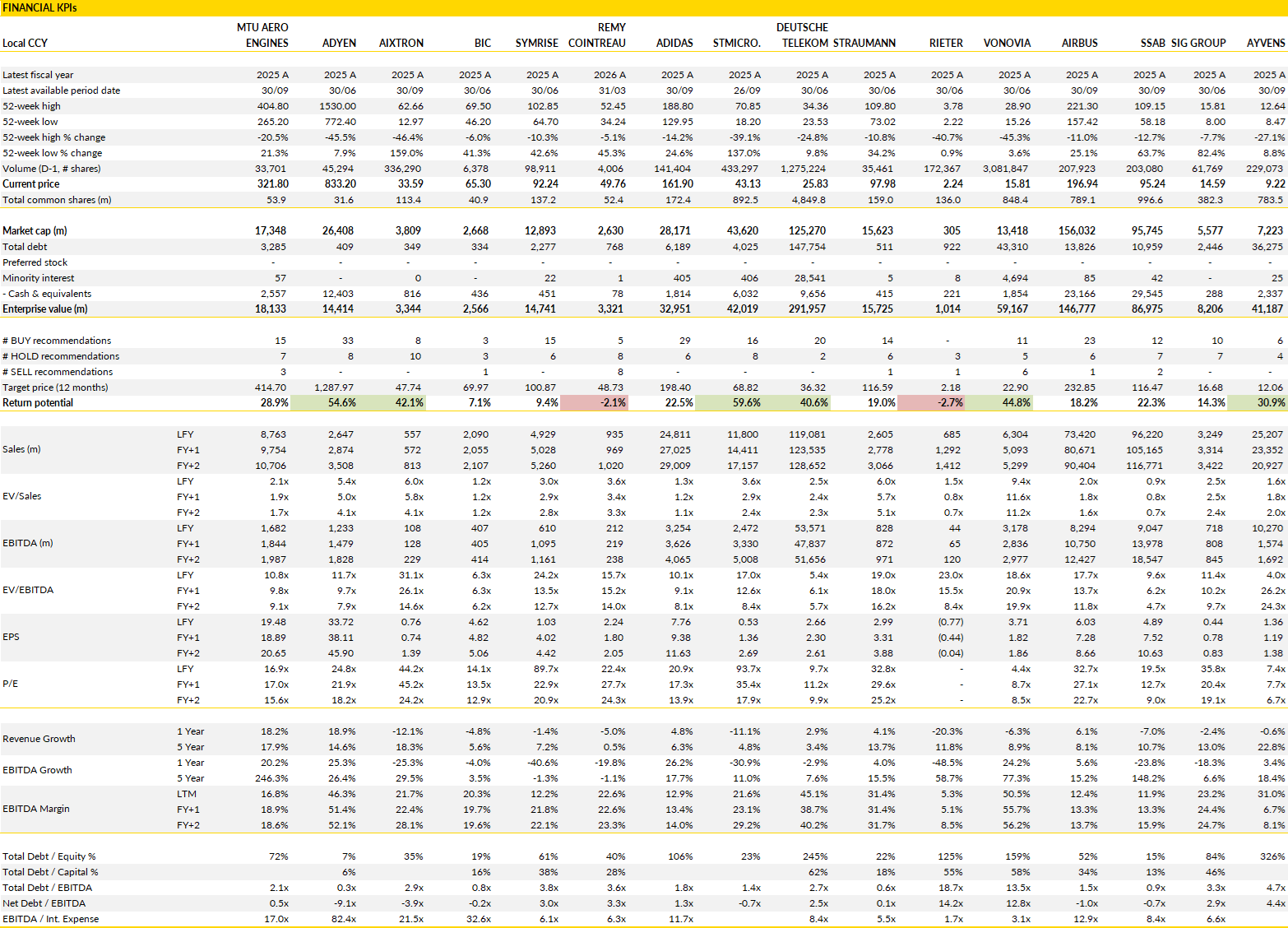
Financial KPIs
Companies covered in this edition: MTU Aero Engines, Adyen, Aixtron, BIC, Symrise, Rémy Cointreau, Adidas, STMicroelectronics, Deutsche Telekom, Straumann, Rieter, Vonovia, Airbus, SSAB, SIG Group, Ayven
MTU Aero Engines (MTX Germany): Strong cash flow, but margins still have some catching up to do
MTU Aero Engines reported solid third-quarter results, with revenue increasing 14% to €2.43bn and adjusted EBIT rising 3% to €349m. The operating margin declined 140 basis points to 14.4%, mainly because higher deliveries of new engines diluted profitability in the OEM business, where margins reached 28.6%. Commercial spare-parts sales grew by a mid-teens percentage, although growth slowed from approximately 19% in Q2. Maintenance performed particularly well, with revenue increasing 14%, while GTF-related work accounted for around 45% of MRO revenue. Defence sales rose 10% to €174m, supported by EJ200 and T408 engine deliveries. Free cash flow was particularly strong at €172m, helped by advance payments from military customers, although this benefit should not be treated as recurring.
Management maintained its 2026 adjusted EBIT guidance of €1.35-1.45bn and narrowed its revenue target to €9.5-9.7bn. Cash conversion guidance also improved to 55-60%, from 50-60% previously. The underlying outlook has strengthened in maintenance and spare parts, where MTU now expects mid-teens growth for the full year. However, commercial series production is expected to grow by only a mid-to-high-single-digit percentage, down from the previous mid-to-high-teens target. The recovery in Pratt & Whitney's GTF engine fleet remains an important driver of maintenance demand, although the pace of aftermarket growth could moderate as the recovery progresses. Higher new-engine deliveries also create a less favourable earnings mix, limiting margin expansion despite healthy revenue growth.
MTU's valuation seems attractive following the recent share price weakness. At approximately 15.7 times forward earnings, the shares trade below their ten-year average of 20.4 times and at discounts of 28% to Safran and 32% to Rolls-Royce. These discounts look substantial given MTU's exposure to commercial aviation aftermarket demand and the improving GTF situation.
That said, the weaker OEM margin and slowing spare-parts growth deserve attention, particularly after several strong quarters. The Capital Markets Day on 30 November could provide a boost should MTU be able to provide a clearer picture of medium-term profitability and cash generation. At the current valuation, the shares look interesting, but stronger evidence of margin recovery would make the case more convincing.
Adyen (ADYEN Netherlands): Stronger demand coming at the expense of margins (again)
Adyen delivered another strong quarter, with net revenue increasing 22% at constant currencies to €738m, supported by €451bn in processed payment volumes. The take rate remained broadly stable at 16.4 basis points, showing that growth continues to come primarily from higher transaction volumes. Management maintained its 2026 revenue growth guidance of 21-23%, reflecting healthy demand from existing customers and continued expansion into new markets. However, the company reduced its EBITDA margin guidance to 50%, compared with the previous expectation of approximately 51.7%. More significantly, Adyen abandoned its medium-term ambition of exceeding a 55% EBITDA margin by 2028. The decision creates uncertainty around future profitability, particularly as the company has not provided a revised margin target.
The additional spending reflects growing opportunities in the US and emerging payment technologies. Adyen plans to accelerate recruitment, particularly of experienced engineers in expensive technology markets such as San Francisco, while higher share-based compensation will add to costs. Management also sees considerable potential in agentic AI, where autonomous software systems could increasingly initiate and manage payments. Meanwhile, recently acquired Talon.One and Orb are attracting new customers, with Orb adding Route and Wasabi Technologies since the acquisition. These investments could support faster revenue growth over time, but management has not quantified the expected contribution. The company indicated that margins should remain broadly around current levels, suggesting that operating leverage may be limited for longer than previously expected.
Adyen's decision to prioritise growth is understandable given the opportunities in US payments and AI-driven commerce. However, abandoning a long-standing profitability target is a meaningful change, especially for a company whose valuation has historically reflected expectations of both rapid growth and substantial margin expansion.
At roughly €830 per share, the stock has already fallen considerably from previous highs, but the latest guidance makes it harder to assess its longer-term earnings potential. Revenue growth remains impressive, and the additional investment could strengthen Adyen's competitive position. Still, without evidence that higher spending will translate into faster growth, the shares may struggle to recover. The business remains attractive, but the investment case has become less straightforward.
Aixtron (AIXA Germany): The recovery is broadening beyond photonics
As expected and recently flagged, Aixtron's third-quarter results confirmed a sharp recovery in demand, with orders increasing 122% year-on-year to €275m and revenue growing 54% to €184m. Optoelectronics accounted for approximately 68% of equipment orders, supported by strong investment in optical connectivity for AI data centres. Profitability also improved considerably, with the EBIT margin reaching 30.9%, helped by higher production volumes and a favourable product mix. Free cash flow increased to €128m, although much of the improvement came from customer advance payments. The order backlog almost doubled to €549m, providing a strong base for 2027. Management maintained its full-year guidance of €560m in revenue, plus or minus €30m, a gross margin of approximately 42% and an EBIT margin of 17-20%.
Encouragingly, demand is also recovering in Aixtron's power electronics business, where GaN and SiC customers are reporting better capacity utilisation and renewed investment activity. AI infrastructure is creating additional opportunities for both technologies, with GaN increasingly used in lower-voltage power applications and SiC supporting higher-voltage systems.
Meanwhile, the transition towards 1.6T optical connectivity should sustain investment in photonics equipment, with co-packaged optics potentially providing another source of demand from 2027. Management expects orders to remain at least around current levels over the coming quarters, with further growth possible. Aixtron is already working with suppliers to increase manufacturing output, suggesting that the recovery could extend well beyond the recent surge in optoelectronics orders.
The improvement in order intake is particularly significant because the current quarterly run rate implies approximately €1.1bn in annual orders, almost twice the company's 2026 revenue guidance. Converting this demand into shipments will require a successful production ramp-up, and customer investment cycles remain volatile, particularly in power semiconductors. However, the recovery now seems broader and more sustainable than earlier in the year.
At roughly 11x expected 2027 EBITDA, Aixtron trades well below its three-year average of around 16x. That discount looks more and moare difficult to justify given the growing backlog, strong margins and improving demand across multiple technologies.
BIC (BB France): Margin recovery is on track, but (decent) growth still remains far off
BIC reported third-quarter revenue of €516m, down 0.6% organically, with continued weakness in its traditional businesses offsetting stronger performance in shavers.
Lighters were particularly disappointing, with sales declining 4.6% across all regions after growing during the first half. Stationery revenue fell 1.1%, reflecting difficult conditions in North America and Latin America, although Europe and the Middle East/Africa remained positive. Shavers performed better, growing 3.9%, helped by strong razor sales in Europe and a 29% increase at Tangle Teezer. However, competitive pressure continues to affect the business in the Americas. Overall, organic revenue growth reached just 1% during the first nine months, showing that BIC is still struggling to generate consistent growth across its portfolio.
Management maintained its 2026 guidance, expecting modest organic revenue growth, an adjusted operating margin slightly above 14% and broadly stable free cash flow. The margin target represents an improvement from 13.6% in 2025, despite limited revenue growth. BIC is benefiting from cost discipline and a stronger contribution from higher-growth categories, particularly beauty and personal care. Looking further ahead, management aims to accelerate annual organic growth to approximately 3% over 2026-2030. Achieving this will require stronger performance in stationery and lighters, alongside continued expansion in shavers and Tangle Teezer. The latter is developing into an important growth driver, but its contribution remains relatively small compared with BIC's established businesses.
BIC's defensive product portfolio, established brands and cash generation provide a solid foundation, although the latest results offer little evidence of a broad demand recovery. The improvement in operating margins is encouraging, particularly given the weak sales environment, but sustained earnings growth will eventually require better revenue performance.
The current valuation needs to be assessed against a business delivering only modest organic growth, with the potential for higher margins and a gradual recovery in its core categories. BIC remains an interesting turnaround candidate, but the case for a substantial rerating would be stronger if the company could demonstrate that its 3% medium-term growth ambition is achievable.
Symrise (SY1 Germany): Better volumes, but margins are still disappointing
Symrise delivered a stronger third quarter, with organic revenue growth accelerating to 5.3% from 4.5% in Q2. Volumes increased 6.1%, although pricing remained negative at -0.8%, suggesting that customers are buying more without giving Symrise much room to recover prices. Scent & Care led the improvement, with organic growth of 5.6%, supported by strong demand for aroma molecules and higher volumes across the division. Fragrances also grew, although UV filters remained particularly weak, with sales declining at a double-digit rate. Taste, Nutrition & Health grew 5.2%, helped by continued demand in food applications and a return to modest growth in pet food. The latter is encouraging after a difficult period, but pricing pressure in pet nutrition remains an issue.
Overall, the quarter shows a healthier demand environment, although growth is still coming almost entirely from volumes.
Management now expects full-year organic growth near the midpoint of its 2-4% guidance range, following 3% growth during the first nine months. However, Q4 growth is expected to slow from the third-quarter level because of tougher comparisons. More disappointing is the revised profitability outlook, with the adjusted EBITDA margin now expected in the lower half of the previous 21.5-22.5% range. Investments in technology, innovation and personnel are limiting the benefit from higher volumes, while negative pricing adds further pressure. Symrise should eventually benefit from these investments, particularly through product development and operational improvements, but the immediate impact on earnings is less encouraging. The recovery in pet food also remains fragile, with palatability performing better than nutrition.
Symrise has a strong competitive position in ingredients and fragrances, supported by long-standing customer relationships and exposure to relatively defensive consumer markets. That said, the results suggest that improving demand is not translating into the margin recovery investors might have expected. The company needs to deliver more consistent earnings growth to justify a stronger valuation.
The volume recovery is encouraging, particularly in Scent & Care, but continued pricing pressure and higher operating costs are holding back profitability. Symrise remains a high-quality business, but the current operating performance does not seem particularly compelling at this valuation.
Rémy Cointreau (RCO France): Cognac is recovering, but the valuation is stretching it
Rémy Cointreau's recovery is gaining traction in cognac, where organic sales increased 12.4% in the second quarter, marking the fourth consecutive quarter of growth. China remains the main contributor, with strong shipments ahead of the Mid-Autumn Festival supporting demand. The US is proving more difficult, although underlying consumption seems relatively resilient. Much of the weakness reflects inventory reductions following changes to distribution arrangements, which should eventually normalise.
Group revenue increased 4.2% organically to €288m, but the performance was uneven. Liqueurs & Spirits declined 7.4%, also affected by US destocking, while Western European consumers remained cautious. Africa continued to grow, and the UK showed signs of improvement. Cognac is clearly doing the heavy lifting, with the rest of the portfolio still struggling to regain momentum.
Management maintained its outlook for a return to sustainable organic revenue growth in FY2026/27, expecting a gradual improvement through the year. Currency movements have become considerably more favourable, with foreign exchange now expected to add €15m to revenue and €3-5m to operating profit, compared with previously anticipated negative effects of €15m and €5-8m, respectively. The expected tariff burden has also fallen from €20m to €5m, although management intends to reinvest these savings in growth initiatives. This means the lower tariff costs will not immediately improve profitability, but the additional spending could help rebuild brand momentum. Easier comparisons, improving Chinese demand and the eventual completion of US distributor inventory adjustments should also support the recovery over the coming quarters.
The improvement in cognac is encouraging, particularly after the prolonged downturn in premium spirits, but Rémy Cointreau's valuation already reflects considerable optimism. At approximately 28 times forward earnings, the shares look expensive for a business still facing weak demand across several categories and considerable uncertainty in the US.
The stronger currency outlook should help reported earnings, but it doesn't do much to change the underlying operating performance. China offers a source of growth, and the US destocking issue should prove temporary, yet the recovery remains concentrated in that one division. With the shares already having performed strongly this year (relatively), further gains seem difficult to justify without a broader improvement in sales and profitability.
Adidas (ADS Germany): Europe should bounce back, and the shares still look cheap
Adidas continues to deliver good growth across most of its markets, although the third quarter exposed some weakness in Europe.
Revenue increased 7% at constant currencies to €7.25bn, supported by double-digit growth in every region outside Europe. Japan and South Korea grew 19%, Latin America 16%, Greater China 13% and North America 12%, showing that the brand's recovery remains broad-based. Europe was the exception, with sales declining 4% as retailers reduced orders amid elevated inventories, particularly in lifestyle footwear. A temporary disruption from the SAP system migration also delayed wholesale shipments into Q4. Direct-to-consumer sales in Europe still grew at a high-single-digit rate, suggesting that underlying demand is healthier than the regional headline implies. Across the group, apparel grew 19%, while footwear sales were flat, reflecting continued weakness in wholesale orders.
Profitability improved considerably, with EBIT increasing 37% to €1.01bn, although the result benefited from €200m in US tariff refunds. Excluding this benefit, the underlying gross margin was approximately 52%, slightly above last year's 51.8%. Management maintained its recently upgraded 2026 guidance of 9-10% currency-neutral revenue growth and €2.5bn in EBIT. Europe is expected to return to high-single-digit growth in Q4 as delayed shipments are completed and wholesale orders recover. Footwear should also improve, although the inventory situation in lifestyle products deserves attention. The contrast between direct-to-consumer growth of 17% and wholesale growth of just 2% suggests that consumer demand remains stronger than retailer purchasing activity, which could support a recovery once inventories normalise.
At approximately 13-14x expected 2027 earnings, Adidas trades well below its historical valuation of more than 20x. This discount seems excessive given the company's improving profitability, continued market share gains and strong international demand. The reliance on tariff refunds boosted reported Q3 earnings, and the footwear business still needs to return to growth, but neither issue seems sufficient to justify such a depressed multiple.
A recovery in European wholesale shipments during Q4 would help demonstrate that the recent slowdown is largely temporary. With the brand performing well across most regions and margins recovering, Adidas looks attractively valued, provided the expected footwear improvement materialises.
STMicroelectronics (STMPA France): The recovery is accelerating, and margins are following
STMicroelectronics delivered yet another encouraging quarter, with revenue increasing 17.9% year-on-year to $3.76bn and adjusted operating profit reaching $429m. Operating margin improved to 11.4%, supported by a 210-basis-point sequential increase in gross margin to 37.3%.
Demand was particularly strong in personal electronics, communications equipment and computer peripherals, while bookings continued to improve across the business. Inventory levels also look healthier, with days of inventory declining to 126 from 135 a year earlier. Distributor inventories remain below normal targets, suggesting that customer restocking could provide additional support. Adjusted EPS of $0.37 was weaker than expected, but this reflected financial instrument losses and a higher tax rate, not deterioration in the underlying business. The operational recovery seems to be progressing well.
Management's fourth-quarter guidance is particularly encouraging. Revenue is expected to reach approximately $4.15bn, representing sequential growth of 10.5%, while gross margin should increase further to around 39%. This would bring full-year revenue to approximately $14.5bn, up nearly 23%, with second-half growth exceeding normal seasonal patterns. Importantly, the margin improvement is occurring despite continued costs from unused manufacturing capacity, which still account for approximately 40 basis points. Higher utilisation should therefore provide further operating leverage as volumes recover.
Beyond the cyclical improvement, STMicroelectronics is benefiting from growing semiconductor demand in AI data centres and low-Earth-orbit satellite communications. Management has previously indicated ambitions for data-centre revenue exceeding $1bn in 2026 and well above $2bn in 2027, although these targets were not reiterated in the latest release.
The shares are no longer particularly cheap on historical multiples, but the current recovery in revenue, utilisation and margins could justify a higher valuation, particularly if AI-related applications become a larger part of the business. The company still faces cyclical risks, and the pace of the recovery outside its strongest end markets remains important.
Nevertheless, stronger bookings, lean distributor inventories and better-than-expected fourth-quarter margin guidance suggest that earnings have considerable room to improve. The valuation seems reasonable given the improving operating performance, with further upside depending on how quickly STMicroelectronics converts higher revenue into sustainable profit growth.
Deutsche Telekom (DTE Germany): Strong US performance and fewer reasons to worry
T-Mobile US continues to deliver strong growth, reinforcing the importance of the American business to Deutsche Telekom's earnings and cash generation.
Third-quarter service revenue increased 6% to $19.4bn, while core adjusted EBITDA grew 11% to $9.6bn, showing continued operating leverage. Postpaid net additions remained healthy at 274,000, broadly unchanged from the previous quarter, while average revenue per account increased 4%. Adjusted free cash flow reached $14.5bn over the first nine months, up 5%, allowing T-Mobile to raise its quarterly dividend by 15% to $1.17 per share. Management also increased its 2026 guidance, now expecting core adjusted EBITDA of $37.35-37.45bn and adjusted free cash flow of $18.7-18.8bn. The increases are relatively small, but they confirm that the US business continues to perform well despite its already substantial scale.
Several developments could also ease concerns surrounding Deutsche Telekom's US exposure. According to Bloomberg, discussions about a potential merger between Deutsche Telekom and T-Mobile US have been shelved for now, removing a source of uncertainty that had weighed on both shares. Meanwhile, the threat from Starlink seems manageable. T-Mobile US remains uninterested in providing Starlink with a mobile virtual network arrangement, and building a competitive nationwide mobile service without access to existing terrestrial infrastructure would require substantial investment and time. Meta's Muse initiative could even create opportunities for T-Mobile, particularly if new AI-powered devices stimulate connectivity demand. Management also sees potential to increase pricing over time, as existing customers generally pay less than newly acquired subscribers. Its upcoming T-Mix plans, featuring longer contract durations, could help improve customer retention and revenue per account.
Deutsche Telekom trades at approximately 10x earnings, compared with around 14x for the broader telecom sector. The discount seems hard to justify given T-Mobile US's consistent earnings growth, improving cash generation and opportunities for further pricing gains. Competitive risks from satellite connectivity and emerging AI devices deserve attention, but neither currently seems likely to undermine the economics of established mobile networks.
With the proposed merger apparently off the table and US operations continuing to exceed expectations, Deutsche Telekom offers an attractive combination of earnings growth and relatively modest valuation. The shares look undervalued (ioo), particularly if T-Mobile can maintain its current operating momentum.
Straumann (STMN Switzerland): US demand holds up, with China starting to recover
Straumann delivered another strong quarter, with organic revenue growth of 9.2%, supported by continued market share gains across its dental implant and digital dentistry businesses.
North America remained particularly resilient, growing 7.5% despite high interest rates and continued pressure on consumers' ability to finance dental treatments. Patient volumes were broadly stable, with demand for premium iEXCEL implants and the more affordable Neodent range supporting growth. The performance is encouraging given the difficult financing environment, which has also reduced private equity investment in dental service organisations. Longer term, North America offers considerable room for expansion. Annual implant penetration stands at approximately 80 per 10,000 inhabitants, compared with 130-180 in Europe. Straumann's broad portfolio allows it to serve both premium and value-conscious customers, which should help it capture further market share as treatment penetration increases.
China is also showing signs of improvement after several difficult quarters. Revenue returned to growth in Q3, helped by stable patient demand and easier comparisons. However, uncertainty remains around the next round of volume-based procurement, expected to take effect in early 2027. Management anticipates potential price reductions of 5-15%, which should be accompanied by a substantial increase in treatment volumes. Straumann has already shown that it can compete effectively in a more price-sensitive environment, although the eventual impact on revenue and profitability will depend on the final procurement rules. Easier comparisons should support stronger growth in Q4, while the company's challenger brands and digital solutions provide additional opportunities across Asia. The recovery in China could become an increasingly important contributor alongside the more established North American business.
Straumann's ability to sustain high-single-digit organic growth in a challenging consumer environment shows the strength of its competitive position. The company benefits from established relationships with dental professionals, a broad implant portfolio and continued investment in digital dentistry. North American demand seems capable of remaining resilient even without meaningful interest rate relief, while China offers potential for faster volume growth once procurement uncertainty clears. Pricing pressure in China and affordability constraints in the US remain risks, but neither currently seems to be undermining Straumann's market share gains.
Rieter (RIEN Switzerland): Turnaround taking longer than expected
Rieter's recovery remains disappointing despite the significant expansion of its business through the Barmag acquisition.
Nine-month revenue almost doubled, but organic sales declined 2%, showing that demand for the company's traditional textile machinery remains weak. China performed well, growing 51% on strong automation demand, while India benefited from factory modernisation projects, with sales increasing 5%. However, the Americas suffered a 51% decline, and Turkey continues to weigh on European demand. The growing contribution from Asia is supporting volumes but also putting pressure on pricing and margins. Management now expects 2026 revenue at the lower end of its CHF1.3-1.5bn guidance range and has reduced its EBIT margin outlook to between -2% and 0%, compared with the previous 0-3%.
The restructuring program is progressing, although its financial benefits are taking longer to emerge. Rieter has reduced its workforce by approximately 40% since the end of 2022 and is shifting more operations to China and India to improve its cost position. Barmag integration synergies are reportedly running slightly ahead of schedule, particularly in purchasing and overheads, but weaker volumes, rising raw material costs and an unfavourable geographical mix are offsetting these savings.
Management does not expect a meaningful market recovery in 2027, with the full benefits of restructuring unlikely to materialise before 2028. Incoming CEO Daniel Lippuner, who previously held senior positions at Rieter, Oerlikon Textile Components and Saurer, brings relevant industry experience. His appointment suggests continuity in the existing restructuring strategy.
At ~6.6x 2028 EBITDA, Rieter trades below its historical average of 9x. The discount seems good enough given the repeated delays in restoring profitability and the continued weakness in several important markets. Barmag and the lower cost base should eventually improve earnings, but the recovery remains heavily dependent on stronger machinery demand.
With limited prospects for a substantial improvement before 2028, there seems little reason to expect a near-term rerating despite the relatively low valuation.
Vonovia (VNA Germany): Higher rates are taking their toll
Vonovia's rental business remains resilient, but higher interest rates are forcing management to scale back its growth ambitions.
Rising financing costs are reducing demand for property disposals and development projects, while interest expenses are putting additional pressure on earnings. The company now expects 2026 adjusted EBITDA in the lower half of its €2.95-3.05bn guidance range, with adjusted EBT of approximately €1.9bn. Organic rental growth has been reduced slightly to 3.8%, reflecting lower investment and less favourable German rent indices.
More concerning is the medium-term outlook. Management now expects earnings to remain broadly flat through 2028, abandoning its previous ambitions for sustained growth. Even by 2028, EBITDA is expected to reach only the lower end of the €3.2-3.5bn range, despite rental growth recovering towards 4.5%.
Balance sheet repair is becoming increasingly a thing. Vonovia reduced planned investment to approximately €1.3bn in 2026 and €1.7bn in 2028, suspended new Manage-to-Green projects and scaled back development activities. A strategic review of the property development business is also underway. These measures should help preserve cash, but lower investment could eventually constrain rental growth and portfolio improvements. With property values expected to remain broadly stable this year, achieving the targeted loan-to-value ratio of approximately 40% by 2028 also looks more and more difficult. Vonovia's substantial residential portfolio provides predictable rental income, but its financial flexibility remains limited.
Political uncertainty in Berlin adds another complication. A potential left-leaning coalition is considering the socialisation of large private housing portfolios from 2028, with proposed compensation of approximately €100,000 per apartment. Under those terms, Vonovia could face an estimated €8bn loss. However, implementation would require legislation, financing and the resolution of substantial constitutional questions. The federal government is separately considering protections requiring market-value compensation, although these remain proposals. Actual expropriation therefore seems far from certain, but the political risk could continue weighing on the shares.
At the current valuation, Vonovia offers exposure to a resilient rental business, yet stagnant earnings, slower deleveraging and unresolved regulatory risks make a sustained recovery in the share price difficult to see (for now).
Airbus (AIR France): Preparing for a strong finish
Airbus is preparing for a substantial acceleration in aircraft deliveries during the final quarter, with management maintaining its 2026 target of approximately 870 aircraft despite persistent supply chain constraints.
Engines remain the main bottleneck, although all components required to meet the annual delivery target are reportedly already on the final assembly line. Recent quality problems affecting certain A321neo and A330neo aircraft have also been brought under control, with deliveries expected before year-end. Third-quarter adjusted EBIT declined 9% to €1.77bn, representing a margin of 10.1%. Commercial Aircraft performed relatively well, but higher R&D spending weighed heavily on Defence & Space, while Helicopters also disappointed. Free cash flow was negative at €102m, largely because inventories increased by approximately €2.8bn during the quarter. This inventory build-up should reverse as aircraft are delivered, making Q4 particularly important for cash generation.
Management reiterated its full-year targets of approximately €7.5bn in adjusted EBIT and €4.5bn in free cash flow. Meeting these objectives will provide reassurance that Airbus can manage its industrial ramp-up despite continuing supplier constraints. The company has also maintained its 2027 engine supply assumptions for the A320 family and currently has no plans to build aircraft without engines. Shareholders should also benefit from the planned €5bn share buyback, which Airbus intends to launch before year-end. The combination of higher deliveries, inventory conversion and share repurchases could provide meaningful support over the coming months.
At ~21.1x 2027 earnings and a close to 5% free cash flow yield, Airbus is not particularly cheap on near-term metrics. But the valuation becomes more attractive if production volumes increase as planned, allowing earnings and cash generation to grow considerably over the following years. The main risk remains execution, particularly given the dependence on engine suppliers and the unusually large concentration of deliveries in Q4.
Still, the current share price seems to leave plenty og room for improvement if Airbus meets its annual targets. A successful year-end delivery ramp-up would strengthen confidence in the company's longer-term earnings potential, making the shares attractive despite the remaining operational challenges.
SSAB (SSABA Sweden): US steel prices are doing the heavy lifting
SSAB delivered a solid third quarter, with EBITDA increasing 13% year-on-year to SEK 3.26bn despite the usual summer slowdown and scheduled maintenance. Revenue grew 12% to SEK 25.6bn, supported by stronger pricing across the main divisions. The Americas business benefited from particularly favourable conditions in the US plate market, with prices increasing 8% sequentially, ahead of management's previous guidance. European operations also performed well despite weak demand, with EBITDA more than doubling year-on-year to SEK 875m. Special Steels remained the largest earnings contributor at SEK 1.62bn, supported by relatively resilient demand from industrial customers. Volumes declined across the main divisions, particularly in Europe, but pricing discipline helped protect profitability. Free cash flow was slightly negative at SEK 167m as spending resumed on the Luleå transformation project, leaving SSAB with a still-strong net cash position of SEK 8.4bn.
The outlook for Q4 remains encouraging, particularly in North America, where management expects further price increases of 5-10%. Europe and Special Steels should also benefit from increases of up to 5%, although weak automotive and construction demand continues to limit volumes. SSAB's exposure to heavy transport, energy and material handling provides some protection, with these markets holding up better than traditional European steel-consuming industries. Management also reduced its 2026 capital expenditure guidance from SEK 13.5bn to SEK 11.2bn, primarily because of changes in supplier payment schedules. The overall investment program remains unchanged, meaning some spending will shift into subsequent years.
At c. 5.4x 2027 EBITDA, SSAB trades at a modest premium to the broader steel sector. This makes sense given its stronger balance sheet, higher-value product portfolio and favourable exposure to US plate prices. European demand remains weak, and the Luleå investment program will absorb considerable capital over the coming years, but the company is managing the cycle well.
With further price increases expected in Q4 and net cash providing financial flexibility, SSAB looks attractive despite the recent improvement in earnings.
SIG Group (SIGN Switzerland): Stronger margins are starting to change the story
SIG's latest results and Capital Markets Day suggest that the improvements seen over the past year are becoming more sustainable. Third-quarter organic revenue growth accelerated to 7.2%, bringing nine-month growth to 3%, while the adjusted EBIT margin increased 260 basis points to 17.4%. This marks the fourth consecutive reporting period in which SIG has delivered stronger growth and profitability than expected. Management has now raised its 2026 margin guidance to 16.0-16.5%, although its organic growth target remains unchanged at 0-2%. That seems cautious given the recent momentum, even allowing for tougher comparisons in Q4. The stronger margins are particularly encouraging because they show that SIG can improve profitability without relying on a substantial acceleration in sales.
The Capital Markets Day also provided a good idea of where future earnings growth could come from. Aseptic cartons are already generating an adjusted EBIT margin of 19.1%, close to the new medium-term target of more than 20%. Demand is supported by growing consumption of dairy products, high-protein beverages and convenient single-serve formats, while sustainability requirements are encouraging customers to consider carton packaging. SIG has consistently gained market share, achieving annual volume growth of approximately 2% since 2020 against a broadly flat market. The weaker businesses offer a different opportunity. Bag-in-Box & Spouted Pouch generated a margin of just 4.7%, while the remaining operations, including chilled cartons, achieved 6.4%. The planned €250m goodwill impairment reflects their disappointing performance, but even modest operational improvements could make a meaningful contribution to group profitability.
Management's medium-term ambitions of 3-5% organic growth and an adjusted EBIT margin above 18% look more credible. The gap between the profitability of aseptic cartons and the rest of the portfolio also gives SIG considerable scope to improve its earnings mix. The weaker divisions still need attention, and the impairment is a reminder that not every acquisition has delivered as intended.
That said, SIG's recent execution has been consistently strong, and the underlying aseptic business seems capable of supporting further growth. The improving operating performance makes the current valuation more and more interesting, particularly if management can sustain the recent margin gains.
Ayvens (AYV France): Stronger fundamentals deserve a higher valuation
Ayvens continues to deliver impressive operating results, even as the used-car market remains challenging.
Third-quarter margins on earning assets increased to 620 basis points, up from 609 in Q2 and 587 in Q1, reflecting management's decision to prioritise profitability over fleet expansion. The financed fleet declined 2.7% year-on-year to 2.47m vehicles, although the pace of contraction has slowed considerably. Management still expects the fleet to stabilise by year-end, with earning assets benefiting from a growing proportion of higher-value electric vehicles. Cost discipline has been equally strong. The underlying cost-to-income ratio improved to 49.2%, well below the full-year target of approximately 52%, while operating expenses remained broadly stable at €402m. Results indicate that the integration and efficiency measures are delivering tangible benefits, with the core leasing business performing better than the headline earnings imply.
Used-car sales remain the main source of pressure. Earnings per vehicle before depreciation fell to €118 from €326 in Q2, reflecting a higher proportion of electric vehicles being resold at a loss and weaker pricing for combustion-engine vehicles. The division recorded a €21m loss after impairment, only slightly worse than Q2 despite deteriorating market conditions. This compares favourably with the much sharper decline reported by competitor Arval. Ayvens also absorbed a €58m negative hyperinflation impact from Turkey, although a favourable tax adjustment helped offset this at group level. Net profit attributable to shareholders after AT1 distributions reached €222m. Importantly, the stronger contribution from leasing margins and cost savings suggests that underlying profitability is improving even as residual-value pressures persist.
The valuation remains difficult to reconcile with this operating performance. Ayvens trades at approximately 7x forward earnings and ~1x tangible book value, despite maintaining strong leasing margins, improving efficiency and showing relatively limited deterioration in used-car profitability.
There are still risks, particularly from electric-vehicle residual values and the gradual replacement of older, higher-margin contracts with newer business. However, the company's disciplined approach to fleet growth should help protect returns.
The shares seem substantially undervalued if Ayvens can sustain its current profitability and demonstrate that used-car losses remain manageable. Each successive quarter is providing more evidence that the underlying business is stronger than its valuation suggests.
Thank you for reading.