A big one
Deutsche Börse, Ferrari, BMW, Heidelberg Materials, Zalando, AUTO1, Endesa, Bayer, Cirsa, Scout24, ASM International, dsm-firmenich, Raiffeisen Bank International, Fresenius, Gestamp, Deutz, Kontron, IMCD, RENK, Weir

At Lux Opes, we break down companies into quick takes that get straight to the point - what is happening, why it matters, and what to watch next. We publish 2-3 times per week, depending on the news flow.
For the best reading experience, we recommend reading at Lux Opes
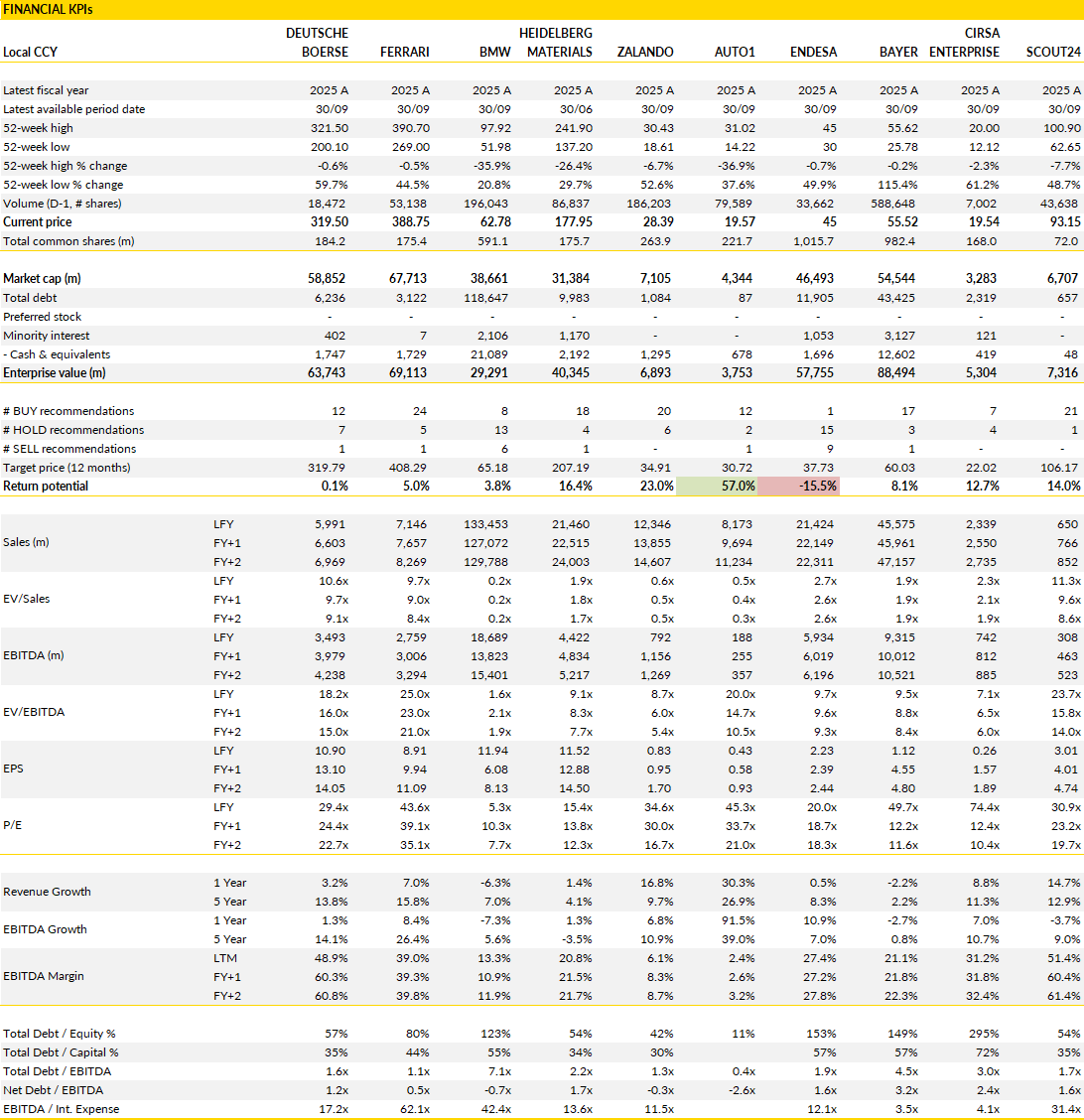
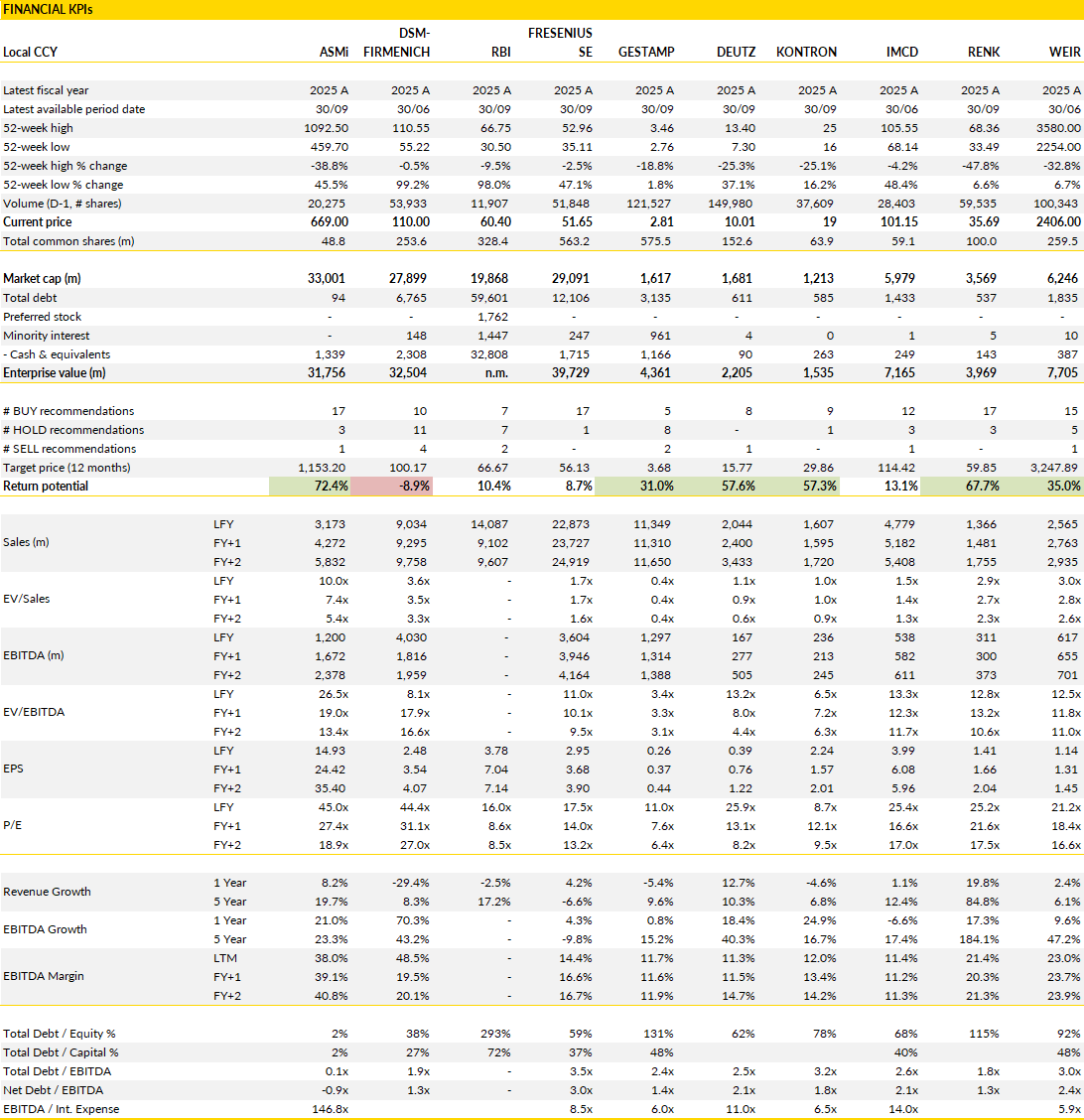
Financial KPIs
Companies covered in this edition: Deutsche Börse, Ferrari, BMW, Heidelberg Materials, Zalando, AUTO1, Endesa, Bayer, Cirsa, Scout24, ASMi, dsm-firmenich, RBI, Fresenius, Gestamp, Deutz, Kontron, IMCD, RENK, Weir
Deutsche Börse (DB1 Germany): Most of the growth would survive a quiet market
Deutsche Börse grew net revenue excluding treasury income by 12% in the first nine months of 2026, and only 3 points of that came from favourable markets. The other 9 points were structural: more customers, new products and regulation pushing activity onto its platforms. The third quarter was stronger still. Net revenue without treasury income rose 14% to €1,415m, six of eight businesses grew at double-digit rates, EBITDA on the same basis increased 19% to €760m and net profit attributable to shareholders went up 18% to €559m. Management raised its revenue guidance for 2026 again.
The buy-side strategy is doing much of the structural work. SimCorp, the investment management platform, keeps winning new clients worldwide, often asset managers replacing legacy systems to save costs, and Deutsche Börse sells its other products to the same customers. ESG data, Stoxx indices, FX and collateral management, Axioma risk tools, ISS governance services and post-trade and securities services can all be added to the platform, which is open to third-party providers as well. SimCorp is adding AI features, and the group argues that covering the whole investment management value chain protects it against AI-driven competitors. The planned Allfunds transaction would add fund distribution to the same set-up.
Fixed income is the other engine. Trading in fixed income derivatives hit a record in September and stayed strong in October, if a little lower, helped by heavy bond issuance and volatile rates. The repo business is gaining as central banks drain liquidity. Progress in euro OTC clearing is slower. Deutsche Börse now has 24% market share, and the EU's active account requirement has brought more than 2,600 accounts, but only about 20% of them are actually used, and short-term interest rate derivatives remain stuck at around 10% share. The company has cut planned investment in that area, and real gains probably need tougher EU rules on where euro derivatives must be cleared.
Cost discipline completes it all. Underlying cost growth is running at about 3%, in line with target, helped by AI adoption, digitalisation and better use of a more global workforce, while reported costs rose 7% because of share-based pay and Allfunds deal expenses.
At around 22–24x earnings, Deutsche Börse is not cheap, but most of its growth would continue even in calmer markets. That justifies a premium, though it leaves little room for disappointment.
Ferrari (RACE Italy): Exceptional pricing power, but how much further can it go?
Ferrari delivered another strong quarter, with profitability improving despite slightly lower vehicle deliveries.
Revenue increased 7.4% to €1.90bn, while shipments declined 1% to 3,368 cars. The difference came from a richer product mix and higher customer spending, with average revenue per vehicle rising 8% to €471,000. Personalisation and optional equipment reached a record 21% of automotive revenue, while limited editions accounted for 22% of deliveries, compared with just 7% a year earlier. EBITDA increased 12% to €753m, lifting the margin by 170bp to 39.7%. Industrial free cash flow was particularly strong at €567m, up 43%. Ferrari is extracting remarkable profitability from relatively stable production volumes, helped by its ability to control supply and encourage customers to spend considerably more on each vehicle.
Management raised its 2026 guidance, now targeting approximately €7.65bn in revenue, at least €3bn in EBITDA and €2.285bn in EBIT. The improvement reflects stronger personalisation revenues, favourable currencies and assumptions regarding Ferrari's Formula 1 championship position. The outlook for 2027 also looks promising as production of the F80 and other exclusive models increases. Only around 50 F80s were delivered during Q3, leaving room for further growth as production approaches the levels achieved by previous limited editions. That said, Ferrari's exceptionally favourable product mix cannot improve indefinitely. Electrification also introduces uncertainty, particularly around customer demand and the economics of future electric models.
Ferrari deserves a substantial valuation premium given its exceptional brand, pricing power and unusually resilient customer base. Its order book extends beyond twelve months, while China accounts for only around 5% of deliveries, limiting exposure to one of the more difficult luxury markets.
However, at over 30x forward earnings, the valuation already incorporates considerable confidence in continued profit growth. Ferrari also trades at a ldd% premium to Hermès, despite historically commanding a discount. Perhaps not the best comparison indeed, but an indication nonetheless.
In short, the business remains exceptionally attractive, but further valuation expansion seems difficult to justify when much of the recent earnings growth has come from an increasingly favourable mix of limited editions and personalisation.
BMW (BMW Germany): The car business is close to breaking even
BMW has now lowered its 2026 outlook three times. In June it cut the automotive EBIT margin target to 1–3% from 4–6%, already its second reduction of the year, and it now expects a margin between minus 0.5% and plus 0.5%. Management blames the latest cut on restructuring charges in the fourth quarter, from further job reductions and the early retirement of older electric vehicle platforms. That covers only part of it. Delivery guidance also fell, to a decline of 5–10% from 1–5% previously, and that has nothing to do with restructuring.
The third quarter shows how thin the underlying margin has become. The automotive margin was 3.4%, 180bp below a year earlier, and that figure included a €350m settlement with Aumovio. Without it, the margin would have been 2.1%, lower than in the second quarter, because volumes fell in every major region. In the US the decline was cyclical and product-related, Europe had its usual seasonal dip, and China kept weakening. The Chinese market has been deteriorating all year, with combustion-engine cars hit hardest, and the conflict in the Middle East has pushed up energy costs and hurt consumer confidence. Group EBIT and free cash flow were both below expectations.
CEO Milan Nedeljković, who took over this year, has made speed and efficiency his priority and said in June that BMW must adapt its structures to "the drastic downturn in market conditions". The cost of doing that is still unclear. On the call, the company gave no split of the new restructuring charges between write-downs and job cuts, no indication of their cash impact and nothing on 2027. The product side looks better. Nedeljković has promised the strongest line-up in BMW's history over the next two years, with the Neue Klasse models and the new X5 among the launches.
BMW can afford a bad year. Net industrial cash stands at around €42bn, automotive free cash flow is still guided above €2.5bn, and the 30–40% payout ratio and the buyback program remain in place. At about 0.4x book value, the shares already discount a lot of bad news. Still, with the underlying automotive margin likely to be slightly negative in the fourth quarter, restructuring cash costs to come and Chinese competition getting tougher, there is no evidence yet that earnings have stopped falling. The balance sheet limits the downside, but a recovery case needs proof that margins have found a floor, and this quarter offered none.
Heidelberg Materials (HEI Germany): European margins are recovering, with more savings ahead
Quite good results form Heidelberg Materials after a disappointing first half, with improving volumes and a recovery in pricing relative to costs.
Revenue increased 10.4% to €6.41bn, including 5.6% like-for-like growth, while EBITDA rose 8.1% to €1.62bn. The net volume contribution reached €61m, supported by improving construction activity, and the price-cost balance returned to a positive €18m after turning negative in Q2. Group EBITDA margins remained under modest pressure at 25.3%, down 54bp, partly because of acquisitions and weaker profitability in Asia-Pacific. Europe was considerably stronger, however, with EBITDA increasing 11.3% to €640m and the margin improving 145bp to 24.5%. The regional performance is encouraging given the difficult conditions in European construction over recent years.
Management confirmed its 2026 guidance for operating profit of €3.40-3.65bn, net capital expenditure of €1.2-1.3bn and leverage around 1.5x. More interestingly, Heidelberg announced another €300m of cost savings to be delivered across 2027 and 2028, with Europe accounting for most of the program. This should provide meaningful support to earnings even if construction demand recovers gradually. The company has already completed its €1.2bn share buyback, although free cash flow over the past twelve months declined to €1.9bn from €2.3bn a year earlier. Financial leverage remains stable, leaving Heidelberg with reasonable flexibility to pursue further operational improvements and shareholder returns.
The improvement in European profitability and renewed positive price-cost development make the earnings outlook considerably more encouraging than earlier in the year. North America remains an important contributor, generating €541m in quarterly EBITDA, although growth there was more modest. The main uncertainty is whether construction volumes can sustain their recent improvement, particularly outside Europe, where margins remain under pressure.
Nevertheless, Heidelberg has considerable scope to increase profitability through cost reductions, better capacity utilisation and disciplined pricing. The additional savings program is especially attractive because it reduces dependence on a strong cyclical recovery. Following a difficult start to 2026, the company now has a more credible path towards higher earnings in 2027 and 2028, with further upside if construction activity strengthens.
Zalando (ZAL Germany): B2B growth and cost savings could drive another strong year
Zalando is moving into 2027 with improving sales momentum and several opportunities to increase profitability. Q3 gross merchandise value grew 8% to €4.54bn, with combined pro forma growth of 6.1% across Zalando and ABOUT YOU. Revenue increased 5% to €3.18bn, while adjusted EBIT rose to €107m, lifting the margin by 20bp to 3.4%. The consumer business remains under some pressure, with its EBIT margin declining 50bp to 2.3%.
Higher promotional spending, particularly on sneakers, and increased marketing expenses weighed on profitability. However, management expects gross margins to recover as promotional activity normalises, supported by improving sneaker demand and a healthier inventory position. The company maintained its 2026 guidance for adjusted EBIT of €680-720m, alongside GMV and revenue towards the lower halves of their respective target ranges.
The B2B business is becoming more and more an important source of earnings growth. Revenue increased 27.2% in Q3, while its adjusted EBIT margin expanded from 7.1% to 11.9%, helped by higher fulfilment volumes and a growing contribution from software services. Management expects margins to settle around 9-10%, leaving the division with attractive profitability even after the exceptional Q3 performance. New customer contracts across Europe and the US should support further expansion. Meanwhile, fulfilment costs declined by 90bp relative to sales as earlier investments began generating efficiency gains. The integration of ABOUT YOU's logistics operations, closure of the Erfurt facility and expansion of automated warehouses should deliver additional savings through 2028.
Zalando has several reasons to expect another year of double-digit adjusted EBIT growth in 2027. Consumer margins should benefit from lower promotional pressure, while retail media and greater participation from third-party partners offer additional opportunities to improve profitability. The B2B division also provides a second source of growth with structurally higher margins. Higher financial expenses may weigh on net earnings, but the underlying operating performance is moving in the right direction.
The combination of improving consumer demand, acquisition synergies and a more efficient fulfilment network makes the earnings outlook attractive, particularly if management can sustain the recent improvement in GMV growth.
AUTO1 (AG1 Germany): Good profitability dynamics, though volume growth needs to recover
AUTO1 delivered another quarter of strong earnings growth, although weaker vehicle volumes raised questions about the pace of expansion.
Total units sold increased 11.1% to 242,800, with the Merchant business growing 10.3% and Retail advancing 16.2%. Both divisions fell short of market expectations, particularly Retail, where growth remains below the company's longer-term ambitions. The introduction of a new trading system during the quarter may have temporarily disrupted activity, but it remains unclear how much of the slowdown can be attributed to this transition. Revenue increased 10.4% to €2.35bn, with softer volumes also contributing to a modest shortfall against expectations. The next few quarters will be important in determining whether growth can return to its previous pace.
Profitability remains the stronger part of AUTO1's performance. Gross profit increased 15.7% to €298m, comfortably exceeding unit growth as the company extracted more value from each transaction. Gross profit per vehicle improved approximately 4% in both businesses, reaching €2,777 in Retail and €1,005 in Merchant. Adjusted EBITDA rose 45.7% to €75.6m, lifting the margin from 2.4% to 3.2%. The improvement in operating leverage is encouraging, particularly given the slower volume growth. AUTO1 is becoming more efficient as it scales, and further improvements in unit economics could support earnings even in a less favourable demand environment.
Nonetheless, the valuation still requires considerable earnings growth, at close to 20x 2027 earnigns. AUTO1 has made impressive progress in profitability, but the pace of unit expansion remains important for a business seeking to increase its share of Europe's fragmented used-car market. Merchant volumes are now growing towards the lower end of management's long-term ambitions, while Retail has further to go. A successful transition to the new trading system and improving consumer demand could help restore momentum.
For the moment, the operating performance remains attractive, but the weaker volume trends make it harder to justify a substantially higher valuation without clearer evidence of renewed growth.
Endesa (ELE Spain): The upside sits in 2028 power prices
Endesa's current strategic plan assumes an average captured power price of €58/MWh. The Spanish pool averaged €96/MWh at the end of September. That gap is mostly locked away for now, because the company sells much of its output forward, but its hedging becomes far more open from 2028, when only 65% is secured. Endesa sells around 50 TWh a year in mainland Spain. About half goes to households on fixed-price contracts, and the rest is split between business customers on contracts that usually run for a year and sales on wholesale markets. If wholesale prices stay where they are, the plan's price assumption looks conservative.
Management is talking a lot about the Spanish system itself in recent weeks. It wants more investment in transmission and distribution, because grid congestion is starting to hold back economic development, and it wants a capacity market to reward firm generation, including longer lives for nuclear plants. Its own spending matches the argument. Gross investment rose 19% to €1.62bn in the first nine months, and grid investment jumped 42% to about €900m. Renewables spending is more selective, with priority for repowering existing sites, projects that fit with demand growth and capacity that can be dispatched when needed.
Ancillary service costs are a real problem: they rose from €16/MWh in January to €27/MWh at the end of September, and Endesa estimates the total cost to the system at €5.5–6.0bn this year, with around €200m hitting its own supply results, only partly offset by thermal generation. Retail customer losses have eased, falling by more than half in October compared with June and July, and management expects the pressure to fade by early 2027.
Nine-month net profit rose 15% to €1.96bn and EBITDA 8% to €4.58bn, with regulated businesses providing almost half. Endesa expects recurring net profit above €2.4bn for the year. Around 70% of the €2bn buyback had been executed by the end of September, and no new program is planned for the next strategic period. Instead, management may look at selective acquisitions of players more exposed to market volatility, and it denied that Enel intends to buy out the free float.
At around 20x earnings and 10x EBITDA, with a dividend yield below 4%, the valuation already prices in a well-run utility. The pricing reset from 2028 is the main reason to be more positive, and it is still some way off.
Bayer (BAYN Germany): Pharma is finally delivering a convincing recovery
Bayer's pharmaceutical business is emerging as a much stronger earnings contributor, helping offset continued weakness in Crop Science.
Third-quarter group revenue increased 4.1% to €10.05bn, while adjusted EBITDA rose 6.9% to €1.62bn. Pharma accounted for most of the improvement, generating €1.29bn in EBITDA, up 24%, on revenue growth of 8%. The newer medicines are performing particularly well, with Kerendia sales increasing 65% and Nubeqa advancing 58% on an adjusted basis. Meanwhile, the revenue erosion from established products Eylea and Xarelto is becoming less severe. Bayer also has another potential growth opportunity in asundexian, which recently received approval in China, becoming the first approved Factor XIa inhibitor globally. Its early entry into this market could provide a competitive advantage as the product expands internationally.
Management responded to the stronger performance by raising its 2026 adjusted EBITDA guidance to €9.8-10.3bn, with the expected Pharma margin increasing from 23-25% to 25-27%. The group also improved its free cash flow outlook by €1bn, now anticipating an outflow of €0.5-1.5bn, and reduced its year-end net debt forecast to €28-29bn.
These changes are encouraging given Bayer's substantial financial obligations and the continuing impact of litigation. Better working capital management, stronger pharmaceutical earnings and eventually lower legal payments could materially improve cash generation over the next few years. That would give management greater flexibility to reduce debt and invest in its drug pipeline.
Bayer still faces considerable challenges, particularly the uncertain cost of Roundup litigation and the weaker profitability of its agricultural business. However, the pharmaceutical recovery is becoming more convincing, with newer products growing rapidly and margins improving faster than expected. The combination of higher earnings and stronger cash generation could gradually reduce the financial pressure that has constrained Bayer for several years. Much will depend on maintaining the momentum in Pharma and achieving further progress on litigation. The operating performance is moving in the right direction, and a sustained recovery in free cash flow would make the company's longer-term prospects considerably more attractive.
Cirsa Enterprises (CIRSA Spain): The World Cup customers are sticking around
About 30% of the online customers Cirsa won during the World Cup are still active, more than management had expected. Customer acquisition costs and lifetime values have not been disclosed, but the retention rate is the first evidence that the tournament spending will pay off after the final whistle. Online turnover grew 33% in the third quarter, with casino up 39% and sports betting 17%, and growth would still have exceeded 20% excluding Paraguay. A larger online casino business should lessen the dependence on sportsbook results, which cost €10m of EBITDA this quarter, although Peru and Spain remain exposed to the same football outcomes.
Spanish slots still have room to grow profits. Management now sees an EBITDA margin of around 55% as the ceiling for the business, against 53.6% in the third quarter. Most of the growth comes from operating machines, where fixed taxes per machine mean extra revenue falls largely to the bottom line, and sales per machine should keep rising by about 5% over the coming quarters, helped by simpler games that attract younger and female players. Management put the slower growth in the quarter down to seasonality.
The cash picture is the most reassuring part. Management confirmed that the €100m dividend for 2026 is the expected payment, not merely a maximum, and it expects about €300m of levered free cash flow this year for dividends and acquisitions. Refinancing has already cut annual interest costs by €68m, with another €14m identified through the merger with Lottomatica.
Under the deal terms, Cirsa shareholders receive 0.668 Lottomatica shares per share plus a €1.56 dividend and end up with 32.5% of a group with around €2bn of pro forma EBITDA, against a synergy target of €115m that looks conservative. Merger costs will add another €6–7m in the fourth quarter after €8m in the third. At under 7x EBITDA with a free cash flow yield around 10%, Cirsa remains attractive going into the combination.
Scout24 (G24 Germany): Plenty of room to monetise
Scout24 continues to deliver impressive growth despite a difficult European property market, benefiting from higher subscription revenues and increasing adoption of premium services.
Q3 revenue rose 19.7% to €198m, including 10.1% organic growth, with both consumer and professional customers contributing. The Private segment accelerated to 10.5% growth, helped by an 8.9% increase in average revenue per user and greater demand for higher-tier memberships. Pro and Unlimited subscriptions now represent around 40% of the consumer membership base, providing a growing source of recurring revenue. Professional revenue increased 23.3% to €147m, supported by continued expansion in Spain and 11.5% growth in German B2B subscriptions. Scout24 is successfully increasing the amount customers spend on its platforms without relying heavily on a recovery in property transactions.
Profitability remains exceptionally strong. Adjusted EBITDA increased 15.9% to €121m, although the reported margin declined 200bp to 60.9% following the consolidation of the lower-margin Spanish business. Organically, the margin improved 40bp to 63.3%, reflecting the operating leverage of Scout24's subscription model. Adjusted earnings per share increased approximately 21% to €1.09, supported by ongoing share repurchases. Management now expects 2026 revenue growth of around 18%, at the upper end of its previous guidance, while maintaining margin targets of up to 61% reported and 64% organically. Additional monetisation opportunities are emerging through AI-enabled products, ImmoPoints and other services that extend beyond traditional property listings.
Scout24's competitive position remains attractive, particularly in Germany, where its established platform and subscription relationships provide considerable pricing power. The company can grow through premium memberships, new services and higher customer spending even when housing transactions remain subdued.
At approximately 13.4x 2027 EV/EBITDA, compared with around 14.5x for its closest peers, the valuation also looks reasonable for a business generating double-digit organic growth and margins above 60%. Spain introduces some near-term margin dilution, but offers additional expansion opportunities. Scout24's combination of recurring revenue, strong cash generation and improving monetisation makes it one of the more attractive businesses in the European online classifieds sector.
ASM International (ASM Netherlands): AI demand is driving another major growth cycle
ASM International is benefiting from two powerful developments in semiconductor manufacturing: increasingly complex chip architectures and the rapid expansion of AI-related capacity. Customers are accelerating factory investments and sharing production plans further in advance, giving ASM unusually strong insight into demand through 2027. The company expects revenue to exceed €5.7bn that year, representing approximately 35% growth. Advanced Logic and Foundry remains the largest business, accounting for around 77% of sales, with demand supported by the transition towards 1.4nm manufacturing and continued investment in established 3-5nm technologies. The 1.4nm generation is particularly attractive because it requires substantially more deposition equipment, increasing ASM's addressable market to approximately €500m per 100,000 monthly wafer starts, compared with around €400m at 2nm.
ASM's competitive position is strengthening alongside these technological changes. The company estimates its atomic layer deposition market share at 55-60%, with further gains expected at 1.4nm following additional customer wins. Memory provides another opportunity, particularly as manufacturers increase the complexity and capacity of DRAM and high-bandwidth memory production. New ALD contracts should begin contributing in 2027, with a larger impact expected in 2028. Photonics and advanced packaging offer additional longer-term opportunities, although both remain relatively small contributors today. The recovery in silicon carbide equipment is progressing slowly, but demand for silicon-related power applications in data centres is improving. Importantly, the expansion of ASM's addressable market comes from greater equipment requirements per wafer as well as higher semiconductor production volumes.
Profitability should also benefit from the expected revenue acceleration. Management sees the 2026 gross margin of approximately 52% as a starting point for 2027, supported by a favourable product mix and operating leverage. SG&A expenses are expected to decline from around 8% of revenue towards a longer-term target below 7%, although investment in engineering talent remains substantial.
At approximately 15x forward EBITDA, compared with a three-year average of 23x, the valuation looks attractive given the growth prospects and ASM's strong technological position. Customer investment plans remain vulnerable to changes in semiconductor demand, but the increasing importance of ALD across advanced manufacturing provides a compelling foundation for sustained earnings growth.
dsm-firmenich (DSFIR Netherlands): Strong fragrance demand, but the valuation is getting expensive
dsm-firmenich delivered yet another solid quarter, with volume growth doing all the work as pricing remained flat.
Revenue increased 5% organically to €2.37bn, while adjusted EBITDA rose 8% on a like-for-like basis to €482m. The reported EBITDA margin was broadly unchanged at 20.4%, although currency movements reduced the margin by approximately 80bp, masking a healthier underlying improvement. Perfumery & Beauty remained the strongest business, generating 8% organic growth and €223m in EBITDA, supported by continued demand for fragrances. Its margin held at 22%, showing that the division can sustain attractive profitability alongside healthy volume growth. The overall results were slightly better than expected, but the improvement was concentrated in fragrances.
Performance elsewhere was more subdued. Taste, Texture & Health generated €813m in revenue and €168m in EBITDA, both below expectations, with weaker North American demand weighing on the business. Its margin slipped to 20.7% from 21% a year earlier. Health, Nutrition & Care performed better on profitability despite softer sales, lifting its margin to 22.1% from 21.7%. Growth in human milk oligosaccharides and biomedical products, alongside lower costs, helped offset the weaker revenue performance.
Management raised its 2026 organic sales growth guidance from 2-4% to approximately 5%, while maintaining its adjusted EBITDA margin target around 20%. The improvement in underlying margins is encouraging, particularly given the currency pressure, but the absence of pricing growth leaves earnings dependent on volumes and cost efficiency.
dsm-firmenich has made considerable progress in establishing a more focused portfolio of higher-value ingredients, with fragrances providing a particularly attractive source of growth. However, the valuation now reflects much of that progress. At over 16x forward EBITDA, the company trades near the highest multiple in its recent history, following a substantial revaluation this year. The strong operating performance supports a premium, but the latest results offer limited grounds for a further increase in earnings expectations. Fragrance demand remains healthy and margins are improving beneath the currency effects, yet weaker performance in the other divisions deserves attention.
The business looks fundamentally sound, although further valuation gains may be difficult without broader growth across the portfolio.
Raiffeisen Bank International (RBI Austria): Better earnings and a valuation that still looks cheap
RBI continues to improve its operating performance outside Russia, supported by healthy lending growth, resilient margins and low credit losses. Third-quarter net profit excluding Russia reached €419m, with net interest income increasing 10% to €1.2bn. Loan volumes have grown 8% since the beginning of the year, while deposits increased 3%, allowing the bank to benefit from both higher business volumes and favourable interest margins. Fee income also advanced 10%, helped by payments and clearing activities. Operating costs increased just 2%, keeping the cost-income ratio at approximately 55%. Asset quality remains reassuring, with the non-performing exposure ratio declining to 1.5% and loan loss provisions falling 36% to €49m. The bank's underlying profitability is improving without requiring a meaningful increase in credit risk.
Management has raised its 2026 net interest income guidance to more than €4.5bn, although the expected cost base has also increased to approximately €3.9bn. Credit losses remain comfortably contained, with the nine-month cost of risk around 19bp against guidance of no more than 35bp. Outside the core business, RBI is gradually reducing its Russian exposure, with loans down 83% and customer deposits down 66% since February 2022. Progress on legacy Swiss franc mortgage litigation in Poland is also encouraging, with remaining exposure below €1bn and provisions covering approximately 152% of that amount. The Rasperia dispute remains an important uncertainty, but a favourable resolution could materially improve the bank's financial flexibility. Meanwhile, acquisitions involving Addiko and Garanti Romania offer opportunities to deploy surplus capital into markets where RBI already has considerable expertise.
The valuation remains attractive relative to European banking peers. RBI trades at just over 1x book and 8x 2026 earnings, compared with sector multiples of around 1.7-1.8x book value and 11x earnings. Its expected return on equity of approximately 13% in 2027 remains below the sector, but the profitability gap is narrowing. Shareholder distributions are likely to remain relatively modest while capital is allocated towards acquisitions and legacy risks are resolved. However, successful integration of recent transactions, continued earnings growth and further reductions in Russian exposure could support a meaningful revaluation.
The discount still seems excessive given the improving performance of the core banking franchise, although legal and geopolitical risks remain substantial.
Fresenius SE (FRE Germany): Biosimilars are (finally) becoming the growth driver
Fresenius's most important news came just before its third-quarter results. The company signed an exclusive development agreement with China's WuXi Biologics covering up to 37 biosimilar candidates, which would take Kabi's potential biosimilar pipeline from 29 to 66 molecules over the next decade. The candidates span 13 therapeutic areas and several modalities, from antibodies to antibody-drug conjugates, and target originator drugs with more than €370bn in combined sales, including Roche's Polivy and Amgen's Tepezza. Fresenius can choose which molecules to develop, keeps full commercial rights and will fund the program from operating cash flow. CEO Michael Sen called it a way to potentially triple the portfolio.
Biopharma is already Kabi's fastest-growing business. Organic sales grew 29% in the third quarter and helped lift the growth vectors to 9% organic growth, with MedTech up 6% and Nutrition only 4%, though the latter should improve in the fourth quarter. The growth vectors' EBIT margin reached 17.9%, although management warned against extrapolating Biopharma's profitability. Fresenius wants Biopharma revenue to nearly double between 2025 and 2030 at an EBIT margin of around 20%, and it completed the €750m takeover of mAbxience in October. The IV drugs and fluids business is the weak spot, growing just 1% organically because US price pressure offset volume growth there and solid growth in Europe.
Group revenue rose 6% to €5,803m, or 5% organically, and EBIT grew 11.1% to €638m, an 11.0% margin. Core EPS came in at €0.72. Helios grew organically by 5% with a 10.6% margin, supported in Germany by better pricing, more inpatient treatments and, for the last full quarter, a temporary surcharge. The fourth quarter will lack that support, and the German hospital financing reform remains a burden, but management still expects Helios EBIT to grow this year, and the Spanish business is healthy. The full-year outlook was confirmed.
Fresenius seems to be valued as a steady healthcare group. It is becoming one with a credible long-term growth driver in biosimilars, and the WuXi deal extends that runway well into the 2030s. Rising development spending will weigh on margins before new products arrive, but the risk/reward favours patient investors.
Gestamp (GEST Spain): North America slips again
Gestamp's turnaround plan in North America was meant to deliver a double-digit EBITDA margin in the region by the end of this year. After the third quarter that target looks out of reach. North American revenue fell 17% to €481m and EBITDA dropped 21% to €33m, a margin of 6.8%, down from 8.8% in the second quarter. Demanding comparisons, uncertainty over tariffs and cancelled electric vehicle projects all hurt volumes, and the Phoenix plan's progress on costs could not make up for it. North America has been Gestamp's problem region for years, and this quarter undid much of the improvement shown in the first half.
Most other regions held up well. In Mercosur, revenue rose 18% to €247m on strong growth in Brazil, at a 12.7% margin. Eastern Europe grew sales 4% to €435m and EBITDA 10% to €69m, at 9.7%. Western Europe increased revenue 3% to €907m in a shrinking market, and EBITDA rose 10% to €89m thanks to a better product mix and cost cuts, for a 9.8% margin. Asia was weaker, with revenue down 2% to €425m and EBITDA down 13% to €54m, because China's slump outweighed strong growth in India. Gescrap, the scrap metal business, grew revenue 26% to €143m on higher scrap prices and the integration of Industrias López Soriano.
At group level, revenue was flat at €2.6bn. Automotive sales excluding Gescrap fell 2.8% at constant currency, about a point worse than global light vehicle production, entirely because of North America. Cost cuts and capacity adjustments still lifted adjusted EBITDA 4% to €296m, an 11.2% margin, while EBIT rose 3% to €117m, a margin of 4.4%. Net profit fell 6% to €31m. Management confirmed its guidance of an EBITDA margin above 11.7% excluding restructuring, which needs a solid fourth quarter.
The balance sheet is in better shape than it used to be. Net debt was €1.7bn at the end of June, the lowest first-half level since 2017, at 1.4x EBITDA. Free cash flow remains thin, though, at around 1% of revenue, and in July S&P Global Mobility forecast a 2.1% fall in global light vehicle production this year. At roughly 2x EBITDA and <8x earnings, Gestamp is cheap, but that has been true for a long time. Until North America delivers, there is little reason for the valuation to change.
Deutz (DEZ Germany): Really turning into a defence company
The third quarter was the last one before Deutz became a substantially different company. The €1.6bn acquisition of FFG Flensburger Fahrzeugbau has now closed. FFG builds armoured personnel carriers, infantry fighting vehicles and recovery vehicles for more than 15 armed forces, and Deutz's CEO expects it to generate more than €1bn of revenue next year at a margin above 20%. That compares with a group adjusted EBIT margin of 7.0% in the quarter. Deutz paid partly in new shares, leaving FFG's founding families with up to 29.9% of the company, and raised around 10% of its share capital to pay down the debt. Management says the deal will bring its 2030 targets of €4bn revenue and a 10% margin forward significantly. Insiders bought shares heavily over the summer.
The existing business is improving too. Sales grew 12% to €554m and adjusted EBIT 23% to €39m, and new orders jumped 34% to €631m, for a book-to-bill ratio of 1.14x. The Engines division, the old core, was barely profitable in the first half of 2025 and has been turned around by the Future Fit cost program, while the Energy business, which supplies power generation equipment, including for data centres, should pass €300m of revenue this year. Reported EPS halved to €0.04 because of restructuring charges, and adjusted free cash flow was minus €21m, against minus €12m a year earlier.
With FFG included, management now expects to reach the top of its 6.5–8.0% adjusted EBIT margin range for 2026, on sales of €2.3–2.5bn, and adjusted free cash flow in the high double-digit millions. Deutz still trades like a cyclical engine maker at about 10-12x this year's earnings, and the multiple falls sharply once FFG contributes for a full year. Integration and defence contract timing are the risks, but that valuation leaves plenty of room for the new profile to be recognised.
Kontron (KTN Germany): Everything now rides on the fourth quarter
Kontron is holding on to its 2026 guidance of around €1.6bn revenue and EBITDA of about €200m, or €225m before restructuring costs. Getting there will take a very strong fourth quarter. Sales in the third quarter were €365.8m, so the final quarter needs something close to €500m, a double-digit increase on last year. Part of that should come from products already built but not yet shipped: the shortage of memory chips left €68.6m of undelivered goods at the end of September, up from about €50m in June, and Kontron expects to ship most of it in the fourth quarter. Its largest shareholder, the Taiwanese group Ennoconn, which now owns around 48% after a tender offer at €23.50 a share, should help secure the components.
The quarter itself was weaker on profitability. The gross margin fell to roughly 40%, around 2 points below the first-half quarters, which was the main reason EBITDA came in at €41.5m. Operating cash flow over nine months was only €4.3m, against €49.7m a year earlier, largely because inventory was built up during the chip shortage. A dispute with Volkswagen, which is not taking the volumes it committed to despite a binding order, may lead to a non-cash impairment of up to €25m. The backlog is solid at €2,752m, with a nine-month book-to-bill ratio of 1.23x, and the GreenTec restructuring should save more than €30m a year from 2027.
CEO Hannes Niederhauser has kept buying shares on the open market, and the company has kept its 2030 targets of €2.6bn revenue and €420m EBITDA, with dividends due to resume. At about 11x earnings and below 7x EBITDA, the valuation is undemanding. Even so, the near-term numbers depend on chip supply and a single quarter, and the year-end guidance carries real risk.
IMCD (IMCD Netherlands): Margins are moving the right way again
In the first half of 2026, IMCD's gross margin fell 0.7 points to 24.9%, held back by lower-margin acquisitions and product mix. In the third quarter it moved firmly the other way, rising 80bp year-on-year to 25.1%. Organic gross profit grew 9.6% on organic revenue growth of 5.6%, and total revenue rose 10.3% to €1,326m, with gross profit up about 14% to €333m. The specialty chemicals distributor is earning more on each sale again, after two years of inventory normalisation across its customer base.
Asia-Pacific did most of the work, with 9.9% organic revenue growth, sharply higher margins and operating EBITA up 29.7%. EMEA grew EBITA 18.5%, although conversion of gross profit into operating profit was weaker there. The Americas remain the weakest region, after a first half in which EBITA fell 16%, but organic growth turned positive on revenue, gross profit and EBITA, a sign that the business there is stabilising. Group operating EBITA rose 18.2% to €140m, at a conversion margin of 42.1%, and IMCD now expects organic growth in operating EBITA for the full year, even though geopolitical uncertainty makes demand hard to forecast.
Free cash flow is up 12% so far this year and leverage has fallen to 2.6x EBITDA from 2.8x in June, leaving room to keep adding bolt-on acquisitions such as the recent deals in South Korea, Thailand and the UK. At the current valuation (refer to table), IMCD seems fully valued for a distributor, but recovering margins, an asset-light model and a long runway for consolidation make it a quality business worth paying for.
RENK (R3NK Germany): Orders keep running ahead of deliveries
RENK booked €469m of new orders in the third quarter, well above management's own indication of €300–400m and 1.4x revenue. The largest single order was a €130m extension of transmissions for the KNDS Leopard 2 tank, alongside a €30m Patria contract and steady service and spare parts business. That follows a record first half, with almost €1.2bn of orders, including a framework extension of around €270m for the Rheinmetall Lynx infantry fighting vehicle and a US Army order for HMPT 800 transmissions. The backlog stood at a record €7.4bn at the end of June, so revenue for the next several years is largely in hand.
Vehicle Mobility Solutions, the military gearbox business, is where the growth is. Revenue rose 21.9% to €231.5m, including part of the expected deliveries to Israel, and adjusted EBIT reached €48.9m at a 21.1% margin, up 110bp, helped by higher volumes and a modular production concept. Marine & Industry was weaker, with revenue down 6.7% to €85.8m because of soft industrial markets, but strong naval demand lifted its margin to 11%.
The group is also becoming more focused. Slide Bearings, which made €31.8m of revenue in the quarter, is being sold to Miba and will be reported as discontinued from the fourth quarter. Group revenue grew 12.1% to €344.8m and adjusted EBIT reached €60.6m, a 17.6% margin, up 80bp. Free cash flow was €11m, leaving net debt at €397m.
For continuing operations, management expects about €1.4bn of revenue and €240–255m of adjusted EBIT in 2026, with a delivery-heavy fourth quarter, and is aiming for the upper half of that range. It also has a €2bn order intake target for the year.
~15x EBIT, falling quickly as the backlog converts, RENK trades below most European defence names despite strong earnings growth, high margins in its core business and a large aftermarket. That looks too cheap.
Weir (WEIR UK): Waiting on a big fourth quarter
Weir's third-quarter orders rose 11% to £687m, but almost half of that came from currency and acquisitions. Organic growth was 6% in Minerals original equipment and 5% in aftermarket, decent numbers that look modest next to the double-digit growth in mining equipment orders reported by Weir's Nordic competitors. Management argues it is still winning share in competitive trials for large pumps, and that its shorter lead times mean orders pick up later in the cycle than at peers.
Several one-off problems also hurt the quarter. Extreme weather disrupted production in Chile, the situation in the Middle East slowed phosphate activity, and two Minerals equipment orders worth a combined £30m slipped. One of those has already been booked, and Weir expects everything except phosphate to recover in the fourth quarter. Equipment is only about 20% of sales, so individual contracts move the numbers a lot: with the two delayed orders included, Minerals equipment orders would have grown around 35%.
The bigger question is delivery. After a slow first half, hit by delays as production moved to lower-cost locations, Weir needs a strong second half, and with these setbacks most of that now has to come in the fourth quarter. It has the backlog for it. The aftermarket order book is £50–60m larger than a year ago, and the Performance Excellence program should have its full £90m of cumulative savings in the run rate by year-end. Disrupted freight markets are the main risk to getting products to customers on time.
Management says it is on track to meet market expectations for the year, while monitoring macro and sector risks. With a book-to-bill ratio of 1.10x, supportive commodity markets and operating margins above 20%, the business is in better shape than the order figures show. And the valuation seems reasonable for a mining services company with this much recurring revenue, provided the fourth quarter delivers.
Thank you for reading!